
Benefits of Big Data in Advertising: 12 Powerful Positive Gains 2025
Why Big Data is Revolutionizing Modern Advertising
The benefits of big data in advertising are changing how businesses reach and engage their target audiences. Today’s advertising landscape generates massive amounts of customer data every second, creating unprecedented opportunities for marketers.
Key Benefits of Big Data in Advertising:
- Precise Audience Targeting – Identify micro-segments and create look-alike audiences
- Real-Time Campaign Optimization – Adjust bids, creative, and budgets instantly
- Predictive Customer Insights – Forecast trends and purchase behaviors
- Cross-Channel Attribution – Track customer journeys across all touchpoints
- Personalized Messaging – Deliver dynamic ads custom to individual preferences
- Higher ROI – Companies report up to 20% increases in engagement rates
The global big data analytics market is expected to exceed $655 billion by 2029, up from $241 billion in 2021. For mid-sized businesses struggling with underperforming campaigns, big data offers a clear path forward.
I’m Guy Leon, founder and CEO of Guac Digital, where we’ve helped clients achieve a 350% boost in engagement through strategic data-driven campaigns. Let’s explore how big data can open up your advertising success.

Benefits of big data in advertising vocab explained:
– big data advertising platform
– how big data analytics is solving big advertiser problems
– big data advertising example
Big Data 101: The 4 Vs & Data Sources Every Advertiser Must Know
Big data isn’t just about having lots of information. It’s characterized by four key traits—the “4 Vs”—that separate it from traditional customer spreadsheets.
Volume means mind-boggling amounts of information. Instagram users upload 70 million photos daily, while Google processes 99,000 searches every second.
Velocity means this data never stops flowing. Real-time streams create opportunities for advertisers who can process and act on insights instantly.
Variety includes structured data like customer databases alongside unstructured data like social media posts, videos, and images. Each type tells a different part of your customer’s story.
Veracity ensures accuracy. With 80% of marketing data being unstructured, ensuring quality becomes critical for effective campaigns.
The social media analytics market is exploding from $7 billion in 2021 to over $26 billion by 2028. Data sources include first-party data from your website, social listening for brand mentions, and IoT signals providing location and device usage patterns.
Modern cloud analytics powered by AI and machine learning allows these diverse data sources to work together, creating comprehensive customer profiles and predictive models.
More info about Big Data Advertising
Why Technology Evolution Matters
The 1980s relied on basic CRM systems with weekly updates. The 1990s brought web analytics with monthly reports. The 2000s exploded with social media data we couldn’t process effectively.
Today’s game-changer is the convergence of 5G streaming, edge computing, and advanced AI processing. Advertisers can now analyze massive datasets and make campaign adjustments in milliseconds rather than months.
12 Benefits of Big Data in Advertising

The benefits of big data in advertising fundamentally change how effectively you can reach and convert your ideal customers. Instead of throwing marketing dollars at broad audiences and hoping something sticks, you get precise insights that guide every decision.
At Guac Digital, I’ve seen these advantages transform underperforming marketing efforts into revenue-driving machines. One client combined precise audience targeting with real-time optimization to achieve a 285% increase in conversion rates within three months.
Each benefit represents a specific way big data can improve your campaign performance—from reaching the right people to delivering the right message at the perfect moment.
1. Precise Audience Targeting — Key Benefit of Big Data in Advertising
Big data transforms advertising from broad demographic buckets to micro-segments based on actual behavior. Instead of targeting “women aged 25-45 who like fitness,” you can find people who “shop for organic products on Tuesday evenings, engage with sustainability content, and have visited competitor websites recently.”
Look-alike modeling analyzes your best customers and finds thousands of others who share similar behavioral patterns, psychographic profiles, and intent indicators. This captures contextual signals like browsing during lunch breaks or purchasing after reading specific content.
With third-party cookies disappearing, first-party data from your website visitors, email subscribers, and customer purchase history provides incredibly valuable targeting information. Companies using big data analytics report a 20% increase in engagement rates by refining their targeting strategy.
The shift from spray-and-pray advertising to precision targeting means every dollar works harder, investing in prospects genuinely interested in what you offer.
How is Big Data Used in Advertising?
2. Hyper-Personalized Messaging & Creative
Dynamic ads change based on who’s viewing them. Headlines might shift from “Save 20%” for price-conscious shoppers to “Premium Quality Guaranteed” for luxury-focused customers—all automatically.
Sentiment analysis understands how people feel about your brand and industry by analyzing social media conversations. This emotional intelligence becomes the foundation for creative that truly resonates.
AI-powered systems test thousands of image and headline combinations, learning which photos work best for different audience segments. One e-commerce client saw click-through rates jump 40% when we implemented dynamic creative matching product recommendations to individual browsing history.
3. Real-Time Campaign Optimization
Real-time campaign optimization fixes broken campaigns while they’re running, instead of finding problems weeks later when your budget is spent.
Live dashboards monitor performance every second, watching for changes in click-through rates, conversion costs, and engagement. When data shows an ad creative is underperforming, the system automatically pauses it and shifts budget to converting variants in minutes.
A/B/n testing becomes sophisticated with big data, testing dozens of combinations simultaneously. Bid shading algorithms analyze auction dynamics in real-time, adjusting bids to win valuable auctions while avoiding overpaying.
This means your advertising budget always works at peak efficiency, with money automatically flowing to the highest-performing combinations.
4. Predictive Customer Insights & Trend Forecasting
Machine learning algorithms analyze historical data to spot patterns revealing future behaviors and market trends. Purchase propensity modeling identifies who’s most likely to buy specific products, focusing budget on customers showing the strongest buying signals.
Big data might reveal that customers engaging with fitness content in January are 3x more likely to purchase workout equipment in February. Seasonality analysis uncovers subtle trends like B2B software purchases spiking on Wednesdays in Q3.
Social media sentiment analysis identifies emerging interests before mainstream awareness, giving you first-mover advantage in targeting new audiences. This transforms advertising from reactive to proactive, anticipating customer needs before they realize them.
5. Cross-Channel Attribution & Smarter Budget Allocation
Multi-touch attribution models track customers’ entire journey from first awareness to final purchase. Instead of giving all credit to the last click, these models show how each touchpoint contributes to sales.
This comprehensive tracking follows customers across every interaction—display ads, Google searches, email newsletters, and social media—capturing the entire sequence with each channel getting proper credit.
Media Mix Modeling (MMM) examines how different advertising channels work together, revealing synergies between channels. You might find that combining radio with digital campaigns increases effectiveness by 40%.
The result is smarter budget allocation based on actual performance data, preventing common attribution mistakes that waste advertising dollars.
Data-Driven Campaign Management
6. Competitive Intelligence & Market Benchmarking
Share-of-voice analysis reveals exactly how your brand presence stacks up against competitors across channels and keywords. Pricing signals track competitor pricing changes, promotional strategies, and product launches in real-time.
Social listening tools monitor competitor mentions, campaign launches, and customer sentiment across platforms. When competitors increase spend in particular segments, you can evaluate whether to compete directly or find underserved niches.
This intelligence transforms reactive marketing into proactive market leadership, positioning your brand ahead of competition.
7. Improved Customer Experience & Journey Mapping
Customer experience heatmaps reveal insights like visitors spending 40% more time reading reviews than viewing photos, or customers who watch explainer videos being twice as likely to purchase.
Journey mapping across multiple channels connects social media engagement, website visits, email interactions, and offline behaviors. Churn prediction alerts identify customers losing interest through behavioral pattern analysis.
These insights create positive feedback loops where better customer experiences lead to higher engagement rates, generating more data for further optimization.
8. Fraud Detection & Brand Safety
Anomaly detection algorithms learn genuine user behavior patterns and spot suspicious activity like 10,000 clicks from the same IP address. Machine learning models analyze click timing, mouse movements, and user journeys that humans would never catch.
Brand safety tools scan millions of web pages in real-time, ensuring ads don’t appear next to inappropriate content. Companies using advanced fraud detection report saving 15-20% of advertising budgets otherwise lost to invalid traffic.
These protective measures scale automatically, becoming more sophisticated at identifying new threats as campaigns grow.
9. Operational Efficiency & Cost Savings
Automation eliminates hours of manual campaign management. Instead of constantly monitoring bids and adjusting budgets, intelligent systems handle these tasks automatically, freeing teams for strategic thinking and creative development.
One client reduced campaign management time by 60% after implementing automated big data systems. Cloud scalability means paying only for computing resources actually used, with costs automatically decreasing during quieter periods.
Operational efficiency gains compound over time as systems learn from more data, creating improved performance and reduced manual overhead.
10. Higher ROI & Revenue Growth — More Benefits of Big Data in Advertising

Companies implementing big data strategies consistently see 20% increases in engagement rates. McKinsey research reveals businesses using data-driven personalization achieve 250% greater marketing efficiency compared to traditional approaches.
Instead of spending $10,000 to generate 100 leads, you might generate 250 qualified prospects for the same amount. Each campaign generates insights that improve the next campaign’s performance, creating compounding returns.
We’ve seen clients achieve a 350% boost in engagement by strategically applying big data insights to targeting and creative strategies.
Scientific research on campaign ROI confirms that data-driven businesses maintain competitive advantages that compound over time.
11. Innovative Ad Formats (AR, VR, CTV)
Augmented reality (AR) advertising uses contextual data to create personalized experiences. A furniture retailer might use location data to show how a couch looks in customers’ actual living rooms, with recommendations based on browsing history.
Virtual reality (VR) campaigns create custom virtual environments based on user interests. Travel companies create personalized destination tours based on previous searches and booking patterns, achieving engagement rates 3-4 times higher than traditional video ads.
Connected TV (CTV) advertising combines television’s emotional impact with digital precision, targeting specific households during relevant programming with the accountability of digital advertising.
12. Data Monetization Opportunities
Second-party data marketplaces allow businesses with rich customer datasets to share anonymized market intelligence with complementary businesses. A fitness equipment company might share workout trends with nutrition brands, creating mutual value.
Advertising data reveals untapped market segments or unmet customer needs that become new product opportunities. Some businesses find their data insights become more valuable than original products, successfully pivoting to data-driven consulting.
Monetization potential grows exponentially when combining multiple data sources with proprietary analytical methods, creating competitive assets difficult for others to replicate.
Challenges & Privacy: Navigating the Data Minefield
While benefits of big data in advertising are impressive, implementation challenges exist. Data quality presents the biggest headache, with 80% of marketing data being unstructured. Integration puzzles arise from data living across multiple systems.
Many teams face skills gaps in statistical analysis and machine learning. Privacy regulations like GDPR and CCPA have changed data collection practices, while security concerns require protecting sensitive customer information.
| Challenge | Practical Solution |
|---|---|
| Data Quality | Use validation processes and cross-reference sources |
| Integration | Invest in unified platforms or partner with specialists |
| Skills Gap | Provide training or work with experienced agencies |
| Privacy Compliance | Implement consent management and focus on first-party data |
| Security | Use encryption, limit access, conduct regular audits |
Successful companies balance personalization with privacy protection, building trust through transparency about data use and consistently delivering relevant experiences.
Big Data’s future of advertising shows companies managing these challenges gain sustainable competitive advantages.
Future Trends, Roadmap & FAQs
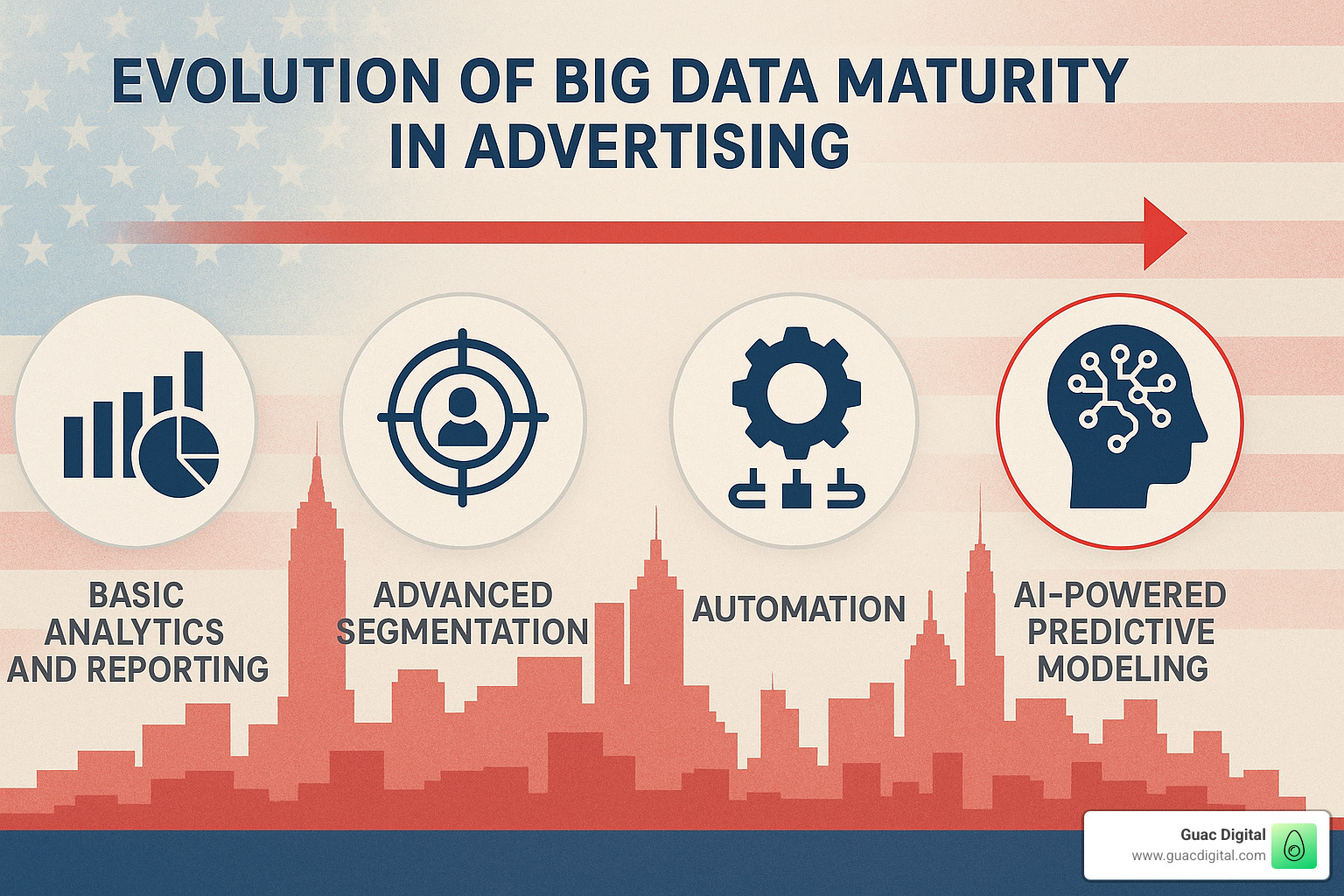
AI-generated creative will automatically generate hundreds of ad variations, testing different elements simultaneously. Federated learning enables analyzing data without sharing sensitive customer information. Cookieless identity technologies use first-party data for effective targeting without cookies.
5G connectivity will enable truly instantaneous real-time advertising based on weather, traffic, or local events.
Implementation roadmap: Define clear goals → Audit current data → Choose integrated tools → Start with pilots → Scale gradually. Most businesses see meaningful results within 6-12 months.
Data-Driven Marketing Strategies: Your Blueprint for Success
Frequently Asked Questions about Big Data Advertising
How do I start if my data is messy?
Start with your cleanest first-party data from website analytics and customer databases. Focus on answering one specific business question rather than analyzing everything. Perfect data doesn’t exist—companies with “messy” data often achieve better results by starting immediately.
What tools deliver real-time ad insights?
Google Analytics 4 provides live reporting, Facebook Ads Manager offers real-time performance monitoring, and programmatic platforms like The Trade Desk optimize automatically. Choose tools that integrate with existing technology.
How can I respect privacy while personalizing ads?
Focus on first-party data collection with clear consent and zero-party data customers intentionally share. Use consent management platforms for compliance. Be transparent about data collection and provide clear value in return for customer information.
Conclusion
The benefits of big data in advertising have fundamentally changed how smart businesses connect with customers. Companies using data-driven strategies see 20% increases in engagement rates and up to 250% greater marketing efficiency.
At Guac Digital, our Tampa-based team has helped clients achieve a 350% boost in engagement through strategic data-driven campaigns. The secret is knowing how to turn data into campaigns that connect with real people.
Start with your objectives and focus on trusted data sources. Invest in appropriate tools and expertise for your business size. Respect customer privacy while delivering personalized experiences. Test everything and scale thoughtfully as you build confidence.
Companies embracing big data advertising today aren’t just improving current campaigns—they’re building sustainable competitive advantages. Your customers are already generating the data you need to reach them more effectively.
Ready to turn your advertising data into your biggest competitive advantage? Our team at Guac Digital combines technical expertise with creative strategy to help businesses implement data-driven campaigns that deliver measurable results.