
Open uping the Power of Programmatic Intelligence
A big data advertising platform transforms how brands connect with consumers in today’s digital landscape. Think of it as your marketing command center—collecting vast amounts of consumer signals, making sense of them, and turning those insights into precisely targeted ads that reach the right people at exactly the right moment.
What is a Big Data Advertising Platform?
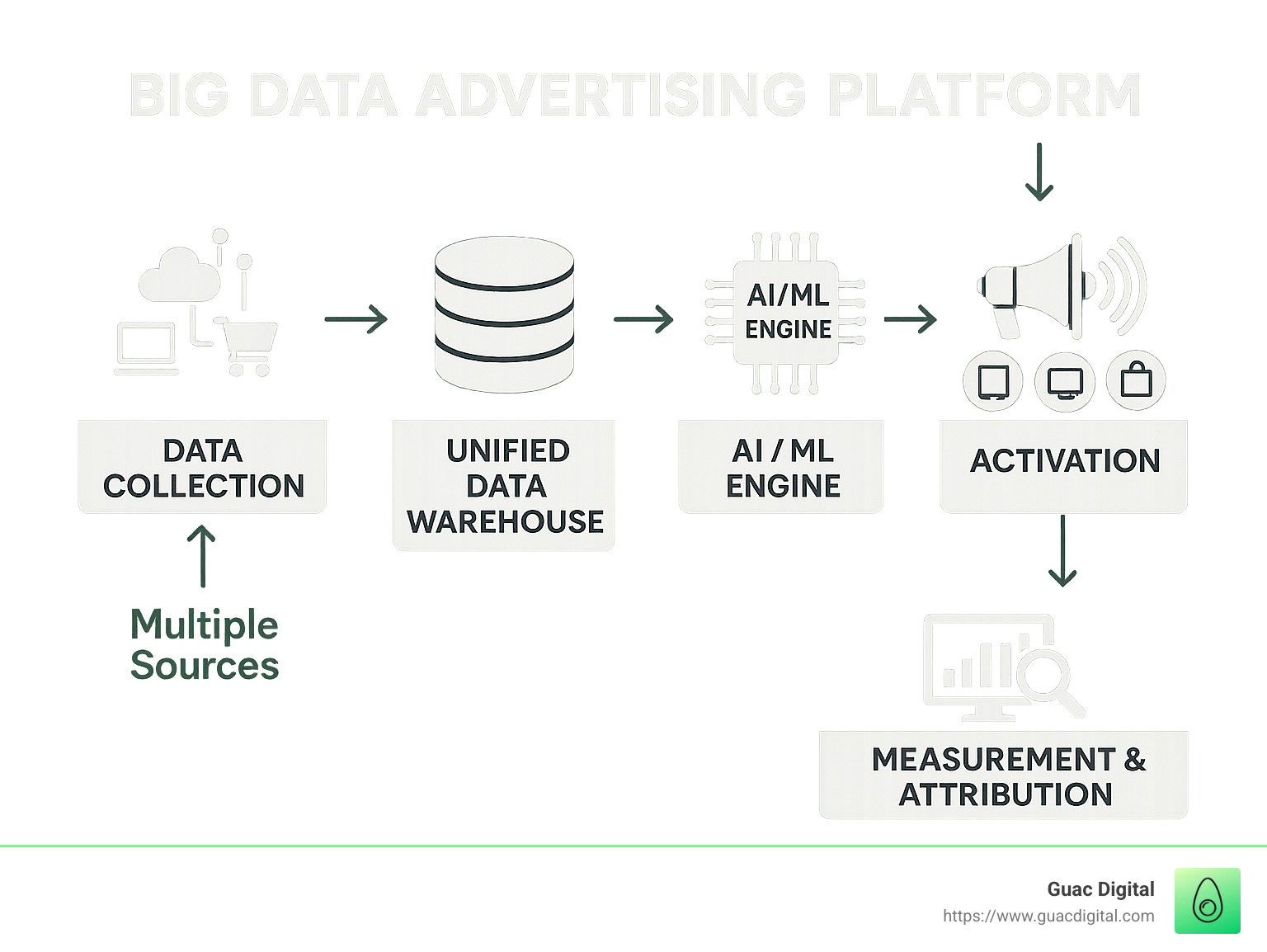
At its heart, a big data advertising platform unifies your marketing universe. It brings together all your customer data points—from website visits to purchase history to email interactions—and creates a coherent picture of who your audience really is and what they truly want.
| Key Component | Description |
|---|---|
| Data Collection | Gathers first-party, second-party, and third-party data from 600+ potential sources |
| Unified Data Warehouse | Centralizes and organizes data in a marketing data lakehouse |
| AI-Powered Analysis | Uses machine learning to identify patterns and optimize campaigns in real-time |
| Omnichannel Activation | Deploys ads across web, mobile, CTV, DOOH, and retail media channels |
| Performance Measurement | Provides attribution and ROI analysis with detailed reporting |
Remember when digital advertising meant setting up campaigns and checking back a week later to see how they performed? Those days are gone. Today’s marketing landscape demands real-time intelligence and adaptation.
As one Head of Marketing Insights shared after implementing a modern solution: “We freed up 80% of the time that we were spending on data integration, mapping and cleansing.” Imagine what your team could accomplish with that extra bandwidth!
Traditional advertising platforms rely on manual targeting and occasional reporting updates. They’re like driving with the rearview mirror as your main guide. In contrast, big data advertising platforms use artificial intelligence to process billions of data points as they happen, allowing you to see what’s ahead and adjust your course instantly.
The results are genuinely impressive:
- 44% increase in customer conversions compared to traditional DSPs
- 77% more efficient cost per acquisition
- 107% higher conversion rates when combining brand and direct response strategies
I’m Guy Leon, founder and CEO of Guac Digital. I’ve walked alongside dozens of businesses as they’ve implemented these powerful platforms, watching them transform chaotic data streams into coherent, actionable marketing strategies that deliver measurable ROI.
Want to dive deeper into how these platforms are revolutionizing the industry? Check out our resources on how big data analytics is solving big advertiser problems, how is big data used in advertising, and big data advertising examples to see real-world applications that might inspire your next campaign breakthrough.
What is a Big Data Advertising Platform?
A big data advertising platform is like having a super-powered marketing brain that never sleeps. Unlike traditional advertising systems, these platforms are sophisticated ecosystems that collect, process, and activate massive amounts of consumer data across multiple channels with remarkable precision.
Think of it this way: traditional advertising was like fishing with a net, hoping to catch something valuable. Modern big data advertising platforms are more like fishing with a smart sonar system that tells you exactly where the fish are, what they’re hungry for, and the best time to cast your line.
These platforms operate through programmatic models, automating the buying and selling of ad inventory through real-time bidding (RTB) rather than old-school insertion order (IO) buying. With RTB, you’re bidding on individual impressions in milliseconds based on each user’s specific value to your business, not just buying blocks of space and hoping for the best.
As one platform vendor perfectly puts it: “Target anything and measure everything.” This incredible capability comes from handling three key types of data:
- First-party data: The gold you already own – information collected directly from your audience (website visitors, app users, email subscribers, CRM data)
- Second-party data: Your trusted neighbor’s treasure – another company’s first-party data accessed through direct partnerships
- Third-party data: The marketplace of insights – data collected by entities not directly related to your business
What makes modern big data advertising platforms truly special is their unified identity graph – a comprehensive mapping of consumer identities across devices and platforms. This means you can maintain consistent messaging as people bounce between their phones, laptops, smart TVs, and the physical world.
Legacy systems often struggle with data trapped in silos, limited scale, and painfully slow optimization cycles. These gaps create inefficiencies that big data advertising platforms specifically address, helping marketers connect the dots in ways never before possible.
Traditional vs Big Data Advertising Platform
The evolution from traditional to big data advertising platforms represents a quantum leap in how marketers plan, execute, and measure their campaigns.
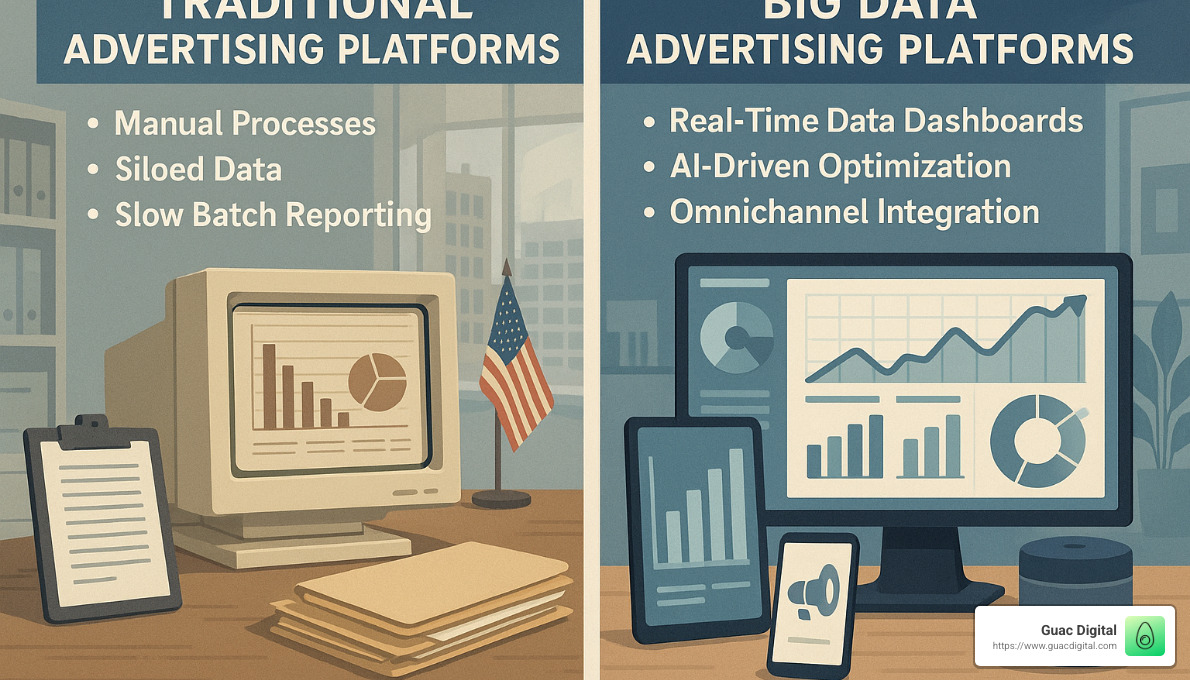
Traditional advertising platforms are like driving a car with the windows painted black, only stopping occasionally to check your map. They rely heavily on batch reporting (data delivered in fixed intervals), siloed metrics (performance data trapped in separate systems), manual optimization (humans making adjustments based on past performance), and contextual targeting (placing ads based on content rather than audience behavior).
By contrast, a big data advertising platform is like having a self-driving car with a 360-degree view and GPS that updates in real-time. These platforms offer real-time data processing (continuous analysis and optimization), unified measurement (seeing performance across all channels at once), AI-driven optimization (automated adjustments based on complex patterns), and audience-based targeting (reaching specific users based on their unique behaviors).
As The Trade Desk, a leading platform in this space, points out: “because we don’t own or operate media, we can help you objectively prioritize inventory that drives better performance for your campaign.” This neutrality gives independent platforms a crucial advantage – they’re focused solely on optimizing your outcomes, not selling their own inventory.
How a Big Data Advertising Platform Works End-to-End
Understanding how these platforms work is like seeing the inner workings of a Swiss watch – complex but beautifully orchestrated.
The journey begins with data ingestion, where the platform collects raw data from everywhere that matters: website interactions, CRM systems, ad server logs, point-of-sale transactions, third-party providers, and partner platforms.
This information flows into a data lakehouse – a more flexible approach than traditional data warehouses. As Aqfer explains, “Most CDPs on the market store only pre-processed vendor data rather than true log-level records.” The lakehouse approach preserves all the rich details for deeper analysis.
Next come the ETL pipelines (Extract, Transform, Load), which prepare data by cleaning formats, resolving inconsistencies, enriching with additional attributes, and structuring everything for efficient analysis.
The magic really happens with identity resolution, where the platform connects all the dots – cookies, device IDs, email addresses, phone numbers, household data – creating a unified view of each consumer while respecting privacy boundaries.
With this unified data, marketers create precise audience segments based on demographics, purchase history, content consumption, location patterns, and sophisticated lookalike modeling.
The platform then handles campaign activation, pushing these segments to execution channels including demand-side platforms, social media, email systems, connected TV networks, and digital out-of-home displays.
As campaigns run, real-time optimization continuously analyzes performance, adjusts bidding strategies, refines targeting, optimizes messaging, and reallocates budgets across channels – all without human intervention.
Finally, comprehensive measurement and attribution tracks results and assigns proper credit through multi-touch attribution models, incrementality testing, conversion path analysis, ROAS calculation, and lifetime value prediction.
Throughout this entire process, robust consent frameworks ensure compliance with privacy regulations by managing user consent, enforcing data usage restrictions, supporting opt-out mechanisms, anonymizing data where required, and enabling data subject access requests.
The result? A marketing ecosystem that’s smarter, faster, and more effective than anything possible just a few years ago – changing how brands connect with their audiences in the digital age.
Core Capabilities: Data Pipelines, AI & Omnichannel Activation
The true magic of a big data advertising platform happens when three powerful capabilities work together in harmony: robust data pipelines, intelligent AI systems, and seamless omnichannel activation. Think of it as the perfect digital marketing trio – one collects the insights, one makes sense of them, and one puts them to work.
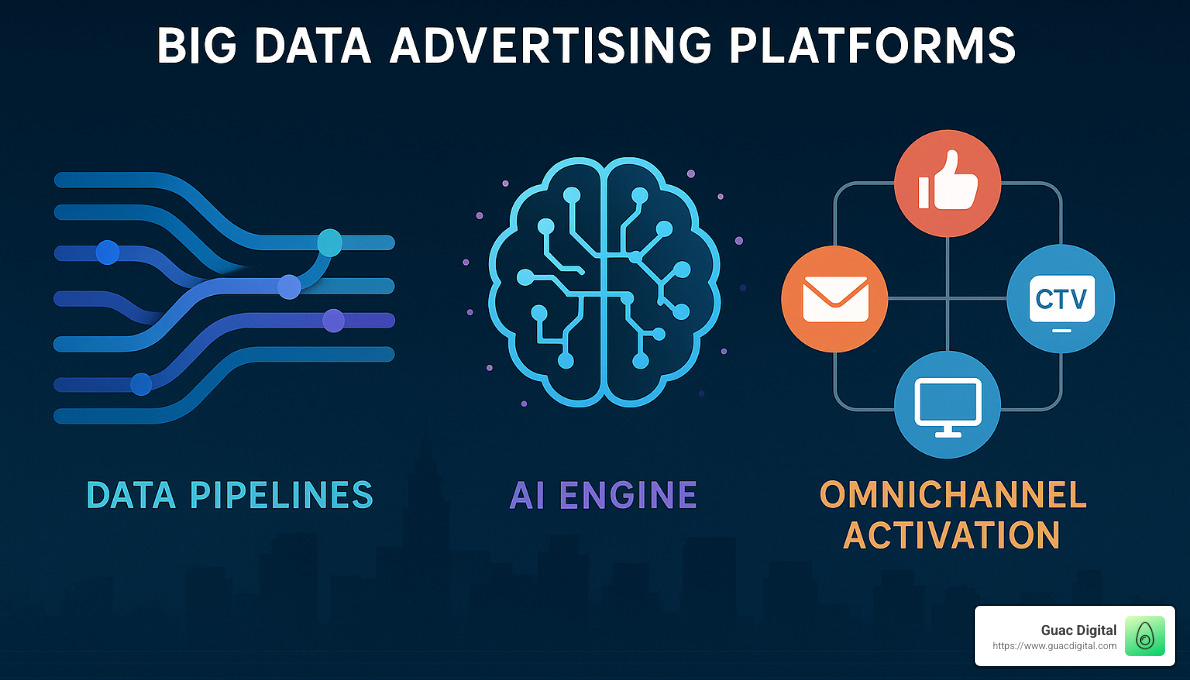
Modern platforms like Adverity don’t mess around when it comes to connectivity. With “a library of 600+ pre-built data connectors for seamless integration,” you’ll never need to build custom connections just to access your data sources. It’s like having every key to every door, ensuring no valuable signal gets left behind.
As we wave goodbye to third-party cookies (finally!), these platforms have cleverly developed cookieless targeting approaches that maintain effectiveness while respecting privacy. One Quantcast automotive campaign using cookieless targeting “delivered 46% lower CPA and doubled audience reach” compared to traditional methods. Not too shabby for a privacy-first approach!
The predictive modeling capabilities are where things get really interesting. These platforms can look at your historical data and make surprisingly accurate forecasts about:
- Which users are most likely to convert (hello, efficiency!)
- How many times you should show ads to different segments
- What the lifetime value of new customers might be
- How price-sensitive your customers are
- Which customers might be planning their exit
Cross-device capabilities ensure your messaging stays consistent whether someone’s scrolling on their phone, working on their laptop, or binging shows on their smart TV. As one platform proudly shares, they can “absorb and analyze audience behavior continuously to predict patterns and refine campaigns” across all these devices. It’s like having a conversation that flows naturally no matter where it happens.
Want to dig deeper into how this all works? Check out our Programmatic Advertising Explained guide for more insights.
Data Collection, Unification & Privacy
At the heart of any big data advertising platform is its ability to gather, connect, and manage data while keeping privacy front and center.
Customer Data Platforms (CDPs) are like the data feeders of these systems, but there’s an important distinction to be made. As one provider notes, “Most CDPs on the market store only pre-processed vendor data rather than true log-level records.” The best platforms preserve those detailed log-level records – the individual breadcrumbs of every impression, click, and conversion – allowing for much deeper analysis.
Deterministic IDs are the secret sauce for accurate targeting. Unlike probabilistic methods that make educated guesses about who’s who, deterministic matching uses confirmed identifiers (like when someone logs in) to create definite connections between devices and people. Zeta Global proudly highlights its “deterministic ID graph with no data silos” as a key advantage delivering “guaranteed, measurable omnichannel results.”
When it comes to privacy, there’s simply no wiggle room in today’s world. Modern big data advertising platforms must support:
Privacy regulations like CCPA and GDPR, industry initiatives such as IAB’s Transparency Framework, and respect user preferences like Do Not Track. The technology handles these requirements through thoughtful anonymization, consent management, data minimization, purpose limitation, and smart retention policies.
As Adsquare aptly puts it, “Data protection by design” means building privacy safeguards directly into the platform’s DNA rather than tacking them on as an afterthought. It’s privacy baked in, not bolted on.
For more on how we handle privacy concerns, check out our Do Not Sell My Personal Information CCPA Privacy Notice.
AI & Machine Learning Engines
The brains of a big data advertising platform transform raw data into actionable insights and automated decisions that drive real results.
Budget optimization algorithms are like smart financial advisors for your ad spend, constantly determining the ideal way to distribute your budget across channels, campaigns, and tactics. They shift resources toward what’s working while maintaining enough exploration to find new opportunities.
Reinforcement learning represents the cutting edge of this technology. Unlike traditional machine learning that just studies historical data, reinforcement learning algorithms improve through trial and error, learning from the outcomes of their own decisions. This approach is particularly valuable in the constantly changing world of digital advertising.
Several platforms have developed their own special AI technologies with unique capabilities:
VideoAmp’s VALID™ functions as a “super-advanced technology machine” processing detailed log-level data for precise measurement. Quantcast AI interprets “real-time audience patterns to continuously optimize campaigns” delivering a reported “44% increase in customer conversions vs. traditional DSPs.” Meanwhile, Moloco focuses on “real-time adaptation of ML models to policy changes and performance signals” to stay effective even as platforms change.
The real-time bidding ecosystem requires these AI systems to make incredibly complex decisions in milliseconds – evaluating user value, conversion likelihood, appropriate bid prices, creative variations, and frequency caps all faster than you can blink.
As one platform wisely states, “We designed our industry-leading AI to work with you, not in place of you.” This collaborative approach combines machine intelligence with human strategic guidance – because the best results come when humans and AI work together.
Cross-Channel & Omnichannel Activation
A true big data advertising platform lets you activate your campaigns across all relevant channels through one integrated system – like conducting an orchestra where all instruments play in perfect harmony.
Connected TV (CTV) has emerged as a standout channel, blending the targeting precision of digital with the emotional impact of television. The Trade Desk highlights their ability to reach “millions of viewers during live sports events” through CTV capabilities. This channel has become particularly valuable for brand marketers transitioning traditional TV budgets into the digital field.
Digital Out-of-Home (DOOH) represents another exciting frontier, with platforms like Hivestack offering “programmatic DOOH with precision, globally.” Their system enables you to “create measurable, highly-targeted campaigns along the customer journey” by activating digital billboards and screens programmatically – bringing the precision of digital to the physical world.
Retail media networks have become essential touchpoints, especially for consumer packaged goods brands. These advertising platforms operated by retailers like Amazon, Walmart, and Target can be integrated with your big data advertising platform to unify campaign management across all retail environments.
Email and SMS activation allows you to coordinate these direct channels with your broader advertising efforts. By using the same audience segments and measurement framework, you create truly integrated campaigns where messages reinforce each other across touchpoints, creating a cohesive customer experience.
In-app advertising reaches consumers where they spend increasing amounts of their digital time. Platforms like Moloco specialize in this environment, offering “machine learning-powered performance advertising solutions” optimized for app-specific metrics like retention and in-app purchases.
Social extensions connect your big data advertising platform to social networks, enabling coordinated campaigns across these walled gardens and the open web. As one client shared, “running an omnichannel campaign enabled us to expand our horizons beyond social media advertising and reach relevant consumers across several channels.”
The ultimate goal is true omnichannel activation – coordinated execution across all channels based on a unified understanding of your audience. A PepsiCo executive summarized it perfectly: “Working with The Trade Desk enabled us to try something we had never done before—merge our brand and retail sales campaigns seamlessly into a full-funnel, omnichannel campaign.” That’s the power of bringing everything together under one strategic roof.
Benefits & Use Cases for Advertisers, Agencies & Publishers
When you implement a big data advertising platform, everyone in the advertising ecosystem wins – from brands to agencies to publishers. The real-world results we’ve seen with our clients speak volumes about the transformative power of these technologies.
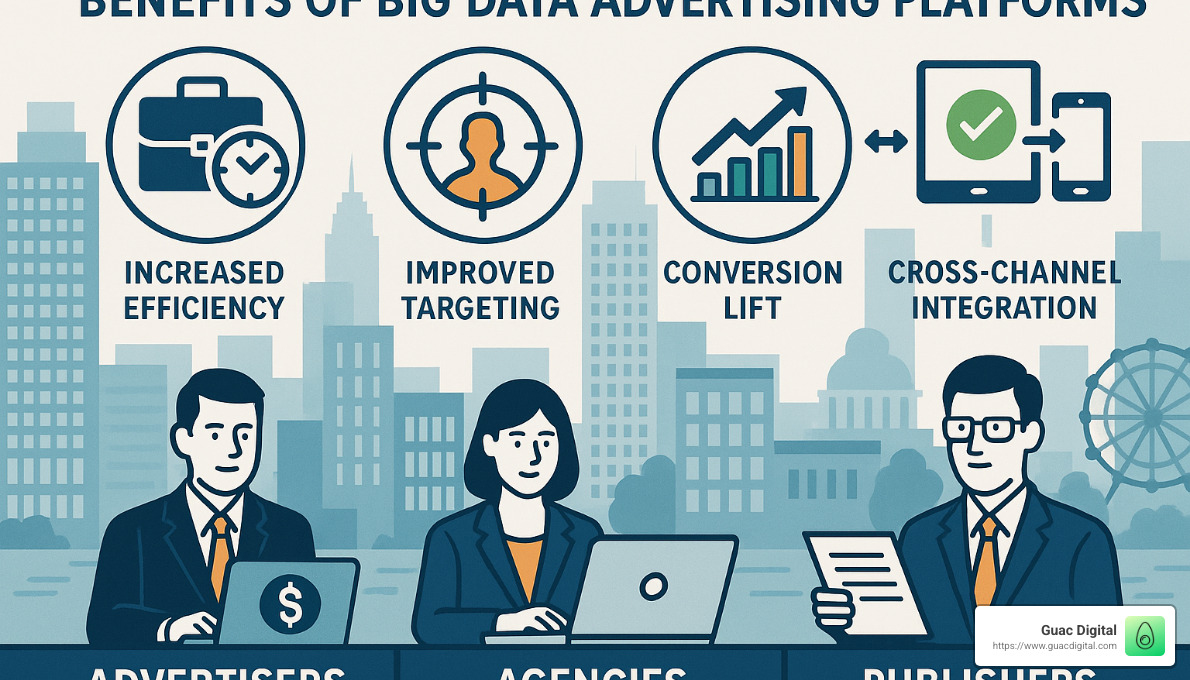
Imagine reclaiming 80% of the time your team currently spends on tedious data tasks like integration, mapping, and cleansing. That’s exactly what one Head of Marketing Insights reported after implementing their platform. Think about what your team could accomplish with all that extra time – more strategic thinking, creative optimization, and campaign innovation.
The performance improvements are just as impressive. Clients using Quantcast’s platform have seen a 44% increase in conversions compared to traditional DSPs. Why? Because these platforms deliver laser-focused audience targeting, smarter creative delivery, and intelligent budget allocation that traditional approaches simply can’t match.
We’ve all experienced that annoying moment when we see the same ad ten times in a row. With big data advertising platforms, those days are over. Cross-device frequency capping ensures viewers don’t get bombarded with repetitive ads, creating a better experience for consumers while maximizing your ad budget efficiency.
For growth-focused brands, audience look-alike capabilities are a game-changer. By identifying new prospects who share key characteristics with your best customers, you can scale acquisition efforts without sacrificing quality. It’s like having a crystal ball that shows you exactly where to find your next best customers.
Agencies love these platforms too. As Nova Media’s CEO said about NUVIAD’s platform: “NUVIAD has improved our advertising agency’s competitive edge. Through their white-label DSP and DMP solution, we have seamlessly integrated online and offline advertising for our billboard clients.” Agencies gain a competitive edge, deliver more strategic value to clients, operate more efficiently, and access enterprise-grade technology that might otherwise be out of reach.
Publishers aren’t left out of the party either. They benefit from richer audience data that commands higher CPMs, more efficient inventory monetization, reduced tech costs, better yield optimization, and stronger relationships with advertisers who see better results.
More info about Big Data Advertising Examples
Advanced Audience Segmentation & Targeting
Gone are the days when “women 25-54” counted as sophisticated targeting. Today’s big data advertising platforms offer audience capabilities that feel almost magical in their precision and effectiveness.
Knowledge graphs represent one of the most powerful approaches to understanding audiences in context. Imagine connecting 240 million individual profiles with 120 million households and over 6 million points of interest to create a three-dimensional view of consumer behavior. That’s exactly what Mobiquity Networks’ platform does, enabling targeting that goes far beyond simple demographics or interests.
Want to reach someone the moment they walk into a specific neighborhood or store? Hyper-local geofencing makes it possible. NUVIAD’s “hyper-local AI-driven geofencing” delivers precisely targeted messages when users enter defined areas. One client successfully used this technology to drive measurable foot traffic increases to their New Jersey locations.
Understanding consumer movement patterns adds another valuable dimension to your targeting. Adsquare’s TravelGraph™ uses location-based machine learning to translate device visits into real-world behavior segments. This helps you understand not just where consumers are, but what stage of their journey they’re in – perfect for travel, retail, and automotive advertisers.
Perhaps the most valuable data comes directly from consumers themselves. Zero-party signals – information that people explicitly share with brands – provide crystal-clear insights into preferences and intentions. When combined with observed behaviors, these signals create golden opportunities for hyper-relevant messaging.
What makes the big data advertising platform approach truly special is its multidimensional nature. Rather than simple segments, these platforms incorporate hundreds of variables that update in real-time. They don’t just tell you what consumers did yesterday – they predict what they’ll do tomorrow. And they maintain consistent audience definitions across all channels while respecting privacy regulations.
As one platform provider beautifully puts it: “Every customer interaction should feel like a conversation with an old friend.” That level of personalization is only possible with the sophisticated understanding that comes from a robust big data advertising platform.
Measurement, Attribution & ROI
Let’s be honest – if you can’t measure it accurately, how do you know it’s working? That’s why measurement and attribution capabilities are the crown jewels of any big data advertising platform.
Traditional last-click attribution is like giving all the credit to the person who scored the winning goal while ignoring the teammates who made it possible. Multi-touch attribution models offer a fairer picture by recognizing all touchpoints in the customer journey. Advanced platforms can implement sophisticated approaches that distribute credit appropriately – whether that means giving more weight to recent touchpoints (time decay), emphasizing first and last interactions (position-based), or using algorithms to determine the true contribution of each touchpoint (data-driven).
Want scientific proof that your campaigns are working? Lift studies provide exactly that by comparing results between exposed and control groups. These experiments can measure brand metrics like awareness and consideration or hard performance outcomes like conversions and sales. Travel Texas, for example, achieved an impressive 32% overall lift in familiarity, with 2.6x familiarity lift when using Quantcast-designed creative.
The real-world results speak volumes:
United Airlines achieved 77% more efficient CPA and 14% awareness lift using Quantcast. SodaStream saw 107% higher conversions when consumers were exposed to both brand and direct response ads, resulting in 28% more sparkling water makers sold. MBNA/TD Bank crushed their campaign goals by 88% and achieved a 38% higher approval rate through audience-optimized targeting.
What makes these insights possible? Log-level analytics. Rather than looking at aggregated reports, big data advertising platforms let you analyze individual impression and interaction data. This granular view enables deeper analysis of frequency, unique users, audience matching, attribution, and verification – all within a single platform.
What matters most is ROI – the actual business impact of your advertising investment. Big data advertising platforms excel at connecting ad activity to business outcomes by integrating with sales and CRM data, testing incrementality, calculating lifetime value, tracking costs comprehensively, and applying advanced modeling techniques.
At Guac Digital, we’ve helped dozens of clients implement these measurement frameworks, changing their understanding of what’s working and why. The result? Smarter decisions, better optimization, and higher returns on every advertising dollar spent.
Selecting & Implementing the Right Big Data Advertising Platform
Choosing the optimal big data advertising platform requires careful evaluation based on your specific business needs, technical requirements, and growth objectives.
When we work with clients at Guac Digital, we first help them assess their unique situation. Does your platform easily connect with existing data sources? How does it handle cross-device identity? What AI capabilities does it offer? These questions are just the beginning of a thoughtful evaluation process.
The user interface deserves special attention – after all, your team will interact with it daily. An intuitive, well-designed interface can dramatically increase adoption and effectiveness. Similarly, consider the service model offered. Some businesses thrive with self-service tools, while others benefit from hands-on strategic guidance and support.
Scalability is another critical factor that’s often overlooked. Your marketing needs will inevitably grow and evolve. The right platform should handle increasing data volumes and campaign complexity without performance degradation. I’ve seen too many companies outgrow their initial platform choice within a year, creating painful migration headaches.
Pricing models vary significantly across vendors, which can make comparison challenging. Some charge a percentage of media spend (typically 10-20%), others use CPM-based fees, and many offer subscription models. Hybrid approaches are increasingly common. Be sure to calculate the total cost of ownership, including implementation, training, and ongoing support.
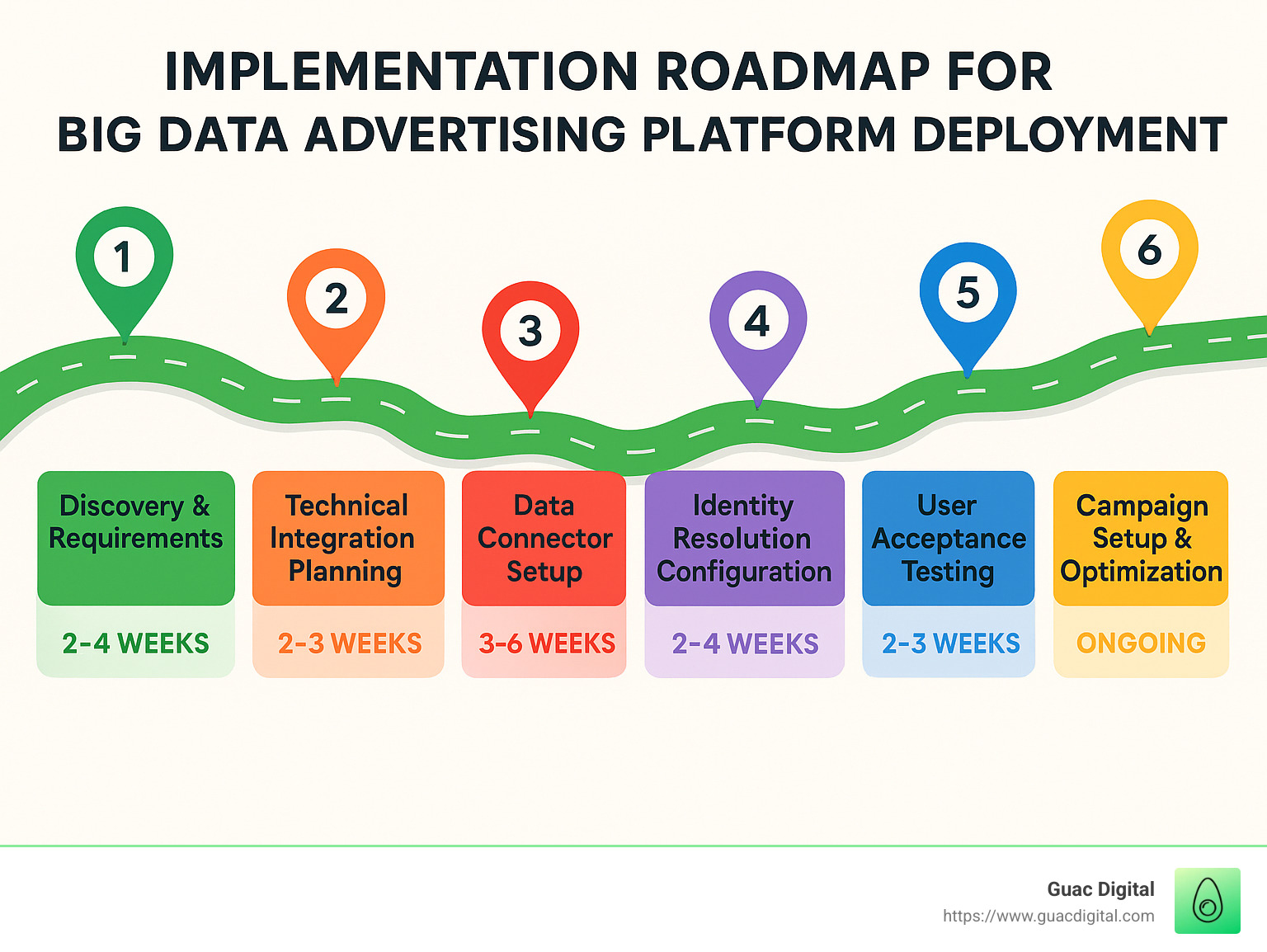
Integration timelines depend largely on your existing tech stack complexity. A typical implementation follows a predictable sequence, starting with findy and requirements (2-4 weeks), moving through technical planning (2-3 weeks), data connector setup (3-6 weeks), identity resolution configuration (2-4 weeks), and user testing (2-3 weeks). From there, campaign setup and optimization continue as ongoing activities.
DMP vs CDP vs Marketing Data Platform
I often find that clients are confused about the differences between various data platform types – and for good reason! The landscape is complex and constantly evolving.
A Data Management Platform (DMP) traditionally focuses on anonymous audiences rather than known individuals. DMPs excel at third-party data enrichment and activation, primarily using cookie-based identity (though this is evolving). They’re advertising-centric and typically handle limited or no personally identifiable information (PII).
Customer Data Platforms (CDPs), in contrast, provide “real-time PII-based audience management.” They’re built on first-party data foundations with persistent, unified customer profiles. CDPs integrate directly with customer experience systems and handle PII with appropriate security and compliance measures. They’re more marketing-centric, extending beyond just advertising use cases.
The newest evolution is the Marketing Data Platform (MDP) or Marketing Data Lakehouse, which combines elements of both DMPs and CDPs while adding advanced capabilities. Think of it as the best of both worlds – comprehensive data collection from all sources, raw log-level data storage, built-in advanced analytics and AI, omnichannel activation, and flexible identity frameworks supporting both anonymous and known contexts.
| Feature | DMP | CDP | Marketing Data Platform |
|---|---|---|---|
| Identity | Anonymous | Known | Both |
| Data Types | Mostly 3rd party | Mostly 1st party | All types |
| PII Management | Limited/None | Core capability | Configurable |
| Data Detail | Aggregated | Individual | Log-level |
| Activation Focus | Advertising | Marketing | Omnichannel |
| Primary Use Cases | Audience targeting | Customer experience | Integrated marketing |
| Data Retention | Short-term | Long-term | Configurable |
As one client put it after we helped them steer this decision: “I finally understand why we need both systems for different purposes.” However, many organizations are now looking to Marketing Data Platforms to reduce complexity by providing unified capabilities in a single solution.
Market Leaders & Differentiators
The big data advertising platform landscape includes established leaders and innovative specialists, each with unique strengths and positioning.
Google Marketing Platform offers seamless integration with Google’s advertising ecosystem and comprehensive analytics through GA4. Their extensive reach across Google’s network and partner sites, combined with a strong cross-device identity graph, makes them appealing to many marketers. They also offer free tools for small businesses alongside enterprise solutions.
The Trade Desk stands out for its independence from media ownership, providing unbiased optimization. Their strong connected TV capabilities and leadership in the Unified ID 2.0 initiative for post-cookie identity have positioned them well for the future. Their advanced AI “works with you, not in place of you,” and their open architecture makes integration easier.
Quantcast has made a name for itself with impressive performance claims – “44% increase in customer conversions vs. traditional DSPs” and “50% faster than traditional DSPs.” Their proprietary AI for audience pattern recognition and built-in cookieless targeting capabilities are particularly valuable as third-party cookies phase out.
VideoAmp has carved out a niche in cross-channel measurement with their VALID™ technology. Their unified measurement across TV, streaming and digital, along with detailed log-level data for advanced analytics, makes them especially valuable for advertisers with significant video investments.
Adverity specializes in data integration and management, with clients reporting they “freed up 80% of the time that we were spending on data integration, mapping and cleansing.” With 600+ pre-built data connectors and AI-powered data change detection, they’re a strong choice for organizations with complex data needs.
Moloco, NUVIAD, Hivestack, and Adsquare each offer specialized capabilities for specific use cases. Moloco excels at app user acquisition, NUVIAD offers hyper-local targeting, Hivestack specializes in programmatic digital out-of-home, and Adsquare focuses on location intelligence.
Emerging vendors continue to enter the market with innovative approaches. When evaluating options, I always advise clients to consider their specific requirements and how each platform’s strengths align with their priorities.
Deployment Challenges & Best Practices for a Big Data Advertising Platform
Implementing a big data advertising platform involves several challenges, but following established best practices can help ensure success.
Data onboarding is typically the first major hurdle. As one of our clients finded, “Data onboarding is an ongoing process, not a one-time activity.” We recommend involving technical teams early to establish persistent data flows and prioritizing data sources based on business impact. Start with implementing data quality checks, documenting all data changes, and beginning with core datasets before expanding incrementally.
Taxonomy design – how you organize and categorize your data – requires thoughtful planning. I’ve seen many implementations stumble because they either over-segmented (creating too many tiny audience groups) or under-segmented (creating groups too large to be actionable). The sweet spot is a scalable structure that balances granularity with usability and establishes clear governance processes.
Change management often proves surprisingly challenging. Even the best technology fails without user adoption. Identifying internal champions and providing comprehensive training are crucial first steps. We’ve found that starting with quick wins helps demonstrate value and build momentum. Clear communication about timelines and expectations, along with establishing new KPIs that leverage platform capabilities, rounds out an effective change management approach.
ROI measurement should begin early, not as an afterthought. One of our clients reported achieving “7-month ROI” after implementation by establishing baseline metrics before implementation and defining clear success criteria linked to business outcomes. Be sure to track both efficiency gains and performance improvements, calculate fully-loaded costs, and measure incremental lift rather than just raw performance.
Team structure dramatically impacts success rates. Cross-functional teams with representation from marketing, analytics, and IT tend to achieve the best results. Clear roles and responsibilities, regular sprint planning, and a continuous learning mindset create the foundation for ongoing optimization. Strong executive sponsorship helps overcome inevitable organizational problems.
As one platform user shared after we helped them implement their solution, “Since using Adverity, collecting data and creating reports are now table stakes. It’s on autopilot, allowing our team to focus on getting the most out of our data.” This shift from operational tasks to strategic analysis represents the ultimate goal of successful implementation – and it’s incredibly satisfying to see it happen.
Conclusion & Future Outlook
The world of big data advertising platforms isn’t standing still—it’s evolving faster than ever before. As I’ve helped clients steer this landscape at Guac Digital, I’ve seen how several key trends are reshaping what’s possible.
Privacy has moved from checkbox to cornerstone in today’s marketing world. With third-party cookies fading away and regulations tightening globally, platforms are reinventing how they target and measure. This isn’t just theory—it’s happening right now. I remember how impressed I was when a Unilever marketing director shared: “The success of our campaigns using the cutting-edge Unified ID 2.0 solution showcases our adaptability in the post-cookie landscape.” Smart brands aren’t fighting the privacy wave—they’re riding it.
AI is making a fascinating leap from helper to partner. We’re moving beyond simple optimization algorithms to what I like to call “marketing co-pilots”—intelligent systems that can spot opportunities, test ideas, and implement strategies with minimal human input. One platform developer recently told me they envision a future where “solving every marketing challenge is automated, precise, and lightning-fast.” While I don’t think AI will replace marketers, it will absolutely transform how we work.
Cookieless strategies have become a competitive advantage rather than just a contingency plan. Forward-thinking platforms are building solutions around first-party data, contextual signals, and privacy-safe audience cohorts. The results are already compelling—I worked with an automotive client whose campaign achieved “46% lower CPA and doubled audience reach” with cookieless targeting approaches. Being ahead of this curve matters.
At Guac Digital, we’ve guided businesses from startups to enterprises in using these powerful platforms. What I’ve learned is that technical implementation is just one piece of a successful strategy. The technology itself is powerful, but it’s how you use it that makes the difference.
The most successful organizations I’ve worked with view these platforms not as isolated tools but as central components of their marketing foundation. They become the engine that powers data-driven decisions, personalized customer experiences, and continuous improvement.
If you’re thinking about your own big data advertising platform strategy, success depends on more than just choosing the right vendor. You’ll need equal attention to your data strategy and governance practices, your team’s skills and readiness, your measurement framework, your partner relationships, and your processes for ongoing optimization.
By taking this holistic approach, you can open up the full potential of big data advertising to drive real competitive advantage in an increasingly complex digital world. The future belongs to those who can harness these platforms not just as technology solutions, but as business change engines.