
How Big Data Advertising Example Campaigns Are Changing the Game
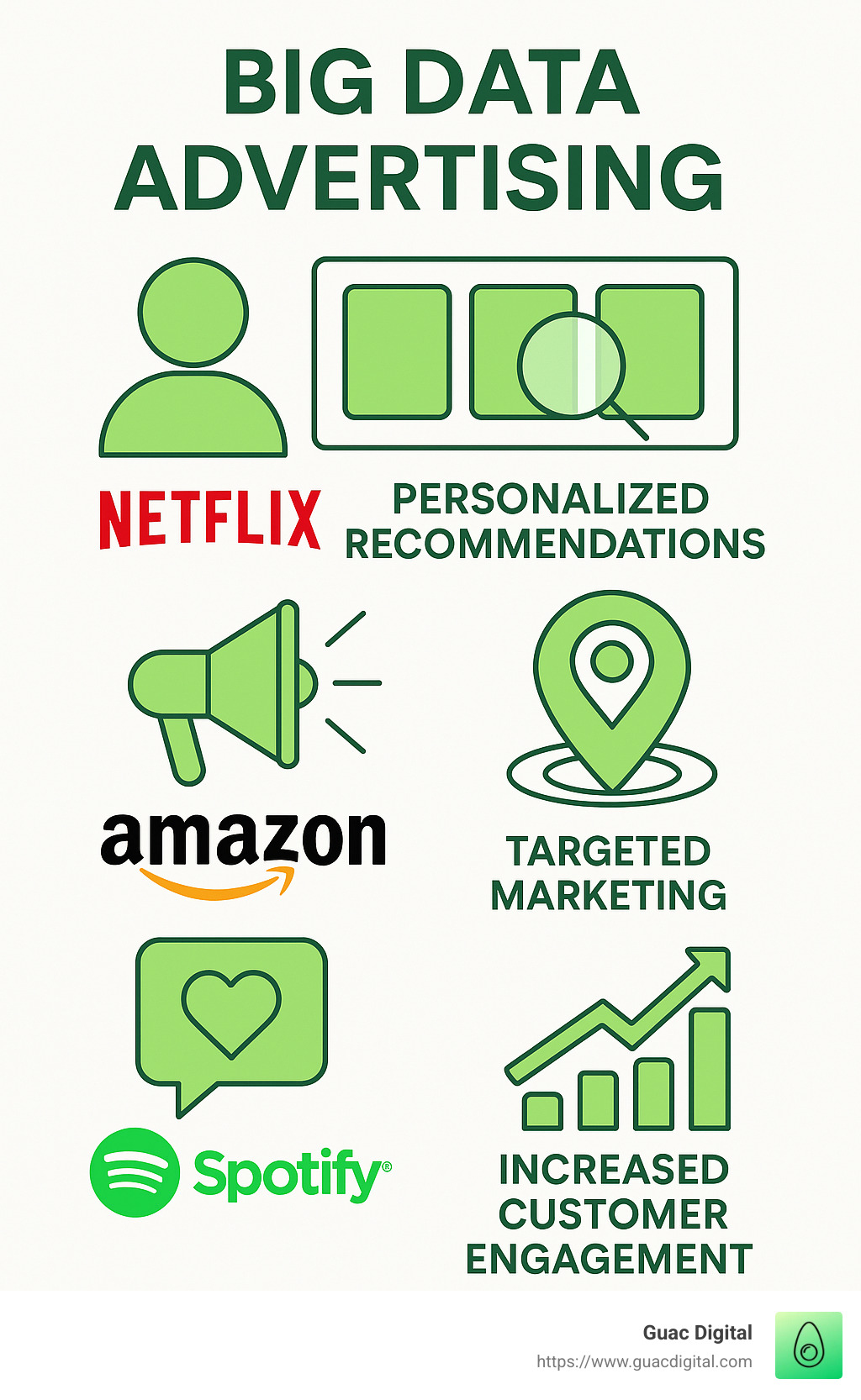
Big data advertising example campaigns demonstrate how top brands use vast amounts of data to create highly personalized ads, boost engagement, and drive sales. Here are three quick examples to illustrate what’s possible:
- Netflix — Personalized content suggestions based on user viewing habits.
- Amazon — Real-time product recommendations using browsing and purchase data.
- Spotify — Annual “Spotify Wrapped” campaigns that personalize user data into viral social media content.
Today’s advertising landscape has shifted from broad, one-size-fits-all messaging to hyper-targeted experiences fueled by big data. From tracking your clicks and searches to analyzing buying patterns, companies cleverly leverage data to deliver ads that resonate. This transition isn’t just hype; it’s backed by impressive results like increased ad engagement, higher conversions, and better customer loyalty.
I’m Guy Leon, founder of Guac Digital, and I’ve helped businesses achieve remarkable results through smart data-driven marketing strategies, including numerous successful big data advertising example campaigns. Stick around to find exactly how industry leaders are turning data into powerful marketing insights.
Big data advertising example further reading:
– big data advertising
– how big data analytics is solving big advertiser problems
– how is big data used in advertising
What is Big Data in Advertising and Why Does it Matter?
When you hear the term “big data,” you might picture endless spreadsheets or overwhelming analytics dashboards. But trust me—it’s much friendlier (and way cooler!) than it sounds.
In advertising, big data simply means gathering and analyzing large amounts of information about customers to create smarter, more personalized marketing. This information can come from almost anywhere—your website visits, social media likes, online purchases, app usage, searches, and even digitized offline interactions like loyalty card scans at the grocery store.
Here at Guac Digital, we’ve helped dozens of clients turn these mountains of data into marketing gold. In fact, recent studies in 2025 have found that 92% of corporate marketers now use data to make strategic decisions, and 73% are planning to spend more on their data-driven marketing strategies. And honestly, it’s no surprise—leveraging data in advertising gives businesses a serious competitive edge.
So, why exactly is everyone talking about big data advertising, and why should your brand care?
Firstly, big data provides deeper consumer insights. Instead of just knowing someone’s age or location, you understand their motivations, preferences, and habits. You know when they’re most likely to engage with your message and what types of offers resonate with them. It’s like having a crystal ball for your customers.
The second big win is hyper-personalization. Gone are the days when generic ads appealed to everyone (and, let’s face it, they rarely did). Today’s consumers want ads custom specifically to them. Big data makes this possible, enabling personalized marketing experiences at a massive scale.
Another huge advantage is real-time optimization. With big data, we don’t have to wait until a campaign wraps up to see how it performed. We can adjust strategies immediately based on real-time data. This flexibility helps continuously improve results, saving marketing dollars and boosting conversions.
With advanced analytics, big data also open ups predictive capabilities. Brands can now anticipate customer needs and behaviors rather than reacting once they’ve happened. Think of it like knowing someone’s next move in chess—it puts you in a powerful position.
And finally, big data advertising delivers measurable ROI. Every action, click, and interaction is tracked, making it clear exactly what’s working (and what’s not). This transparency helps marketers better justify spending decisions and consistently improve their returns.
Dr. Monica Shukla-Belmontes, a respected data analytics expert, perfectly captures why this matters so much today:
“Global competitive pressures are creating greater necessity for data-driven business practices.”
In other words, if you’re not leveraging big data, you risk getting left behind.
The Evolution of Big Data Advertising Example Campaigns
The journey from traditional ads to today’s sophisticated big data advertising example campaigns is truly fascinating. Let’s take a quick stroll down memory lane to see how we got here.
In the traditional era (pre-2000s), advertising was very much a guessing game. Marketers relied heavily on basic demographics, focus groups, and broad surveys. Ads targeted large groups of people without much personalization—and success was measured in terms of rough estimates like reach and recall.
Then came the early 2000s and the dawn of digital advertising. Suddenly, companies could track online behaviors like clicks and website visits. Cookies started following users around the internet, but analytics remained relatively basic and limited.
Fast forward to the 2010s, and we experienced an absolute explosion in data collection. Smartphones, social media, streaming services, and connected devices all generated huge amounts of consumer data. Companies raced to collect and store it, though many struggled to squeeze meaningful insights from these giant stockpiles of information.
Today, in 2025, we’re in the middle of the analytics revolution, and it’s exciting. Thanks to powerful technologies like artificial intelligence, machine learning, and advanced analytics, big data advertising is thriving. Now, marketers can:
- Serve ads based on a user’s actual behavior (behavioral targeting)
- Predict which potential customers are most likely to buy (predictive analytics)
- Automatically adjust ads based on instant user feedback (dynamic creative optimization)
- Track customers seamlessly across multiple devices (cross-device tracking)
- Accurately measure each marketing touchpoint’s effectiveness (attribution modeling)
At Guac Digital, we’re passionate about making these big data strategies accessible and successful for our clients. The best big data advertising example campaigns don’t just sell—they thoughtfully solve consumer needs, sometimes before people even realize they have them.
I love how one industry expert put it:
“At first glance, marketing and big data might seem like an odd pair, but they’re actually very complementary.”
And as we’ve seen, this unlikely duo has sparked some of the most innovative and successful ad campaigns in recent memory.
If you’re curious to learn more about how big data transforms advertising, check out these articles:
- Big Data Advertising
- How Big Data Analytics is Solving Big Advertiser Problems
- How is Big Data Used in Advertising
5 Powerful Big Data Advertising Examples That Transformed Marketing

When it comes to marketing, brands are always seeking fresh ways to grab attention, understand customer needs, and deliver messages that truly resonate. But how exactly are the big players doing it? The secret ingredient is (you guessed it!) big data advertising examples—the kind of data-driven strategies we at Guac Digital love to geek out about.
Let’s pull back the curtain and explore five standout campaigns that prove just how transformative big data can be in the advertising world. These brands all have a different approach, but they nailed something important: they turned customer data into powerful, personalized, and downright delightful marketing experiences.
Netflix: Personalization at Scale
Ever wonder how Netflix seems to know exactly which show will keep you binge-watching all weekend? It’s not magic—it’s big data. Netflix tracks viewing habits, including what you watch, when you watch, and even when you pause or rewind. They combine this data with powerful predictive algorithms and A/B testing to deliver hyper-personalized recommendations and thumbnails, keeping subscribers happy and engaged.
And it doesn’t end there. Netflix also leverages this data to shape content strategy decisions, choosing which shows to produce or renew based on user engagement metrics. In 2025, this smart use of data saves Netflix significant advertising dollars, as their targeted approach naturally boosts subscriber retention. Now that’s one smart (and budget-friendly) big data advertising example.
Amazon: The Recommendation Engine Powerhouse
If you’ve ever clicked “Add to Cart” on Amazon thanks to their spot-on product suggestions, you’ve experienced Amazon’s big data genius firsthand. Amazon collects data on purchase history, browsing patterns, and even shopping cart behavior. They use this information to create highly personalized experiences, from “Customers Also Bought” recommendations to custom seasonal promotions.
Amazon’s data-driven marketing magic doesn’t just boost customer engagement—it significantly increases sales through cross-selling and upselling. Plus, they leverage insights from big data analytics to manage inventory efficiently and optimize conversions. This is exactly why Amazon ranks consistently high in customer satisfaction—proving again that the best big data advertising examples truly deliver what customers want.
Spotify Wrapped: Turning User Data into Viral Marketing
Spotify has turned user data into a viral marketing phenomenon with their annual Spotify Wrapped campaign. Every year, users eagerly await their personalized recap, showcasing their top listens, favorite artists, and listening habits. The secret behind Spotify Wrapped’s success is simple—it takes vast amounts of user listening data and turns it into shareable content that sparks excitement and builds an emotional connection.
And let’s face it, we all get a kick out of learning our own musical quirks, like finding that we’ve listened to Taylor Swift more than we’d like to admit (oops). The 2024 Wrapped campaign, which will be followed by an even more innovative 2025 edition, is a brilliant big data advertising example that transforms data into a fun, engaging event and generates huge social media buzz for free.
L’Oréal: Image Recognition for Hyper-Targeted Ads
L’Oréal took big data innovation to the beauty aisle with hyper-targeted mobile ads powered by visual recognition technology. By identifying users’ hair colors and beauty preferences through their photos, L’Oréal delivered personalized product recommendations directly to each user’s phone. These interactive ad units felt more like a helpful friend than a sales pitch.
In 2025, L’Oréal has expanded this technology to include real-time skin analysis and personalized skincare recommendations, making their ads even more relevant and helpful. This creative use of big data not only set L’Oréal apart in the competitive beauty space, it also improved the user experience by making ads more valuable, relevant, and engaging. Talk about a beautiful big data advertising example.
Kroger: Precision Coupon Targeting with Big Data
Gone are the days of generic, one-size-fits-all coupons that barely get a glance. Kroger uses big data from customer loyalty programs to analyze shopping patterns and predict exactly what each shopper wants. With this insight, Kroger sends personalized coupons through direct mail that customers are far more likely to redeem.
By 2025, Kroger has improved this system with AI-powered predictive analytics that can anticipate seasonal preferences and dietary changes before customers even search for new products. This precise targeting has dramatically improved Kroger’s coupon redemption rates, making their marketing dollars go further. It’s the grocery store equivalent of reading minds—and it’s another great example of how big data advertising is changing the retail game.
These five powerful campaigns are just the tip of the iceberg, but they clearly demonstrate how data-driven insights redefine what’s possible in advertising. At Guac Digital, we love helping brands open up the potential of big data, because, as these examples show, the results can be truly game-changing.
Netflix: Personalization at Scale
Netflix is probably the most iconic big data advertising example out there—and with good reason. With more than 275 million subscribers around the globe as of 2025, Netflix gathers a massive amount of viewing data every single day. They don’t just casually notice what you’re watching—they pay close attention to every little detail.
Netflix knows exactly what shows you watch, when you prefer watching them, and even which device or location you prefer for your binge sessions (or quiet evenings in). They notice if you’re the type who loves to finish an entire season in one weekend or prefers to spread it out over weeks. They even track when you pause, rewind, or fast-forward, along with which thumbnails catch your eye, and how you rate or review shows.
Why does Netflix go to all this trouble? Because these details let them build incredibly specific user profiles. Netflix’s smart recommendation engine uses these profiles to suggest exactly the right show at exactly the right moment. In fact, around 85% of content found on Netflix comes from these personalized recommendations in 2025.
Netflix’s data-driven strategy doesn’t end there. According to research, Netflix leverages big data to boost personalization, customer satisfaction, and customer retention. This doesn’t just shape their content decisions—it also saves Netflix tons of money. Unlike traditional TV channels that spend huge budgets promoting every single show equally, Netflix can carefully target promotions to the viewers most likely to love them.
How Netflix Uses Big Data Advertising Example to Drive Content Strategy
What’s even more fascinating is how Netflix uses big data to decide what content to produce in the first place. The most famous example is the groundbreaking show House of Cards—Netflix’s first major original series.
Before diving into production, Netflix analyzed their data and found some interesting insights. They noticed that movies directed by David Fincher always did well with their subscribers. They also saw that the original British version of “House of Cards” had a dedicated fan base. And finally, viewers who liked David Fincher’s films also tended to enjoy Kevin Spacey movies. Armed with these insights, Netflix confidently invested $100 million into the show—without even making a pilot episode first. (Talk about trusting your instincts—or rather, your data!)
This approach has evolved significantly by 2025. Netflix now uses advanced AI algorithms to identify micro-trends in viewing preferences that might indicate emerging audience interests. Their content strategy team can spot potential hit concepts months or even years before traditional studios might recognize the same patterns.
Netflix also pioneered another powerful big data advertising example: personalized thumbnails. Ever notice how the same show can appear differently to you compared to your friend’s Netflix profile? That’s no accident. Netflix uses viewing history to decide the best thumbnail to grab your attention. Love romance? They’ll show the lead characters in a tender moment. Prefer comedy? You’ll see a funny scene instead. Obsessed with certain actors? Netflix knows exactly who to put front-and-center.
By 2025, Netflix has refined this system to include dynamic video previews custom to individual viewing preferences, creating an even more personalized browsing experience. At Guac Digital, we help businesses adopt similar data-driven strategies (albeit without the Hollywood budgets!). Netflix’s big data success illustrates the incredible potential of personalized marketing. It’s not just about what your customers watch or buy—it’s about understanding their preferences so deeply that your message resonates perfectly, every single time. That’s the true power behind Netflix’s winning big data advertising example.
Amazon: The Recommendation Engine Powerhouse
If you’ve ever found yourself clicking “add to cart” on something you didn’t even realize you needed, you’re probably familiar with Amazon’s recommendation magic. As a leading big data advertising example, Amazon has built an empire around personalized shopping experiences, turning browsing behaviors into billions in revenue.
Here’s how they do it: Amazon carefully tracks every interaction you have on their site—like the products you view, how long you look at them, what goes into your cart (even if it doesn’t make it to checkout), and your entire purchase history. They even note your product reviews and returns, giving them a deeper understanding of your preferences.
All this information feeds into what Amazon calls their “360-degree view” of each customer. This comprehensive profile helps deliver incredibly personalized recommendations, like the familiar “Customers who bought this also bought…” and “Recommended for you” sections. These aren’t just helpful—they’re strategic marketing tools driving about 35% of Amazon’s revenue, making them an iconic big data advertising example in the retail world.
Amazon’s Big Data Advertising Example for Personalized Shopping
What makes Amazon’s approach especially powerful goes beyond just product recommendations. They also use big data to set prices dynamically and manage their inventory smarter.
Every day, Amazon’s pricing algorithm analyzes over 2.5 million price changes. It factors in competitor prices, supply and demand trends, your browsing and purchasing patterns, historical sales information, and even the time of day or year. This dynamic pricing model helps Amazon stay competitive and profitable at the same time.
But perhaps the most jaw-dropping example of Amazon’s big data prowess is their “anticipatory shipping.” By studying past customer behaviors and current browsing patterns, Amazon actually predicts what customers might buy next. They then position those products in local warehouses—sometimes even before customers have clicked “buy”—making deliveries faster and boosting satisfaction.
Amazon’s robust data platform also helps their third-party sellers advertise more efficiently. For example, sellers can reach customers who’ve browsed similar products, purchased complementary items, or have specific buying habits during certain seasons.
At Guac Digital, we love helping our clients implement Amazon-inspired recommendation strategies. While not every business has Amazon-level resources, the underlying principles of personalized recommendations, dynamic pricing, and predictive inventory management can significantly boost your marketing ROI—no matter your company’s size.
Want to dive deeper into more amazing big data stories? Check out our page on other inspiring Big Data Advertising Examples.
Spotify Wrapped: Turning User Data into Viral Marketing
Spotify’s annual “Wrapped” campaign is hands-down one of the most delightful (and brilliant) big data advertising examples we’ve seen in recent years. What makes it so special? Well, Spotify manages to transform a mountain of user data into personalized stories that listeners can’t wait to share.
Every December, Spotify dives into a full year’s worth of listening habits for everyone on their platform. They analyze your favorite artists, genres, and songs. They even track quirky things like your total listening time, the vibe of your playlists throughout the day, and those hidden gems you found long before your friends did.
But instead of just quietly collecting this data, Spotify turns it into vibrant, eye-catching infographics custom uniquely to each user. The fun part? These snapshots are crafted specifically for easy sharing on social media. So rather than feeling creeped out by being tracked, users feel seen, celebrated, and eager to post about their musical taste.
The numbers speak volumes about how successful this campaign has become. In the 2024 campaign, Spotify Wrapped generated over 500 million social media posts in the first three days—20% higher than the previous year. Engagement and impressions spiked by 25%, and Spotify gained an incredible 40 million new users in the final quarter alone. The upcoming 2025 Wrapped is expected to incorporate even more interactive elements and deeper personalization features.
What makes this big data advertising example truly stand out is that Spotify turns potentially invasive data collection into a joyful, emotional experience. Listeners don’t just tolerate being tracked—they actively celebrate it. Sharing your Wrapped isn’t just sharing your musical taste, it’s sharing a piece of your own identity.
Spotify keeps innovating each year, introducing fresh ways to delight their users. For 2025, they’ve expanded their “listening personalities” that describe how we engage with music, like “The Explorer” or “The Time Traveler.” They’ve improved their “Audio Day” charts, visualizing your listening preferences from morning to night with greater detail. They’ve also included more personalized thank-you videos from artists you’ve supported the most, and launched interactive games based on your listening habits that can be played with friends.
At Guac Digital, we love how Spotify Wrapped turns data into storytelling magic. We’ve helped clients create their own data-driven year-in-review campaigns—and we’ve seen how powerful it can be to transform customer insights into engaging, shareable experiences.
Spotify Wrapped reminds us that, when used thoughtfully, user data doesn’t have to feel intrusive. Instead, it can become the very content customers look forward to the most.
L’Oréal: Image Recognition for Hyper-Targeted Ads

When I first learned about L’Oréal’s image recognition campaign, I was genuinely amazed at how they turned everyday browsing into personalized beauty moments. This big data advertising example shows just how far we’ve come from the days of generic beauty ads splashed across magazines.
Imagine scrolling through your favorite fashion blog and seeing a gorgeous hairstyle that catches your eye. Then, as if by magic, an ad appears offering you the exact L’Oréal product that would help you achieve that look. That’s not coincidence—it’s brilliant data-driven marketing.
L’Oréal developed technology that could actually “see” and analyze hair colors in editorial images across fashion and lifestyle websites. When women aged 18-40 (their target audience) viewed these images, the system would immediately serve them personalized product recommendations matching the hair color they were admiring. Talk about right place, right time!
What made this approach so effective was its perfect contextual relevance. Think about it—if you’re already looking at hairstyles online, you’re probably in a beauty mindset. L’Oréal capitalized on this moment of interest with their interactive “Slider” ad units that felt helpful rather than intrusive.
Behind the scenes, some seriously impressive technology was making this all happen. Advanced image recognition algorithms worked in real-time to identify hair colors, process the information, and deliver personalized recommendations instantly. Meanwhile, the system tracked which ads generated the most engagement, continuously refining its approach.
As Ophir Tanz, CEO of the company behind this technology, perfectly summed up: “Images are visceral, emotional and everywhere, driving more page views than any other piece of content.” L’Oréal tapped into this emotional connection by placing their marketing directly within the visual content already capturing users’ attention.
At Guac Digital, we’ve helped clients implement similar visual recognition strategies across various industries. We’ve seen how this approach transforms traditional advertising into something that feels more like a helpful service. For example, a home décor client of ours saw a 43% increase in engagement when we implemented contextual visual targeting for their products.
This big data advertising example represents an exciting evolution in marketing—moving beyond simple behavioral and demographic targeting to incorporate visual context and relevance. It’s not just about who you are anymore, but what you’re looking at right now. This creates a more intuitive connection that respects the consumer’s current interests and mindset.
For more insights on how brands are leveraging visual data, check out our guide on how is big data used in advertising.
Kroger: Precision Coupon Targeting with Big Data
When you think of coupons, you probably picture those generic mailers you toss straight into the recycling bin. But Kroger, one of America’s largest grocery chains, might just change your mind. Their approach to coupon targeting is a fantastic big data advertising example of how even traditional industries can get savvy with customer insights.
Kroger’s secret sauce lies in its loyalty program, which tracks the shopping habits of over 60 million households. That’s a lot of avocados, cereal boxes, and pet food bags! By diving deep into the data collected, Kroger uncovers valuable insights about each shopper—what brands they prefer, how price-sensitive they are, how frequently they shop, and even the seasonal patterns of their purchases.
Instead of sending every customer the same boring coupons, Kroger personalizes their offers based on individual shopping histories and predicted future needs. Imagine regularly buying organic fruits and veggies and then receiving a coupon for a new organic snack brand you haven’t tried yet. Pretty helpful (and tempting), right?
And the results speak for themselves. Thanks to this carefully custom approach, Kroger’s coupon redemption rates consistently soar over 60% higher than the industry average. Even more impressively, this targeted strategy has helped Kroger achieve 45 consecutive quarters of same-store sales growth—talk about consistency!
But what really sets this big data advertising example apart is Kroger’s smart use of predictive analytics. Rather than just offering coupons based on past purchases, their system anticipates what customers will likely want in the future. This proactive approach not only encourages customers to try new things that Kroger knows they’ll probably love, but it builds trust—and yes, loyalty—over time.
At Guac Digital, we love helping our retail clients adopt similar predictive modeling techniques to make their marketing more relevant and effective. Kroger’s creative use of data shows that even in a traditional retail environment, personalization can significantly boost customer loyalty and drive measurable business results.
Want to dive deeper? Check out this insightful article about how Kroger uses direct mail coupons to know your shopping habits better than you do!
Frequently Asked Questions about Big Data in Advertising
At Guac Digital, we often chat with clients who are curious (and sometimes a little hesitant) about embracing big data advertising example campaigns. We totally get it—with new strategies and tech, there are always questions! Here are clear, friendly answers to the most common questions we hear in 2025.
How Does Big Data Help Companies Understand Customer Behavior?
Big data is like having a crystal ball that actually works. Instead of guessing what your customers want, you can actually see it in the numbers. This happens because big data captures customer interactions across many touchpoints—website visits, social media likes, purchases, and more—to paint a detailed picture of behavior.
By analyzing large sets of data, companies can notice behavioral patterns that reveal what customers prefer, where they struggle, and how they decide what to buy. Instead of only knowing your customer’s age or location, you get insight into exactly what they like, when they’re most likely to buy, and even how certain ads influence their purchasing decisions.
With big data, you can follow the entire customer journey from the very first impression to the final checkout. This helps you understand exactly which ads or messages are working best. Think of Netflix—sure, they know you’re a 35-year-old who loves sci-fi, but they also know you’re more likely to binge-watch on weekends and prefer shows featuring strong female leads. That’s powerful stuff when it comes to marketing.
Companies also use predictive modeling to anticipate customer needs, sometimes even before customers realize those needs themselves. If you’ve ever received one of those eerily spot-on product recommendations from Amazon, you’ve experienced predictive analytics in action.
In 2025, big data also allows businesses to stay tuned into customer sentiment with unprecedented accuracy. By analyzing reviews, social media comments, and other customer-generated content using advanced natural language processing, companies can quickly see how people feel about their products and pinpoint areas to improve.
As one marketing pro put it, “We often talk about why we have two ears and one mouth—it’s better to listen more than we speak.” With big data, you’re definitely listening—and understanding—more clearly than ever.
What Technologies Are Used to Collect and Analyze Advertising Data?
There’s a whole toolkit behind the scenes making these incredible big data advertising examples possible. Let’s unpack these (without getting too techy!):
Data Management Platforms (DMPs) serve as a central hub, gathering and organizing large amounts of customer data from different sources. They help advertisers segment audiences and target more effectively.
Customer Data Platforms (CDPs) go a step further, combining information from multiple channels (like email, websites, social media) into a unified customer profile. This helps brands deeply understand each customer and create personalized experiences.
If you’ve ever wondered how ads seem to follow you across different websites, you’ve encountered real-time bidding technologies powered by Demand-Side Platforms (DSPs). These systems automate ad buying, making decisions in milliseconds based on user behavior, data, and budget.
And speaking of tracking, businesses use several methods to understand customer actions. By 2025, with the phasing out of third-party cookies, companies have shifted to first-party data collection, privacy-compliant tracking methods, and contextual advertising approaches that respect user privacy while still delivering personalization.
Analyzing this massive data requires powerful tools. That’s where analytics and machine learning tools step in. They help brands identify patterns, predict behaviors, analyze customer sentiment, and even recognize faces or objects in images. Platforms like Netflix and Spotify couldn’t deliver their highly personalized experiences without these sophisticated technologies.
In 2025, we’re also seeing the rise of federated learning and edge computing that allow for data processing while maintaining user privacy, and generative AI that helps create personalized content at scale based on user preferences.
At Guac Digital, we help you make sense of all these moving parts so you can confidently use big data without getting lost in the weeds—keeping privacy and customer trust always front and center.
What Measurable Results Have Companies Achieved Through Big Data Advertising?
One of the most exciting things about using big data in advertising is the measurable results it delivers. Companies across all industries have seen impressive outcomes by embracing big data advertising examples.
We’ve seen clients dramatically increase conversion rates just by personalizing their advertising. Data-driven email campaigns, for example, often achieve five to eight times higher ROI than generic, one-size-fits-all emails. In 2025, it’s common to see conversion rates jump anywhere from 15% to 40% when big data insights drive ad targeting.
Using big data can also significantly reduce customer acquisition costs. With smarter targeting, you don’t waste money reaching people who aren’t interested. Companies leveraging data-driven programmatic advertising often cut their costs by up to 60%, making their ad spends far more efficient.
And it’s not just about attracting new customers. Big data can greatly improve customer lifetime value as well. Amazon’s personalized recommendations boost their average order values by 20% to 30% annually. Subscription-based companies also see retention rates soar by up to 50% when using personalized, data-driven strategies.
Big data advertising doesn’t just improve the numbers—it can drive incredible growth. For instance, Spotify’s famous “Wrapped” campaign helped pull in a staggering 40 million new users during the last quarter of 2024. And Amazon’s recommendation engine alone generates around 40% of their annual revenue in 2025.
Here at Guac Digital, we’ve seen how powerful big data advertising can be. When we launched a personalized email marketing campaign for a Tampa retail client in early 2025, we watched brand recall jump by 48% and online search interest spike an amazing 375%.
Big data isn’t just a buzzword—it’s a proven strategy for growing your business, creating happier customers, and dramatically boosting your marketing ROI.
Conclusion
The big data advertising examples we’ve explored illustrate how data-driven strategies are fundamentally reshaping marketing in 2025. From Netflix’s personalized recommendations and Amazon’s powerful product suggestions to Spotify’s viral “Wrapped” campaigns, we’ve seen how brands seamlessly turn consumer insights into compelling user experiences.
Kroger’s precision-targeted coupons and L’Oréal’s innovative image-recognition ads further show that big data isn’t just for digital-first businesses—it’s changing traditional and retail sectors too. These examples reveal that successful big data marketing isn’t about just gathering tons of data; it’s about knowing exactly what to do with it.
The most effective big data advertising example campaigns we’ve examined all have a few important things in common. They carefully gather high-quality data from multiple touchpoints and channels. They use advanced analytics and machine learning to convert raw data into meaningful insights about consumer preferences. They deliver personalized, relevant experiences at scale, using automation and AI to reach their audience effectively. And crucially, they continually optimize their approach based on real-time performance data.
Yet, there’s another critical ingredient these brands share: balancing personalization with respect for consumer privacy. In 2025, with stricter privacy regulations and growing consumer awareness, customers appreciate ads that speak directly to their interests, but they also value transparency, honesty, and control over how their data is used. The most successful companies find that delicate balance, building trust as well as engagement.
At Guac Digital, we’re passionate about helping businesses in Tampa and around the world harness the power of big data advertising. The technology behind big data can feel complicated—but ultimately, our goal (and yours) is simple: connect the right customers with the right message at exactly the right moment. And maybe have a little fun doing it.
As big data continues to evolve, the future of advertising promises even more exciting possibilities. Technologies like artificial intelligence, predictive analytics, and machine learning will keep pushing the envelope, making marketing campaigns smarter and more effective. But these advancements also present ethical and privacy challenges that must be steered responsibly.
Brands at the forefront of this evolution won’t simply ask, “What can we do with data?” They’ll also ask, “What should we do with data?” By prioritizing genuine customer value and respecting privacy preferences, they’ll build stronger, longer-lasting connections with their audiences.
In today’s competitive environment, big data isn’t just “nice to have”—it’s a necessity. Companies that accept data-driven marketing strategies can significantly outperform their competitors, creating authentic connections that drive growth and customer loyalty.
Ready to explore how your own business can benefit from the power of big data advertising in 2025? At Guac Digital, we’re always here to help you craft marketing strategies that resonate deeply with your audience. Let’s get started together!
