
Open uping Success Through Data-Driven Marketing
Data-driven campaign management is the key to open uping the true potential of your marketing efforts. By leveraging customer data, you can optimize your campaigns and create personalized strategies that resonate with your audience. Here’s what you need to know to get started:
- Data-Driven Marketing: Use data insights to craft targeted and effective campaigns.
- Customer Data: Collect and centralize customer information for precise targeting.
- Campaign Optimization: Continuously adapt and refine your strategies based on data.
- Personalized Strategies: Tailor your messaging to meet individual customer needs.
Tired of underperforming campaigns and wasted ad spend? Open up the potential of data-driven campaign management to transform your approach and drive significant growth.
My name is Guy Leon, founder and CEO of Guac Digital. With years of experience in data-driven campaign management, I’ve helped businesses boost conversion rates and improve digital presence through strategic, data-backed marketing. Let’s dive into how you can achieve similar success.
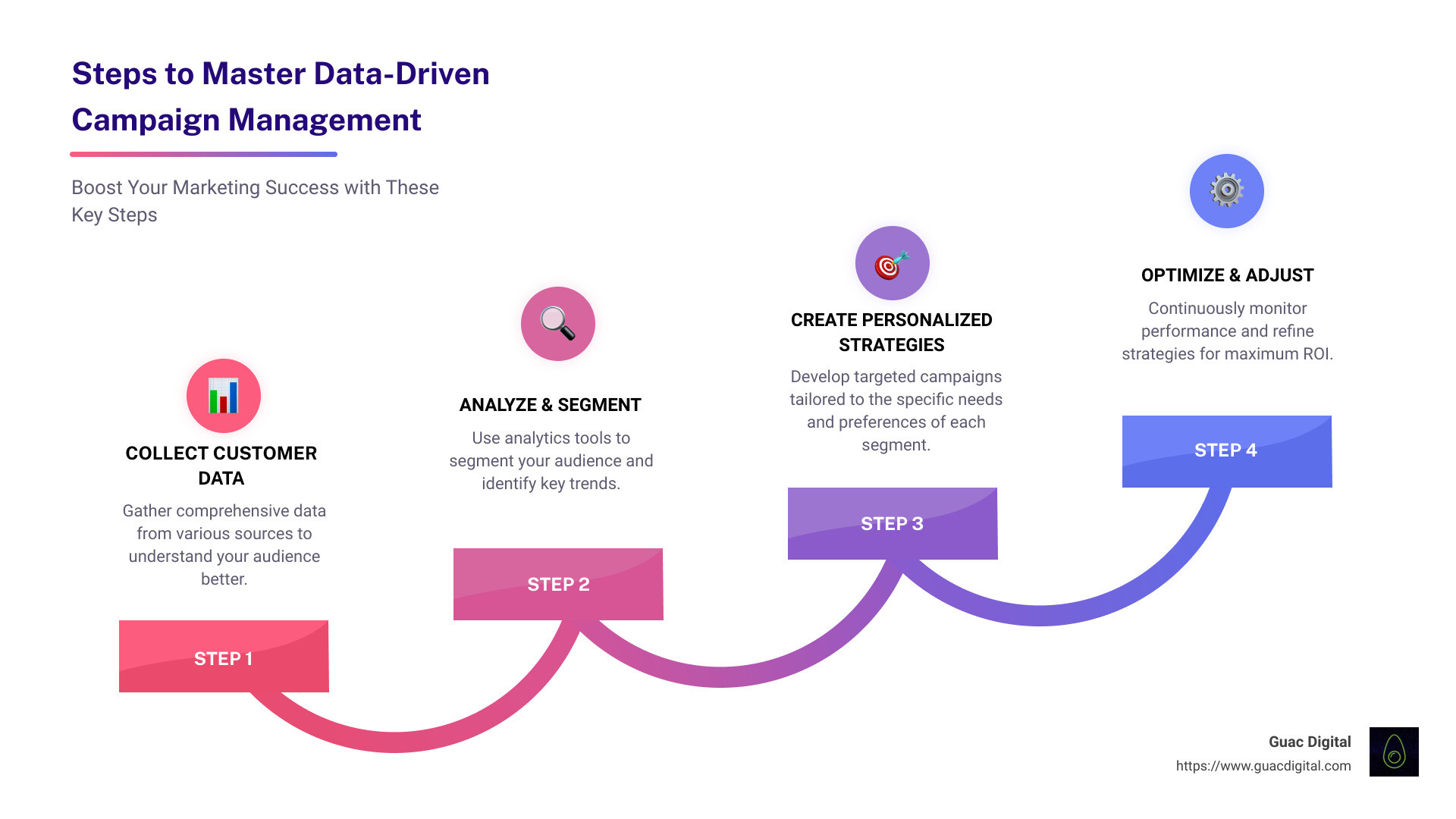
Understanding Data-Driven Campaign Management
What is a Data-Driven Campaign?
A data-driven campaign uses detailed customer data to predict behavior and optimize performance. Unlike traditional marketing that relies on gut feeling, this approach leverages facts and insights.
For instance, imagine you run a retail store. By analyzing purchase history, you can predict which products a customer might buy next. This allows you to tailor promotions specifically to their interests.
Customer insights are the backbone of a data-driven campaign. Using predictive analytics, you can forecast future actions and design personalized strategies that resonate deeply with your audience.
Benefits of Data-Driven Campaigns
Data-driven campaigns offer several advantages:
Personalized Campaigns: Tailoring your messages to individual preferences leads to more effective marketing. According to Forbes, 61% of high-performing marketers have created a single view of the customer by unifying data from multiple touchpoints.
Relevant Messaging: When you understand your audience’s interests and challenges, you can create more in-context messages. This relevance increases engagement and conversion rates.
Audience Segmentation: Breaking down your audience into smaller, more specific groups allows for highly targeted marketing. For example, demographic data can help you design campaigns that appeal specifically to millennials or baby boomers.
Better Customer Experience: Personalized marketing doesn’t just drive sales; it also improves the overall customer experience. When customers feel understood and valued, they are more likely to remain loyal.
High ROI: Data-driven campaigns are not just effective; they’re efficient. By focusing your efforts on what works, you can achieve a higher return on investment. In fact, 64% of global marketing leaders agree that data-driven strategies are vital in today’s economy.
Predict Needs: Using customer data, you can anticipate future needs and trends. This proactive approach ensures you’re always one step ahead, offering products or services just as your customers realize they need them.
Incorporating these elements into your marketing strategy will not only optimize your campaigns but also foster stronger connections with your audience. Ready to take your marketing to the next level? Let’s explore how to build a data-driven marketing campaign.

Building a Data-Driven Marketing Campaign
Define Outcomes
Speed to market is essential. The faster your message reaches people, the higher your chances of success.
Defining your outcomes is vital for data-driven marketing. It gives your analysts a clear starting point. Americo Campos Silva, Shell’s Global Head of Integrated Brand and Communications, emphasizes focusing on objectives first. He says, “Keep your objectives in the center of your thinking – and surround those objectives with insights that are related, not random pieces of data.” This approach helps you think creatively about how data can add value.
Use Technology
AI and other tools make data analysis manageable. Tools like HubSpot and Salesforce can optimize the admin side of your business. This leaves more time for creative thinking.
Optimized and automated admin means more time for creativity. Choose the tech that complements your team’s strengths. For example, HubSpot might work better for some, while Salesforce might be perfect for others. The key is to find what fits your needs.
Make Your Campaign Human
Your data shows what the world needs or wants. Now, build a bridge between your product and those needs.
Engage your audience. Speak their language. Use well-written blog posts if they like reading. Create funny tutorial videos if you sell complex machines.
Brand management is crucial. Consider the human reaction to sudden changes. Sudden changes can intrigue but also confuse loyal customers. Balance these factors for campaign success.
Pivot Your Branding or Marketing Campaign
Sometimes, you need to change course based on data.
For example, you might start with a marketing campaign but find that building consumer trust in your brand is better. This requires flexibility. Shift from marketing strategies to branding tips as needed.
Behavioral insights can reveal the best direction. Be ready to pivot based on what the data shows. This flexibility is key to heading in the right direction.
By focusing on customer-centricity, continuous learning, and empowerment through insights, you ensure a measurable impact.
Let’s explore effective strategies for data-driven campaign management.
Effective Strategies for Data-Driven Campaign Management
Use Demographic Data for Campaigns
Demographic data is a goldmine for creating targeted campaigns. This data includes age, gender, income, and relationship status. For example, if you find that 75% of your audience is millennials, you can tailor your messaging, tone, and design to appeal to their interests and habits.
Key Steps:
1. Analyze your demographic data.
2. Design messaging and visuals that resonate.
3. Adjust your product positioning.
Pro Tip: Use social media platforms like Facebook and Instagram to create audience segments based on demographic data. This increases the specificity and effectiveness of your campaigns.
Use Cross-Channel Data for Better Campaigns
Cross-channel data helps you understand your audience from multiple angles. Data from social media, email campaigns, and websites can be used to create more informed and cohesive campaigns.
Example: If your social media data shows interest in a music event, you could send targeted emails offering free tickets. This leverages your social media insights to boost email campaign engagement.
Key Steps:
1. Collect data from all marketing channels.
2. Integrate this data to get a holistic view of your audience.
3. Craft campaigns that use insights from multiple channels.
Run A/B Tests on Campaigns
A/B testing is crucial for optimizing campaign performance. It helps you determine which elements of your campaign work best by comparing two versions.
Example: If you can’t decide between two email subject lines, use A/B testing. Send both versions to a sample audience and see which one gets more opens. Use the winner for your broader audience.
Key Steps:
1. Create two versions of a campaign element (like subject lines or ad visuals).
2. Test them on a small segment of your audience.
3. Analyze the results and implement the best-performing option.
Optimize Your Data Collection and Analytics Process
Accurate data is the backbone of effective data-driven campaign management. If your campaigns aren’t performing as expected, your data collection process might need improvement.
Key Steps:
1. Audit your current data collection process.
2. Identify inefficiencies and gaps.
3. Implement better tracking codes and visualization tools.
4. Document changes for future reference.
Pro Tip: Regularly review your data collection methods to ensure accuracy. Use tools like HubSpot or Salesforce to streamline your data analytics process.
By leveraging these strategies, you can optimize your campaigns and achieve better results. Up next, let’s explore how segmentation and personalization can further improve your campaigns.
Crafting Connections through Segmentation and Personalization
Support a Data-Driven Culture
Data isn’t just about numbers; it’s a narrative waiting to be uncovered. A data-driven culture empowers marketing teams to make informed decisions based on evidence rather than assumptions. To foster this culture, create a collaborative environment where insights are shared across departments.
Key Actions:
- Hold regular data review meetings: Encourage open discussions about data insights and their implications for ongoing campaigns. This helps bridge the gap between analytics and creativity.
- Organize workshops and skill development sessions: Equip your team with the skills needed to interpret and act on data.
- Promote a shared language of data: When everyone understands the language of data, it becomes easier to align strategies, measure success, and pivot swiftly based on real-time insights.
For example, Shell’s Global Head of Integrated Brand and Communications, Americo Campos Silva, suggests focusing on objectives first and surrounding them with related insights. This approach ensures creatives have a manageable set of insights to work with, prompting innovative thinking about how data can add value.
Involve Creative Agencies Early
Strategy and creativity need to operate as coexisting partners to achieve the best outcomes. Engaging a creative team alongside clearly defined goals early can help in several ways:
Benefits:
- Surface unmet needs: Creative agencies can uncover needs that your internal team might overlook.
- Inspire different thinking: Fresh perspectives can lead to innovative solutions.
- Explore new solutions: Address old problems with new approaches.
- Reduce risk: Early involvement of creatives can help identify potential pitfalls before they become issues.
- Generate solutions: Aim for groundbreaking ideas, not just incremental improvements.
- Accelerate learning: Faster iteration and feedback loops improve your organization’s ability to adapt and learn.
- Anticipate tactical solutions: Creative teams can foresee and plan for tactical execution challenges.
For instance, if your data shows a decline in customer engagement, a creative agency might suggest new content formats or channels that resonate better with your audience. This collaboration can lead to more effective and engaging campaigns.
By supporting a data-driven culture and involving creative agencies early, you can craft personalized campaigns that resonate deeply with your audience. This approach not only improves engagement but also nurtures long-term customer relationships.
Measuring Success and KPIs
Define Clear Goals
To succeed at data-driven campaign management, start by defining clear, measurable goals. These goals serve as your campaign’s compass, guiding every decision and action.
Here are some common objectives:
- Increase website traffic: Aim for a specific percentage increase in visitors.
- Grow email subscribers: Set a target number of new subscribers.
- Boost sales: Define a sales revenue goal.
- Improve customer engagement: Focus on metrics like click-through rates and social media interactions.
Clearly defined goals make it easier to select relevant Key Performance Indicators (KPIs) and measure success.
Track KPIs
Once your goals are set, identify the KPIs that align with them. KPIs are quantifiable metrics that help you track progress and make data-driven adjustments.
Some essential KPIs include:
- Website traffic: Measure the number of visitors and their behavior on your site.
- Email subscribers: Track new sign-ups and engagement rates.
- Sales: Monitor revenue, conversion rates, and average order value.
- Customer engagement: Look at metrics like click-through rates, time on page, and social media interactions.
Use analytics tools like Google Analytics, HubSpot, or Salesforce to track these KPIs. These tools offer real-time insights, helping you understand what’s working and what needs improvement.
Campaign Adjustments
The beauty of data-driven campaigns lies in their adaptability. Regularly review your KPIs to see if you’re meeting your goals. If not, dig into the data to find out why.
For example:
- Low click-through rates: Experiment with different messaging or call-to-action buttons.
- High bounce rates: Improve your website’s user experience or content relevance.
- Poor conversion rates: Re-evaluate your sales funnel and identify drop-off points.
By making data-driven adjustments, you can continually optimize your campaigns for better performance.
Tools to Track KPIs
Analytics tools are essential for tracking KPIs and making informed decisions. Some popular options include:
- Google Analytics: Great for website traffic and user behavior.
- HubSpot: Excellent for email marketing and CRM.
- Salesforce: Ideal for sales tracking and customer relationship management.
These tools provide detailed reports and dashboards, making it easier to monitor your KPIs and adjust your strategy as needed.
By defining clear goals and tracking the right KPIs, you can ensure your campaigns are always on the path to success.
Frequently Asked Questions about Data-Driven Campaign Management
What is a data-driven campaign?
A data-driven campaign uses customer data to make informed decisions about marketing strategies. Instead of guessing what will work, marketers analyze data to understand customer behavior and preferences. This allows for highly personalized campaigns that are more likely to succeed.
For example, if you know that 75% of your target audience are millennials, you can tailor your messaging, content, and even the platforms you use to better reach them. *According to research, over 64% of global marketing leaders agree that data-driven strategies are vital in today’s economy.*
What is data-driven management?
Data-driven management involves making decisions based on data analysis rather than intuition or observation alone. This approach applies to all aspects of a business, not just marketing. It means using data to guide strategy, operations, and even daily tasks.
For instance, a company might use data from various sources like CRM systems and social media to gain insights into customer needs and preferences. This helps in creating more effective marketing campaigns, improving customer service, and optimizing operations. *Tom Benton, CEO of the Data and Marketing Association, emphasizes the importance of leveraging data to deliver personalized experiences at scale.*
What is an example of a data-driven marketing plan?
Imagine you run an e-commerce store. A data-driven marketing plan for your store might look like this:
- Set Objectives: Increase website traffic by 20% and boost sales by 15% in the next quarter.
- Gather Data: Use Google Analytics to track website traffic, HubSpot for email marketing data, and social media insights from Facebook and Instagram.
- Analyze Data: Identify which products are most popular, what times of day people visit your site, and which marketing channels drive the most traffic.
- Create Campaigns: Develop targeted email campaigns offering discounts on popular products. Use social media ads to reach potential customers during peak times.
- Run A/B Tests: Test different email subject lines and ad creatives to see which performs better.
- Track KPIs: Monitor metrics like click-through rates, conversion rates, and sales to measure success.
By following this structured approach, you can continuously optimize your campaigns for better performance. A McKinsey article highlights that companies with clear goals and regular tracking are more successful. source
Ready to take your marketing to the next level? Up next, we’ll explore how to craft connections through segmentation and personalization.
Conclusion
At Guac Digital, we believe in the power of personalized strategies to drive high ROI. Our approach to programmatic marketing ensures that your campaigns are not just data-driven but also customer-centric.
We use advanced data analytics to understand your audience deeply. This enables us to create custom campaigns that resonate with your target market. Our goal is to help you connect with your customers on a personal level, fostering loyalty and driving long-term success.
Our team is dedicated to helping you achieve your marketing objectives. Whether you need to boost your online presence, improve customer engagement, or drive sales, we have the expertise and tools to make it happen. By leveraging data effectively, we ensure that every campaign is optimized for maximum impact.
Ready to transform your marketing efforts? Partner with Guac Digital and experience the difference that a data-driven, customer-centric approach can make.
Request your free marketing plan from our marketing experts. 🥑