
Advertising Using Big Data: 7 Powerful Ways to Boost ROI 2025
Understanding the Big Data Revolution in Advertising
Advertising using big data refers to leveraging massive volumes of consumer information to create highly targeted, personalized, and effective ad campaigns. This approach transforms traditional advertising by using advanced analytics to optimize every aspect of the customer journey.
What is Big Data Advertising?
– The use of large, complex datasets to inform advertising decisions
– Analysis of consumer behavior across multiple touchpoints
– Real-time optimization of ad placement and content
– Predictive modeling to anticipate customer needs
– Personalization at scale for more relevant messaging
Nine years ago, the New York Times announced the beginning of the “Age of Big Data.” Since then, this concept has become one of the most important tools in modern marketing. Every day, advertisers process billions of data points to deliver precisely targeted messages to the right people at the right time.
The worldwide big data analytics market is expected to exceed $655 billion by 2029, up from about $241 billion in 2021. This growth reflects how critical data-driven strategies have become for businesses seeking competitive advantage.
I’m Guy Leon, founder and CEO of Guac Digital, where I’ve helped businesses achieve up to 350% increases in conversion rates through strategic advertising using big data and built comprehensive analytics systems that transform raw customer data into actionable insights.

Advertising using big data terms made easy:
– big data analytics for advertising
– how big data analytics is solving big advertiser problems
– big data advertising platform
Explaining Big Data in Modern Advertising
Big data in advertising isn’t just about having mountains of information – it’s about having the right information and knowing how to turn it into campaigns that connect with real people.
Big data comes in two forms: structured data (organized information like customer demographics) and unstructured data (messy but valuable information like social media conversations and video engagement).
To understand big data, marketers typically discuss the “4 Vs”:
Volume: Massive amounts of information. Walmart processes over a million customer transactions hourly, generating 2.5 petabytes of data.
Velocity: Today’s data arrives at breakneck speed, enabling real-time bidding decisions in milliseconds.
Variety: Customer digital footprints span from Instagram likes to website browsing, email opens to in-store purchases.
Veracity: Having accurate, trustworthy information is crucial for campaign success.
Modern advertising using big data relies on sophisticated tools like identity graphs (connecting a person’s activity across devices) and data lakes (massive repositories storing all types of information).
| Traditional Advertising | Big Data Advertising |
|---|---|
| Broad audience targeting | Hyper-personalized messaging |
| Fixed campaign schedules | Real-time optimization |
| Intuition-based decisions | Data-driven strategy |
| Limited performance metrics | Comprehensive attribution |
| Media buying based on demographics | Behavioral and predictive targeting |
| Separate channel strategies | Omnichannel coordination |
| Post-campaign analysis | Continuous optimization |
| Creative testing with focus groups | A/B testing at scale |
Why the 4 Vs Matter for Marketers
Each V creates unique opportunities for smarter marketing:
Volume reveals patterns that small sample sizes miss. At Guac Digital, we’ve found hidden micro-segments within seemingly uniform audiences that respond to completely different messaging approaches.
Velocity enables real-time campaign adjustments, capitalizing on trending topics or shifting budget away from underperforming segments.
Variety creates a complete picture of your customers, connecting website visits, social engagement, email responses, and in-store purchases.
Veracity is non-negotiable. We’ve helped clients improve campaign performance by up to 30% simply by implementing better data validation processes.
Primary Sources of Advertising Data
First-party data is your marketing gold – information collected directly from your audience, including CRM records, website behavior, mobile app usage, email engagement, and purchase history.
Second-party data comes through direct partnerships with other companies, while third-party data is acquired from specialized data providers.
Other sources include IoT devices tracking real-world behaviors, social media platforms revealing interests, ad logs documenting campaign interactions, search queries showing consumer intent, and location data mapping physical movements.
Advertising Using Big Data: From Collection to Compliance
The journey from raw data to actionable advertising insights blends science with strategy. When we collect those first data points, we’re laying the foundation for your brand’s competitive advantage.
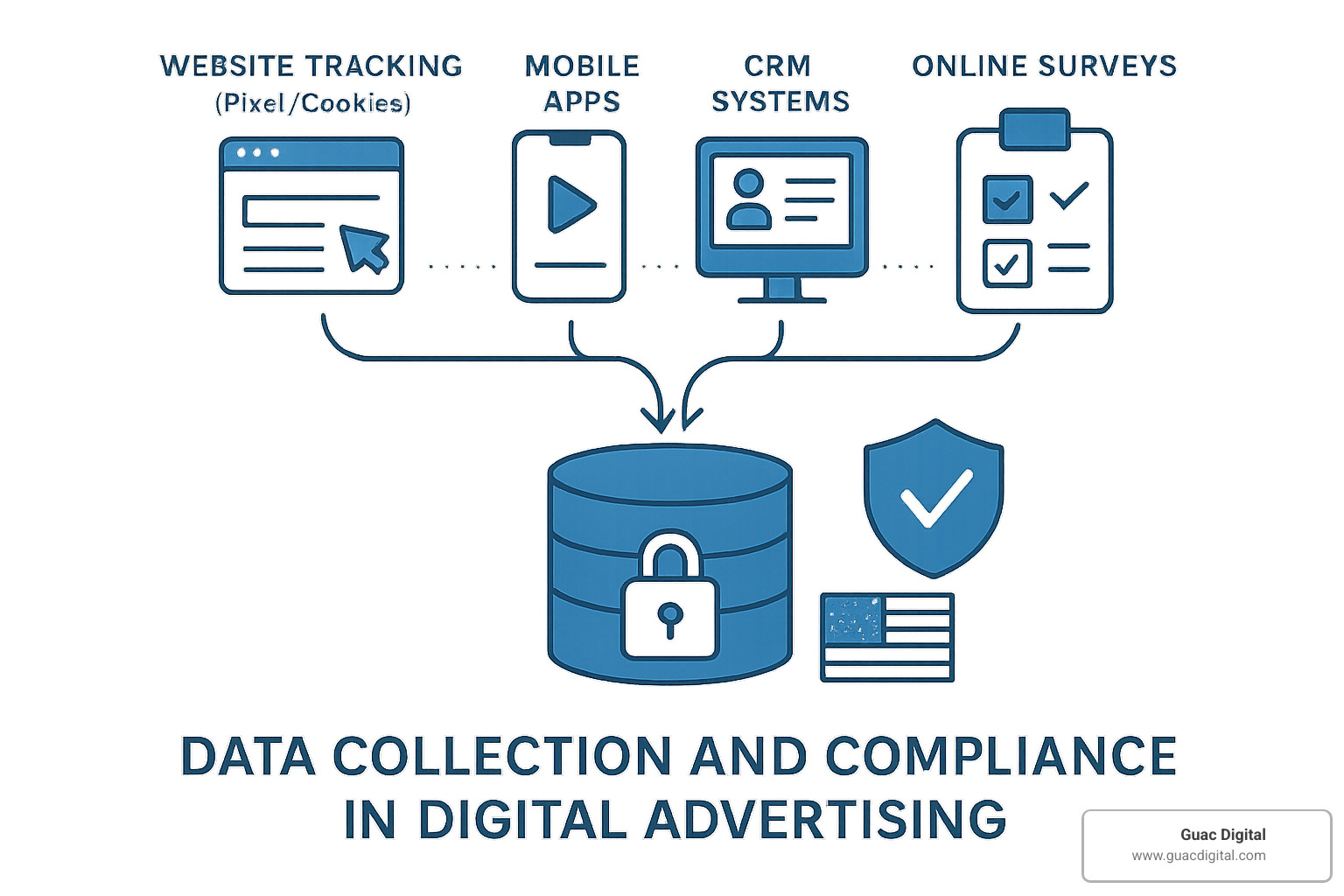
Today’s data collection happens across countless touchpoints. Website pixels track visitor journeys, mobile app SDKs capture behaviors, CRM systems record customer interactions, and social channels gather engagement signals. Even physical store sensors and loyalty programs build valuable data profiles.
The data collection landscape is changing dramatically. Privacy regulations like GDPR in Europe and CCPA in California have transformed what’s possible. These aren’t just compliance problems—they represent a fundamental shift in the relationship between brands and consumers.
With Google following Safari and Firefox in phasing out cookie tracking in Chrome, we’re witnessing “The Great Data Pivot.” Smart brands are already shifting toward first-party and zero-party strategies.
Zero-party data has become our new best friend at Guac Digital. This is information customers willingly share through preference centers, quizzes, or surveys. It’s both accurate and freely given.
Once collected, your data needs integration. ETL (Extract, Transform, Load) processes clean and normalize what you’ve gathered, while Customer Data Platforms (CDPs) create unified customer profiles. Despite these powerful tools, Gartner research shows marketing analytics currently influence only 53 percent of decisions—meaning there’s still a massive opportunity for brands willing to become truly data-driven.
Staying Legal & Ethical with Big Data
Ethical data practices aren’t just about avoiding fines—they’re about building trust that pays dividends for years.
Privacy-by-design should be your mantra. Build privacy into your data strategy from day one by only collecting what you genuinely need and protecting it by default.
Consent management means creating transparent systems where consumers clearly understand what they’re sharing and can easily change their minds.
Data anonymization techniques and thoughtful data governance policies prevent misuse that leads to both legal and reputation disasters.
Connecting Offline & Online Touchpoints
The holy grail of advertising using big data is creating that seamless view of customers across all touchpoints.
Your loyalty program isn’t just about rewarding customers—it’s a bridge linking in-store purchases to online identities. Post-purchase surveys connect physical experiences to digital profiles. Through data onboarding, we can match offline interactions to online identifiers, building comprehensive omnichannel profiles.
I remember working with a retail client who finded customers were using their website as a research tool before making in-store purchases. This completely changed their digital strategy—optimizing product pages for the research phase rather than pushing immediate online conversion.
Learn more about our approach to creating actionable Data-Driven Insights for our clients.
Advertising Using Big Data for Laser-Sharp Execution
The true power of advertising using big data emerges when you put it into action, changing campaigns from broad-based guesswork into precision marketing.
Audience Segmentation & Targeting at Scale
Today’s segmentation is multidimensional and incredibly specific. At Guac Digital, we start with demographic segmentation as a foundation, then layer in behavioral data showing exactly how people interact with your brand.
The real magic happens with psychographic segmentation. Understanding someone’s values, interests, and lifestyle choices helps craft messages that resonate on a deeper level. One retail client saw conversion rates triple when we segmented their audience by lifestyle preferences.
Modern geographic segmentation goes beyond simple zip codes to understand movement patterns like daily commutes or weekend activities.
The most sophisticated approach is dynamic segmentation, where audience groups evolve in real-time as new data flows in.
We’ve helped brands find their perfect customers by building look-alike models that identify prospects with striking similarities to their best existing customers.
Check out our collection of Big Data Advertising Examples showing how real companies implement these strategies.
Personalization that Converts
True personalization isn’t just slapping someone’s name on an email. It’s creating an experience that feels custom-built for each person—at scale.
I remember working with a travel client whose engagement skyrocketed when we implemented content variants based on past travel preferences. Families who had previously booked kid-friendly resorts saw images of playgrounds, while couples who preferred adult-only getaways saw romantic sunset dinners.
Dynamic Creative Optimization (DCO) assembles personalized ads on the fly. One e-commerce client saw a 215% jump in click-through rates when we implemented dynamic creative that adjusted messaging based on visitor type.
We’ve seen remarkable results with real-time messaging that adapts to immediate context. For a coffee shop chain, we created ads that changed based on local weather conditions, increasing foot traffic by 28% during weather events.
AI recommendations have transformed cross-selling and upselling, predicting with surprising accuracy which products will appeal to each individual.
For a deeper dive, take a look at our guide to Data-Driven Advertising.
Predictive Analytics & Automated Bidding
The crown jewel of advertising using big data is the ability to see into the future with predictive analytics.
Media Mix Modeling (MMM) helps understand which marketing channels deliver the best results. Multi-Touch Attribution (MTA) gives credit throughout the customer journey.
The real game-changer is how machine learning algorithms predict human behavior with remarkable accuracy, forecasting:
– Which website visitors are most likely to become customers
– How much to bid for each ad impression based on conversion probability
– The perfect time to reach each person when they’re most receptive
– Which creative elements will resonate best with each viewer
One retail client saved 40% on ad spend while increasing conversions by 65% after implementing our predictive bidding strategy.
According to McKinsey research on predictive ROI, companies leveraging advanced analytics can achieve up to 250% greater efficiency compared to traditional targeting.
Measuring Success & Maximizing ROI
The beauty of advertising using big data is how it transforms measurement from guesswork into precision. Now you can track every dollar to see exactly what’s working.
When clients first see a real-time dashboard showing exactly how their campaigns are performing, it’s a game-changing moment. Imagine adjusting your strategy today based on what happened an hour ago, not last month.
Modern attribution has evolved far beyond simple metrics. It’s detective work, piecing together the customer’s journey across various touchpoints.
Attribution models help determine how to distribute credit for conversions. First-click attribution honors where the relationship began, while last-click attribution rewards the final nudge. More sophisticated approaches like linear attribution share credit evenly, and time-decay attribution gives more weight to recent interactions.
The holy grail is data-driven attribution, where algorithms analyze thousands of customer journeys to determine each touchpoint’s actual contribution.
Beyond attribution, we use tools like Media Mix Modeling (MMM) to understand how different marketing channels work together, and Multi-Touch Attribution (MTA) to track individual customer journeys. Lift tests compare results between test and control groups, revealing the true impact of your advertising.
What matters most is how these insights translate to your bottom line through Return on Ad Spend (ROAS), showing exactly how much revenue you’re generating for each advertising dollar invested.
Learn more about our Data-Driven Campaign Management services.
Smarter Attribution Models
Attribution isn’t just about assigning credit – it’s about understanding your customer’s journey. Each model tells a different story about how people find and choose your brand.
First-click attribution celebrates the channels that create awareness, perfect for brands focused on expanding their audience.
Last-click attribution spotlights the final touchpoint before conversion. It’s simple but can be misleading, like crediting only the cashier for a sale while ignoring everything else that influenced the purchase.
Fractional credit models distribute conversion value across multiple touchpoints, acknowledging everyone who played a role in the sale.
At Guac Digital, we’ve seen clients completely transform their marketing strategy after implementing more sophisticated attribution. One client finded their podcast sponsorships, which seemed ineffective by traditional metrics, were actually initiating 40% of their highest-value customer relationships.
Turning Insights into Action
A/B testing is the scientific method applied to marketing. With big data, you can test multiple elements simultaneously to find winning combinations faster.
Sentiment analysis reveals how customers really feel about your brand by analyzing social media posts, reviews, and other feedback.
The most successful marketers accept continuous improvement as a mindset. A financial services client implemented a weekly optimization routine for their campaigns, improving conversion rates by 27% within three months through dozens of small improvements that compounded over time.
Future Trends & How to Get Started
The world of advertising using big data keeps evolving in fascinating ways that open new doors for marketers everywhere.
AI co-pilots have moved beyond simple automation to become true creative partners, helping write compelling ad copy, suggest targeting strategies, and predict campaign performance.
Real-time analytics continue getting faster and more user-friendly, shrinking the gap between collecting data and acting on it.
First-party data has become marketing gold in our privacy-conscious world, giving brands with direct customer relationships a massive advantage.
Zero-party data strategies create genuine value exchanges where consumers willingly share their preferences.
Edge computing brings processing power closer to data sources, enabling ads to react to real-world triggers almost instantly.
IoT devices are creating entirely new data streams as smart homes, connected cars, and wearable tech become everyday realities.
Immersive advertising experiences in augmented and virtual reality are generating entirely new types of behavioral data.

Roadmap for SMBs Entering Big Data Advertising
If you’re running a small or medium-sized business, here’s a practical path forward:
Start with the gold you already have. Before investing in fancy new data sources, fully use what’s already at your fingertips.
Focus on solving specific problems rather than trying to do everything at once.
Accept user-friendly tools that don’t require a computer science degree, like Google Data Studio, Tableau Public, and modern CRM systems.
Look to the cloud for affordable computing power without major infrastructure investments.
Address skill gaps by training existing team members, bringing in specialists for specific projects, or partnering with agencies like Guac Digital.
Take small steps that lead to big results. Start with pilot projects that show value quickly, then expand based on what works.
Make data quality your foundation. Establish clear processes for validating and cleaning your information from day one.
Learn more about our Data-Driven Marketing Solutions designed specifically for growing businesses.
Partnering with Experts
While you can implement some big data advertising tactics in-house, partnering with specialists often fast-tracks your success. Consider connecting with:
Programmatic specialists who understand the complex ecosystem of real-time bidding and ad exchanges.
Data analytics consultants who can design measurement frameworks custom to your specific business goals.
Training providers who can upskill your existing team.
Marketing technology integrators who specialize in connecting your various systems into a unified data view.
The right partnership approach depends on your specific situation. The key is finding partners who truly understand your goals and can translate big data concepts into practical strategies that drive real business results.
Frequently Asked Questions about Big Data Advertising
How expensive is big data advertising to implement?
When businesses first consider advertising using big data, the cost question is usually at the top of their list. The truth is, there’s no one-size-fits-all answer.
At the enterprise level, custom data infrastructure can run into six or seven figures. But you don’t need a Fortune 500 budget to get started. Many small and medium-sized clients at Guac Digital begin with much more reasonable investments.
Cloud-based analytics platforms typically offer tiered subscription models starting around a few hundred dollars monthly. These solutions scale with you – you can start small and expand as you see results. Most programmatic advertising platforms structure their fees as a percentage of your media spend rather than hefty fixed costs.
The smartest approach is starting with focused projects that can deliver quick wins and measurable ROI. Then you can reinvest those gains into more sophisticated capabilities as your confidence grows.
Can small businesses benefit without a data science team?
Absolutely yes! While having data scientists on staff might be the gold standard, it’s definitely not a requirement for leveraging advertising using big data effectively.
Today’s marketing technology landscape offers several pathways for smaller organizations:
Many analytics platforms now feature intuitive visual interfaces and pre-built reporting templates designed specifically for marketers, not data scientists.
Agency partnerships provide access to specialized expertise on a fractional basis – you get the benefit of data experts without the overhead of full-time salaries.
I’ve seen remarkable success stories from small businesses that took a focused approach, solving specific marketing problems with data. One retail client started simply by analyzing their email engagement data to improve segmentation, which led to a 42% increase in email-driven revenue.
The key is starting with clear business objectives and selecting tools that align with your team’s existing capabilities.
What happens when third-party cookies disappear?
The looming “cookiepocalypse” has created anxiety in marketing circles, but I’m actually excited about where advertising using big data is headed in this new landscape.
Smart businesses are already pivoting to first-party data strategies that emphasize direct relationships with consumers, offering something meaningful in return for customer information and consent.
Contextual advertising is making a sophisticated comeback, targeting based on content relevance rather than user profiles. Modern contextual solutions use AI to understand content at a much deeper level than the keyword matching of years past.
We’re also seeing promising developments in privacy-preserving technologies like Google’s Privacy Sandbox and various data clean room solutions.
At Guac Digital, we’ve been helping clients prepare by strengthening their first-party data capabilities and building consent-based marketing ecosystems. Organizations that view this change as an opportunity to build more transparent, trust-based relationships with consumers will find themselves at a significant advantage in the cookie-less future.
Conclusion
Advertising using big data isn’t just a flashy trend anymore—it’s become the backbone of successful digital marketing strategies. The thoughtful use of consumer data can completely transform advertising results, making every dollar work harder and every message land more effectively.
At Guac Digital, we’ve walked alongside clients in Tampa, Florida and across the globe as they’ve finded the power of data-driven advertising. The results speak for themselves:
When you target the right people with precision, your media dollars stretch further. When your messages speak directly to individual needs, conversion rates climb. When you understand the complete customer journey, you create experiences that truly resonate. And when you can clearly see what’s working (and what isn’t), continuous improvement becomes second nature.
The beauty of this approach is that it creates a virtuous cycle. Better data leads to better campaigns, which generate more insightful data, which fuels even more effective advertising.
But technology alone won’t get you there. The most successful data strategies combine powerful tools with thoughtful planning, efficient processes, and skilled people who know how to turn numbers into meaningful connections.
If you’re just starting your data journey, don’t feel overwhelmed. Start with a specific challenge, implement a focused solution, measure the results, and build from there. The organizations seeing the greatest success view their data capabilities as something that evolves over time, not a one-and-done project.
Behind all those numbers are real people with real needs. Advertising using big data works best when it helps you understand and serve your customers better, not just track them more closely.
Ready to see how data-driven advertising could transform your marketing results? Learn more about our services or reach out to discuss how we can help you achieve your specific goals.
