
big data analytics for advertising: 10 Power Trends 2025 Success
Open uping the Power of Data-Driven Advertising
Big data analytics for advertising is the process of collecting, analyzing, and interpreting large volumes of consumer data to create more effective, personalized, and profitable advertising campaigns.
What is big data analytics for advertising?
– Definition: Using advanced tools to process massive datasets from multiple sources to inform advertising decisions
– Purpose: Optimize ad targeting, personalization, and ROI through data-driven insights
– Key components: Data collection, processing, analysis, and actionable insights
– Benefits: 10-30% improvement in marketing performance when properly implemented
In today’s digital landscape, advertising has evolved from creative guesswork to a precise science. As the New York Times announced nearly a decade ago, we’ve entered the “Age of Big Data,” changing how businesses connect with potential customers. The advertising industry now has unprecedented access to consumer information—from browsing behaviors and purchase history to location data and social interactions.
“Without data, you’re just another person with an opinion,” as statistician W. Edwards Deming said. This quote perfectly captures why big data has become the “new oil” of the twenty-first century, especially for advertisers seeking competitive advantage.
The global Big Data and analytics market is predicted to hit $215.7 billion in spending, with advertising taking a significant slice of that investment. Why? Because when properly leveraged, big data analytics can deliver 10% to 30% improvements in marketing performance according to multiple industry studies.
I’m Guy Leon, founder of Guac Digital, where we’ve helped businesses achieve up to 350% increases in engagement through strategic big data analytics for advertising campaigns that transform raw information into actionable marketing insights.

Big data analytics for advertising further reading:
– big data advertising platform
– how is big data used in advertising
– big data advertising example
Understanding Big Data Analytics for Advertising
Big data analytics for advertising is like having a superpower in today’s marketing world. It’s the process where we collect, process, and analyze enormous, complex datasets to uncover hidden patterns and customer preferences that would otherwise remain invisible to the naked eye.
When we talk about big data, marketing professionals often describe it using the famous “3 Vs”:
- Volume: The massive amount of data generated across all digital platforms
- Variety: The diverse types of data coming from countless sources
- Velocity: The lightning speed at which new data appears and needs processing
“Marketing data collection has come a long way over the years due to technological advancements,” as a recent industry report puts it. And wow, what a journey it’s been:
In the 1980s, we had basic demographic information and simple database marketing. The 1990s brought CRM systems and early website analytics. The 2000s saw social media data and behavioral targeting take center stage. By the 2010s, mobile data exploded alongside cross-device tracking. Now in the 2020s, we’re navigating IoT data streams, AI-powered analytics, and privacy-focused solutions.
This incredible evolution represents a fundamental shift from neatly organized structured data to the wild world of unstructured data—things like social posts, images, and videos—that now makes up a whopping 80-90% of all marketing information.
The numbers don’t lie: the advertising market is expected to surge beyond $700 billion, with data becoming what many call the gold mine of the twenty-first century.
How “big” is advertising data today?
The scale of today’s advertising data is mind-boggling. In 2020, global data volume reached 44 zettabytes—up from just 4.4 zettabytes in 2013. For perspective, one zettabyte equals one trillion gigabytes. That’s a lot of cat videos and purchase histories!
On a more practical level, the major platforms are processing astronomical amounts of information:
Facebook handles 30 billion pieces of content shared monthly. Google processes billions of search queries every day. Ad exchanges manage hundreds of millions of ad requests daily. And performance marketing networks can process up to 50 billion events and 3 billion ad impressions in a single day.
A typical recommendation platform might process 30 terabytes of user interaction data daily—that’s roughly equivalent to the text in 30 million books! And this doesn’t even account for the constant flow of data from IoT devices, mobile apps, and offline touchpoints.
Perhaps most striking is that 80-90% of all this data is unstructured—it doesn’t fit neatly into traditional databases and requires specialized tools to make sense of it all.
Key characteristics of big data analytics for advertising
Beyond the traditional 3 Vs, big data analytics for advertising has evolved to include two additional crucial dimensions:
Value: The magic happens when raw data transforms into actionable advertising insights that drive real business results.
Veracity: This refers to the accuracy and trustworthiness of the data—because insights are only as good as the data they’re built on.

These five characteristics work together to create a powerful framework for understanding today’s advertising landscape. For example, IBM Watson Advertising reports that their clients experience at least a 25% increase in ad performance using predictive analytics derived from high-quality, high-volume data.
What makes big data analytics for advertising truly special is its ability to process both historical and real-time data simultaneously. This means advertisers can understand past performance while also predicting future consumer behavior and responding to trends as they emerge—not weeks later when the opportunity has passed.
For a deeper dive into how data analytics has evolved over the decades, check out this comprehensive analysis from CDO Magazine that traces the journey from simple spreadsheets to today’s sophisticated AI-powered systems.
Data Sources, Collection & Integration Pipelines
The beating heart of effective big data analytics for advertising is the data itself. In today’s complex digital landscape, advertisers need to steer a rich ecosystem of information sources, each bringing unique value to the table.
Primary Data Sources
Your advertising insights are only as good as the data feeding them. The most valuable information comes from three key sources:
First-party data is the gold standard – information you collect directly from your audience. This includes website clicks, app usage patterns, purchase records, email interactions, and CRM entries. At Guac Digital, we’ve seen first-party data drive up to 2.5x better campaign performance compared to third-party alternatives.
Zero-party data takes things a step further – it’s information your customers willingly share with you. Think preference selections, profile details, survey answers, and product feedback. This treasure trove of data reflects explicit customer intentions rather than inferred behaviors.
Third-party data rounds out your view – information acquired from external providers including demographic databases, behavioral aggregators, social insights, and public records. However, as one industry report warns, “Marketing firms need to scale their own first-party data capabilities to mitigate against the decline in third-party data access,” highlighting the growing importance of building your own data assets as privacy regulations evolve.
Collection Mechanisms
Modern advertising relies on sophisticated collection tools that capture consumer behavior across touchpoints:
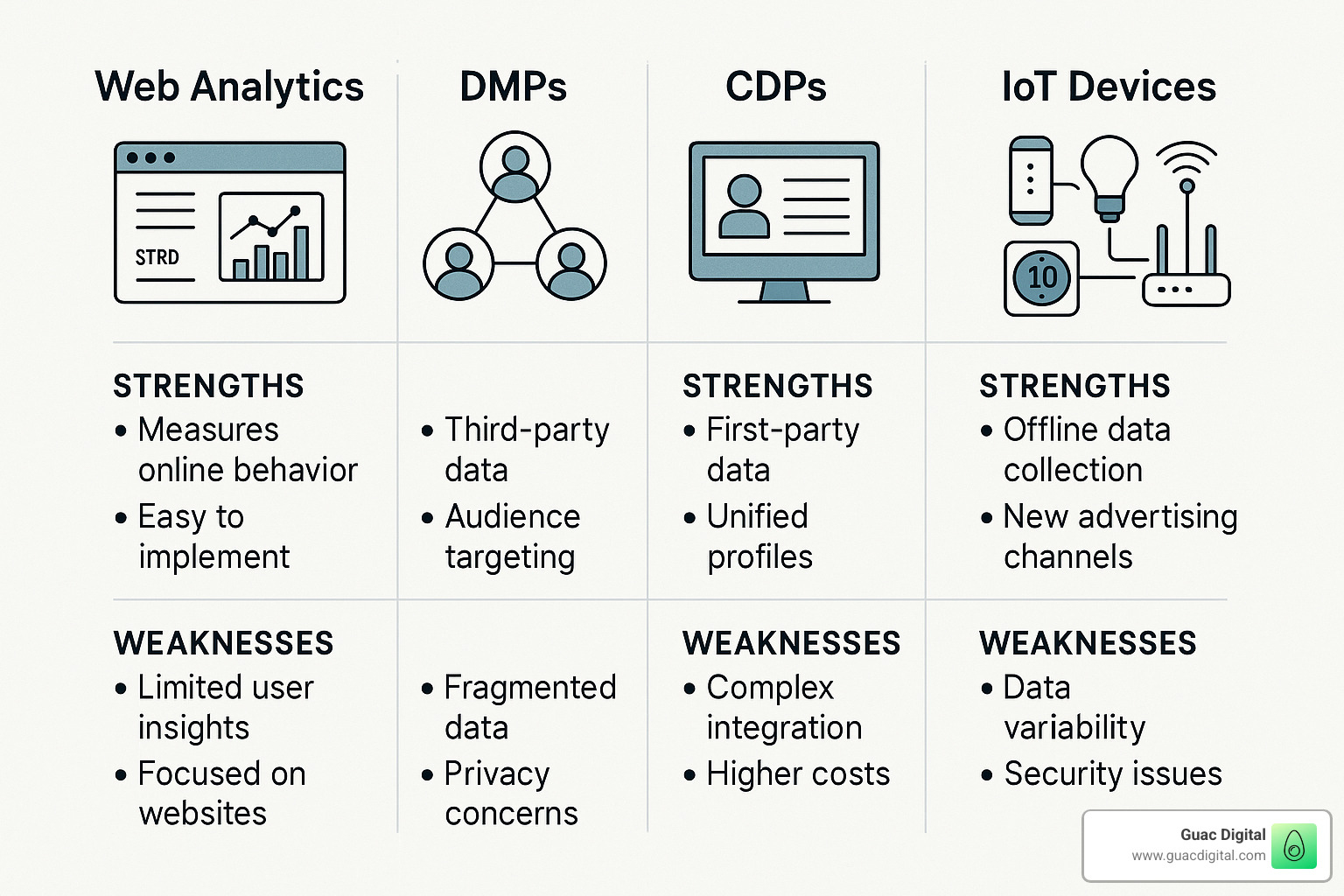
Web analytics tools silently track user journeys, while ad server logs record every impression, click, and conversion. Data Management Platforms (DMPs) organize audience segments, and Customer Data Platforms (CDPs) create unified customer profiles across channels. Meanwhile, retail Point-of-Sale systems capture in-store transactions, and IoT devices generate a constant stream of product usage data.
Bringing these diverse data sources together requires robust technical infrastructure – ETL (Extract, Transform, Load) processes that prepare the data, data lakes for storing raw information, and data warehouses that organize everything for analysis.
The workhorses of advertising analytics are platforms like Google BigQuery (serverless and highly scalable), Apache Hadoop (distributed storage and processing), and Apache Spark (fast, in-memory processing). These technologies aren’t just theoretical – one performance marketing network we’ve partnered with processes over 50 billion events and 3 billion banner impressions daily using this tech stack.
Building a unified advertising data stack
Creating a cohesive data ecosystem is perhaps the trickiest part of implementing big data analytics for advertising. In our work at Guac Digital, we’ve found that successful integration requires four key elements working in harmony:
A robust data ingestion layer that collects information from various sources without missing a beat. Reliable connectors and APIs that enable different systems to talk to each other seamlessly. Thoughtful schema mapping that aligns data formats across platforms so everything makes sense together. And sophisticated identity resolution technology that connects user identities across touchpoints, creating a complete customer view.
Thankfully, specialized platforms like Improvado, Adverity, and Mode Analytics have emerged to simplify this process. These tools offer pre-built connectors to hundreds of marketing platforms, turning what used to be months of custom development into a matter of days. As one client told us after implementing these tools, “We went from spending 70% of our time wrangling data to spending 70% of our time acting on insights.”
Processing structured and unstructured data at scale
Once collected, advertising data needs to be processed to extract meaningful insights. This is where the real magic happens – turning raw information into actionable intelligence.
Structured data (neatly organized in rows and columns) can be processed using traditional SQL queries – think spreadsheets and databases. But unstructured data (like social posts, images, and videos) requires more sophisticated techniques. Natural Language Processing (NLP) helps understand text context and sentiment. Computer Vision extracts meaning from visual content. Machine Learning identifies patterns humans might miss.
Apache Spark has become our go-to framework for processing both types of data, offering specialized libraries for SQL, machine learning, graph processing, and streaming analytics in one package.
We recently helped an ad tech client build a comprehensive analytics pipeline that transformed their capabilities. By implementing user-agent parsing to identify devices, geo-IP mapping to pinpoint locations, session grouping to understand user journeys, and machine learning to predict behaviors, they increased their analytics capabilities six-fold – dramatically improving campaign performance and reducing wasted ad spend.
Learn more about our Data-Driven Campaign Management
Why It Matters: Benefits & ROI Drivers
The investment in big data analytics for advertising might seem hefty at first glance, but the returns are genuinely game-changing. Companies that accept data-driven advertising consistently leave their competitors in the dust.
When we talk to clients at Guac Digital, they often ask “Is it really worth it?” The numbers speak for themselves:
Marketing performance jumps by 10-30% according to McKinsey’s research. IBM Watson reports their clients see a minimum 25% boost in ad performance through predictive analytics. We’ve watched clients achieve a 9% sales lift without spending an extra penny—just by reallocating their budget more intelligently. And email campaigns powered by AI? They’re generating 41% more revenue than traditional approaches.
Audience segmentation powered by big data analytics for advertising
Remember when targeting just meant picking an age range and location? Those days are long gone.
Big data analytics for advertising has transformed audience segmentation into something far more sophisticated. Today’s segmentation looks at the whole person:
Behavioral patterns reveal how users actually interact with your content and ads, not just who they are on paper. Psychographic profiles dig deeper into values, interests, and lifestyle factors that drive decisions. Purchase intent signals help you spot who’s ready to buy right now. And customer lifetime value predictions let you invest more in relationships that will pay off long-term.
“Dynamic segmentation is a smarter evolution of traditional audience segmentation,” as one industry expert puts it. Unlike static lists that quickly grow stale, dynamic segmentation adjusts in real-time as new data flows in.
This isn’t just theory—we’ve seen it work. One of our retail clients saw conversions jump by 78% after implementing dynamic segmentation that adjusted targeting based on real-time browsing behavior and inventory availability. The ads practically sold what customers were already looking for!
Predictive analytics & bid optimizers
The real magic of big data analytics for advertising is its crystal ball quality—the ability to predict what will happen next.
Imagine knowing which customers are most likely to convert before you spend a dollar targeting them. That’s propensity scoring in action. Or calculating exactly how much a customer relationship will be worth over time (Customer Lifetime Value modeling). You can even identify which customers are about to leave before they do (churn prediction).
These capabilities transform advertising from reactive to proactive. You’re no longer just reporting what happened yesterday—you’re shaping what happens tomorrow.
The results can be eye-opening. One consumer electronics company finded through predictive analysis that their YouTube ads (just 6% of their budget) were twice as effective at driving searches as their TV ads (which ate up 85% of their budget). By shifting resources accordingly, they achieved a 9% sales lift without spending an extra dime.
Multi-touch attribution & measurement
The old “last-click” model of attribution is like giving the closer all the credit in a baseball game—it ignores everything that made the win possible.
Big data analytics for advertising gives you the full picture:
Algorithmic attribution uses statistical models to distribute credit fairly across touchpoints. Cross-device path analysis follows customers seamlessly from phone to laptop to tablet. Marketing Mix Modeling (MMM) measures impact across both digital and traditional channels. And Multi-Touch Attribution (MTA) assigns proper value to each interaction along the conversion path.
This matters tremendously. Facebook reports that traditional measurement tools miss almost 45% of digital touchpoints. That’s like driving with half your windshield covered!
“Analytics 2.0 uses terabyte-scale data and real-time processing of hundreds of variables to reveal dynamic interactions among advertising touch points, unlike traditional models that treat channels in isolation,” explains one industry analyst.
When we implemented advanced attribution models for our clients at Guac Digital, we finded that up to 40% of conversion value had been previously misattributed. Fixing this led to much smarter budget allocation and significantly better performance.
Learn more about Big Data Advertising Examples
Advanced Applications: AI, ML & Attribution Breakthroughs
The intersection of artificial intelligence, machine learning, and big data analytics for advertising is where the most exciting innovations are happening today. It’s like watching science fiction become reality right before our eyes!
Integrating AI with big data analytics for advertising
Modern advertising platforms have evolved far beyond simple data analysis – they’re now powered by sophisticated AI capabilities that transform how we connect with audiences:
Deep Learning networks can spot complex patterns in vast datasets that human analysts would never notice. They’re constantly learning and improving, much like our own brains (but much faster).
Reinforcement Learning systems are like savvy bidding experts that learn through trial and error, continuously optimizing your ad spend without human intervention.
Natural Language Processing has become remarkably sophisticated, enabling ads that respond to how people actually talk and search, not just keywords.
Computer Vision technology can analyze the content of images and videos, opening new frontiers for targeting and placement that go beyond text.
“AI allows marketers to act as their own analysts using self-service tools,” notes one industry expert. This democratization of analytics means you don’t need a data science degree to open up powerful insights.
These technologies enable capabilities that feel almost magical:
Dynamic Creative Optimization automatically personalizes ad elements for each viewer. Recommendation engines suggest products based on subtle behavioral patterns. Sentiment analysis gauges how consumers really feel about your brand, while sophisticated fraud detection protects your investment by spotting suspicious patterns instantly.

Case studies that prove the power
The impact of advanced big data analytics for advertising comes alive through real-world success stories:
L’Oréal Taiwan transformed their approach with AI-driven advertising that analyzed thousands of data points to identify the perfect creative elements for different audience segments. The results speak for themselves: a whopping 400% increase in click-through rates and 15% lower cost per acquisition.
Overstock.com brought personalization to a new level by using machine learning to analyze customer browsing and purchase history. Their personalized product recommendations boosted conversion rates by 30% – proving that when ads feel relevant, people respond.
Taboola processes over 30 terabytes of data daily (that’s like 7,500 HD movies!) to optimize content recommendations in real-time. This massive data processing capability increased advertiser engagement by 60%.
The Trade Desk’s reinforcement learning algorithms make over 9 million bid optimizations every second. Just imagine – while you’re reading this sentence, their system has made millions of improvements to campaign performance based on real-time data.
Perhaps most eye-opening is the consumer electronics company that finded YouTube (using just 6% of their budget) was twice as effective at prompting online searches as TV ads (which consumed 85% of their budget). Even more surprising, search ads (a tiny 4% of budget) generated 25% of sales. By reallocating based on these insights, they boosted sales by 9% without spending an extra penny.
Tools & technologies marketers can’t ignore
The technology landscape for big data analytics for advertising is vast, but several platforms have become essential to modern marketing success:
For visualization and making data understandable, tools like Microsoft Power BI, Tableau, ThoughtSpot, Qlik Sense, and Zoho Analytics turn complex numbers into clear stories anyone can understand.
When it comes to attribution and understanding what’s actually working, Google Analytics 360, Ruler Analytics, Adverity, and Improvado help connect the dots between marketing efforts and results.
Behind the scenes, powerful data processing and machine learning platforms like Google BigQuery, Altair RapidMiner, Apache Hadoop, Apache Spark, and Google Cloud Vertex AI handle the heavy lifting of analyzing massive datasets.
“There is no perfect big data analytics tool; each has distinct value,” an industry expert reminds us. The secret is choosing tools that match your specific needs and capabilities – not just following trends.
Open-source frameworks like TensorFlow, PyTorch, and scikit-learn have also become increasingly important, giving organizations the flexibility to build custom machine learning models custom to their unique advertising challenges.
At Guac Digital, we’ve developed our own proprietary integration framework that brings these technologies together into a unified analytics platform. This gives our clients the best of all worlds – leveraging the strengths of each tool while maintaining a single source of truth for advertising performance. It’s like having a custom-built mission control center for your marketing efforts!
Overcoming Challenges & Ensuring Compliance
Let’s be honest – while big data analytics for advertising offers amazing opportunities, it also comes with its fair share of headaches. At Guac Digital, we’ve helped countless clients steer these waters, and I want to share what we’ve learned about tackling the biggest challenges.
Privacy & Regulatory Compliance
The data privacy landscape has transformed dramatically in recent years. Remember when we could collect pretty much any user data without much thought? Those days are long gone!
Today’s marketers face a complex web of regulations that vary by region:
- GDPR in Europe has set the gold standard with its strict consent requirements
- CCPA/CPRA in California gives consumers unprecedented control over their data
- LGPD in Brazil and PIPL in China have further complicated global marketing efforts
These aren’t just legal footnotes – they fundamentally change how we collect and use data. As one legal expert recently warned, “Privacy regulations like the CA Delete Act are extending data protection responsibilities to analysts, disrupting traditional data aggregation.”
Meanwhile, Google’s plan to phase out third-party cookies has sent many marketers into panic mode. But at Guac Digital, we see this as an opportunity to build more meaningful, consent-based relationships with audiences.
Data Quality & Integration Challenges
Even with perfect regulatory compliance, the technical challenges can be daunting. Have you ever tried to reconcile data from five different platforms, each with its own unique format? It’s like trying to complete a puzzle where pieces come from different boxes!
Common headaches include data trapped in disconnected systems, inconsistently formatted information, and the dreaded missing values that can skew your entire analysis. As one technical report noted, “80% of advertising data is unstructured and requires specialized analytics platforms” – making integration particularly complex.
I remember working with a client who had customer data spread across seven different systems. None of them talked to each other, creating a fragmented view of their audience. We spent almost as much time cleaning and connecting data as we did analyzing it!
Talent & Organizational Readiness
Perhaps the most overlooked challenge is the human element. Big data analytics for advertising requires a unique blend of technical expertise and marketing savvy – a combination that’s increasingly rare in today’s job market.
Beyond the skills gap, many organizations struggle with cultural resistance to data-driven decision making. I’ve seen marketing teams cling to “gut instinct” approaches even when the data clearly points in another direction.
“Hiring and training specialized data science talent is a hurdle but yields significant long-term benefits,” as one industry analyst wisely observed. The investment in human capital can’t be overlooked.
Data governance & consent best practices
The good news? These challenges aren’t impossible. Smart governance frameworks can help balance innovation with compliance.
Consent Management Platforms (CMPs) have become essential tools in the modern marketer’s arsenal, allowing you to collect and manage user permissions in a transparent way. Pair these with robust data catalogs that document your sources and ownership, and you’re on the right track.
Access controls are crucial too – not everyone on your team needs access to all data. As one compliance expert advised, “Adhere to privacy regulations by embedding consent management into your data collection workflows.”
I’m particularly excited about emerging techniques like differential privacy and federated learning. These approaches let you derive valuable insights without compromising individual privacy – truly the best of both worlds.
Building the right team & culture
Success with big data analytics for advertising ultimately comes down to people. The right team structure can make all the difference.
You’ll need data engineers to build reliable pipelines, analysts to extract meaningful insights, and possibly data scientists for more advanced modeling. The rising star role is the marketing technologist – those rare individuals who speak both marketing and tech languages fluently.
At Guac Digital, we’ve found that cross-functional “squad” models work beautifully, bringing diverse talents together around specific business problems. As one change management consultant noted, “Integrating analytics into organizational culture is as important as building the technical infrastructure.”
We help our clients develop comprehensive training programs that upskill existing team members while identifying gaps that may require new hires. This balanced approach tends to create the least disruption while maximizing results.
Learn more about our Data-Driven Marketing Strategies
Future Trends & Innovations in Big Data Advertising
The world of big data analytics for advertising never stands still. Just when you think you’ve mastered the current landscape, new technologies emerge that reshape what’s possible. Let’s explore what’s coming next and how smart advertisers are preparing for tomorrow’s opportunities.
Cookieless Identity Solutions
The cookie apocalypse is upon us, but innovative solutions are rising from the ashes. As third-party cookies fade into digital history, advertisers are pivoting to more sophisticated approaches:
Universal ID solutions are bringing the industry together in collaborative initiatives that maintain targeting capabilities while respecting privacy. Meanwhile, probabilistic matching uses statistical models to connect user touchpoints without persistent identifiers.
Contextual targeting is experiencing a renaissance – but forget what you knew about simple keyword matching. Today’s contextual AI understands content at a deeper level, analyzing sentiment, topics, and even visual elements to place ads in perfectly relevant environments.
“Marketers already have the know-how; analytics tools simply empower them to open up insights themselves,” notes an industry expert, highlighting why first-party data networks are becoming so valuable. These collaborative ecosystems allow brands to share anonymized data with explicit consent, creating richer targeting possibilities without privacy compromises.
AI-Powered Creative Optimization
The creative side of advertising is experiencing its own data revolution. No longer just for media buying and audience targeting, big data analytics for advertising is now changing how we develop and optimize creative assets:
Generative AI systems can now create thousands of ad variations automatically, testing different headlines, images, and calls-to-action to find winning combinations. This enables creative testing at an unprecedented scale – what once took months can now happen in days or even hours.
The personalization potential is extraordinary. Dynamic creative optimization platforms can instantly adjust visual elements, messaging, and offers based on individual user attributes and behaviors. Even more impressive, emerging emotional response prediction algorithms can forecast how different audiences will react to specific creative approaches.
The results speak for themselves. IBM Watson Advertising reports that AI-powered creative optimization increases engagement by up to 50% – proving that machines and human creativity can form a powerful partnership.
Advanced Measurement & Attribution
The eternal question in advertising – “what’s actually working?” – is getting clearer answers thanks to advanced measurement approaches:
Unified marketing measurement integrates the best of media mix modeling and multi-touch attribution to provide a complete view of performance across channels and touchpoints. Incrementality testing goes beyond correlation to measure the true causal impact of advertising by comparing test and control groups.
Privacy-preserving attribution methods maintain measurement capabilities without invasive tracking, while real-time optimization systems continuously adjust campaigns based on performance signals.
“Marketing analytics 2.0 can deliver 10% to 30% improvements in marketing performance,” reports MarketShare CEO Wes Nichols. This isn’t just incremental improvement – it’s change at scale.
Emerging Technologies
Several technological breakthroughs are ready to further transform how we use big data analytics for advertising:
5G and edge computing will bring real-time analytics capabilities directly to the network edge, enabling instant processing of data without the latency of cloud roundtrips. This means more responsive, contextual advertising experiences.
Blockchain technology is finding its place in ad verification, creating transparent, immutable records of ad delivery that combat fraud and build trust. Meanwhile, augmented and virtual reality experiences are generating entirely new metrics for understanding immersive consumer engagement.
Voice and visual search analytics are helping brands understand non-text-based consumer behavior, while synthetic data generation creates artificial datasets that preserve privacy while enabling powerful modeling and testing.
“Now is the right time for the advertising industry to invest in bespoke Big Data solutions,” advises a technology consultant who works with major brands. The companies that move early will establish significant competitive advantages.
What advertisers should do today to stay ahead
The future may seem overwhelming, but there are concrete steps advertisers can take today to prepare:
First, invest in cloud infrastructure that provides the flexibility and scalability needed for advanced analytics. Cloud platforms allow you to start small and grow as your needs evolve.
Second, develop robust first-party data strategies that create direct relationships with consumers. The brands that own their data will have a significant advantage in the cookieless future.
Third, experiment with AI and machine learning even if you start small. Begin with targeted pilots that address specific business challenges rather than attempting to transform everything at once.
Fourth, adopt agile methodologies that enable rapid testing and learning cycles. The winners in data-driven advertising are those who can iterate quickly and apply insights immediately.
Finally, build partner ecosystems that extend your capabilities through collaboration with technology providers and data partners. No single organization can excel at everything – strategic partnerships create powerful combinations of expertise.
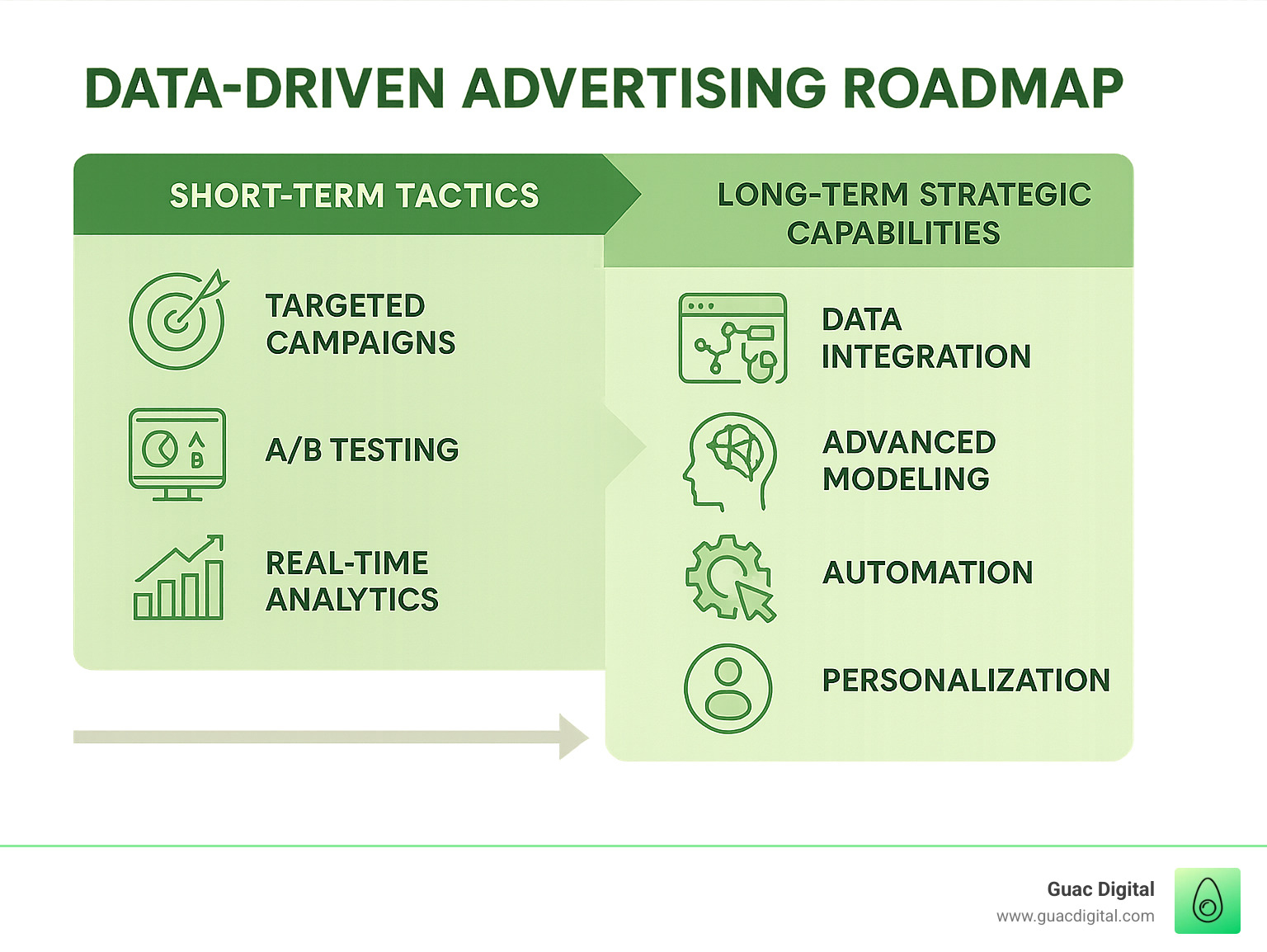
“Only companies with the right talent, tools, and infrastructure will survive the shift to data-driven advertising,” warns an industry analyst. At Guac Digital, we help clients develop roadmaps that balance immediate tactical needs with long-term strategic capabilities, ensuring they remain competitive in this rapidly evolving landscape.
Quick FAQ on big data advertising
Q: What is big data analytics for advertising?
A: Big data analytics for advertising is the process of collecting, processing, and analyzing large volumes of structured and unstructured data from multiple sources to optimize advertising targeting, creative, placement, and measurement.
Q: How does predictive targeting work?
A: Predictive targeting uses historical data and machine learning algorithms to forecast consumer behavior, allowing advertisers to identify and target individuals most likely to respond positively to specific messages.
Q: Is it possible to stay compliant and still personalize?
A: Yes, through privacy-by-design approaches like consent management, data minimization, anonymization, and emerging technologies such as federated learning and differential privacy.
Q: What’s the ROI of investing in big data analytics?
A: Studies consistently show 10-30% improvements in marketing performance, with some organizations reporting even higher returns through optimized targeting, reduced waste, and improved attribution.
Q: How can small businesses leverage big data without massive budgets?
A: Cloud-based platforms, self-service analytics tools, and agency partnerships make sophisticated analytics accessible to organizations of all sizes, with scalable pricing models based on usage.
Conclusion
The evolution of big data analytics for advertising has transformed marketing from an art to a science—but the most successful advertisers understand it’s actually both. Data provides the foundation, but creativity and strategic thinking remain essential for breakthrough results.
Throughout this guide, we’ve seen how data-driven advertising delivers remarkable benefits. When you harness the power of big data, you can target audiences with laser precision, create personalized experiences that resonate, optimize your media investments for maximum return, measure performance with confidence, and gain predictive insights that keep you one step ahead.
Of course, the journey isn’t without its challenges. Privacy regulations continue to evolve, third-party cookies are disappearing, data quality issues persist, and finding the right talent remains difficult. The technology landscape shifts constantly, requiring adaptability and continuous learning.
At Guac Digital, we’ve walked this path with clients across numerous industries, helping them steer these challenges while open uping extraordinary results. We’ve helped a healthcare provider increase new leads by 350%, delivered a 10X ROI improvement for a retail brand, boosted website traffic by 500% for a professional services firm, and doubled conversion rates for e-commerce clients.
What makes our approach different? We blend technical expertise with strategic marketing knowledge. Data without direction is just numbers—we turn those numbers into stories, strategies, and successes. Based in sunny Tampa, Florida, but serving clients worldwide, we specialize in creating custom digital campaigns that leverage the full potential of big data.
The future belongs to organizations that can effectively collect, analyze, and act on the vast amounts of data now available. By applying the principles and practices we’ve shared in this guide, you can position your business for success in this increasingly data-driven landscape.
Ready to transform your advertising strategy with the power of big data? Learn more about our services or reach out today to discuss how we can help your business achieve its marketing goals. Let’s turn your data into your competitive advantage.