
What Is Pay Per Click (PPC)? A Complete Guide to Understanding Modern Digital Advertising
Quick Answer
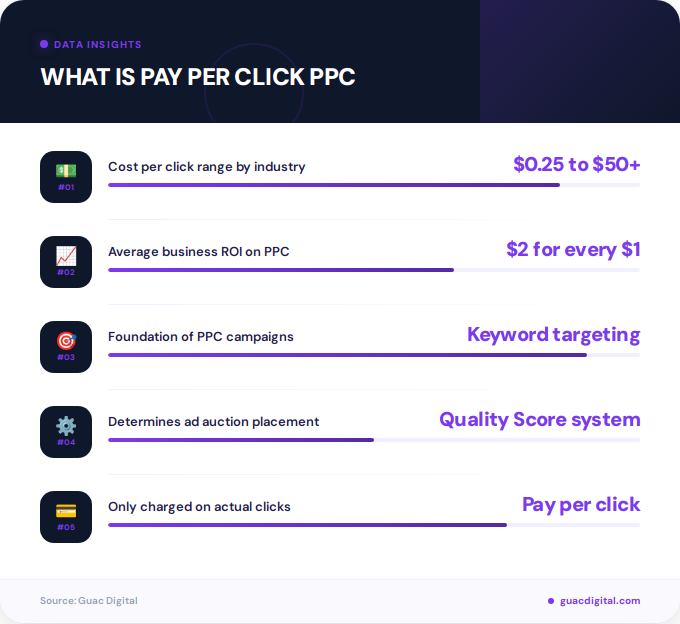
Pay per click (PPC) is an online advertising model where advertisers pay a fee each time someone clicks their ad, rather than paying for impressions. Unlike traditional advertising, PPC ensures you only pay for measurable engagement, with costs typically ranging from $0.25 to $50+ per click depending on industry competition and platform. This performance-based approach allows businesses to target specific keywords and audiences while maintaining full control over their advertising budget.
Did you know that businesses make an average of $2 for every $1 spent on PPC advertising? In today’s digital landscape, where consumers conduct billions of searches daily, understanding what is pay per click (PPC) has become essential for any business looking to capture immediate visibility and drive targeted traffic to their website.
As we move through 2026, digital marketing strategies continue to evolve, but PPC remains one of the most measurable and controllable forms of online advertising. Whether you’re a small business owner exploring digital marketing for the first time or an experienced marketer looking to refine your approach, this comprehensive guide will walk you through everything you need to know about PPC advertising.
What Is Pay Per Click Advertising?
Pay per click (PPC) is a digital advertising model where advertisers pay a fee each time a user clicks on their advertisement. Unlike traditional advertising methods like television commercials or billboards that charge based on impressions or views, PPC advertising charges only for direct engagement.
Think of it as buying visits to your website rather than earning them organically. When you run a PPC campaign, your ads appear on search engines, social media platforms, or other websites, and you only incur costs when someone actually clicks through to your landing page or website.
This performance-based model makes PPC one of the most accountable forms of marketing. You can track exactly how much you’re spending, how many people are clicking, and what actions they’re taking once they reach your site. This level of transparency allows businesses to calculate their return on investment (ROI) with precision that traditional advertising methods simply cannot match.
How Does PPC Work?
The mechanics of PPC advertising operate through a sophisticated auction system that determines which ads appear when users search for specific keywords or browse particular websites. Understanding this system is crucial for maximizing your advertising effectiveness.
Keyword targeting forms the foundation of most PPC campaigns. Advertisers select keywords relevant to their products or services, and when users search for those terms, eligible ads enter an instant auction. The auction winner gets their ad displayed on the search engine results page (SERP) or partner website.
The cost per click (CPC) is calculated using a straightforward formula: CPC ($) = Advertising Cost ($) / Number of Clicks (#). For example, if you spend $500 on a campaign that generates 250 clicks, your average CPC is $2.00.
However, the auction isn’t simply a matter of who bids the highest. Search engines like Google use a Quality Score system that evaluates your ad’s relevance, landing page experience, and expected click-through rate. An advertiser with a lower bid but higher Quality Score can often win placements over competitors with higher bids but less relevant ads.
This creates a meritocracy where quality and relevance matter as much as budget. The ad rank formula combines your maximum bid with your Quality Score to determine final placement, encouraging advertisers to create genuinely useful, targeted campaigns.

What Are the Different PPC Pricing Models?
While the core concept of paying per click remains consistent, PPC advertising actually encompasses several distinct pricing models. Understanding these variations helps you choose the right approach for your specific marketing goals.
Flat-Rate PPC Model
In the flat-rate model, advertisers and publishers agree on a fixed price for each click. This straightforward approach works well for businesses seeking predictable costs. The publisher typically maintains a rate card with different CPCs for various sections of their website, reflecting the value and traffic potential of each placement.
Publishers often offer discounted rates for high-volume or long-term contracts, making this model particularly attractive for businesses with consistent advertising needs and budgets.
Bid-Based PPC Model
The bid-based model powers most major advertising platforms, including Google Ads and Microsoft Advertising. Advertisers set a maximum bid, representing the highest amount they’re willing to pay per click. The actual CPC often comes in lower than the maximum bid, depending on competition and ad quality.
This dynamic auction system means costs fluctuate based on keyword popularity, competition levels, time of day, and seasonality. A keyword that costs $2 per click in January might climb to $5 in December as competition intensifies during the holiday shopping season.
Enhanced CPC and Automated Bidding
Modern PPC platforms offer advanced bidding strategies that use machine learning to optimize bids in real-time. Enhanced CPC automatically adjusts your manual bids based on the likelihood of conversion, while fully automated strategies like Target CPA (cost per acquisition) and Target ROAS (return on ad spend) let the algorithm manage all bid decisions.
These intelligent bidding strategies analyze countless signals to predict which clicks are most likely to convert, helping advertisers maximize their investment efficiency.
Which Platforms Offer PPC Advertising?
Multiple platforms offer PPC advertising opportunities, each with unique strengths, audience demographics, and cost structures. Selecting the right platform depends on your target audience, budget, and business objectives.
Google Ads (Search and Display)
Google Ads dominates the PPC landscape, processing over 8.5 billion searches daily. Search ads appear at the top and bottom of Google’s search results, while Display Network ads reach users across millions of partner websites. Google Shopping ads showcase product images and prices directly in search results, making them essential for e-commerce businesses.
The platform’s sophisticated targeting options let you reach users based on keywords, demographics, interests, locations, and even remarketing to previous website visitors.
Microsoft Advertising (Bing Ads)
While smaller than Google, Microsoft Advertising reaches approximately 13 billion monthly searches across Bing, Yahoo, and AOL. The platform typically offers lower average CPCs than Google, with less competition driving down costs. Microsoft’s audience tends to skew older and more affluent, making it valuable for certain industries like finance and insurance.
Social Media Advertising
Social media platforms offer PPC opportunities based on user behavior, interests, and demographics rather than search intent. Facebook and Instagram provide access to over 3 billion users globally, while LinkedIn specializes in B2B advertising with professional targeting options. TikTok has emerged as a powerful platform for reaching younger demographics with video-first creative.
These platforms excel at awareness and consideration-stage marketing, introducing products to users who may not be actively searching but fit your target customer profile.
Amazon Advertising
For e-commerce businesses, Amazon’s advertising platform places products directly in front of high-intent shoppers already in buying mode. Amazon’s advertising revenue exceeded $46 billion in 2024, reflecting the platform’s effectiveness at converting browsers into buyers.
What Are the Latest PPC Statistics and Benchmarks?
Understanding current PPC benchmarks and industry data helps you set realistic expectations and evaluate your campaign performance against competitive standards. The following data reflects 2025 actuals and 2026 projections based on Q2 2026 industry forecasts.
| Platform | Average CPC (2025) | High-Competition CPC |
|---|---|---|
| Google Search Ads | $1 to $3 | $10 to $50+ (legal, insurance) |
| Facebook/Instagram Ads | $0.50 to $2 | $2 to $5 (B2B) |
| LinkedIn Ads | $5 to $8 | $10+ (high-income B2B) |
| TikTok Ads | $0.50 to $1.50 | $2 to $4 |
Global PPC spending continues its upward trajectory, projected to reach $320 billion in 2026 and $385 billion by 2027, representing a 12% annual increase. This growth reflects businesses’ continued confidence in PPC’s ability to deliver measurable results.
Key performance benchmarks for 2026 include:
- Average click-through rate (CTR): A strong CTR typically exceeds 2%, while industry benchmarks range from 1.5% to 3% for search ads
- Conversion rates: PPC campaigns average 3.5% to 7% conversion rates, significantly outperforming organic search at 2.1%
- Cost per acquisition: Varies dramatically by industry, from $10 to $500+ depending on product value and sales cycle length
- Quality Score distribution: Most advertisers score between 5 and 7, with scores of 8+ indicating exceptional campaign optimization
Industry experts predict that AI-driven bidding strategies will account for over 75% of PPC spending by the end of 2026, as machine learning algorithms consistently outperform manual bid management in both efficiency and conversion optimization.
Why Should Businesses Use PPC Marketing?
PPC advertising offers numerous advantages that make it an essential component of modern digital marketing strategies. Understanding these benefits helps justify investment and set appropriate expectations for campaign performance.
Immediate Visibility and Traffic
Unlike SEO strategies that can take months to generate results, PPC campaigns can drive targeted traffic within hours of launch. Your ads appear immediately once approved, placing your business in front of potential customers actively searching for your products or services. This speed makes PPC ideal for promoting time-sensitive offers, launching new products, or testing market demand.
Precise Targeting Capabilities
PPC platforms offer unparalleled targeting precision. You can reach users based on search keywords, location (down to specific ZIP codes), device type, time of day, demographics, interests, behaviors, and even household income. This granular targeting ensures your advertising budget reaches the most relevant prospects.
Remarketing campaigns can specifically target users who previously visited your website but didn’t convert, keeping your brand top-of-mind as they continue their buying journey.
Complete Budget Control
PPC gives you total control over advertising spending. Set daily or monthly budgets, adjust bids by keyword or ad group, and pause campaigns instantly if needed. No minimum spending requirements mean businesses of any size can participate, scaling investment up or down based on performance and business needs.
The pay-per-click model ensures you only pay for actual engagement, not just eyeballs. If your ad appears but no one clicks, you owe nothing.
Measurable ROI and Performance Tracking
Every aspect of PPC campaigns is trackable and measurable. Analytics tools provide detailed insights into impressions, clicks, conversions, cost per conversion, and ROI. This transparency allows for continuous optimization based on hard data rather than guesswork.
Conversion tracking reveals which keywords and ads generate actual business results, enabling you to allocate budget to the highest-performing elements and eliminate waste.
Competitive Advantage and Market Intelligence
PPC provides valuable competitive intelligence. Auction insights reports show which competitors bid on the same keywords, while ad preview tools let you see competitor messaging and offers. This market intelligence informs both your PPC strategy and broader marketing decisions.
For new businesses or those entering new markets, PPC offers an immediate presence alongside established competitors, leveling the playing field in ways that organic search cannot match.
How to Create an Effective PPC Campaign Strategy
Success in PPC advertising requires strategic planning, meticulous execution, and ongoing optimization. Follow these essential steps to build campaigns that deliver results.
Define Clear Campaign Objectives
Start by establishing specific, measurable goals. Are you focused on generating leads, driving e-commerce sales, increasing brand awareness, or promoting a specific offer? Your objectives directly influence campaign structure, keyword selection, bidding strategies, and ad creative.
Different goals require different approaches. Brand awareness campaigns prioritize impressions and reach at lower costs, while direct response campaigns focus on conversions and ROI, accepting higher CPCs for qualified traffic.
Conduct Comprehensive Keyword Research
Keyword research forms the foundation of search-based PPC campaigns. Use tools like Google Keyword Planner, SEMrush, or Ahrefs to identify relevant keywords with appropriate search volume and manageable competition. Consider search intent carefully, distinguishing between informational, navigational, and transactional queries.
Organize keywords into tightly themed ad groups of 5 to 20 related terms. This structure allows for highly relevant ad copy and landing pages, improving Quality Score and campaign performance. Include a mix of broad, phrase, and exact match types to balance reach and precision.
Don’t neglect negative keywords, which prevent your ads from showing for irrelevant searches. A comprehensive negative keyword list protects your budget from wasted clicks and improves overall campaign efficiency.
Create Compelling Ad Copy
Effective PPC ads grab attention, communicate value, and compel action within strict character limits. Your headline should include the target keyword when possible, establishing immediate relevance. The description should highlight unique selling propositions, benefits, or offers that differentiate you from competitors.
Strong calls-to-action like “Get Started Today,” “Shop Now,” or “Request a Quote” drive click-through and set user expectations. Ad extensions (sitelinks, callouts, structured snippets) provide additional information and increase ad size, improving visibility and CTR.
Test multiple ad variations continuously, using A/B testing to identify which messaging resonates most effectively with your target audience.
Optimize Landing Pages for Conversion
Your landing page makes or breaks campaign success. The page must deliver on the promise made in your ad, with clear messaging, compelling benefits, and a streamlined conversion path. Message match between ad and landing page is critical for both user experience and Quality Score.
Optimized landing pages load quickly, display properly on mobile devices, and minimize distractions that could derail the conversion process. Every element should guide visitors toward your desired action.
Implement Conversion Tracking
Without conversion tracking, you’re flying blind. Install tracking pixels and set up conversion goals in your advertising platform to measure which keywords, ads, and campaigns generate actual business results. Track multiple conversion types (purchases, leads, phone calls, sign-ups) to understand the full customer journey.
Attribution modeling helps you understand how different touchpoints contribute to conversions, especially important for longer sales cycles where users may click multiple ads before converting.
Monitor, Test, and Optimize Continuously
PPC demands ongoing attention and optimization. Review performance data regularly, identifying trends, opportunities, and problems. Adjust bids based on performance, pause underperforming keywords, and allocate more budget to winners. Test new ad copy, landing page variations, and targeting options systematically.
Even successful campaigns benefit from continuous testing and refinement. Small improvements in CTR, conversion rate, or Quality Score compound over time, significantly impacting overall ROI.
What Is the Difference Between PPC and SEO?
Businesses often debate whether to invest in PPC, SEO, or both. Understanding the differences helps you allocate resources effectively and create complementary strategies.
| Factor | PPC | SEO |
|---|---|---|
| Timeline | Immediate results | 3 to 6 months minimum |
| Cost Structure | Pay per click | Ongoing effort, no per-click cost |
| Sustainability | Traffic stops when budget stops | Long-term, cumulative benefits |
| Testing Capability | Rapid testing and iteration | Slower feedback cycles |
PPC excels for immediate visibility, testing, and targeting precision. It’s ideal for time-sensitive campaigns, new product launches, or competitive keywords where organic ranking would take too long. The measurable nature of PPC makes it perfect for performance marketing focused on specific KPIs.
SEO builds sustainable, long-term visibility that doesn’t require ongoing per-click costs. Once you achieve strong organic rankings, you benefit from consistent traffic without direct spending, though maintaining rankings requires ongoing optimization and content creation.
Most successful digital marketing strategies integrate both channels. Use PPC for immediate results and testing while building SEO for long-term sustainability. Keywords that convert well in PPC campaigns make excellent SEO targets, while SEO research can identify valuable PPC opportunities.
Key Takeaways
- PPC is a performance-based advertising model where you pay only when users click your ads, making it one of the most measurable and controllable forms of marketing available
- Average costs range from $0.25 to $50+ per click depending on platform, industry, and competition, with global PPC spending projected to reach $385 billion by 2027
- Google Ads dominates the PPC landscape, but Facebook, LinkedIn, Microsoft Advertising, and TikTok offer valuable targeting opportunities for specific audiences and objectives
- PPC delivers immediate visibility and traffic, unlike SEO strategies that require months to generate results, making it ideal for time-sensitive campaigns and new product launches
- Success requires ongoing optimization including keyword research, ad copy testing, landing page refinement, and bid management based on performance data
- Quality Score impacts ad placement and costs, rewarding advertisers who create relevant, high-quality campaigns with better positions at lower CPCs
- Integration with SEO creates a comprehensive search strategy that balances immediate paid visibility with sustainable organic growth for maximum long-term impact
People Also Ask
How much should I budget for PPC advertising?
PPC budgets vary widely based on industry, competition, and goals, typically ranging from $500 to $50,000+ per month. Start with a modest budget to test campaigns and gather data, then scale investment based on performance and ROI. Most experts recommend budgeting enough for at least 100 to 200 clicks per keyword to gather meaningful performance data.
What is a good click-through rate for PPC ads?
A good CTR for search ads typically ranges from 2% to 5%, though this varies by industry and ad position. Brand name campaigns often achieve CTRs above 10%, while competitive generic keywords may see 1% to 3%. Focus on improving your CTR through compelling ad copy, relevant keywords, and ad extensions that increase visibility.
How long does it take to see results from PPC campaigns?
PPC campaigns can generate traffic and conversions within hours of launch, but meaningful optimization requires 2 to 4 weeks of data collection. Allow at least 30 days to gather sufficient performance data for informed decision-making. Continuous optimization over 3 to 6 months typically delivers the best long-term results as you refine targeting, messaging, and bidding strategies.
Can small businesses compete with large companies in PPC?
Yes, small businesses can effectively compete through strategic targeting, higher Quality Scores, and focusing on niche keywords with less competition. Google’s auction system rewards relevance and ad quality, not just budget size. Small businesses often succeed by targeting long-tail keywords, specific geographic areas, and niche audiences that larger competitors overlook.
What is Quality Score and why does it matter?
Quality Score is Google’s rating of your ad relevance, landing page experience, and expected CTR on a scale of 1 to 10. Higher Quality Scores lead to better ad positions at lower costs because Google rewards advertisers who provide valuable, relevant experiences. Improving Quality Score from 5 to 8 can reduce your CPC by 20% to 50% while improving ad placement.
Should I manage PPC campaigns myself or hire an expert?
The decision depends on your budget, time availability, and expertise level. Small businesses with limited budgets can start managing campaigns themselves using platform tools and educational resources. However, experienced PPC professionals or agencies typically deliver better results through advanced strategies, ongoing optimization, and avoiding costly mistakes that consume budget without returns.
Frequently Asked Questions
What is the difference between CPC and PPC?+
PPC (pay per click) is the advertising model where you pay when someone clicks your ad, while CPC (cost per click) is the actual amount you pay for each click. PPC describes the overall strategy, and CPC is the metric measuring the cost. For example, you might run a PPC campaign with an average CPC of $2.50.
Do PPC ads work on mobile devices?+
Yes, PPC ads are fully optimized for mobile devices, with most platforms showing mobile-specific ad formats. In fact, over 60% of Google searches now occur on mobile devices. You can adjust bids specifically for mobile traffic and create mobile-preferred ads with click-to-call extensions that let users contact you directly from the ad.
What happens if I run out of PPC budget mid-month?+
When your daily or monthly budget limit is reached, your ads simply stop showing until the next day or billing period. You won’t be charged beyond your budget limits. Most platforms offer budget pacing to distribute spending evenly throughout the day, preventing your entire daily budget from depleting in the first few hours.
Can I target competitors’ brand names in PPC campaigns?+
You can typically bid on competitor brand names as keywords, though policies vary by platform and jurisdiction. However, you generally cannot use competitor trademarks in your ad copy without permission. This strategy can be effective but requires careful execution to avoid legal issues and ensure your ads remain relevant and compliant with platform policies.
How do I prevent click fraud in PPC campaigns?+
Major platforms like Google Ads have sophisticated click fraud detection systems that automatically filter invalid clicks and issue refunds when fraud is detected. You can also monitor your campaigns for suspicious activity like unusual click patterns, high bounce rates from specific IPs, or traffic from irrelevant geographic locations. Third-party click fraud protection services provide additional monitoring and protection for high-budget campaigns.
What is remarketing and how does it work with PPC?+
Remarketing (or retargeting) shows ads to users who previously visited your website but didn’t convert. It works by placing a tracking pixel on your site that adds visitors to remarketing audiences. You can then create specific PPC campaigns targeting these audiences with tailored messaging, typically achieving higher conversion rates since you’re reaching people already familiar with your brand.
How often should I optimize my PPC campaigns?+
Review campaign performance at least weekly, making minor adjustments to bids, budgets, and ad scheduling as needed. Conduct more thorough optimization monthly, analyzing keyword performance, testing new ad copy, refining targeting, and adjusting strategy based on conversion data. Avoid making too many changes too quickly, as this prevents you from accurately assessing what’s working and what isn’t.
Further reading: Campaign Management: A Complete Guide to Running High-Performing Ad Campaigns
Further reading: How to Choose a PPC Agency: The Complete 2026 Buyer’s Guide
Further reading: Integrated Digital Marketing Strategy: The Complete 2026 Framework for Coordinated Growth