
Website Conversion Rate Optimization Services: The Complete 2026 Guide to Transforming Your Digital Revenue
Quick Answer
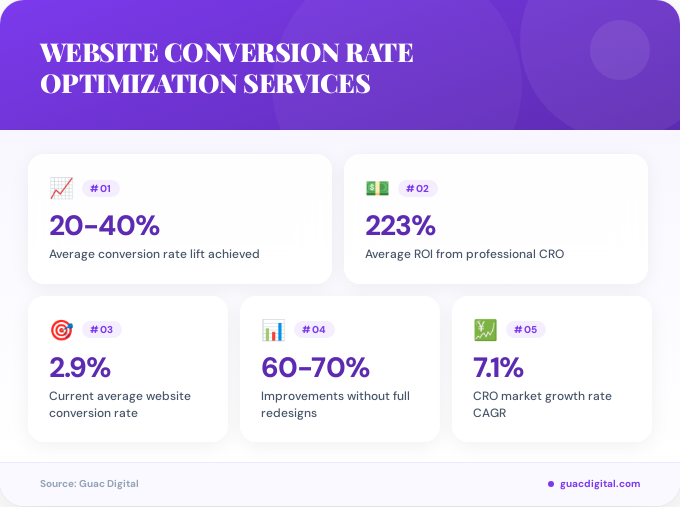
Website conversion rate optimization services help businesses achieve 20 to 40% conversion lifts by strategically refining copy, CTAs, forms, and trust signals without requiring full site redesigns. These specialized agencies use data-driven testing methodologies to increase the percentage of visitors who take desired actions, with businesses typically seeing a 223% average return on investment from professional CRO services.
In 2026, the average website converts only 2.9% of its visitors into customers, paying leads, or subscribers. That means 97.1% of your traffic is leaving without taking action. What if you could flip those numbers?
Website conversion rate optimization services are rapidly becoming essential business investments rather than optional upgrades. The global CRO services market reached USD 1,522 million in 2026 and is projected to grow to USD 2,279 million by 2034, expanding at a 7.1% CAGR. This growth reflects businesses recognizing that conversion rate optimization delivers more revenue from existing traffic without increasing ad spend.
The transformation happens faster than most business owners expect. Strategic optimization delivers 60 to 70% of conversion improvements without full redesigns, targeting the crucial 20% of site elements that drive 80% of results. Whether you’re running an ecommerce platform, a SaaS business, or a professional services firm, understanding website conversion rate optimization services is critical to staying competitive in 2026.
What Are Website Conversion Rate Optimization Services?
Website conversion rate optimization services are specialized consulting and implementation offerings that systematically improve the percentage of website visitors who complete desired actions. These actions range from purchases and form submissions to email signups and demo requests.
Unlike traditional web design that focuses on aesthetics, CRO services use data-driven methodologies to identify friction points and opportunities. Professional agencies employ research, testing, analytics interpretation, and strategic implementation to increase conversions without requiring additional traffic.
The core difference between DIY optimization and professional services lies in expertise, methodology, and resources. CRO agencies bring proven frameworks for conversion improvement developed across hundreds of client projects, eliminating costly trial-and-error cycles.
How Do Conversion Rate Optimization Services Work?
Professional website conversion rate optimization services follow a structured, repeatable process that transforms underperforming pages into revenue-generating assets. The methodology typically includes five critical phases.
Phase 1: Research and Analysis begins with comprehensive data gathering. Agencies analyze quantitative metrics (Google Analytics, heatmaps, session recordings) and qualitative insights (user surveys, customer interviews, usability testing). This dual-lens approach identifies both what users do and why they do it.
Phase 2: Hypothesis Development translates research findings into testable theories. Teams prioritize optimization opportunities using frameworks like ICE (Impact, Confidence, Ease) or PIE (Potential, Importance, Ease), focusing resources on high-impact changes first.
Phase 3: Test Design and Implementation involves creating variations of page elements using conversion optimization tools such as VWO, Optimizely, or Google Optimize. Tests range from simple A/B comparisons to multivariate experiments testing multiple variables simultaneously.
Phase 4: Statistical Analysis ensures results are valid and significant. Professional services understand sample sizes, confidence intervals, and statistical significance, preventing premature conclusions that lead to poor decisions.
Phase 5: Implementation and Iteration rolls out winning variations permanently and documents learnings. The process repeats continuously, creating compounding improvements over time.

What Results Can You Expect from Website Conversion Rate Optimization Services?
Professional website conversion rate optimization services consistently deliver measurable improvements across key performance metrics. Based on 2026 industry data, businesses working with CRO specialists typically achieve 20 to 40% conversion lifts through strategic refinements to copy, calls-to-action, forms, and trust signals.
The financial impact extends beyond conversion rates. Businesses using CRO services report an average 223% return on investment, making optimization one of the highest-ROI marketing activities available. This ROI compounds over time as continuous testing builds institutional knowledge and performance benchmarks.
For ecommerce websites, a conversion rate improvement from 2% to 3% represents a 50% increase in revenue from the same traffic levels. For businesses spending significantly on paid advertising, this translates to dramatically improved customer acquisition costs without reducing ad budgets.
Timeline expectations matter. Initial results often appear within 4 to 8 weeks as quick-win optimizations go live. Sustainable, compounding improvements require 6 to 12 months of continuous testing and refinement. The most successful programs treat CRO as an ongoing capability rather than a one-time project.
What Are the Current Conversion Rate Benchmarks by Industry?
Understanding industry-specific conversion benchmarks helps businesses evaluate their current performance and set realistic improvement targets. The cross-industry median landing page conversion rate stands at 6.6% based on Unbounce’s analysis of 41,000 pages and 464 million pageviews in 2026.
However, conversion rate statistics vary significantly by industry and traffic source. Ruler Analytics reports a lower overall average of 2.9% across industries, with direct traffic converting at 3.3% and paid search at 3.2%.
| Industry | Median Conversion Rate | Top 25% Threshold |
|---|---|---|
| Events/Entertainment | 12.3% | 40.8%+ |
| Education | 8.4% | 15.2%+ |
| Financial Services/Insurance | 8.3% | 14.5%+ |
| Health & Wellness | 5.1% | 11.4%+ |
| Travel/Hospitality | 4.8% | 10.2%+ |
| Professional Services | 4.6% | 9.8%+ |
| Ecommerce | 4.2% | 9.1%+ |
| SaaS | 3.8% | 8.5%+ |
| Healthcare | 3.0% | 6.8%+ |
| B2B Ecommerce | 1.8% | 4.2%+ |
Channel performance also significantly impacts conversion rates. Email marketing remains the highest-performing channel at 19.3%, converting substantially better than paid search or social media. Lead generation landing pages average 11.9%, demonstrating that targeted, single-purpose pages outperform general website pages.
Device considerations reveal critical optimization gaps. While 82.9% of landing page visits come from mobile devices, desktop converts approximately 8% more efficiently. This mobile conversion gap represents one of the most significant opportunities for website conversion rate optimization services in 2026.
Why Should You Hire Professional Website Conversion Rate Optimization Services?
The decision to hire professional website conversion rate optimization services versus attempting in-house optimization hinges on expertise, resources, and opportunity cost. Professional agencies bring specialized skills that most internal teams lack.
Technical Expertise: CRO specialists understand statistical significance, test design, behavioral psychology, and emerging conversion optimization trends. They avoid common mistakes like ending tests too early, testing too many variables simultaneously, or misinterpreting data.
Cross-Industry Insights: Agencies working with multiple clients across industries identify patterns and best practices that single-business teams miss. They bring battle-tested frameworks rather than starting from scratch.
Dedicated Focus: Internal marketing teams juggle multiple priorities. Professional services dedicate focused time to continuous testing and refinement, creating velocity that part-time efforts cannot match.
Tool Access and Expertise: Enterprise-grade testing platforms cost $5,000 to $50,000+ annually. Agencies spread these costs across clients while maintaining expertise in multiple platforms, selecting the optimal tool for each situation.
Objective Perspective: External consultants challenge assumptions and sacred cows that internal teams cannot question. This objectivity often uncovers issues hiding in plain sight.
The most successful businesses combine internal ownership with external expertise, treating CRO agencies as strategic partners rather than vendors.
How Much Do Website Conversion Rate Optimization Services Cost?
Investment in website conversion rate optimization services varies significantly based on engagement scope, business complexity, traffic volume, and provider expertise. Pricing structures typically fall into three models: project-based, retainer-based, and performance-based arrangements.
Project-Based Engagements focus on specific optimization initiatives such as checkout funnel improvement or homepage redesign. These typically range from $10,000 to $75,000+ depending on project complexity, number of pages optimized, and testing duration.
Monthly Retainer Programs provide ongoing optimization services with continuous testing cycles. Retainers generally range from $5,000 to $50,000+ per month, with pricing influenced by traffic volume, number of simultaneous tests, and strategic depth. High-growth companies often invest $15,000 to $30,000 monthly for comprehensive programs.
Performance-Based Models align agency compensation with results, charging based on revenue lifts or conversion improvements. These arrangements require sophisticated attribution and often include base fees plus performance bonuses.
Pricing varies based on several key factors:
- Traffic Volume: Higher traffic sites enable faster testing cycles but require more sophisticated analysis
- Technical Complexity: Custom platforms, multiple integrations, and legacy systems increase implementation costs
- Industry Vertical: Regulated industries like finance or healthcare require specialized compliance knowledge
- Strategic Scope: Comprehensive programs including research, design, development, and analytics cost more than testing-only services
When evaluating proposals, focus on value rather than cost alone. A $20,000 monthly investment that generates $150,000 in additional revenue delivers exceptional ROI regardless of whether competitors charge less. The right CRO partner pays for themselves many times over through sustained performance improvements.
Most agencies offer custom quotes based on specific business needs rather than standardized packages. Contact qualified providers with detailed information about your traffic, conversion goals, and current performance to receive accurate pricing tailored to your situation.
What Are the Top CRO Trends for 2026 and Beyond?
Website conversion rate optimization services are evolving rapidly in response to technological advances and changing user behaviors. Several dominant trends are reshaping the CRO landscape in 2026 and will continue influencing strategies through 2027.
AI-Powered Personalization represents the most significant shift in optimization methodology. Modern CRO platforms use artificial intelligence to deliver individualized experiences based on visitor behavior, demographics, and intent signals. Rather than showing all visitors identical experiences, AI-powered optimization tools adapt messaging, offers, and layouts in real-time to match each visitor’s needs.
Voice and AI Search Optimization has become critical as conversational interfaces proliferate. Content must answer direct, high-intent queries while maintaining natural language that voice assistants can parse and deliver. This trend connects CRO with broader AI and SEO strategies.
Zero-Party Data and Privacy-First Optimization addresses growing privacy concerns and third-party cookie deprecation. Leading agencies now emphasize user research, surveys, and explicit preference collection over behavioral tracking. This shift requires more sophisticated research methodologies but builds stronger customer trust.
Measurement and Data Quality Investments have become priorities as businesses recognize that poor data leads to poor decisions. Modern CRO programs emphasize analytics audits, proper event tracking, and data governance before launching optimization initiatives.
Micro-Moment Optimization focuses on specific decision points in customer journeys rather than broad page improvements. Services identify critical moments where users make go/no-go decisions and optimize these friction points specifically.
Holistic Experience Optimization will define 2027 strategies. Rather than isolated landing page tests, successful programs optimize entire customer journeys across channels, devices, and touchpoints. This requires coordination between marketing, product, and customer success teams.
Content-Led CRO recognizes that compelling, helpful content drives conversions more effectively than aggressive sales tactics in an AI-saturated market. The focus shifts to answering real customer questions comprehensively rather than manipulating users through dark patterns.
How Do You Choose the Right CRO Service Provider?
Selecting the optimal website conversion rate optimization services provider requires evaluating expertise, methodology, cultural fit, and track record. The wrong choice wastes budget and opportunity, while the right partner transforms business performance.
Evaluate Industry Experience: Seek providers with demonstrated success in your specific vertical. A conversion-optimized website for SaaS differs fundamentally from ecommerce or professional services optimization. Request case studies and references from businesses similar to yours.
Assess Methodology Rigor: Quality providers follow structured, research-driven processes rather than implementing hunches. Ask detailed questions about their research methods, hypothesis development frameworks, test design approaches, and statistical analysis standards.
Verify Technical Capabilities: Ensure the agency has expertise with your technology stack, testing platforms, and analytics tools. Technical implementation bottlenecks derail even well-designed optimization programs.
Review Team Composition: Effective CRO requires diverse skill sets including researchers, analysts, copywriters, designers, developers, and strategists. Understand who will actually work on your account versus who sells the engagement.
Examine Communication Practices: Regular, transparent reporting separates professional services from vendors. Clarify reporting frequency, formats, and stakeholder access during the selection process.
Understand Pricing Models: Compare proposals on value delivered rather than hourly rates. Lower-cost providers often deliver lower-quality work, requiring rework that increases total cost. Premium agencies justify higher pricing through superior results and efficiency.
Check Cultural Alignment: The most successful engagements involve true partnership with aligned values and communication styles. Assess whether the provider treats you as a strategic partner or transactional client.
Request Pilot Programs: Many leading agencies offer limited-scope pilot engagements to demonstrate capabilities before committing to long-term contracts. These trials reduce risk while establishing working relationships.
The right team combines technical excellence with business understanding, treating your success as their primary metric rather than simply executing tests.
Key Takeaways
- Website conversion rate optimization services deliver 20 to 40% conversion improvements through strategic refinements without requiring full site redesigns, focusing on the 20% of elements that drive 80% of results
- The global CRO services market reached USD 1,522 million in 2026 and will grow to USD 2,279 million by 2034, reflecting widespread recognition of CRO’s business impact
- Professional services generate an average 223% ROI, making conversion optimization one of the highest-return marketing investments available
- Industry benchmarks vary dramatically, from 1.8% for B2B ecommerce to 12.3% for events/entertainment, making industry-specific comparison essential for realistic goal-setting
- Email converts at 19.3% while paid search converts at 3.2%, demonstrating significant channel performance differences that inform optimization priorities
- Mobile captures 82.9% of traffic but desktop converts 8% better, representing one of the most significant optimization opportunities in 2026
- AI-powered personalization and zero-party data strategies dominate 2026 trends, with holistic experience optimization defining successful 2027 programs
People Also Ask
What is a good conversion rate for my website?
A good conversion rate varies by industry, but the cross-industry median is 6.6% for landing pages. To be in the top 25% of performers, aim for 11.4% or higher, though high-intent industries like events and entertainment can exceed 40%.
How long does it take to see results from CRO services?
Initial results typically appear within 4 to 8 weeks as quick-win optimizations are implemented. Sustainable, compounding improvements require 6 to 12 months of continuous testing. The best programs treat CRO as an ongoing capability rather than a one-time project.
Do I need high traffic to benefit from CRO services?
While higher traffic enables faster testing cycles, even lower-traffic sites benefit from research-driven optimization and best practices implementation. Professional services can optimize user experience, messaging, and design elements that improve conversions regardless of volume, though statistical testing requires minimum traffic thresholds.
What’s the difference between CRO and web design?
Web design focuses on aesthetics, brand expression, and overall user interface, while CRO specifically targets measurable conversion improvements through data-driven testing. CRO uses research, analytics, and experimentation to systematically increase the percentage of visitors who take desired actions, making it performance-focused rather than design-focused.
Can I do conversion rate optimization in-house?
In-house CRO is possible but requires specialized skills in research methodology, statistical analysis, behavioral psychology, and technical implementation. Most businesses achieve better results combining internal ownership with external expertise from agencies that bring cross-industry insights and dedicated focus.
What elements should I optimize first?
Start with high-traffic, high-impact pages like homepages, product pages, checkout flows, and lead capture forms. Focus on elements that directly influence conversion decisions: headlines, value propositions, calls-to-action, trust signals, and friction points in forms or checkout processes.
Frequently Asked Questions
What types of businesses benefit most from website conversion rate optimization services?+
All digital businesses benefit from CRO services, but ecommerce sites, SaaS companies, lead generation businesses, and professional services firms see particularly strong returns. Companies spending significantly on paid advertising gain immediate value by converting more of their existing traffic rather than increasing ad spend.
How do website conversion rate optimization services measure success?+
Success metrics include conversion rate improvements, revenue per visitor increases, customer acquisition cost reductions, and overall ROI. Professional services establish baseline metrics, track test performance with statistical significance, and measure business impact through revenue attribution and customer lifetime value analysis.
What’s the difference between A/B testing and full CRO services?+
A/B testing is one tactic within comprehensive CRO services. Full optimization programs include research (quantitative and qualitative), strategic hypothesis development, test design and implementation, multivariate experiments, personalization, analytics interpretation, and continuous iteration. A/B testing alone without research and strategy rarely delivers optimal results.
How does mobile optimization fit into CRO services?+
Mobile optimization is critical since 82.9% of traffic comes from mobile devices, yet desktop converts 8% better on average. Professional CRO services specifically address mobile friction points including page speed, form usability, navigation simplicity, and touch-target sizing. Device-specific testing often reveals dramatically different optimization opportunities.
What tools do professional CRO services use?+
Professional agencies use enterprise platforms like VWO, Optimizely, Google Optimize, and AB Tasty for testing, alongside analytics tools (Google Analytics, Adobe Analytics), heatmap software (Hotjar, Crazy Egg), session recording tools (FullStory, LogRocket), and user testing platforms (UserTesting, Maze). Tool selection depends on specific business needs and technical requirements.
Can CRO services help with SEO performance?+
Yes, CRO and SEO work synergistically. Improved user experience signals (lower bounce rates, higher engagement, longer session duration) positively influence search rankings. CRO services often improve page speed, mobile usability, and content relevance, all of which are ranking factors. The combination maximizes both traffic acquisition and conversion efficiency.
What deliverables should I expect from a CRO engagement?+
Related: What Is a Conversion Rate Optimization Audit and How Can It Transform Your Revenue in 2026?
Typical deliverables include research reports and user insights, prioritized optimization roadmaps, test designs and hypotheses, implemented variations and experiments, performance dashboards and analytics reports, winning variation documentation, and strategic recommendations for ongoing optimization. Quality agencies provide transparent reporting with actionable insights rather than just raw data.
Further reading: Local SEO Services: The Complete 2026 Guide to Ranking, Reviews, and Revenue