
What Is a Conversion Rate Optimization Agency and How Can They Transform Your Business in 2026?
Quick Answer
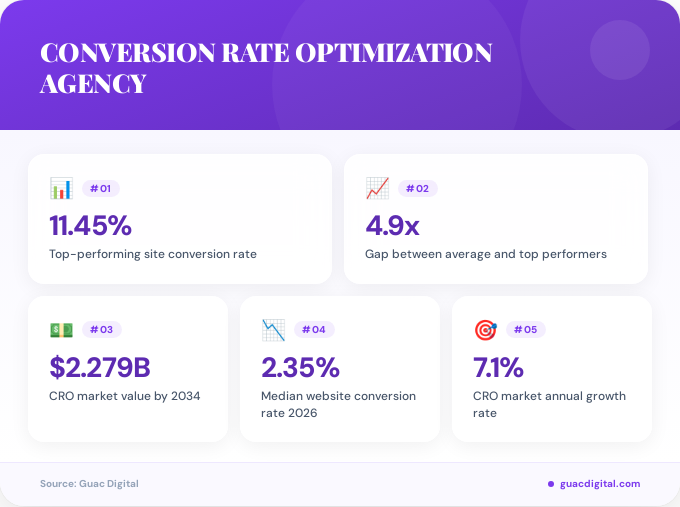
A conversion rate optimization agency specializes in increasing the percentage of website visitors who take desired actions, such as making purchases or submitting lead forms. In 2026, top-performing sites achieve conversion rates of 11.45%, nearly five times higher than the median 2.35%, with agencies leveraging AI-assisted testing, channel-specific strategies, and rigorous measurement disciplines to bridge this performance gap.
Here’s a sobering reality: your competitors who invest in conversion rate optimization are pulling away from you at an accelerating pace. Data from 2026 shows that the gap between average and top-performing websites has widened to nearly 4.9x, with median conversion rates at 2.35% while top performers reach 11.45%. Even more revealing, top quartile sites improved by 0.47 percentage points year-over-year, while bottom quartile sites actually declined by 0.11 points.
This compounding advantage explains why more businesses are turning to specialized conversion rate optimization agencies. These expert teams don’t just make your website look better; they systematically transform how your digital properties convert visitors into customers, subscribers, or leads. With the CRO services market projected to reach $2.279 billion by 2034, representing a 7.1% CAGR, the industry is responding to an undeniable business need.
What Is a Conversion Rate Optimization Agency?
A conversion rate optimization agency is a specialized firm that uses data analysis, user research, and systematic testing to increase the percentage of website visitors who complete valuable actions. Unlike general marketing agencies, CRO specialists focus exclusively on maximizing the return from traffic you already have, rather than simply driving more visitors.
These agencies combine multiple disciplines including behavioral psychology, data analytics, user experience design, and statistical testing. Their goal is straightforward: help you get more value from every visitor, whether that means more sales, more qualified leads, or more engaged users. According to recent conversion rate benchmarks, the methodology matters significantly, as different testing approaches yield vastly different results.
The best conversion rate optimization agencies distinguish themselves through rigorous measurement discipline. In 2026, poor data quality has become one of the biggest obstacles to effective optimization, with measurement issues distorting testing results and prioritization decisions. Top agencies now dedicate substantial resources to ensuring tracking accuracy before running any experiments.
What Are Current Conversion Rate Benchmarks in 2026?
Understanding where your conversion rates stand relative to benchmarks is essential for setting realistic optimization goals. However, the picture is more nuanced than a single number suggests. Overall website conversion rates differ dramatically from landing page performance, and both vary significantly by industry, channel, and device.
For general websites, the median conversion rate sits at 2.35% in 2026, representing a modest 0.18 percentage point increase from 2025. However, this median masks enormous variation. Sites in the top quartile convert at much higher rates, and the very best performers reach 11.45%, demonstrating what’s possible with dedicated optimization efforts.
Landing pages tell a different story. Analysis of 41,000 landing pages generating 464 million pageviews and 57 million conversions reveals an average conversion rate of 6.6%. This higher baseline reflects the focused nature of landing pages compared to full websites with multiple navigation paths and competing calls-to-action.
The year-over-year trend data reveals something particularly important: optimization advantages compound. Top quartile sites improved by 0.47 percentage points while bottom quartile sites declined by 0.11 points, creating a widening performance gap. This suggests that businesses either commit to systematic optimization or fall increasingly behind competitors who do.

How Do Conversion Rates Differ By Industry?
Industry context dramatically affects what constitutes a good conversion rate. A 3% conversion rate might be exceptional in some verticals while concerning in others. Understanding these benchmarks helps agencies set appropriate goals and identify realistic improvement targets based on industry-specific CRO trends.
| Industry | Average Conversion Rate | Performance Context |
|---|---|---|
| SaaS | 3.8% | Lower due to longer sales cycles and complex evaluation |
| Ecommerce | 4.2% | Varies significantly by product category and price point |
| Health & Wellness | 5.1% | Strong intent drives above-average performance |
| Professional Services | 6.1% | High trust requirements balanced by strong consideration |
| Financial Services | 8.3% | Competitive rates due to high visitor intent |
| Education | 8.4% | Strong performance from targeted program seekers |
| Events & Entertainment | 12.3% | Highest rates due to time-sensitive offers and strong intent |
Ecommerce deserves special attention given its importance. While landing page benchmarks show 4.2% conversion rates, full-site ecommerce performance typically runs lower: B2B ecommerce averages 1.8% while B2C sites average 2.1%. This reflects the complexity of the purchase journey across multiple pages, categories, and decision points.
A specialized conversion rate optimization agency uses these benchmarks not as targets but as diagnostic tools. If your SaaS landing page converts at 1.5% against an industry average of 3.8%, that gap represents a concrete opportunity. The agency can then investigate whether messaging, offer structure, trust signals, or technical friction explains the underperformance.
Why Do Channel and Device Matter for Conversion Rates?
Not all traffic converts equally. The source of your visitors and the devices they use create dramatic performance variations that sophisticated conversion rate optimization agencies account for in their strategies. Treating all traffic the same leads to suboptimal results and missed opportunities.
Channel performance shows remarkable differences. Email marketing achieves the highest conversion rates, with some sources reporting 19.3% conversion from email traffic, reflecting the warm, engaged nature of subscribers. Meanwhile, paid social averages just 0.9% for B2B and 2.1% for B2C, highlighting the challenge of converting discovery-phase audiences.
B2B: 2.6%
Strong intent, solid baseline performance
B2B: 1.5%
Lower rates despite targeted keywords
B2B: 0.9%
Awareness-stage traffic requires nurturing
B2B: 2.4%
Highest-quality, most engaged audience
An emerging trend in 2026 is the strong performance of AI search referral traffic, which converts 22% higher than traditional organic at 3.49% versus 2.86%. This reflects the more intentional nature of AI search queries and the pre-qualified recommendations these platforms provide. Forward-thinking agencies are now optimizing specifically for AI search citation and referral.
Device performance presents another critical dimension. While mobile accounts for 82.9% of landing page visits, desktop traffic converts approximately 8% more efficiently. More granular data shows desktop conversion at 5.06% versus mobile at 2.49%, a substantial gap that requires device-specific optimization strategies.
Leading conversion rate optimization agencies address this by creating channel-specific landing pages rather than sending all traffic to generic pages. They also implement mobile-first design principles while recognizing that high-value conversions still skew toward desktop, requiring excellence across both experiences.
What Services Do Conversion Rate Optimization Agencies Provide?
Modern conversion rate optimization agencies offer far more than simple A/B testing. The services have evolved into a comprehensive discipline combining quantitative testing with qualitative research, technical implementation, and strategic guidance. Understanding the full service stack helps businesses evaluate potential agency partners.
Core services typically include comprehensive conversion audits that identify friction points, trust gaps, and messaging disconnects across the customer journey. These audits leverage multiple research methodologies: heatmaps and session recordings to understand behavior, user surveys and interviews to capture intent, and analytics analysis to identify drop-off points. Many agencies now integrate conversion rate optimization tools that provide real-time behavioral insights.
Hypothesis development and test prioritization represent critical agency capabilities. Rather than randomly testing elements, sophisticated agencies build frameworks that prioritize experiments based on potential impact, implementation complexity, and statistical requirements. This systematic approach ensures testing budgets deliver maximum return.
The actual testing execution includes both A/B and multivariate testing, with agencies managing test design, implementation, quality assurance, statistical analysis, and interpretation. In 2026, AI-assisted testing platforms have accelerated iteration speed, but human expertise remains essential for identifying what to test and why.
Qualitative research services have become increasingly central to CRO success. Agencies conduct user interviews, facilitate usability studies, analyze support tickets and sales calls, and map customer journeys. This qualitative layer prevents the common mistake of optimizing in isolation from actual user needs and objections. Understanding what is conversion optimization in digital marketing helps contextualize these services within broader marketing strategies.
Many full-service agencies also provide UX design and copywriting, creating the actual test variations rather than just running experiments on client-created assets. This integrated approach ensures that hypotheses translate into well-executed treatments that genuinely test the underlying question.
What Are the Key CRO Market Trends in 2026?
The conversion rate optimization industry is evolving rapidly in 2026, driven by technological advances, changing consumer behavior, and growing business recognition of optimization’s compounding returns. Understanding these trends helps businesses align with current best practices and anticipate where the discipline is heading.
AI-assisted testing and personalization have moved from experimental to mainstream. Agencies now routinely deploy machine learning models that predict which visitors are most likely to convert, automatically adjust messaging based on behavioral signals, and identify non-obvious patterns in conversion data. However, the most effective agencies combine AI capabilities with human strategic thinking rather than relying on automation alone.
Measurement quality has become a core competency. Poor tracking implementation, bot traffic, and attribution confusion have plagued optimization efforts for years. In 2026, leading agencies dedicate substantial resources to data quality, often conducting tracking audits before accepting new clients. The recognition that bad data leads to misleading tests has elevated measurement from a technical concern to a strategic priority.
Channel-specific landing pages and optimization reflect the reality that different traffic sources require different experiences. Rather than optimizing a single homepage or product page, sophisticated programs now create tailored experiences for SEO visitors, paid search clickers, social referrals, and email subscribers. This approach acknowledges the different intent levels and prior context each channel represents, similar to strategies used by PPC advertising agencies for campaign-specific landing pages.
The market itself shows strong growth signals. One forecast values the CRO software market at $5.07 billion by 2026, up from $3.01 billion in 2019. A separate analysis projects the conversion rate optimization services market at $1.522 billion in 2026, rising to $2.279 billion by 2034 at a 7.1% CAGR. These figures from conversion rate optimization services market research reflect growing business recognition that optimization delivers measurable ROI.
Integration with broader marketing strategy represents another significant shift. Where CRO was once treated as a separate discipline, leading agencies now work closely with SEO teams, content marketers, paid media specialists, and even product teams. This integration reflects the understanding that conversion happens across touchpoints, not just on landing pages. Similar to how AI is transforming search optimization, these tools are reshaping conversion strategies.
How Do You Choose the Right Conversion Rate Optimization Agency?
Selecting the right conversion rate optimization agency requires evaluating capabilities beyond their website and case studies. The wrong choice wastes budget and opportunity; the right partner can transform your business performance. Several key factors distinguish truly effective agencies from those with impressive presentations but limited results.
Methodological rigor should top your evaluation criteria. Ask detailed questions about their testing approach: How do they calculate required sample sizes? What statistical significance thresholds do they use? How do they handle seasonality and external factors? How do they prioritize which tests to run? Agencies with loose methodologies generate misleading results that can actually harm performance if you implement losing variations.
Industry experience and specialization matter significantly. An agency with deep ecommerce experience may struggle with B2B SaaS, where longer sales cycles and different decision-making processes require different optimization strategies. Look for agencies that have worked with businesses similar to yours, not just in industry but also in business model, deal size, and sales complexity.
Research capabilities beyond testing separate sophisticated agencies from those that simply run A/B tests. Ask about their qualitative research methods: Do they conduct user interviews? How do they analyze session recordings? What frameworks do they use for customer research? The best insights often come from understanding why visitors behave as they do, not just what they do.
Communication and collaboration style affects program success as much as technical capabilities. You want an agency that explains their reasoning, shares insights generously, and treats you as a partner rather than simply executing tests in isolation. Ask about reporting frequency, communication channels, and how they involve client teams in hypothesis development and result interpretation.
Realistic expectations and honest assessment indicate agency integrity. Be wary of agencies promising specific lift percentages or guaranteeing results. Legitimate agencies discuss probability, iteration, and learning rather than certainty. They should be able to explain that some tests will lose, that meaningful improvement takes time, and that your specific situation may limit what’s achievable.
Technical implementation capabilities matter especially for complex sites. Can they work within your CMS and testing platform? Do they understand your technical constraints? Can they implement tests without causing site speed issues or breaking functionality? Technical fumbles waste time and can damage user experience. When evaluating agencies, consider the same thoroughness you’d use when to hire a PPC agency.
What Does a Conversion Rate Optimization Agency Cost?
Conversion rate optimization agency pricing varies widely based on scope, your site complexity, traffic volume, technical requirements, and the depth of research and testing involved. Understanding the pricing landscape helps you budget appropriately and recognize when proposals seem unrealistic in either direction.
Most agencies structure pricing in one of three ways: monthly retainers, project-based fees, or performance-based arrangements. Monthly retainers typically range from $5,000 to $50,000+ per month, depending on the level of service, number of tests run, research depth, and agency expertise. Enterprise-level programs with comprehensive testing across multiple properties can exceed these ranges significantly.
Project-based engagements for specific initiatives like conversion audits, landing page optimization programs, or checkout flow redesigns might range from $10,000 to $100,000+, again varying based on scope and complexity. These work well when you have a defined optimization challenge rather than an ongoing program need.
Performance-based pricing, where agencies take a percentage of attributed revenue lift, sounds attractive but comes with complications. Attributing revenue specifically to CRO efforts proves difficult when you’re simultaneously running other marketing programs. Additionally, this model can create misaligned incentives around test rigor and honest reporting. Most sophisticated agencies avoid pure performance models, though some offer hybrid approaches combining a base retainer with performance bonuses.
What drives pricing variations? Traffic volume affects costs because higher traffic allows faster testing and more experiments, requiring more agency bandwidth. Technical complexity matters when your site requires custom implementation or integration with complex technology stacks. Research intensity varies, with programs emphasizing user research, competitive analysis, and customer journey mapping costing more than pure testing execution. Agency expertise and track record command premium pricing, as experienced teams deliver results more efficiently.
Pricing varies based on your specific needs, existing capabilities, traffic characteristics, and optimization maturity. The most valuable agencies position themselves as strategic partners focused on long-term performance improvement rather than competing on price. When evaluating costs, consider the potential return: improving conversion rate from 2% to 3% on $1 million in monthly revenue creates $500,000 in annual gains, making even premium pricing highly profitable.
For a custom quote based on your specific situation, the best approach is to have detailed conversations with multiple agencies about your goals, constraints, and current performance. This allows them to propose appropriate scope and investment levels tailored to your needs.
Key Takeaways
- Performance gaps are widening: Top-performing sites convert at 11.45% versus a 2.35% median, with the gap expanding year-over-year as optimization advantages compound for businesses that invest systematically.
- Industry and channel context is critical: A 2% conversion rate might be excellent for B2B SaaS organic traffic but poor for email campaigns in retail, making blanket benchmarks misleading without proper context.
- Device and traffic source dramatically affect conversion: Desktop traffic converts approximately 8% better than mobile despite mobile representing 82.9% of visits, while email traffic outperforms paid social by 10x or more in many categories.
- Modern CRO combines testing with research: The most effective agencies integrate quantitative A/B testing with qualitative user research, recognizing that understanding why visitors behave as they do is as important as measuring what they do.
- Measurement quality is foundational: Poor tracking, bot traffic, and attribution issues have become recognized as primary obstacles to effective optimization, with leading agencies now conducting data audits before testing.
- AI-assisted testing is mainstream but requires human expertise: Machine learning accelerates pattern recognition and personalization, but strategic thinking about what to test and why remains distinctly human and essential.
- Investment in CRO delivers compounding returns: With modest conversion improvements creating substantial revenue gains, and the services market growing to $2.279 billion by 2034, businesses increasingly recognize optimization as high-ROI investment rather than optional expense.
People Also Ask
What is a good conversion rate in 2026?
A good conversion rate depends heavily on industry and channel, but the median website converts at 2.35% while top performers reach 11.45%. Landing pages average 6.6%, and specific industries like events (12.3%) and education (8.4%) achieve higher benchmarks than SaaS (3.8%) or ecommerce (4.2%).
How much should I expect to pay a conversion rate optimization agency?
Monthly retainers typically range from $5,000 to $50,000+ depending on scope, traffic volume, and agency expertise. Project-based work for specific initiatives ranges from $10,000 to $100,000+. Pricing varies based on your site complexity, testing cadence, research requirements, and the depth of strategic involvement you need.
What’s the difference between a CRO agency and a general marketing agency?
Conversion rate optimization agencies specialize exclusively in maximizing the value of existing traffic through systematic testing and behavioral research, while general marketing agencies focus on broader activities like brand building, traffic generation, and multi-channel campaigns. CRO agencies bring deeper expertise in testing methodology, statistical analysis, behavioral psychology, and user research specific to conversion improvement.
How long does it take to see results from conversion rate optimization?
Initial quick wins from obvious issues can appear within 4-6 weeks, but meaningful, sustained improvement typically requires 3-6 months of systematic testing and iteration. Statistical significance for individual tests depends on traffic volume, but most programs need several months to complete enough tests to materially impact overall conversion rates and revenue.
Do I need high traffic volume to work with a CRO agency?
While higher traffic enables faster testing, many agencies work successfully with moderate-traffic sites by focusing on high-impact pages, using sequential testing strategies, and incorporating qualitative research that doesn’t require large samples. Sites with under 10,000 monthly visitors may struggle to achieve statistical significance quickly, but those with 50,000+ visitors can typically run effective optimization programs.
What tools do conversion rate optimization agencies use?
Leading agencies use testing platforms like VWO, Optimizely, or Google Optimize for A/B testing, analytics tools like Google Analytics and Mixpanel for behavior analysis, heatmap and session recording tools like Hotjar or FullStory for qualitative insights, and survey tools like Qualaroo for visitor feedback. Many also leverage custom data analysis frameworks and specialized research methodologies developed in-house.
Frequently Asked Questions
What’s the ROI of working with a conversion rate optimization agency?+
ROI varies by industry and starting point, but increasing conversion rate from 2% to 3% on $1 million monthly revenue generates $500,000 annually, often making even premium agency fees highly profitable. The compounding effect of sustained optimization creates increasing returns over time as multiple improvements stack together.
Should I hire a CRO agency or build an internal team?+
Agencies offer immediate expertise, established methodologies, and experience across multiple industries without the overhead of full-time salaries and benefits. Internal teams make sense when you have sufficient volume and complexity to justify dedicated resources, typically at enterprise scale. Many companies start with agencies and gradually build internal capabilities while maintaining agency partnerships for specialized expertise.
What industries benefit most from conversion rate optimization?+
Ecommerce, SaaS, financial services, education, and lead-generation businesses see particularly strong returns from CRO because small percentage improvements translate directly to significant revenue or qualified lead volume. However, virtually any business with digital conversion goals can benefit, provided they have sufficient traffic volume to support meaningful testing.
How do agencies measure conversion rate optimization success?+
Success metrics include conversion rate improvements, revenue per visitor increases, and total revenue impact attributed to optimization efforts. Leading agencies also track intermediate metrics like bounce rate, time on page, and micro-conversions, while reporting on test velocity, insights generated, and strategic recommendations beyond just individual test results.
What information should I provide to a CRO agency during the vetting process?+
Share your current conversion rates, traffic volume by channel and device, business model and customer lifetime value, existing testing history and results, technical stack and constraints, and specific business goals. This context helps agencies assess fit, propose appropriate scope, and provide realistic expectations about potential improvement and timeline.
Can conversion rate optimization work alongside my other marketing efforts?+
CRO works best when integrated with other marketing activities rather than in isolation. Optimization amplifies the effectiveness of your SEO, paid media, content marketing, and email campaigns by ensuring the traffic those channels generate converts at higher rates. The best agencies coordinate with your other marketing partners to create aligned, mutually reinforcing strategies.
What makes some CRO tests fail?+
Related: What Is a Good Website Conversion Rate? Benchmarks, Data, and Standards for 2026
Tests fail due to insufficient traffic causing inconclusive results, poor test design that doesn’t actually address the underlying hypothesis, implementation errors that break functionality, external factors like seasonality confounding results, or simply because the hypothesis was wrong. Good agencies view failed tests as learning opportunities that inform better future experiments rather than as program failures.
Further reading: Campaign Management Services: How a Data-Driven Agency Runs High-Performing Ad Campaigns
Further reading: What Does an SEO Agency Do? A Complete Breakdown of Services, Process, and Results