
Campaign Management: A Complete Guide to Running High-Performing Ad Campaigns
Quick Answer
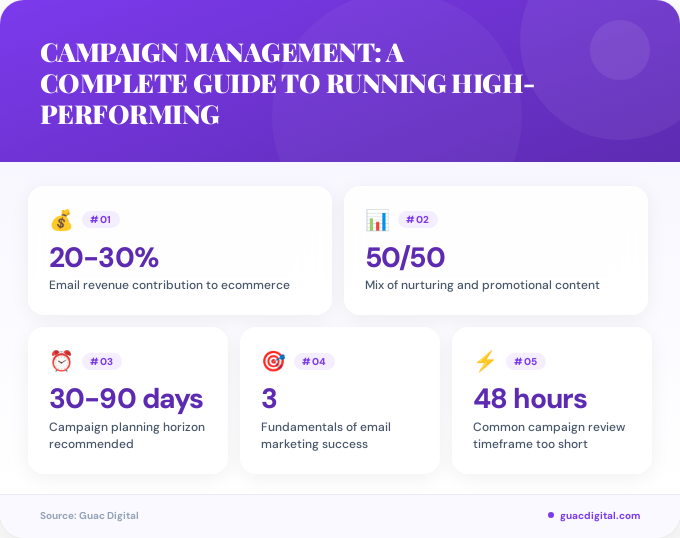
Campaign management is the process of planning, executing, tracking, and optimizing marketing campaigns across channels like email, paid ads, and social media to hit specific revenue and engagement goals. High-performing campaigns in 2026 rely on permission-based audience segmentation, AI-driven automation, and a 50/50 mix of nurturing and promotional content, with email alone contributing 20 to 30% of total ecommerce revenue. Success depends less on budget size and more on disciplined testing, timing, and cross-channel data integration.
Here’s a number that should stop every marketer mid-scroll: brands that treat campaigns as one-off blasts instead of connected systems are leaving 20 to 30% of potential ecommerce revenue on the table, revenue that email campaigns and automated flows routinely generate for brands that get it right. Campaign management: a complete guide to running high-performing ad campaigns starts with a hard truth: the difference between a campaign that drives pipeline and one that gets ignored isn’t creativity alone. It’s structure, timing, segmentation, and a willingness to test relentlessly.
This guide breaks down exactly how modern marketing teams plan, launch, and optimize campaigns that perform, backed by the latest 2026 data on send frequency, content mix, AI automation, and channel strategy.
What Is Campaign Management?
Campaign management is the end-to-end process of setting objectives, defining audiences, building creative, scheduling delivery, and analyzing results across every marketing channel a business uses. It covers everything from a single email drop to a coordinated omnichannel push spanning paid social, search, and lifecycle email.
According to Sprinklr’s breakdown of campaign management fundamentals, the discipline increasingly requires unifying data across channels so marketers can see a single customer journey instead of fragmented touchpoints. Modern teams pair this with digital campaign management platforms that centralize planning, approvals, and performance tracking in one workspace, reducing the chaos of spreadsheets and disconnected ad accounts.
Done well, campaign management turns marketing from a series of guesses into a repeatable, measurable system tied directly to revenue.
Why Do Most Ad Campaigns Fail?
Most campaigns underperform not because of weak creative, but because of poor targeting and inconsistent follow-through. Teams often launch a campaign, watch the first 48 hours of data, and move on, without adjusting segmentation or retesting subject lines and creative variations.
A second major failure point is list quality. Experts note that email marketing success now comes down to three fundamentals:
“Email marketing success in 2026 comes down to 3 fundamentals: building permission-based lists that actually want to hear from you, segmenting audiences so every message feels personal, and connecting email data directly to your sales pipeline,” according to Chase Dimond’s 2026 email marketing best practices analysis.
Purchased lists, generic segmentation, and disconnected sales data all quietly sabotage campaigns before they ever launch. Brands that instead invest in conversion rate optimization alongside campaign strategy tend to see compounding gains, since better-qualified traffic converts at a higher rate once it lands on-site.

How Do You Plan a High-Performing Campaign?
Effective planning starts with a horizon, not a single send date. Marketers should map campaigns 30 to 90 days ahead, extending that window further around major seasons like holidays or product launches, per monday.com’s campaign planning best practices.
A dependable planning framework includes these steps:
- Define one primary objective per campaign: awareness, lead generation, retention, or direct revenue.
- Segment the audience using behavior, purchase history, and engagement recency rather than broad demographics alone.
- Map the content calendar with a 50/50 balance of nurturing and promotional messaging.
- Set testing checkpoints for subject lines, creative, and send times before scaling budget.
- Connect performance data to CRM and sales pipeline reporting so revenue attribution is clear.
Litmus recommends building a formal email campaign strategy framework that documents goals, audience segments, and success metrics before a single asset is designed, since skipping this step is one of the most common reasons campaigns stall mid-quarter. Teams running paid media alongside email should also review how pay-per-click advertising fits into the broader funnel, since search and email should reinforce the same offer and messaging.
What Is the 60/30/10 Marketing Framework?
A widely cited planning model for 2026 splits marketing focus into three time horizons: 60% “tomorrow marketing” (emotional, brand-building content), 30% “today marketing” (urgent offers and promotions), and 10% “yesterday marketing” (win-back and retention campaigns for past customers).
This framework, highlighted in Forbes’ 2026 marketing strategy analysis, pushes back against the industry’s overreliance on constant discounting. Brands that lean too hard into “today marketing” burn out their lists with promotional fatigue, while those that invest in long-term brand affinity see stronger lifetime value.
Applying this ratio practically means auditing your last quarter of campaigns: if more than 40% were purely promotional, it’s time to rebalance toward educational and brand-building content.
Goal: Long-term affinity
Content type: Storytelling, values, education
Goal: Immediate conversion
Content type: Sales, promotions, deadlines
Goal: Reactivate past customers
Content type: Win-back offers, loyalty rewards
When Should You Send and How Often?
Frequency and timing matter more than most marketers assume. Lists of 5,000+ subscribers should receive at least two campaigns per week to maintain engagement without tipping into fatigue. Sending less often risks losing top-of-mind status; sending more without strong segmentation risks unsubscribes.
The strongest send windows, based on aggregated engagement data, are 9 to 11 AM, 1 to 3 PM, and 8 to 10 PM, with Tuesday through Thursday consistently outperforming Mondays and weekends. Because audience behavior shifts seasonally, send-time tests should be repeated on a quarterly basis rather than set once and forgotten.
Mailchimp’s guidance on digital marketing strategy planning reinforces that content mix matters as much as timing: a 50/50 balance between nurturing and promotional messages tends to maximize both engagement and revenue. If engagement metrics start slipping, the recommended fix isn’t more discounts, it’s more value-driven, educational content that rebuilds trust before asking for a purchase.
How Is AI Changing Campaign Management?
AI has moved from experimental add-on to core infrastructure in campaign management. Modern platforms use machine learning to optimize send times automatically, generate on-brand copy variations, and integrate directly with CRMs so marketers get full visibility into how campaigns influence pipeline, not just opens and clicks.
This shift matters even more given that over 60% of emails are now read on mobile devices, which makes single-column layouts, large tappable CTAs, and accessible formatting non-negotiable rather than nice-to-have. HubSpot’s research on marketing statistics and benchmarks shows that mobile-optimized campaigns consistently outperform desktop-first designs across nearly every industry vertical.
Salesforce’s state of marketing statistics report similarly finds that teams using AI-assisted personalization report meaningfully higher customer satisfaction scores compared to teams relying on manual segmentation alone. For brands running experiential or event-based campaigns, this same data-driven approach applies, as outlined in our guide to experiential marketing strategies that blend digital data with in-person engagement.
Which Campaign Management Tools Should You Use?
Choosing a platform depends on team size, channel mix, and how tightly you need campaign data connected to sales. Pricing for enterprise-grade campaign management software, agency retainers, or custom build-outs varies widely, typically ranging from a few hundred dollars a month for small-business tools to $10,000 to $50,000+ annually for full-service agency management and custom platform integrations, depending on scope, channel count, and reporting complexity. Because every business’s stack and goals differ, pricing varies based on your specific project, and it’s worth requesting a custom quote rather than assuming a flat rate applies.
| Approach | Best For | Key Strength |
|---|---|---|
| In-house DIY tools | Small teams, tight budgets | Low cost, fast setup |
| All-in-one marketing platforms | Growing mid-market brands | CRM integration, automation |
| Agency-managed campaigns | Enterprises, complex funnels | Strategy, craftsmanship, scale |
Smartsheet’s marketing campaign management guide and Wrike’s campaign management framework overview both emphasize that the “best” tool is the one your team will actually use consistently, project management complexity kills more campaigns than budget constraints. For businesses weighing whether to build in-house or bring in outside expertise, our digital campaign management services combine strategic planning with hands-on execution across paid, email, and organic channels.
How Do You Measure Campaign Success?
Campaign success should be measured against the objective set at the planning stage, not vanity metrics alone. Open rates and impressions matter, but revenue attribution, pipeline influence, and customer lifetime value are the metrics that justify continued investment.
Pipedrive’s guidance on email marketing best practices stresses connecting every campaign to CRM data so sales and marketing teams share the same view of what’s actually driving revenue. Businesses running local or location-based campaigns should also pair this with strong local SEO strategy, since paid campaign traffic converts better when organic search presence reinforces the same brand trust signals. A quarterly conversion rate optimization audit is one of the fastest ways to find where campaign traffic is dropping off before purchase.
- Email campaigns and automated flows together drive 20 to 30% of total ecommerce revenue for most brands.
- Lists over 5,000 subscribers should receive at least 2 campaigns weekly to stay engaged without causing fatigue.
- Plan campaigns 30 to 90 days in advance, extending the window for major seasonal pushes.
- Balance content with a 50/50 mix of nurturing and promotional messaging.
- Best send times cluster around 9 to 11 AM, 1 to 3 PM, and 8 to 10 PM on Tuesday through Thursday.
- AI now drives send-time optimization, content generation, and CRM integration as standard practice, not a luxury add-on.
- Over 60% of email is read on mobile, making mobile-first design mandatory for every campaign.
People Also Ask
What is a marketing campaign and how do you create one?
A marketing campaign is a coordinated set of messages and touchpoints designed around a single objective, like a product launch or seasonal promotion. Creating one involves defining a goal, segmenting your audience, building creative assets, scheduling delivery across channels, and tracking results against pre-set KPIs.
What are the 10 steps to running a successful marketing campaign?
The general sequence includes setting objectives, defining your audience, researching competitors, choosing channels, setting a budget, building creative, scheduling content, launching, monitoring performance, and optimizing based on data. Skipping the monitoring and optimization steps is the most common reason campaigns underperform.
How far in advance should you plan a marketing campaign?
Most marketers should plan 30 to 90 days ahead of launch, giving enough time for creative production, testing, and approvals. Major seasonal campaigns, like holiday promotions or large product launches, often require even longer lead times to secure assets and media placements.
What’s the difference between a campaign and an automated flow?
A campaign is a scheduled, one-time send tied to a specific moment or promotion, while an automated flow is triggered by user behavior, like a welcome series or abandoned cart sequence. Together, campaigns and flows typically account for the majority of email-driven ecommerce revenue.
Frequently Asked Questions
How often should I send campaign emails without hurting engagement?+
Lists with 5,000 or more subscribers should receive at least two campaigns per week to stay top of mind. Smaller lists can send less frequently, but consistency matters more than volume, irregular sending patterns tend to hurt open rates over time.
What’s the ideal content mix for high-performing campaigns?+
A 50/50 balance between nurturing content (education, community, value) and promotional content (offers, urgency) tends to maximize both engagement and revenue. If engagement drops, shifting more heavily toward nurturing content is the recommended fix before adding more discounts.
What are the best days and times to send campaigns?+
Tuesday through Thursday consistently yield the highest engagement rates, with strong send windows at 9 to 11 AM, 1 to 3 PM, and 8 to 10 PM. Because audience behavior shifts seasonally, these send-time tests should be repeated quarterly rather than assumed to stay constant.
How much does professional campaign management cost?+
Costs vary significantly based on channel mix, team size, and reporting complexity, ranging from a few hundred dollars monthly for basic tools to $10,000 to $50,000+ annually for full-service agency management. Pricing depends on your specific goals and scope, so requesting a custom quote is the most accurate way to plan a budget.
Why is mobile optimization critical for campaign management in 2026?+
Over 60% of emails are now read on mobile devices, meaning campaigns designed only for desktop will underperform significantly. Single-column layouts, large tappable buttons, and accessible fonts are now baseline requirements, not optional enhancements.
How does AI improve campaign management?+
AI automates send-time optimization, generates on-brand copy variations, and integrates campaign data directly with CRM systems for full-funnel visibility. This reduces manual guesswork and lets marketing teams focus on strategy rather than repetitive execution tasks.
Related: Campaign Management Services: How GUAC’s Data-Driven PPC and Campaign Management Drives Results
Related: Campaign Management Services: How a Data-Driven Agency Runs High-Performing Ad Campaigns
Whether you’re managing your first email campaign or overhauling an enterprise-level strategy across paid, organic, and lifecycle channels, the fundamentals remain constant: segment intelligently, test consistently, and connect every campaign back to revenue. If you’re ready to build a campaign system that actually performs instead of guessing month to month, explore how Guac Digital can help design and manage your next high-performing campaign, or visit our contact page to talk through your goals with our team.
Further reading: How to Choose a PPC Agency: The Complete 2026 Buyer’s Guide