
What Is a Conversion Rate Optimization Audit and How Can It Transform Your Revenue in 2026?
Quick Answer
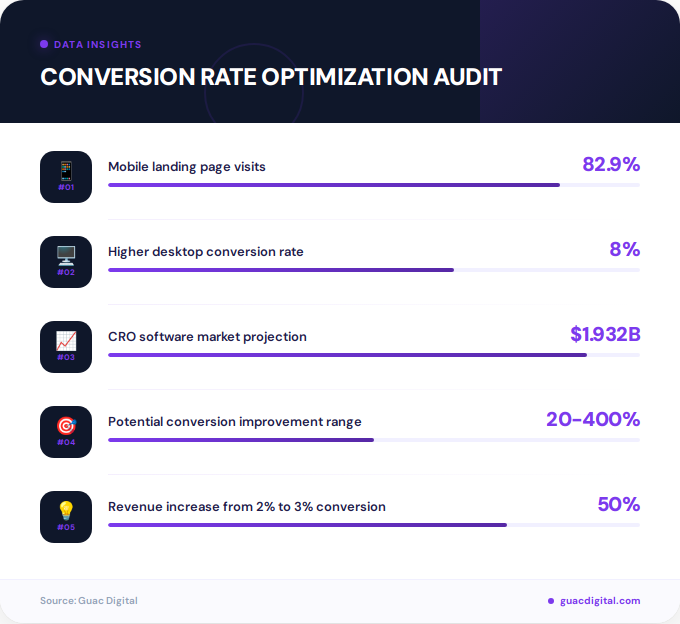
A conversion rate optimization audit is a systematic, forensic investigation of your entire user journey to identify exactly where and why prospects drop off. It goes beyond simple analytics to uncover friction points, anxiety triggers, and confusion patterns that create a repeatable system for revenue improvement, typically revealing opportunities to increase conversions by 20-400% when implemented correctly.
Did you know that while 82.9% of landing page visits come from mobile devices, desktop users convert at a rate 8% higher? This gap alone represents millions in lost revenue for most businesses. Yet this is just one of dozens of conversion leaks that remain invisible without a proper conversion rate optimization audit.
As we move through 2026, the stakes have never been higher. The CRO software market is projected to reach $1.932 billion with a compound annual growth rate of 9.6%, signaling massive investment in optimization technology. But tools alone don’t fix conversion problems. You need a systematic approach to uncover where your funnel is bleeding revenue.
In this comprehensive guide, you’ll discover exactly how to conduct a conversion rate optimization audit that doesn’t just identify problems but creates a roadmap for predictable, sustainable revenue growth. We’ll explore proven frameworks, current benchmarks, and the cutting-edge trends defining CRO success in 2026 and beyond.
What Is a Conversion Rate Optimization Audit?
A conversion rate optimization audit is a deep, systematic forensic investigation of your entire user journey designed to pinpoint exactly where prospects drop off and, more critically, why. Unlike surface-level analytics reviews that simply report metrics, a proper CRO audit identifies the underlying causes of conversion failure, including friction points, anxiety triggers, and confusion patterns throughout the customer experience.
The audit serves as the primary mechanism for identifying and eliminating “leaks” in your sales process. Rather than creating just a list of problems, it establishes a repeatable system for revenue improvement by mapping specific user behaviors to business outcomes. This forensic approach examines everything from technical implementation and page speed to messaging clarity and psychological persuasion elements.
Most businesses approach optimization reactively, making changes based on gut feeling or copying competitors. A structured audit transforms this into a data-driven process that prioritizes fixes based on potential impact. It’s the difference between randomly plugging holes in a leaking boat and systematically repairing them in order of severity.
Why Your Business Needs a CRO Audit in 2026
The digital landscape of 2026 demands precision. With customer acquisition costs rising across all channels and privacy changes limiting targeting capabilities, optimizing existing traffic has become non-negotiable. Organizations that conduct regular CRO audits typically see conversion improvements ranging from 20% to over 400%, depending on baseline performance and implementation quality.
Consider the compounding effect: if your current conversion rate is 2% and you improve it to 3%, you’ve increased revenue by 50% without spending an additional dollar on traffic. For a business generating $1 million annually, that’s an extra $500,000 with the same marketing budget. The return on investment from a thorough audit dwarfs almost any other marketing activity.
Beyond immediate revenue gains, audits reveal systemic issues that affect customer lifetime value, brand perception, and market positioning. You might discover that while your checkout process converts reasonably well, the post-purchase experience creates excessive returns or poor retention. These insights allow you to optimize not just for conversions, but for profitable, sustainable growth.

What Are the Current Conversion Rate Benchmarks?
Understanding where you stand relative to industry standards provides essential context for your audit. The baseline cross-industry average conversion rate is 6.6%, though this varies dramatically by industry, traffic source, and device type. Some aggregators report a general average closer to 2.9%, highlighting the importance of context-specific benchmarking.
Professional services lead all industries with an average conversion rate of 4.6%, while B2B eCommerce lags significantly at just 1.8%. These disparities reflect fundamental differences in sales cycles, consideration periods, and purchase complexity rather than optimization quality alone.
| Industry/Channel | Average Conversion Rate | Key Insight |
|---|---|---|
| Cross-Industry Average | 6.6% | Baseline for comparison |
| Professional Services | 4.6% | Industry leader |
| Lead Gen Landing Pages | 11.9% | Significantly outperforms general pages |
| B2B eCommerce | 1.8% | Lowest performing category |
For SaaS companies specifically, median landing page conversion sits at 3.8%, with Hardware SaaS achieving 4.1% and Data/Infrastructure at 3.3%. Real estate averages 4.7% overall, but this masks a significant channel variation: organic search drives 3.2% while paid search converts at only 1.5%.
These benchmarks should serve as context rather than absolute targets. Your specific conversion rate depends on factors like average order value, product complexity, brand awareness, and competitive positioning. Learn more about conversion rate standards to understand how your business compares.
What Are the Key Elements of a Comprehensive CRO Audit?
A thorough conversion rate optimization audit examines seven critical areas that collectively determine conversion performance. Each element interacts with others, creating compound effects that multiply impact when addressed systematically.
Technical Foundation: Your audit must begin with technical validation. This includes page load times, mobile responsiveness, form functionality, checkout flow integrity, and error tracking. Technical issues create immediate abandonment, often before users even see your value proposition. Tools should verify that all tracking pixels fire correctly and that analytics data accurately reflects user behavior.
User Experience Flow: Map the complete user journey from first touch through conversion and beyond. Document every decision point, friction moment, and potential confusion trigger. This includes navigation clarity, information hierarchy, call-to-action prominence, and cognitive load at each stage. Effective CRO audits examine both macro flows and micro-interactions that accumulate to create the overall experience.
Messaging and Value Proposition: Evaluate whether your messaging clearly communicates what you offer, who it’s for, and why someone should choose you over alternatives. This extends beyond homepage headlines to include product descriptions, testimonials, guarantee language, and objection handling throughout the funnel.
Visual Design and Psychology: Assess how visual elements guide attention, create trust, and motivate action. This includes analyzing color psychology, whitespace usage, contrast ratios, image selection, and social proof placement. Visual design isn’t about aesthetics but about reducing friction and increasing confidence.
Data Quality and Analytics Setup: Verify that your measurement infrastructure provides accurate, actionable insights. This includes event tracking configuration, goal setup, segment definition, and attribution modeling. Many businesses make optimization decisions based on flawed data, creating the illusion of improvement while actual performance stagnates or declines.
Channel-Specific Performance: Different traffic sources convert at vastly different rates and require tailored experiences. Your audit should segment performance by channel and identify whether conversion issues stem from traffic quality, landing page mismatch, or universal friction points.
Device and Browser Testing: With mobile accounting for the vast majority of traffic but converting less efficiently, device-specific issues often represent the largest conversion opportunities. Test actual user experiences across devices, browsers, and screen sizes rather than relying solely on responsive design previews.
How to Conduct a Conversion Rate Optimization Audit
The most effective audits follow a structured framework that ensures nothing critical gets overlooked. While specific implementations vary by business type and complexity, the core methodology remains consistent.
Phase 1: Data Collection and Baseline Establishment
Begin by gathering comprehensive data across all relevant platforms. This includes Google Analytics or your analytics platform of choice, heatmapping tools, session recording software, form analytics, and any existing customer feedback. Document current conversion rates by segment, identify your most valuable traffic sources, and establish clear baseline metrics against which improvements will be measured.
Most auditors spend 20-30% of total audit time in this phase because decisions made with incomplete data inevitably miss critical opportunities. Pull at least 90 days of historical data to identify patterns rather than anomalies, and ensure you’re comparing equivalent time periods when establishing benchmarks.
Phase 2: Heuristic Evaluation
Conduct a systematic expert review of your conversion funnel using established frameworks. Walk through each step of the user journey as if experiencing it for the first time, documenting friction points, confusion triggers, and trust gaps. This qualitative assessment often reveals issues that don’t show up in quantitative data but significantly impact conversion psychology.
The heuristic evaluation should cover clarity (is the value proposition immediately obvious?), motivation (does the messaging create urgency and desire?), friction (how much effort is required to convert?), anxiety (what concerns might prevent action?), and distraction (what pulls attention away from conversion goals?).
Phase 3: Technical Audit
Verify that all technical systems function correctly across devices, browsers, and connection speeds. Test forms for validation errors, checkout flows for payment processing issues, and page loads for performance problems. Many conversion issues stem from technical failures that create silent abandonment without clear signals in your analytics.
Use specialized CRO audit tools to automate portions of this testing while conducting manual verification for critical paths. Pay particular attention to mobile experiences, which often contain device-specific bugs that desktop testing misses.
Phase 4: Behavioral Analysis
Review session recordings, heatmaps, and click tracking to understand actual user behavior rather than assumed behavior. Look for rage clicks (repeated clicking indicating frustration), dead clicks (clicks on non-interactive elements), scroll depth patterns, and abandonment points. This behavioral data reveals the gap between your intended user journey and the reality of how people actually interact with your site.
Phase 5: Prioritization and Roadmap Creation
Document all identified issues and opportunities, then prioritize based on potential impact, implementation complexity, and resource requirements. The best frameworks use a scoring system that weights factors like traffic volume affected, estimated conversion lift, development effort, and confidence level.
Create a phased implementation roadmap that sequences fixes logically, addressing critical blockers first before moving to optimization opportunities. This ensures you’re not polishing details while fundamental problems continue bleeding revenue.
The most valuable CRO audits don’t just identify what’s broken but explain why it’s broken and how to fix it systematically. They transform conversion optimization from a random walk through possible improvements into a strategic process with predictable outcomes.
What CRO Audit Trends Are Shaping 2026?
The conversion optimization landscape continues evolving rapidly. Seven key trends are redefining how effective CRO audits are conducted in 2026 and beyond.
Investing in Measurement and Data Quality: The industry is shifting from “best practice” implementation to rigorous data validation. Leading auditors now spend significant time verifying that analytics setups correctly map events to business goals and that tracking remains accurate across platform updates. This includes auditing GA4 implementations, validating event taxonomies, and ensuring cross-team consistency in naming conventions.
AI-Powered Personalization: Rather than treating all visitors identically, sophisticated audits now evaluate personalization capabilities and opportunities. AI tools enable hyper-personalized messaging based on behavior patterns, traffic source, and engagement signals. Audits assess whether businesses leverage these capabilities or leave significant revenue on the table through generic experiences.
Micro-Moment Optimization: The focus has shifted from optimizing entire pages to optimizing specific moments in the customer journey. This includes identifying and perfecting “make or break” interactions where conversion decisions crystallize. Audits now map these micro-moments and ensure each receives appropriate attention and resources.
Privacy-First Attribution: With third-party cookies disappearing and privacy regulations tightening, modern audits must account for attribution challenges that previous methodologies ignored. This includes implementing first-party data strategies, consent management verification, and alternative measurement frameworks that respect user privacy while maintaining optimization capabilities.
Integrated Customer Journey Analysis: Audits no longer stop at the conversion point but extend through the entire customer lifecycle. This recognizes that some optimization tactics increase immediate conversions while reducing customer lifetime value through buyer’s remorse, returns, or poor onboarding experiences.
How Does Mobile vs Desktop Performance Impact Your Audit?
The mobile-desktop conversion gap represents one of the largest optimization opportunities for most businesses. Despite 82.9% of landing page visits originating from mobile devices, desktop users convert approximately 8% more efficiently. This paradox means the majority of your traffic converts at below-average rates, creating massive revenue potential through mobile-specific optimization.
Your audit must treat mobile and desktop as separate conversion ecosystems rather than responsive variations of the same experience. Mobile users face unique friction points including smaller tap targets, form fill difficulty, cognitive overload from information density, and connectivity variability. These issues compound in ways that desktop testing never reveals.
Prioritize mobile session recording review to identify device-specific problems. Common issues include navigation menus that require excessive taps to reach key pages, forms that trigger incorrect keyboard types, checkout flows that break on specific mobile browsers, and call-to-action buttons positioned outside thumb-reach zones.
The audit should also examine mobile-specific opportunities. Features like click-to-call buttons, simplified single-column layouts, progressive disclosure of information, and mobile wallet integration often dramatically improve mobile conversion rates when implemented thoughtfully.
Which Traffic Channels Should Your Audit Prioritize?
Not all traffic converts equally, making channel-specific analysis essential for audit prioritization. Email remains the highest-performing channel globally at 19.3%, converting significantly more traffic than paid search, paid social, or display advertising. In the SaaS sector specifically, email converts at 16.9%, more than four times any other channel.
This performance disparity reflects fundamental differences in user intent, awareness level, and relationship warmth rather than channel quality alone. Email subscribers have explicitly opted into your communications and typically convert on focused campaigns to warm audiences. Paid traffic, conversely, often reaches cold prospects with minimal brand awareness.
SaaS Specific: 16.9%
Priority: High-value existing relationships
Real Estate: 1.5%
Priority: High-intent cold traffic
Represents: Brand awareness, repeat visitors
Priority: Existing familiarity signals
Challenge: Lower intent, interruption-based
Priority: Awareness and consideration
Your audit should segment conversion performance by channel and evaluate whether landing experiences match user expectations and intent levels. Paid social traffic, for example, typically requires more education and trust-building before asking for conversions compared to retargeting campaigns or branded search traffic.
Channel analysis also reveals budget allocation opportunities. If email converts at 16.9% while paid social converts at 2.9%, incremental investment in email list growth and engagement often delivers superior ROI compared to scaling paid social spend, all else being equal.
What Tools Do You Need for an Effective CRO Audit?
The right technology stack transforms a conversion rate optimization audit from theoretical exercise to actionable roadmap. While specific tool selection depends on business needs and budget, certain categories prove essential across virtually all comprehensive audits.
Analytics Platforms: Google Analytics 4 or alternatives like Mixpanel provide the quantitative foundation for understanding user behavior, conversion funnels, and segment performance. Your audit must verify correct implementation, event tracking accuracy, and goal configuration before relying on this data for decision-making.
Heatmapping and Session Recording: Tools like Hotjar, Crazy Egg, or Lucky Orange visualize how users actually interact with pages beyond what analytics alone reveals. Session recordings expose frustration moments, confusion points, and unexpected behaviors that quantitative data misses entirely.
Form Analytics: Specialized form analysis tools identify which fields create abandonment, where users struggle with validation, and how much time each input requires. Since forms represent the final conversion barrier for most businesses, this granular insight often reveals quick wins with outsized impact.
Speed Testing: Page speed directly impacts conversion rates, making performance monitoring essential. Tools like Google PageSpeed Insights, GTmetrix, and WebPageTest identify technical bottlenecks that create silent abandonment before users even engage with content.
A/B Testing Platforms: While not required for the audit itself, documenting which testing infrastructure exists (or needs implementation) ensures recommendations can be validated scientifically. Platforms like Optimizely, VWO, or Google Optimize enable hypothesis testing rather than opinion-based changes.
User Feedback Tools: On-site surveys, exit-intent polls, and post-purchase questionnaires provide qualitative insights that explain the “why” behind behavioral data. This voice-of-customer input often surfaces objections and concerns that no amount of analytics watching reveals.
If you’re evaluating options, explore our comprehensive guide to conversion rate optimization tools for detailed comparisons and implementation recommendations.
Pricing for professional CRO audit services varies dramatically based on business complexity, traffic volume, and implementation depth. Expect ranges from $3,000 to $25,000+ for one-time audits, with enterprise-level comprehensive analyses reaching $50,000 to $100,000+. These wide ranges reflect differences in scope: some audits provide high-level recommendations while others include detailed implementation specifications, wireframes, and ongoing optimization support.
When evaluating providers, prioritize demonstrated expertise and proven methodology over lowest cost. A thorough audit from an experienced conversion rate optimization agency typically pays for itself many times over through the revenue improvements it enables. The investment should be measured against potential return rather than compared to commodity services.
Key Takeaways
- A conversion rate optimization audit is a systematic investigation of your entire user journey that identifies where and why prospects drop off, creating a repeatable system for revenue improvement rather than just a problem list.
- Current benchmarks vary dramatically by industry and channel: the cross-industry average is 6.6%, lead generation pages average 11.9%, while B2B eCommerce lags at just 1.8%. Use these as context, not absolute targets.
- Mobile represents the largest optimization opportunity for most businesses, with 82.9% of traffic but 8% lower conversion rates compared to desktop, revealing significant device-specific friction that standard responsive design doesn’t address.
- Email dramatically outperforms other channels at 19.3% conversion rate globally (16.9% for SaaS), more than 4x paid search or paid social, suggesting resource reallocation opportunities for many businesses.
- Seven critical audit elements must be examined: technical foundation, user experience flow, messaging clarity, visual psychology, data quality, channel-specific performance, and device-browser testing.
- 2026 trends emphasize data quality over best practices: rigorous analytics validation, AI-powered personalization, micro-moment optimization, privacy-first attribution, and integrated customer journey analysis now define cutting-edge audits.
- Professional audit investment ranges from $3,000 to $100,000+ depending on complexity and depth, but should be measured against potential revenue impact rather than compared as a commodity cost. Most comprehensive audits deliver ROI of 5x to 50x through implementation of findings.
People Also Ask
How long does a conversion rate optimization audit take?
A thorough CRO audit typically requires 2-6 weeks depending on site complexity, traffic volume, and analysis depth. This includes data collection (1-2 weeks), heuristic evaluation and technical testing (1-2 weeks), behavioral analysis (1 week), and documentation with prioritized recommendations (1 week).
What is the difference between a CRO audit and regular analytics review?
A CRO audit is a comprehensive, systematic investigation covering technical, psychological, and experiential factors beyond metrics alone. Regular analytics reviews report what happened, while CRO audits explain why it happened and provide actionable recommendations for improvement across the entire conversion funnel.
Can I conduct a CRO audit myself or should I hire an expert?
You can conduct basic audits using established frameworks and tools, but professional auditors bring pattern recognition from analyzing hundreds of sites, knowledge of psychological principles, and unbiased perspective that internal teams typically lack. For businesses with significant traffic or complex funnels, professional audits usually deliver substantially higher ROI.
How often should you perform a conversion rate optimization audit?
Most businesses benefit from comprehensive audits annually, with lighter quarterly reviews to catch emerging issues. Major site redesigns, product launches, or significant traffic changes warrant immediate audits regardless of schedule. Continuous optimization between audits implements findings and tests hypotheses systematically.
What conversion rate increase can I expect from implementing audit findings?
Results vary widely based on baseline performance and implementation quality, but businesses typically see conversion improvements ranging from 20% to over 400%. Sites with significant technical issues or major user experience gaps tend to see larger gains, while already-optimized sites experience smaller but still meaningful lifts of 10-30%.
Do CRO audits work for B2B companies or only eCommerce?
CRO audits are equally valuable for B2B, though they focus on different conversion goals like demo requests, consultation bookings, or whitepaper downloads rather than immediate purchases. B2B audits often emphasize trust signals, authority building, and handling longer consideration cycles compared to eCommerce transaction optimization.
Frequently Asked Questions
What is the main purpose of a conversion rate optimization audit?+
The main purpose is to systematically identify where and why prospects drop off in your conversion funnel, then create a prioritized roadmap for eliminating those barriers. Unlike simple analytics reviews, audits uncover the root causes of conversion problems including technical issues, user experience friction, messaging gaps, and psychological barriers that prevent prospects from becoming customers.
What conversion rate should I target for my business?+
Target conversion rates depend heavily on your industry, average order value, traffic sources, and sales complexity rather than universal benchmarks. Professional services average 4.6%, lead generation pages reach 11.9%, while B2B eCommerce sits at 1.8%. Rather than chasing arbitrary numbers, focus on continuous improvement relative to your baseline and understanding what percentage improvement would meaningfully impact revenue.
How much does a professional CRO audit cost?+
Professional CRO audit pricing ranges from $3,000 to $25,000+ for small to mid-sized businesses, with enterprise-level comprehensive audits reaching $50,000 to $100,000+. Pricing depends on site complexity, traffic volume, number of conversion funnels analyzed, depth of competitor research, and whether implementation support is included. This investment should be evaluated against potential revenue improvement rather than compared as a commodity service.
What tools are essential for conducting a CRO audit?+
Essential tools include analytics platforms (Google Analytics 4, Mixpanel), heatmapping and session recording software (Hotjar, Lucky Orange), form analytics tools, speed testing platforms (PageSpeed Insights, GTmetrix), and user feedback mechanisms. The specific combination depends on your site type and optimization priorities, but all comprehensive audits require both quantitative analytics and qualitative behavioral insight to identify issues accurately.
Why does mobile convert worse than desktop despite higher traffic?+
Mobile converts approximately 8% worse than desktop despite 82.9% of traffic because mobile users face unique friction including smaller screens, touch-based navigation challenges, form-fill difficulty, slower connection speeds, and higher distraction levels. Many sites treat mobile as a responsive version of desktop rather than designing mobile-first experiences, creating accumulated friction that depresses conversion rates significantly.
How is a CRO audit different from A/B testing?+
A CRO audit is a diagnostic process that identifies problems and opportunities across your entire conversion funnel, while A/B testing is a validation method that scientifically measures whether specific changes improve performance. Audits inform what to test, testing validates whether changes work. Effective optimization requires both: audits for hypothesis generation and strategic direction, testing for implementation validation.
What metrics should a CRO audit track beyond conversion rate?+
Related: What Is Pay Per Click (PPC)? A Complete Guide to Understanding Modern Digital Advertising
Related: Campaign Management Services: How GUAC’s Data-Driven PPC and Campaign Management Drives Results
Comprehensive audits track micro-conversions (email signups, content downloads), engagement metrics (time on page, scroll depth), form analytics (field completion rates, error triggers), exit rates at key pages, cart abandonment by stage, traffic source conversion rates, device-specific performance, and revenue per visitor. These supporting metrics explain why overall conversion rates perform as they do and identify specific improvement opportunities.
Further reading: Brand Identity Examples: Best Examples and What Makes Them Work