
ROI Tracking: Crucial Guide 2025
Why Your Marketing Budget Needs Better Tracking
ROI tracking measures the revenue your marketing generates compared to its cost. It’s the key to making strategic, data-driven decisions instead of guessing where your budget should go.
Here’s a quick overview of ROI tracking:
- Basic Formula: (Revenue – Investment) ÷ Investment × 100 = ROI%
- Key Metrics: Customer Acquisition Cost, Lifetime Value, Return on Ad Spend
- Essential Tools: Google Analytics, CRM systems, UTM parameters
- Common Methods: Conversion tracking, attribution modeling, lead scoring
- Timeline: Results vary from real-time (PPC) to months (SEO/content)
If your marketing budget disappears without clear results, you’re not alone. Research shows that 76% of marketers struggle to track ROI effectively, and 74% can’t measure their impact on business results. The problem isn’t a lack of data; it’s knowing how to connect spending to revenue.
Without proper ROI tracking, you’re flying blind, potentially wasting money on channels that don’t convert while your competitors optimize their spend based on proven performance. This guide will show you how to fix that.
I’m Guy Leon, founder and CEO of Guac Digital. We’ve helped clients boost engagement and conversions by 350% through strategic ROI tracking. I’ve seen how proper measurement transforms marketing from a cost center into a profit driver, and I’ll show you how to make that shift.
Know your roi tracking terms:
Why ROI Tracking is Crucial for Your Business
Spending thousands on marketing without knowing what works is a common struggle. The pressure to prove marketing’s value is immense, as leadership wants to see real numbers connecting budget to business results. Marketing is an investment, but only when you can demonstrate a return.
At Guac Digital, we’ve seen how Data-Driven Marketing Strategies transform businesses. When you know which efforts drive revenue, you stop guessing and start building a predictable growth engine.
ROI tracking justifies your budget by connecting every dollar spent to actual business outcomes. It’s the difference between saying “we got 10,000 visitors” and “we generated $50,000 in revenue from a $10,000 investment.” Beyond justification, it enables strategic optimization. You can identify your most profitable channels, cut wasteful spending, and make informed decisions, giving you a significant competitive edge.
Understanding Your Profitability
Profitability in marketing isn’t about vanity metrics like likes or website visits. It comes down to net profit versus gross revenue. A campaign generating $100,000 in sales isn’t impressive if it cost $90,000 to run.
ROI tracking forces you to conduct campaign-level profitability analysis. You might find that high-lead-volume Facebook ads rarely convert, while a simple email newsletter consistently brings in high-value clients.
Channel-level analysis reveals these hidden truths. Understanding which channels deliver real profit—not just activity—allows you to make informed decisions that turn marketing into a strategic growth driver.
Optimizing Your Marketing Spend
Once you know what’s working, you can optimize your budget allocation strategically. Instead of spreading your budget thin, you can invest heavily in proven winners.
Scaling successful campaigns becomes straightforward. If a Google Ads campaign delivers 300% ROI, you increase its budget to multiply profits. Conversely, cutting underperforming ads stops you from wasting money on campaigns that aren’t delivering.
This continuous cycle of measurement and optimization improves efficiency across your entire marketing operation. Every dollar works harder because it’s invested where it performs best. This is how mid-sized businesses can compete with larger companies—by being smarter with every dollar spent, an approach we use when Maximizing ROI With A Digital Marketing Agency.
How to Calculate Marketing ROI: The Core Formulas
Calculating marketing ROI turns your data into actionable insights. It doesn’t require advanced math, just the right formulas and attention to detail.

The Basic ROI Formula
The foundation of all ROI tracking is: (Net Profit / Investment Cost) x 100.
- Net Profit is the revenue your campaign generated minus its cost. If a $2,000 campaign brings in $5,000 in sales, your net profit is $3,000.
- Investment Cost includes all expenses: ad spend, creative work, software, and team time.
For example, if you invested $1,000 in a campaign that brought in $4,000 in revenue, your net profit is $3,000. The ROI is: ($3,000 ÷ $1,000) × 100 = 300%. This means you earned $3 in profit for every $1 invested.
Positive vs. Negative ROI is simple: positive means you made money, negative means you lost it. A negative ROI is a clear signal to fix or cut a campaign.
Key Metrics Beyond the Basic Formula
To get the full picture, savvy marketers use additional metrics:
- Customer Acquisition Cost (CAC): The total cost to acquire a new customer (Total Marketing & Sales Costs / New Customers). If you spent $10,000 to gain 100 customers, your CAC is $100.
- Customer Lifetime Value (LTV): The total revenue you expect from a customer over their entire relationship with you. LTV helps you determine how much you can afford to spend on CAC.
- The LTV > 3x CAC Rule: For SaaS companies, a healthy business model means LTV is at least three times CAC.
- Return on Ad Spend (ROAS): This focuses specifically on ad campaigns, measuring gross revenue per dollar of ad spend. A $2,000 ad campaign generating $10,000 in revenue has a 500% ROAS.
Understanding these metrics is key to How To Calculate Digital Marketing ROI.
Calculating ROI for Lead Generation
For B2B or lead-focused businesses, you must assign a dollar value to each lead.
- Determine your Average Closed Lead Value (average revenue from a new customer).
- Calculate your Lead-to-Customer Conversion Rate (the percentage of leads that become customers).
- Your Per Lead Value = Average Closed Lead Value x Lead-to-Customer Conversion Rate. (e.g., $2,000 average value x 25% conversion rate = $500 per lead).
Now, use this formula: (Total Value of Generated Leads – Campaign Cost) / Campaign Cost × 100.
If a $15,000 campaign generated 80 leads at $500/lead, the total lead value is $40,000. The ROI is: ($40,000 – $15,000) ÷ $15,000 × 100 = 167%. This method gives concrete financial value to your lead generation efforts.
A Step-by-Step Guide to Effective ROI Tracking
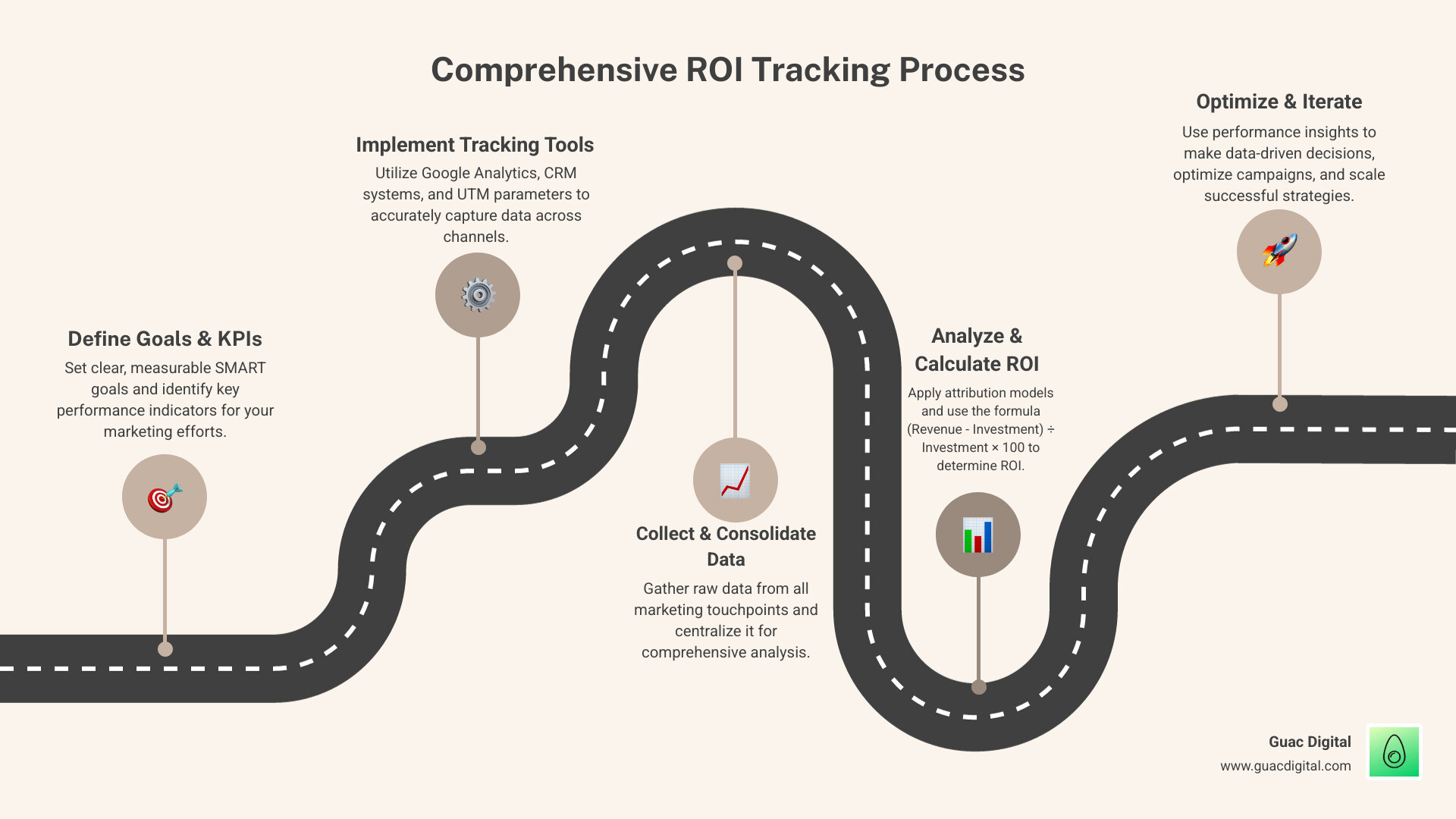
Effective ROI tracking is a systematic process that turns data into profit. Many businesses jump straight to tracking without a plan, leaving them with data but no insights. We follow a proven four-step process to build a profit-generating machine.
Step 1: Define Clear Goals and KPIs for ROI Tracking
First, define what success looks like. Set SMART (Specific, Measurable, Achievable, Relevant, Time-bound) goals. Instead of a vague goal like “more traffic,” aim for something specific: “increase organic search traffic by 25% in Q1, resulting in 15 additional qualified leads per month.”
Next, identify the Key Performance Indicators (KPIs) that measure progress toward those goals, such as conversion rate, cost per acquisition (CPA), customer lifetime value (CLV), and return on ad spend (ROAS). The crucial step is Defining conversion goals in GA. This allows you to assign dollar values to actions and know which campaigns are actually making you money.
Step 2: Use UTM Parameters for Granular Tracking
UTM parameters are tags you add to your marketing links that tell you exactly where your visitors came from. They track the source (e.g., Google), medium (e.g., paid ad), and campaign (e.g., summer sale). This allows you to see which specific efforts are driving traffic and conversions.
Consistency is key. Use standardized naming conventions to avoid data fragmentation in your analytics. Tools like Google’s UTM builder help keep everything organized. You can even use UTMs for offline campaigns by creating a unique, tagged URL to share on print ads or at events.
Step 3: Implement and Integrate Your ROI Tracking Tools
This step involves connecting your tools to create a complete picture of the customer journey.
- Google Analytics (GA4): Your foundation. GA4’s event-based model offers sophisticated tracking. You can also import cost data to GA4 from other ad platforms for a unified view of ROI.
- CRM Integration: Connecting your CRM (like HubSpot or Salesforce) is critical. It allows you to trace revenue back to specific marketing touchpoints.
- Ad Platform Pixels: The Facebook Pixel and Google Ads conversion tracking code monitor post-click actions, telling you who converted, not just who clicked.
- Marketing Automation: Platforms like Marketo track email engagement and lead nurturing, completing the view of the customer journey.
Step 4: Analyze the Data and Generate Insights
With data flowing in, it’s time to turn numbers into decisions.
- Attribution Models: Understand how credit is assigned across multiple touchpoints. Instead of last-click, consider models that recognize the entire customer journey.
- Identify Trends: Look for patterns over time. Do certain channels perform better on specific days? Does some content attract higher-value customers?
- Channel Performance Comparison: With clear data, you can definitively see which channels deliver the best ROI, making budget allocation decisions obvious.
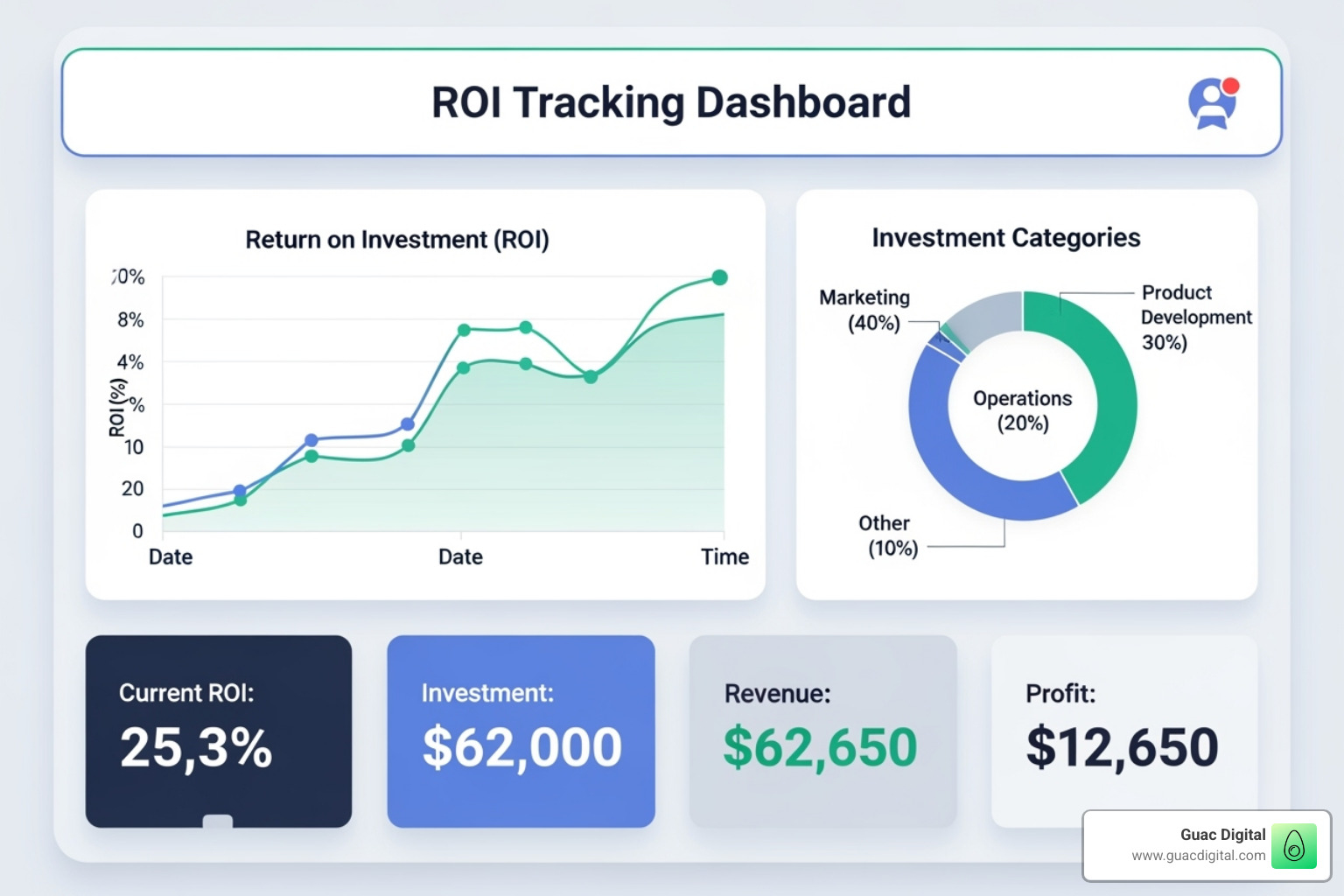
Finally, create reporting dashboards to visualize this data. This is where our expertise in Data-Driven Insights transforms complex data into clear action items that drive growth.
Essential Tools and Platforms for Marketers
Successful ROI tracking depends on the right toolkit. The best platforms centralize data collection, automate processes, and ensure accuracy, giving you clear insights instead of guesses.
Analytics Platforms
- Google Analytics (GA4): The foundation for website analytics. It’s free, powerful, and its event-based tracking offers great flexibility. A key feature for ROI tracking is the ability to import cost data from non-Google ad platforms, creating a complete ROAS picture.
- Kissmetrics: This platform excels at user journey analysis. It tracks visitors from their very first interaction, connecting behavior across multiple sessions. This is especially useful for understanding complex, multi-touch conversion paths common in B2B marketing.
CRM and Marketing Automation
Connecting marketing efforts to sales revenue is where the magic happens.
- HubSpot: An all-in-one platform (CRM, marketing, sales) ideal for small to mid-sized businesses. It allows you to trace a customer’s entire journey from first touch to final purchase, which is essential for accurate ROI tracking.
- Salesforce: A powerful and customizable CRM for larger enterprises, offering deep revenue attribution reporting across multiple teams and product lines.
- Marketo & ActiveCampaign: These marketing automation platforms are great for lead nurturing and segmentation. When integrated with a CRM, they show how automated sequences contribute to revenue, which is valuable for measuring things like Social Media ROI.
Specialized ROI and Data Aggregation Tools
These tools solve specific tracking problems or consolidate data from multiple sources.
| Tool | Primary Function | Key Features |
|---|---|---|
| Supermetrics | Data aggregation and reporting automation | Connects marketing data from various platforms (Google Ads, Facebook Ads, SEO, etc.) to spreadsheets/BI tools. |
| Planful | Financial planning & performance management | Helps businesses with budgeting, forecasting, consolidation, and financial reporting, including ROI. |
| CallRail | Call tracking and analytics | Tracks phone calls from marketing campaigns, attributing them to specific sources and providing insights. |
Supermetrics automates data consolidation, saving hours of manual work. Planful integrates marketing ROI into broader business financial planning. CallRail solves the problem of tracking phone call conversions from digital campaigns, filling a major gap for many businesses.
The key is to choose an integrated stack where your tools work together, turning ROI tracking into a competitive advantage.
Common Challenges in Measuring ROI (and How to Solve Them)
ROI tracking can be complex. Customers interact with multiple channels over long periods and sometimes convert offline. These challenges are common, but there are proven strategies to overcome them.
The Attribution Puzzle
A customer might see a Facebook ad, then do a Google search, read a blog, and finally convert from an email. Which touchpoint gets the credit? This is the attribution puzzle.
Traditional “last-click attribution” is flawed because it ignores earlier touchpoints. Multi-touch attribution provides a fairer view by distributing credit across the journey. Models include linear (equal credit), time decay (more credit to recent touches), and position-based (credit to first and last touches).
The best solution is using a CRM to connect touchpoints. Integrating platforms like HubSpot or Salesforce creates a unified customer profile that tracks every interaction, revealing the true path to conversion. This approach leverages data to solve complex advertiser problems, as detailed in How Big Data Analytics Is Solving Big Advertiser Problems.
Tracking Long-Term and Intangible Returns
Not all marketing delivers immediate results. Brand awareness and content marketing can take months or years to pay off.
- Brand Awareness: While you can’t deposit “awareness,” you can track it via proxy metrics like increases in branded search volume, direct traffic, and social media mentions.
- Customer Loyalty: Investments in customer service or loyalty programs are measured through repeat purchase rates, Net Promoter Scores (NPS), and customer retention rates.
- Content Marketing and SEO: These are long-term plays. We track organic traffic growth, keyword ranking improvements, and the lifetime value of customers acquired via organic search, who often have lower acquisition costs.
Bridging the Online-Offline Gap
Many conversions happen offline but start online. Failing to track these connections gives you an incomplete ROI picture.
- Call Tracking Software: Tools like CallRail use unique phone numbers for different campaigns, allowing you to attribute phone call conversions directly to the marketing source.
- In-store Coupon Codes: Unique promo codes for online campaigns can connect digital marketing efforts to physical sales.
- “How did you hear about us?” Surveys: This simple method can fill in attribution gaps by capturing information about word-of-mouth referrals or other offline touchpoints.
Frequently Asked Questions about ROI Tracking
Here are answers to the most common questions we get about ROI tracking at Guac Digital.
What is a good marketing ROI?
There’s no single answer, as a “good” ROI depends on your industry, profit margins, and business model. However, a 5:1 revenue-to-cost ratio is a common benchmark, meaning you generate $5 in revenue for every $1 spent on marketing.
A SaaS company might succeed with a 3:1 ratio due to high customer lifetime value, while a low-margin e-commerce store might need an 8:1 ratio to be profitable. The key question is whether your ROI is high enough to fuel sustainable growth for your specific business.
How often should I track ROI?
The frequency of ROI tracking depends on the marketing channel.
- Real-time/Daily: For paid advertising (PPC) like Google Ads or Facebook Ads, where budgets can be spent quickly. This allows for immediate adjustments.
- Weekly/Monthly: For email marketing and social media campaigns. This provides enough data to identify trends without overreacting to daily fluctuations.
- Quarterly: For long-term strategies like SEO and content marketing. While monthly check-ins are good, a quarterly deep-dive reveals meaningful patterns and informs strategy.
Balance continuous monitoring to catch major issues with periodic deep dives to analyze the bigger picture.
Can I track the ROI of SEO?
Yes, you absolutely can track SEO ROI, though it’s more complex than for paid ads. The formula is the same—(Revenue from SEO – SEO Investment) ÷ SEO Investment × 100—but defining the revenue requires careful setup.
We track organic traffic conversions in Google Analytics, monitoring every sale or lead that originates from search. It’s also important to consider that organic customers often have higher lifetime values. Additionally, ranking #1 for a major keyword has inherent value, as it saves money you would have otherwise spent on paid ads.
SEO is a long-term investment, typically taking 6-12 months to show significant returns. For a detailed guide, Moz explains how to approach Calculating SEO ROI with Google Analytics.
Transform Your Data into Dollars
Knowing how to track ROI is only the first step. The real change happens when you consistently apply these insights to turn your marketing into a profit engine. By implementing proper ROI tracking, you move from uncertainty to a world where every marketing decision is backed by data.
Instead of guessing, you’ll know exactly which campaigns drive profitable customers and which content moves them through your sales funnel. This is the change we bring to our clients at Guac Digital. We build the tracking systems and analytical processes that turn scattered metrics into clear growth strategies.
Our approach leverages big data and programmatic marketing to ensure every campaign is precisely targeted and delivers measurable results. We create personalized client strategies that align tracking with your actual business goals, not vanity metrics.
This continuous improvement cycle—measure, analyze, optimize—becomes second nature. You’re no longer just running campaigns; you’re making calculated investments with predictable returns. Your marketing budget becomes a growth lever.
Ready to make the shift from guesswork to growth? We can help you build the ROI tracking systems to transform your results. Leverage our data-driven expertise to maximize your marketing ROI and see what happens when every marketing dollar works as hard as you do.