
What is a good roi for marketing: 7 Powerful Success Benchmarks 2025
The Bottom Line on Marketing ROI
What is a good ROI for marketing? Based on extensive industry research, here’s what you need to know:
| ROI Ratio | Interpretation | Example |
|---|---|---|
| 2:1 (200%) | Break-even point for many businesses | $2 return for every $1 spent |
| 5:1 (500%) | Strong performance benchmark | $5 return for every $1 spent |
| 10:1 (1000%) | Exceptional performance | $10 return for every $1 spent |
Note: Actual “good” ROI varies by industry, business model, and profit margins.
When you spend money on marketing, you expect it to come back with friends. What is a good ROI for marketing isn’t just an academic question—it’s the difference between campaigns that drain your resources and those that fuel your business growth. Whether you’re analyzing your Google Ads performance or evaluating your entire marketing strategy, understanding ROI benchmarks gives you the compass to steer your marketing investments.
In today’s data-driven business landscape, marketing ROI has moved beyond a nice-to-have metric to a boardroom essential. The days of “I know half my advertising is wasted, I just don’t know which half” are long gone. Modern marketers can—and must—quantify their impact.
I’m Guy Leon, founder and CEO of Guac Digital, where I’ve helped hundreds of businesses improve their what is a good ROI for marketing metrics through data-driven strategies that consistently outperform industry benchmarks. My team has specialized in changing underperforming campaigns into revenue engines that deliver measurable results.
What is a good roi for marketing terms to remember:
– marketing investment
– romi
– social media roi
The ROI Mindset
Before diving into specific numbers, it’s important to understand that ROI thinking requires a shift in how we view marketing. Rather than seeing marketing as a cost center, the ROI mindset frames it as an investment with expected returns. This perspective transforms marketing from a necessary expense into a strategic lever for business growth.
At Guac Digital, we believe marketing objectives should always connect to profitability. Whether it’s building brand awareness, generating leads, or driving conversions, each activity should ultimately contribute to your bottom line. This doesn’t mean every campaign needs to deliver immediate returns—some investments take time to mature—but it does mean having a clear path from spend to profit.
What Is Marketing ROI & Why It’s Mission-Critical
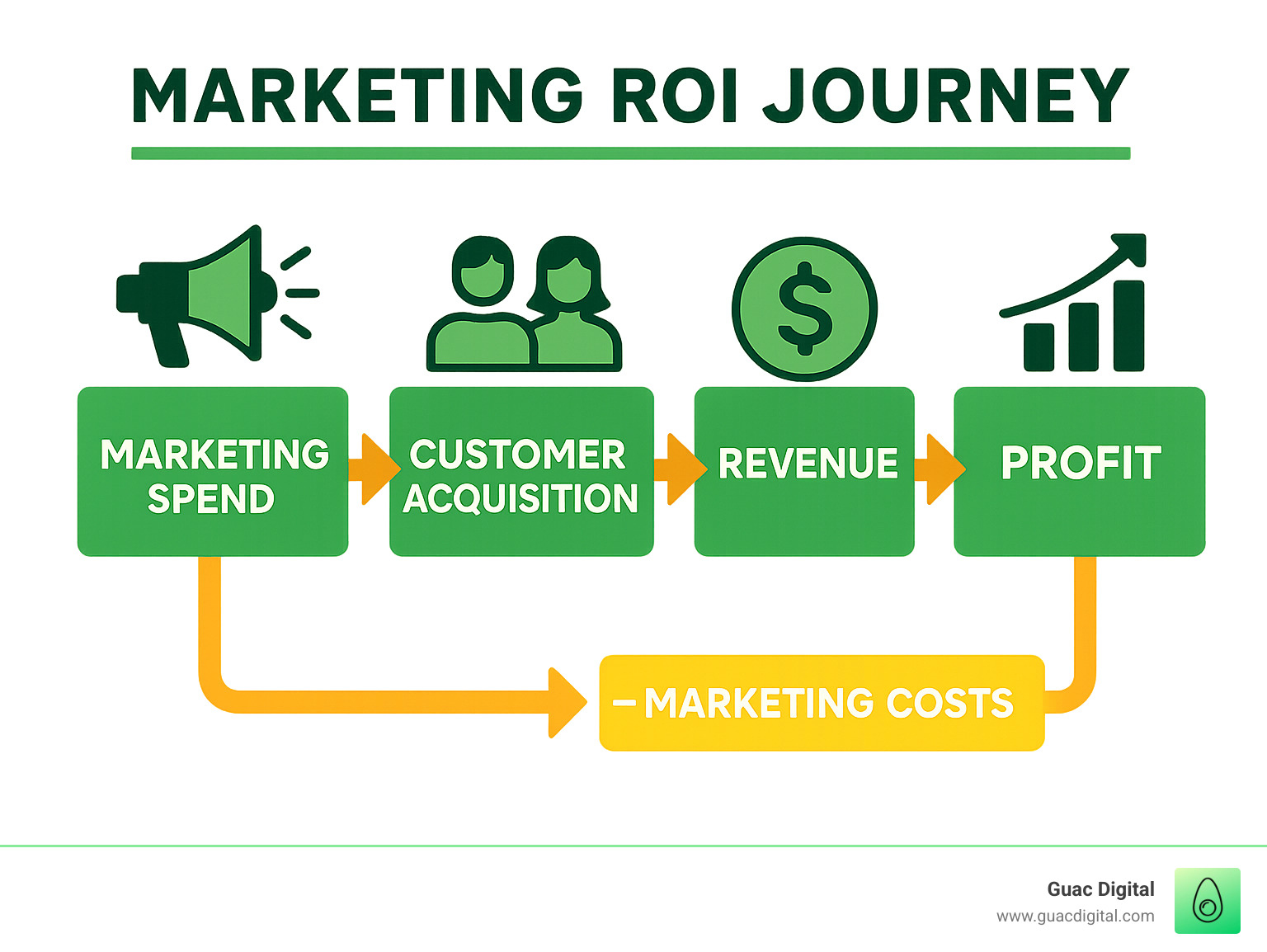
Ever wonder if your marketing dollars are actually working for you? That’s exactly what Marketing ROI tells you – it’s the profit or revenue your business generates compared to what you’ve spent on marketing. At its heart, the concept is beautifully simple:
Marketing ROI = (Revenue Generated from Marketing - Marketing Cost) / Marketing Cost × 100%
But don’t let that simplicity fool you. This little formula packs a powerful punch for your business strategy.
Think about it – when you can clearly show that for every $1 spent on marketing, you’re bringing in $2, $5, or even $10 in return, suddenly those marketing “expenses” transform into smart investments. This isn’t just about number-crunching – it’s about building a sustainable business that grows intelligently.
Why do I call ROI “mission-critical”? Because it fundamentally changes how you run your marketing operations. With solid ROI data, you can justify your marketing budget to even the most skeptical stakeholders. You gain the confidence to allocate resources to channels that actually work, quickly identify underperforming tactics before they drain your budget, and clearly demonstrate marketing’s contribution to your company’s growth.
Perhaps most importantly, understanding your ROI gives you a competitive advantage – while your competitors might be throwing money at the wall to see what sticks, you’re investing strategically for maximum returns.
The numbers back this up. Nielsen research reveals the average marketing ROI hovers around $1.09 for every $1 spent. But here’s the exciting part – with proper analysis and optimization, you can improve advertising effectiveness by 30-40%. That’s the difference between barely breaking even and significant profitability!
Scientific research on marketing ROI accuracy also reveals fascinating insights about how different channels deliver varying impacts. Your PPC campaigns might drive immediate sales spikes, while content marketing and PR build brand equity that compounds over months and years.
From “Nice to Have” to Boardroom KPI
Remember when marketing was considered the “make things pretty” department? Those days are long gone. What is a good ROI for marketing isn’t just a marketer’s concern anymore – it’s a central boardroom discussion.
Today’s leadership teams and investors expect clear accountability for every dollar spent. CMOs who can’t connect their creative campaigns to actual revenue growth find themselves with increasingly shorter tenures. The shift is unmistakable: marketing has evolved from a creative-led function operating on gut feeling to a strategic powerhouse driven by data and measured by financial impact.
At Guac Digital, we’ve witnessed this change with our Tampa clients. They now approach us seeking not just eye-catching campaigns but measurable results they can confidently report to their boards and investors. The conversation has fundamentally changed from “How does this look?” to “What will this return?”
Beyond Dollars: ROMO & Brand Equity
While ROI focuses on financial returns, savvy marketers understand that some marketing efforts create value that’s harder to immediately quantify. This is where ROMO (Return on Marketing Objective) enters the picture.
ROMO expands our understanding of “return” to include non-financial outcomes that ultimately drive business value. These include brand awareness and perception, customer sentiment and loyalty, market share gains, and growth in customer lifetime value.
The good news? Modern sentiment analysis tools now help translate these seemingly intangible assets into quantifiable metrics. For example, we might find that a 10% improvement in brand perception correlates to a 5% increase in sales over time – allowing us to assign actual financial value to brand-building efforts that previously seemed unmeasurable.
Want to dive deeper into how we measure the full spectrum of marketing returns? Learn more about our approach to ROI Marketing and how we help businesses capture both immediate returns and long-term value creation.
How to Calculate Marketing ROI (Formulas, Metrics & CLV)

Let’s face it – marketing math isn’t always sexy, but it’s the secret sauce behind every successful campaign. I’ve worked with hundreds of businesses struggling to make sense of their numbers, and I’m here to explain the process of calculating your marketing returns.
The Simple Equation
At its heart, marketing ROI boils down to a straightforward formula:
ROI = (Sales Growth - Marketing Cost) / Marketing Cost × 100%
Imagine you invested $10,000 in a campaign that generated $50,000 in additional sales. Your calculation would look like this:
ROI = ($50,000 - $10,000) / $10,000 × 100% = 400%
This translates to a 5:1 ratio – you earned $5 for every $1 spent. In my experience, most marketers (and especially executives) find ratios more intuitive than percentages. When someone asks “what is a good ROI for marketing,” saying “we’re seeing a 5:1 return” immediately communicates value in a way that “400%” sometimes doesn’t.
Adjusted for Organic Growth & Margins
The simple formula works for quick estimates, but it doesn’t tell the whole story. What about sales that would have happened anyway? Or the actual cost of delivering your products?
A more sophisticated approach accounts for organic growth:
Adjusted ROI = (Sales Growth - Organic Sales Growth - Marketing Cost) / Marketing Cost × 100%
Let’s say of that $50,000 in growth, research shows $10,000 would have happened without your marketing efforts. Your adjusted calculation becomes:
Adjusted ROI = ($50,000 - $10,000 - $10,000) / $10,000 × 100% = 300%
For businesses with significant product costs, focusing on profit rather than revenue paints a more accurate picture:
Profit-Based ROI = (Gross Profit from Marketing - Marketing Cost) / Marketing Cost × 100%
This distinction is crucial. I’ve seen businesses celebrate a seemingly impressive 5:1 revenue ratio, only to find their actual return was minimal because their COGS consumed 80% of that revenue. Don’t fall into this trap!
Forecasting ROI for Lead Gen & Ecommerce
B2B and lead generation businesses face unique challenges in ROI calculation. Since the sales cycle might take months, we often use pipeline math to forecast expected returns:
Forecasted ROI = (Number of Leads × Close Rate × Average Sale Value - Marketing Cost) / Marketing Cost × 100%
Picture this: your campaign generated 100 leads with a 10% close rate and $5,000 average sale value. Your forecasted ROI would be:
Forecasted ROI = (100 × 0.1 × $5,000 - $10,000) / $10,000 × 100% = 400%
For ecommerce businesses, incorporating metrics like Average Order Value (AOV) and Customer Lifetime Value (CLV) provides a more holistic view:
Ecommerce ROI = (Number of New Customers × CLV - Marketing Cost) / Marketing Cost × 100%
At Guac Digital, we’ve found that businesses that factor in customer lifetime value make dramatically different (and often more profitable) marketing decisions than those focused solely on immediate returns.
For a deeper exploration of these calculation methods, check out our comprehensive guide on How to Calculate Digital Marketing ROI.
| Metric | Formula | Best For | Limitation |
|---|---|---|---|
| ROI | (Revenue – Cost) / Cost | Overall performance | Doesn’t account for margins |
| ROAS | Revenue / Ad Spend | Paid advertising | Focuses only on revenue, not profit |
| CAC | Total Marketing Cost / New Customers | Acquisition efficiency | Ignores customer value differences |
| CLV | Average Order Value × Purchase Frequency × Customer Lifespan | Long-term value | Requires historical data |
Understanding these different metrics isn’t just about impressing your boss with fancy acronyms – it’s about gaining clarity on what’s actually working in your marketing mix. When you know your numbers, you can make confident decisions about where to double down and where to pull back.
What Is a Good ROI for Marketing? Benchmarks & Ratios Explained
Now to the heart of the matter: what is a good ROI for marketing? The answer isn’t one-size-fits-all—it varies depending on your industry, business model, and profit margins. But don’t worry, there are some widely accepted benchmarks that can guide you.

Core Benchmarks: “what is a good roi for marketing” Answered
I’m often asked about marketing ROI targets, and here’s what our experience at Guac Digital has taught us:
A 2:1 ratio (100% ROI) is typically the minimum acceptable return. Think of this as your break-even point when you factor in the cost of goods sold, which often eats up about half of your sale price. You’re not losing money, but you’re not exactly printing it either.
A 5:1 ratio (400% ROI) is where the magic happens. This is considered strong performance and should be the target most businesses aim for. It’s worth noting that Nielsen research shows the average marketing ROI is surprisingly low—just $1.09 for every dollar spent. So if you’re hitting 5:1, give yourself a pat on the back because you’re significantly outperforming the market.
A 10:1 ratio (900% ROI) is the marketing equivalent of striking gold. While certainly possible (we’ve achieved it for clients), setting this as your baseline expectation might lead to disappointment. Consider this your “stretch goal” rather than your standard benchmark.
My advice? Aim for that 5:1 sweet spot as your North Star, understanding that some channels will soar while others might struggle to get off the ground.
Industry, Model & Margin Matter
When it comes to what is a good ROI for marketing, context is everything:
B2B companies with high-value contracts might be perfectly happy with a 3:1 ratio. When each deal is worth six or seven figures, you don’t need as many conversions to justify your marketing spend.
Service-based businesses typically aim for 3:1 to 5:1 ROI, while B2B SaaS companies often shoot higher—targeting 5:1 to 8:1 thanks to their subscription model and healthier profit margins.
Ecommerce businesses, particularly Amazon sellers, often speak a different language altogether. They focus on TACoS (Total Advertising Cost of Sale) instead of ROI, with good performance ranging from 10-30% depending on what they’re selling.
Subscription businesses play the long game. They might accept a negative initial ROI if the Customer Lifetime Value makes sense over time. Sometimes you need to spend $100 to acquire a customer worth $300 over three years.
At Guac Digital, we’ve worked with businesses across Tampa and worldwide to establish realistic ROI benchmarks custom to their specific situation. Trust me—generic averages can be misleading when your business is anything but average.
Short-Term vs Long-Term: “what is a good roi for marketing” Over Time
Time horizon dramatically affects what constitutes “good” ROI:
Short-term campaigns like direct response ads should deliver quick returns. You’re looking for that 3:1 to 5:1 ROI within days or weeks, or it’s time to pivot.
Medium-term investments such as content marketing might start slow but build momentum. Expect a modest beginning that grows to 5:1 or even 8:1 within months as your content gains traction.
Long-term strategies like SEO and brand building require patience. These often show minimal (or even negative) initial ROI but can eventually deliver 10:1 or higher returns as they compound over years. Think of them as the marketing equivalent of retirement savings—the earlier you invest, the bigger the eventual payoff.
For example, an SEO investment might look like a money pit for 6-9 months before delivering a 5:1 return that continues growing as your organic visibility increases. The tortoise often beats the hare in marketing ROI.
Channel Snapshot
Not all marketing channels are created equal when it comes to ROI potential:
Email marketing wears the ROI crown at approximately 36:1 ($36 for every $1 spent), according to industry research. Some studies even suggest returns up to 4,400%. Not too shabby for a channel some mistakenly consider “old school.”
SEO delivers around 22:1 ROI on average, though it requires the patience of a saint as results build over time. The good news? These returns tend to be more sustainable than paid channels.
Paid search (Google Ads) typically returns 2:1 to 8:1, with Google’s economic impact reports suggesting an average of 8:1. Your mileage may vary based on competition in your space.
Social media advertising is the wild card, varying widely from 3:1 to 10:1 depending on platform, targeting precision, and creative quality. A well-executed TikTok campaign can deliver results that make your CFO dance, while a poorly targeted Facebook campaign might just burn cash.
LinkedIn outreach for B2B campaigns can achieve 3:1 to 8:1 ROI when properly targeted. Just remember that LinkedIn users aren’t there to shop—they’re there to network.
Influencer marketing packs a surprising punch, with 89% of marketers reporting that influencer ROI is comparable to or better than other channels. The key is finding authentic partners whose audience actually matches your ideal customer.
For deeper insights into social performance metrics, check out our comprehensive guide on Social Media ROI.
Factors That Influence ROI & Why Measurement Gets Messy
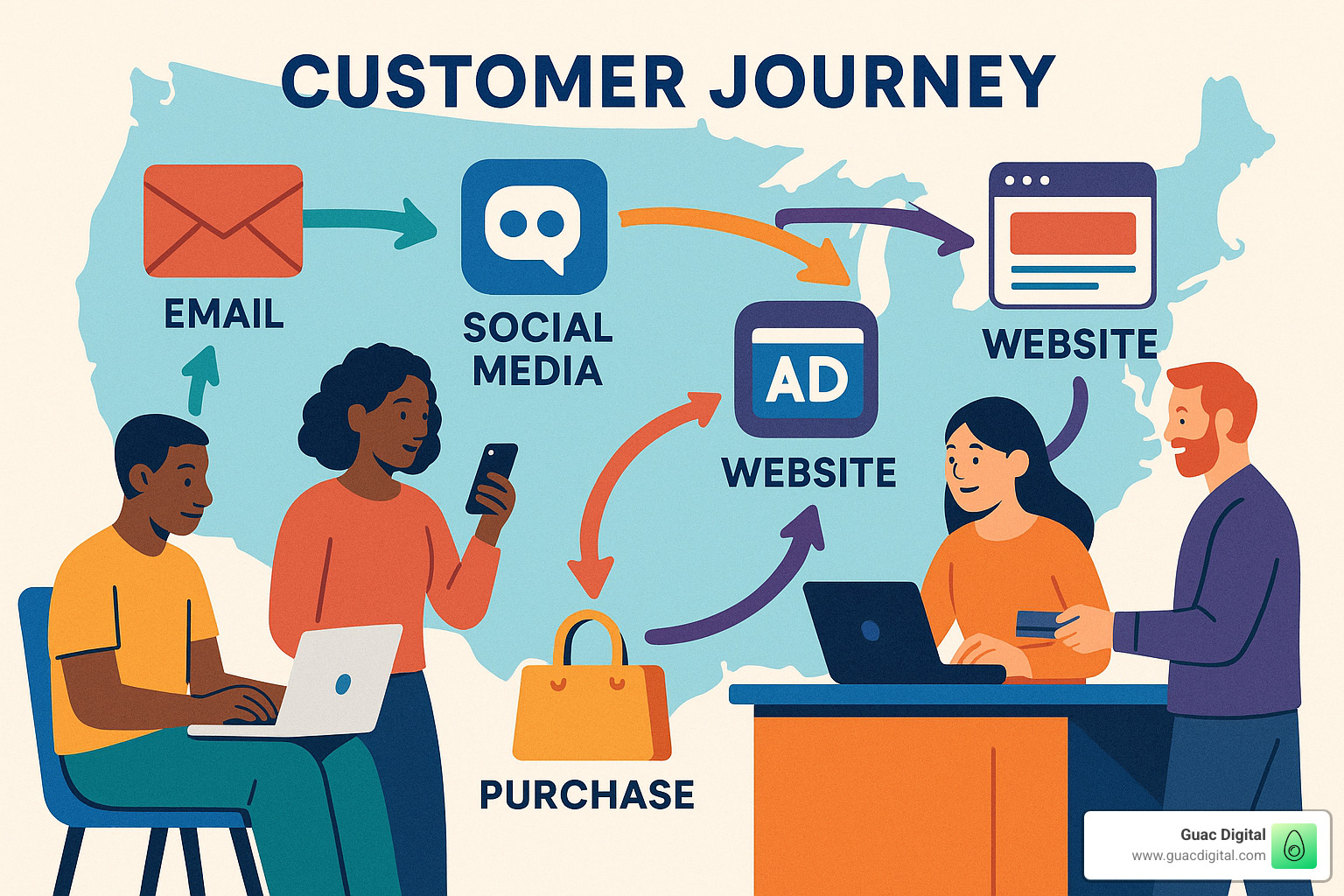
Let’s be honest – figuring out what is a good ROI for marketing would be so much easier if customer journeys were simple straight lines. But they’re not. They’re more like a plate of spaghetti.
At Guac Digital, we’ve seen how messy marketing measurement can get. Most customers interact with 6-10 different marketing touchpoints before pulling out their credit card. That prospect you just closed? They probably saw your Google ad, read your blog post, downloaded your ebook, opened three emails, and checked out your Instagram before deciding to buy.
So who gets the credit for that sale? Your paid search team is claiming it. Your content folks think their blog post sealed the deal. Your email marketers are pointing to that perfectly-timed nurture sequence. And they’re all partially right.
This attribution challenge gets even trickier when you consider how people bounce between devices. Sarah might see your ad on her phone during lunch break, research your company on her work laptop that afternoon, and finally make a purchase from her tablet while watching Netflix that evening. Without proper cross-device tracking, these look like three different customers in your analytics.
Data privacy regulations have thrown another wrench into the works. With GDPR, CCPA, and the death of third-party cookies, our tracking capabilities are becoming more limited just as customer journeys are getting more complex. Talk about unfortunate timing!
Then there’s the question of overhead. When calculating what is a good ROI for marketing, should you include your marketing team’s salaries? Your office space? Your marketing technology stack? Different companies handle this differently, making benchmark comparisons tricky.
Creative quality and seasonality add even more variables to the equation. A brilliant creative concept can deliver twice the ROI of a mediocre one, even with identical spend and placement. And trying to compare holiday season performance to summer doldrums? That’s apples to oranges.
Measurement Pitfalls
The road to accurate ROI measurement is full of potholes. The most common one we see at Guac Digital is last-click bias – giving all the credit to whatever marketing channel touched the customer last. This approach is like crediting only the final runner in a relay race while ignoring everyone who came before.
Many marketers also fall into the vanity metrics trap. Likes, shares, and impressions might make you feel good, but they don’t pay the bills. We’ve worked with clients who were celebrating record-high engagement rates while their actual sales were plummeting.
Siloed data is another major culprit. Your online analytics don’t talk to your CRM, which doesn’t connect to your in-store point-of-sale system. The result? A fragmented view of your customer’s journey that leads to misguided decisions about what is a good ROI for marketing.
Perhaps the most costly mistake is ignoring lifetime value in ROI calculations. That customer you acquired for $100 who made a $150 purchase might seem like a modest win (1.5:1 ROI). But if they go on to spend $1,000 over the next three years, your actual ROI is 10:1. That’s the difference between a campaign you might kill and one you should double down on.
Solving the Attribution Puzzle
Fortunately, there are solutions to these measurement challenges. User-ID tracking systems can help maintain consistent identification across platforms, giving you a more complete picture of the customer journey. For our Tampa clients with significant offline sales, we often implement unique promo codes for each marketing channel to bridge the online-offline gap.
Multi-touch attribution models have come a long way in recent years. Instead of giving all credit to the first or last touchpoint, these models distribute conversion credit across multiple interactions. Some use simple rules (like giving equal credit to each touchpoint), while others use sophisticated algorithms to determine which touchpoints had the most influence.
For larger marketing budgets, marketing mix modeling uses statistical analysis to determine how different channels impact overall sales, even accounting for external factors like seasonality and competitor activities.
According to research on cross-device attribution, implementing advanced tracking can increase attributed conversions by up to 40% and connect 85% of offline sales to digital touchpoints. Those are numbers worth paying attention to if you’re serious about understanding what is a good ROI for marketing for your specific business.
The most sophisticated approach is what we call unified measurement – combining different attribution methods to get a more complete picture. This isn’t just for enterprise companies anymore. At Guac Digital, we’ve developed accessible versions of these approaches for businesses of all sizes, helping our clients see the true impact of their marketing investments.
How to Improve & Track Your Marketing ROI
Now that you understand what is a good ROI for marketing, let’s talk about turning that knowledge into action. I’ve seen countless businesses transform their marketing performance by following a simple principle: measure what matters, optimize what works, and cut what doesn’t.
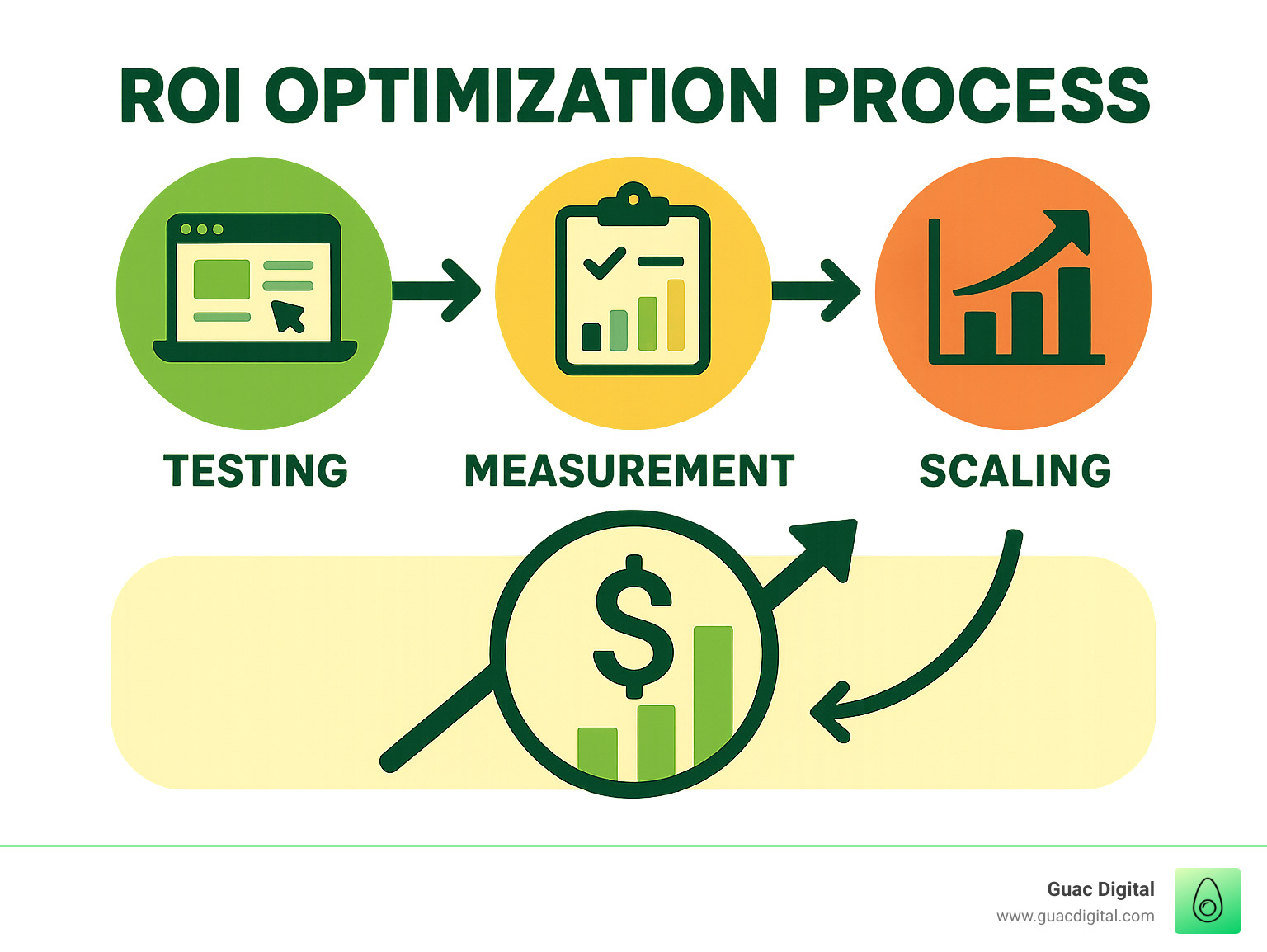
The secret to improving marketing ROI isn’t mysterious – it’s methodical. When we identify a channel that’s delivering strong returns, we don’t immediately double the budget. Instead, we gradually scale investment while watching for that tipping point where returns start diminishing. This careful approach has helped our Tampa clients avoid the common trap of overspending on initially promising channels.
Systematic testing is your best friend here. Every A/B test on your ad creative, landing page, or email subject line creates an opportunity to lift performance without spending an extra dime. I’ve seen conversion rates double from smart testing alone, instantly changing an acceptable ROI into an exceptional one.
Better attribution modeling often reveals hidden value in your marketing mix. Many businesses find that channels they thought were underperforming were actually initiating customer journeys that other channels got credit for completing.
The most overlooked ROI booster? Customer lifetime value. Focusing exclusively on acquisition costs misses the bigger picture. A campaign might seem expensive if you only count the first purchase, but could be your most profitable channel when you factor in repeat business and referrals.
Sometimes the path to better ROI means prioritizing quality over quantity. We’ve helped clients reduce lead volume while dramatically improving lead quality, resulting in higher close rates and lower sales costs. The math is simple: 10 quality leads often outperform 100 mediocre ones.
At Guac Digital, we’ve helped clients leverage programmatic advertising to achieve remarkable ROI improvements. By using big data for precision targeting, we eliminate wasted spend and focus budgets where they’ll generate the highest returns. Learn more about our approach to Programmatic Advertising ROI.
Quick Wins & Long Plays
Want to boost your ROI this quarter? Start with conversion rate optimization. Even small improvements in your conversion funnel can dramatically increase returns without requiring additional spend. I’ve seen a simple checkout page optimization increase conversions by 25%, instantly improving ROI across all acquisition channels.
Email segmentation remains one of the highest-ROI tactics available. When you stop sending the same message to everyone and start tailoring content to specific audience segments, engagement rates typically jump 20-30%. One client saw their email ROI double after implementing basic segmentation.
Don’t overlook the power of content refreshes. Updating high-potential existing content is often far more efficient than creating new material from scratch. Those older blog posts and landing pages already have authority and traffic – they just need a tune-up to convert better.
Retargeting campaigns almost always outperform cold prospecting. When you focus on warm audiences who’ve already shown interest, you’ll typically see conversion rates 3-5x higher than with new prospects. This makes retargeting a reliable ROI booster for most businesses.
Looking for sustained ROI growth over years rather than months? Invest in content marketing that generates leads long after publication. Create SEO foundations that reduce paid acquisition costs over time. Implement marketing automation sequences that nurture leads to higher quality. And don’t forget customer retention programs – reducing churn by just 5% can increase profits by 25-95%, according to research from Bain & Company.
Tech Stack Essentials
You can’t improve what you don’t measure. The right tools make ROI tracking not just possible, but practical:
Google Analytics 4 gives you the foundation for website performance tracking and multi-channel attribution. The shift from Universal Analytics has been challenging for many, but GA4’s event-based model actually provides better insights into customer journeys.
HubSpot CRM connects your marketing activities directly to sales outcomes, closing the loop on ROI measurement. When marketing and sales data live in the same ecosystem, attribution becomes much clearer.
For advanced attribution across online and offline touchpoints, tools like Ruler Analytics help bridge the gap between digital interactions and real-world conversions.
Sprout Social provides social media performance tracking that goes beyond vanity metrics to connect social activities with business outcomes.
E-commerce businesses benefit from platform-specific analytics like Shopify Analytics, which ties marketing campaigns directly to product sales and customer lifetime value.
The right tech stack varies by business model and marketing mix. At Guac Digital, we help clients build custom measurement frameworks that provide clear visibility into their true marketing ROI, not just surface-level metrics.
For businesses working with agencies, understanding how to evaluate their performance is crucial. Learn more about Determining the ROI of a PPC Agency.
Set Realistic ROI Goals & Governance
ROI management isn’t a one-time event – it’s an ongoing practice that requires structure and discipline:
Set SMART targets for each channel based on realistic benchmarks. Specific, Measurable, Achievable, Relevant, and Time-bound goals keep your team focused on outcomes rather than activities.
Create regular dashboards that consolidate reporting and highlight ROI by channel and campaign. When everyone can see what’s working and what isn’t, better decisions happen naturally.
Establish a review cadence with weekly tactical adjustments and monthly strategic assessments. This rhythm keeps you responsive to short-term opportunities while maintaining focus on long-term ROI goals.
Build in budget flexibility so you can shift resources quickly based on performance data. The ability to reallocate spend from underperforming channels to winners can dramatically improve overall ROI.
Cultivate a test-and-learn culture that encourages experimentation while maintaining ROI discipline. Not every test will succeed, but each provides valuable data that improves future decisions.
Many businesses find that working with a specialized agency improves ROI through expert guidance and economies of scale. Learn how to maximize results with agency partnerships in our guide to Maximizing ROI with a Digital Marketing Agency.
Frequently Asked Questions about Marketing ROI
Can marketing ROI be negative?
Absolutely! Just like that diet plan you tried last January, sometimes marketing campaigns don’t deliver the results you hoped for. Negative ROI happens when your campaigns simply don’t generate enough revenue to cover what you spent on them.
This is particularly common when you’re venturing into uncharted territory – testing a new social platform, targeting an unfamiliar audience, or launching a product nobody asked for (we’ve all been there!). Seasonal factors can also tank your numbers, like trying to sell beach umbrellas in December.
Here’s the silver lining though: a negative ROI isn’t always cause for panic. Think of it as paying for market research. You’ve finded something that doesn’t work, which is valuable information! However, if you’re consistently seeing red across your campaigns, it’s definitely time to hit the brakes and reassess.
At Guac Digital, we build safety nets into our campaigns by establishing performance thresholds. When something isn’t working, we don’t wait for the quarterly review – we pivot quickly to protect your overall marketing ROI.
Does a higher ROI always mean campaign success?
Not so fast! While a sky-high ROI might look impressive on paper, context matters enormously.
Consider this: would you rather have a 20:1 ROI on $100 spent (giving you $2,000) or a 5:1 ROI on $10,000 spent (returning $50,000)? The lower percentage actually puts more money in your pocket.
Scale is just one piece of the puzzle. Some tactics deliver amazing returns in small tests but fall apart when you try to scale them. That clever TikTok campaign might crush it with a test budget but struggle to maintain performance when you pour in serious money.
There’s also the halo effect to consider – some campaigns might show modest direct ROI but significantly boost performance across other channels. For instance, that brand awareness campaign might not directly drive sales, but it could boost your conversion rates on Google Ads.
The key is finding the sweet spot between healthy ROI and your broader business objectives. Sometimes a slightly lower ROI is worth it if it helps you break into a new market or attract a more valuable customer segment.
How do I set ROI goals for brand-building campaigns?
Brand campaigns are the marathon runners of marketing – they’re in it for the long haul, not the immediate sprint to conversion. That doesn’t mean they should get a free pass on accountability, though!
When setting ROI expectations for brand initiatives, think longer time horizons. Instead of expecting results in days or weeks, measure impact over 12-24 months to capture those delayed effects that compound over time.
In the meantime, track proxy KPIs that signal you’re moving in the right direction. These might include increases in brand awareness, growing search volume for your brand terms, upticks in direct website traffic, more engaged social media followers, or an expanding share of voice compared to competitors.
Controlled experiments can be particularly revealing. Try running your brand campaign in specific markets while keeping others as control groups. The difference in performance over time can help you isolate the brand impact.
For clients from Tampa to Tokyo, we develop custom measurement frameworks that capture both the immediate returns and the long-term brand value. This balanced approach ensures you’re building both short-term sales and long-term brand equity – because the most successful businesses need both.
What is a good ROI for marketing brand campaigns often looks different than for direct response efforts. Patience and proper attribution are key to seeing the full picture.
Conclusion
Alright, so what’s the verdict on what is a good ROI for marketing? After diving deep into the numbers, formulas, and benchmarks, here’s the simple truth: while a 5:1 ratio (or 400% ROI) serves as a solid target for most businesses, your “perfect” number depends on your specific situation – your industry, your business model, those all-important profit margins, and where you’re headed growth-wise.
I’ve seen companies obsess over hitting arbitrary ROI targets without considering the bigger picture. That’s like judging a baseball player solely on batting average while ignoring runs batted in or on-base percentage. The number matters, but context matters more.
Here’s what really counts:
Measure consistently across all your channels. When you’re comparing apples to oranges (or Facebook ads to email campaigns), you need the same yardstick. Choose your attribution models and stick with them.
Benchmark against businesses like yours. A local Tampa restaurant shouldn’t expect the same ROI as a SaaS company or an ecommerce giant. Your 4:1 might be another company’s 10:1 depending on margins and business model.
Balance your short and long-term vision. Some of your best marketing investments might look terrible on paper for the first six months. SEO often works this way – patience pays off with compounding returns that eventually dwarf your paid channels.
Never stop optimizing. Marketing ROI isn’t something you “solve” once and forget about. It’s an ongoing cycle of testing, learning, and reallocating resources to what’s working best right now.
Look beyond the raw numbers. A campaign with moderate ROI might be introducing you to entirely new customer segments or building foundation for future growth. Sometimes the story behind the metric matters more than the metric itself.
At Guac Digital, we’re genuinely passionate about helping businesses in Tampa and worldwide achieve exceptional marketing ROI. It’s not just about hitting a number – it’s about creating sustainable growth through smart, data-driven decisions. Our programmatic approach taps into the power of big data to find exactly the right audiences and deliver personalized messages that resonate, consistently beating those industry benchmarks.
Marketing ROI isn’t a destination you reach once; it’s a journey of constant refinement. The frameworks and strategies we’ve outlined here aren’t just theoretical – they’re the same practical approaches we use with our clients every day to drive real business growth.
Ready to transform your marketing ROI from guesswork to greatness? Learn more about our services and how we can help you achieve exceptional returns on every marketing dollar you invest.
