
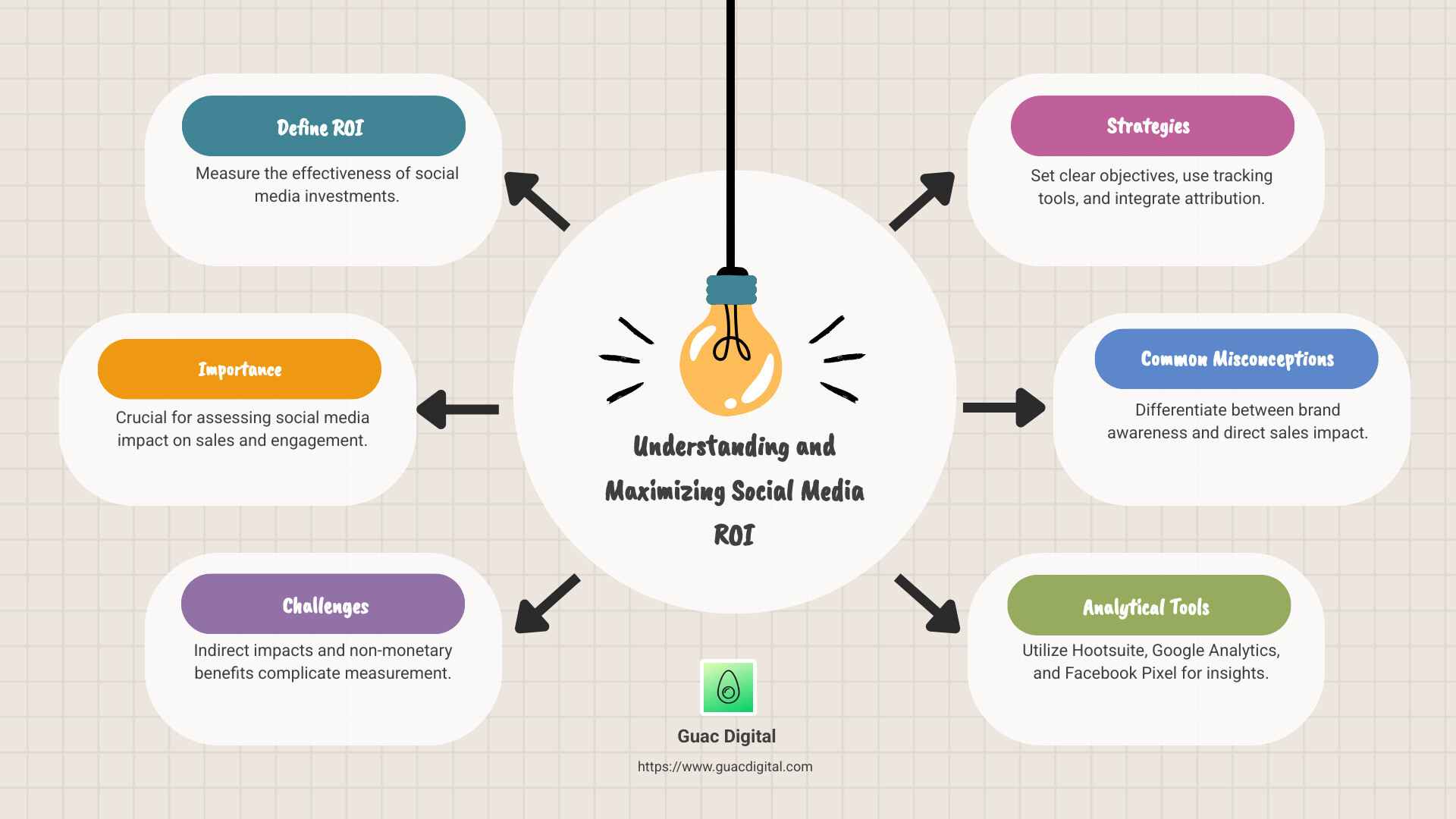
Social media ROI is a crucial metric that determines the effectiveness of your investments in social media channels. This isn’t just about likes or shares; it’s about tangible outcomes like increased sales, brand visibility, and customer engagement. Here’s a quick overview:
- Importance: Social media ROI helps you understand the return on your social media efforts and spending.
- Challenges: Measuring ROI can be complex due to indirect impacts and non-monetary benefits.
- Strategies: Focus on setting clear objectives, using precise tracking tools, and integrating multi-touch attribution for accuracy.
In today’s digital landscape, understanding social media ROI can make or break your strategy. While many business owners recognize its potential, they often struggle with precise measurement and maximizing returns. Addressing these challenges is essential for navigating the digital marketing world successfully.
I’m Guy Leon, the founder and CEO of Guac Digital. With years of experience crafting successful digital campaigns that significantly improve our clients’ social media ROI, I’m here to guide you through this journey. Let’s dig deeper into how strategic efforts can maximize your social media returns.
Social media roi vocabulary:
– how to calculate digital marketing roi
– roi marketing
Understanding Social Media ROI
Social media ROI is a financial metric that calculates the return on your social media investments. It’s not just about the number of followers or likes but how these efforts translate into real business value.
Definition and Importance
At its core, ROI measures how much revenue your social media activities generate compared to the costs involved. If you’re spending $1,000 on a campaign and it brings in $1,200 in revenue, your ROI is 20%. This tells you that for every dollar spent, you earned an additional 20 cents.
Understanding this metric is crucial. It helps businesses decide if their social media strategies are effective and worth continuing. A positive ROI indicates profitable campaigns, while a negative ROI suggests the need for strategy adjustments.
Business Value and Financial Metric
The true business value of social media lies in its ability to drive sales, increase brand awareness, and improve customer engagement. Social media can be a powerful tool for building relationships with customers and driving long-term loyalty.
By using social media ROI as a financial metric, businesses can align their social media efforts with broader financial goals. This alignment ensures that social media strategies contribute to the overall profitability and growth of the business.
Revenue from Social Media
Revenue from social media can come from various sources, such as direct sales from ads, increased website traffic leading to purchases, or even new customer acquisitions. For example, a jewelry brand might spend $2,000 on an Instagram campaign that results in $2,400 in sales, yielding a 20% ROI.
Costs of Social Media Investment
When calculating ROI, consider all costs associated with social media activities. This includes not only the direct costs like ad spend but also indirect costs such as time spent by employees, content creation, and platform management fees.
By understanding both the revenue generated and the costs involved, businesses can make informed decisions about where to allocate their marketing budgets for maximum impact.
In summary, social media ROI is a vital metric for assessing the effectiveness of your social media investments. It bridges the gap between social media activities and their financial outcomes, providing a clear picture of how these efforts contribute to your business’s bottom line.
How to Calculate Social Media ROI
Calculating social media ROI might seem tricky, but it boils down to a simple formula:
ROI = [(Value Generated – Costs) ÷ Costs] x 100
This formula helps you understand how much profit you’re making from your social media investments. Let’s break it down with some practical examples.
Value Generated
The “value generated” refers to the revenue or benefits your social media campaign brings in. This could be direct sales, new leads, or even increased website traffic. For instance, if a campaign on Instagram results in $50,000 in sales, that’s your value generated.
Costs
Costs include all expenses related to the campaign. This isn’t just about ad spend. Consider content creation, software subscriptions, and even the time your team spends. For example, if you spend $10,000 on ads, $5,000 on creating content, and $3,000 on tools, your total cost is $18,000.
E-commerce Example
An e-commerce business runs a social media campaign and generates $50,000 in sales. Their total costs, including ads and content, amount to $18,000. Using the ROI formula:
[ \text{ROI} = \left(\frac{50,000 – 18,000}{18,000}\right) \times 100 = 178\% ]
This means the campaign generated 178% more value than what was invested.
B2B Example
For a B2B company focused on lead generation through LinkedIn, let’s say they acquire 100 qualified leads, each valued at $200, totaling $20,000. Their costs are $2,000 for ads, $1,500 for content, and $500 for analytics tools, totaling $4,000. The ROI calculation would be:
[ \text{ROI} = \left(\frac{20,000 – 4,000}{4,000}\right) \times 100 = 400\% ]
This impressive 400% ROI shows a strong return on investment, proving the campaign’s effectiveness.
Understanding these calculations helps businesses make informed decisions about their social media strategies. By knowing how to calculate social media ROI, you can evaluate the success of your campaigns and optimize your efforts for even better results.
Next, we’ll explore proven strategies to maximize your social media ROI, diving into key performance indicators and optimization techniques.
Proven Strategies to Maximize Social Media ROI
To make the most of your social media investments, it’s crucial to adopt strategies that maximize your social media ROI. Here’s how you can do it:
Identify Key Performance Indicators (KPIs)
KPIs are the backbone of measuring your social media success. They provide a clear picture of how your efforts align with business goals. Key KPIs include:
- Brand Awareness: Track metrics like reach and impressions to see how many people are exposed to your brand.
- Engagement: Look at likes, shares, comments, and mentions. This shows how well your content resonates with your audience.
- Conversions: Monitor actions like sign-ups, downloads, or purchases to gauge how effective your campaigns are in driving desired outcomes.
- Customer Satisfaction: Use surveys or feedback forms to measure customer happiness and loyalty.
Optimize Your Social Media Strategy
Optimization is about constant improvement. Here’s how to refine your strategy:
Testing and Optimizing: Regularly test different content types and strategies. A/B testing can help you determine what works best. For example, try different post formats or call-to-action phrases.
Content Performance: Use analytics to track which posts get the most engagement. Scale up successful content and tweak or drop what’s not working.
Audience Targeting: Tailor your content to specific audience segments. Use insights from platforms like Facebook and Instagram to understand your audience better.
Leverage Analytics Tools
Analytics tools are indispensable for tracking your progress:
Hootsuite Analytics: Monitor your social media performance across platforms and get insights into your audience and content.
Google Analytics: Use it to track website traffic from social media and understand user behavior.
Facebook Pixel: This tool helps you track conversions and optimize ads for better performance.
Adobe Analytics: Offers advanced insights into customer interactions, helping you refine your strategies.
Competitor Analysis
Keeping an eye on your competitors can give you a competitive edge:
Tracking Competitors: Use tools like Hootsuite Analytics to see what your competitors are doing. Analyze their successful strategies and adapt them to your needs.
Benchmarking: Compare your performance with industry standards. This helps you set realistic goals and measure your progress.
Use UTM Parameters
UTM parameters are essential for tracking the effectiveness of your social media links:
Tracking URLs: Add UTM codes to your URLs to see where your traffic is coming from. This helps in understanding which posts drive the most traffic.
Measuring Traffic and Conversion Tracking: Use these parameters to track conversions from specific campaigns. This data is crucial for calculating your social media ROI and optimizing future campaigns.
By implementing these strategies, you can significantly improve your social media ROI, ensuring your efforts translate into tangible business outcomes.
Next, we’ll dig into the top social media platforms for achieving high ROI and how to leverage them effectively.
Top Social Media Platforms for High ROI
Choosing the right social media platform can dramatically boost your social media ROI. Each platform offers unique features and benefits, making them suitable for different goals and audiences. Let’s explore the top platforms that can deliver high returns on your investment.
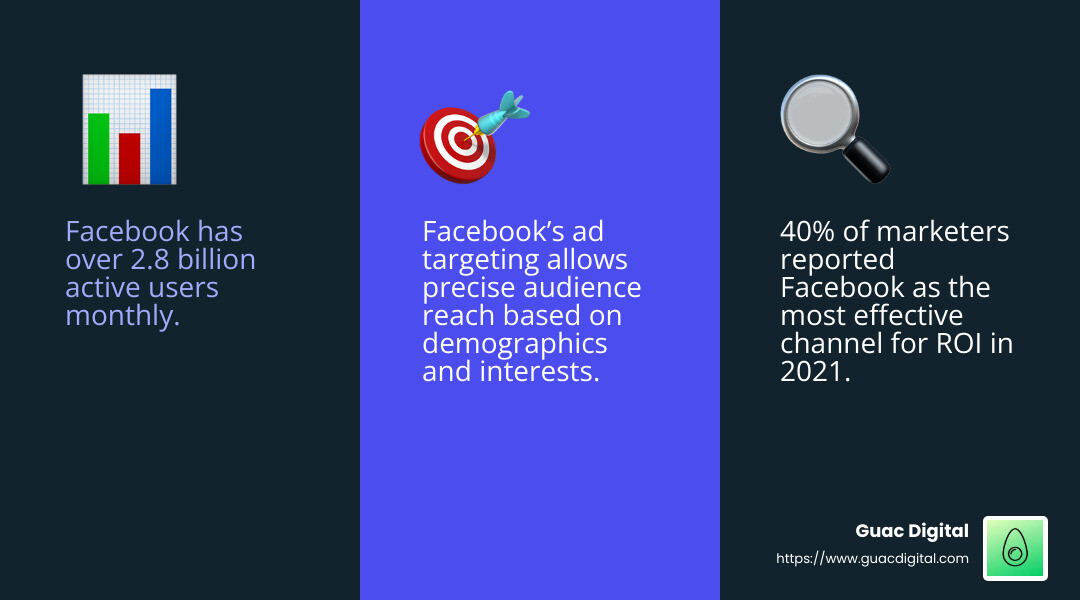
With over 2.8 billion active users monthly, Facebook is a powerhouse for reaching diverse audiences. Its sophisticated ad targeting capabilities allow you to pinpoint specific demographics, interests, and behaviors, ensuring your ads reach the right people.
- User Base: Massive and varied, making it ideal for both B2C and B2B marketing.
- Ad Targeting: Facebook’s robust targeting features help you reach niche audiences effectively.
- Engagement Metrics: Track likes, shares, and comments to gauge content resonance.
Instagram is the go-to platform for brands that thrive on visual content. With an engagement rate higher than Facebook, it’s perfect for brands looking to connect with a younger audience.
- Visual Content: Use eye-catching images and videos to captivate your audience.
- Engagement Rate: Known for high engagement, especially with visual and story content.
- Influencer Marketing: Collaborate with influencers to expand your reach and credibility.
YouTube
As the second-largest search engine, YouTube offers incredible opportunities for video content and audience engagement. It’s a platform where creative storytelling can lead to significant returns.
- Video Content: Leverage the power of video to tell compelling stories and showcase products.
- Audience Reach: Tap into a global audience with diverse interests.
- Monetization: Use ads and partnerships to generate revenue directly from your content.
LinkedIn stands out for B2B marketing and professional networking. It’s the ideal platform for generating leads and building business relationships.
- B2B Marketing: Reach decision-makers and industry professionals directly.
- Lead Generation: Use LinkedIn’s tools to connect with potential clients and partners.
- Professional Network: Build a network of industry contacts and thought leaders.
Each platform has its strengths and can contribute significantly to your social media ROI. By understanding and leveraging these unique features, you can optimize your social media strategy for maximum impact.
Next, we’ll address some common misconceptions about social media ROI and how to steer them effectively.
Common Misconceptions about Social Media ROI
When it comes to social media ROI, there are several misconceptions that can lead businesses astray. Let’s clear up some of these myths to help you make informed decisions.
Brand Awareness vs. Sales
One common misconception is that social media is only good for building brand awareness, not for driving sales. While it’s true that social media can significantly boost brand visibility, it can also directly influence purchasing decisions. According to TIME’s Social Media Strategist, Tameka Bazile, 75% of people who follow brands on social media plan to purchase from them. This statistic highlights the potential of social media to convert followers into customers, proving that brand awareness and sales are not mutually exclusive.
Virality
Another myth is that going viral equals high social media ROI. While viral content can increase visibility, it doesn’t always translate to meaningful engagement or sales. Eileen Kwok from Hootsuite explains that virality should not be the ultimate goal. Instead, focus on creating content that addresses audience pain points and fosters genuine engagement. Virality is great, but consistent and targeted engagement is more valuable in the long run.
Engagement Metrics
Many businesses focus heavily on engagement metrics like likes, shares, and comments, thinking they are the ultimate indicators of success. However, these metrics alone don’t give a complete picture of social media ROI. While engagement is important, it’s crucial to link these interactions to tangible business outcomes. For instance, track how engagement leads to website visits, lead generation, or sales. This approach provides a more comprehensive view of your social media performance.
Long-Term Value
Social media is often seen as a tool for achieving quick results. However, its true power lies in its long-term value. Building a strong social media presence takes time, but it can lead to sustained customer loyalty and brand advocacy. According to a 2024 Deloitte Digital survey, brands with mature social strategies experience an average year-over-year revenue growth of 10.2%. This underscores the importance of patience and persistence in realizing the full potential of social media.
By understanding and addressing these misconceptions, businesses can better harness the power of social media to drive real, measurable results. Next, we’ll dive into frequently asked questions about social media ROI to further improve your understanding.
Frequently Asked Questions about Social Media ROI
What is a good social ROI?
When it comes to determining what constitutes a “good” social media ROI, there’s no one-size-fits-all answer. However, industry benchmarks suggest that an ROI of 5:1 (500%) is considered strong, meaning you earn $5 for every $1 spent. For social media, a 300% ROI is often seen as a reasonable target, especially given the varying nature of platforms and strategies.
To put this into perspective, if you invest $100 in a campaign and generate $300 in revenue, that’s a 300% ROI. This ratio shows that your investment is yielding three times the return, which is generally favorable in the marketing world.
Does social media have a high ROI?
Social media can indeed deliver a high ROI, but it largely depends on how effectively you use the platforms. Different platforms excel in different areas:
- Facebook is known for its robust ad targeting capabilities and large user base, making it cost-effective for reaching a broad audience.
- Instagram shines with visual content and high engagement rates, particularly beneficial for brands focusing on aesthetics and influencer marketing.
- LinkedIn is ideal for B2B marketing and lead generation, offering a professional network that can drive high-quality leads.
- YouTube provides vast audience reach through video content, which can be monetized effectively.
Each platform has its strengths, and the key is to align your strategy with the platform that best suits your business goals. This alignment can significantly improve your ROI.
Why is measuring social media ROI important?
Measuring social media ROI is crucial for several reasons:
Resource Allocation: Knowing your ROI helps you allocate resources more effectively. You can invest more in strategies that yield high returns and cut back on those that don’t.
Strategy Optimization: By understanding what works, you can optimize your strategies to improve performance. This might involve tweaking your content, adjusting your targeting, or experimenting with new platforms.
Proving Value: Demonstrating a positive ROI is essential for justifying your social media spend to stakeholders. It shows that your efforts contribute to the company’s bottom line, which can help secure future budgets and support.
In conclusion, understanding and tracking your social media ROI not only helps in making informed decisions but also ensures that your marketing efforts align with your business objectives. Next, we’ll explore the top social media platforms that can offer the highest ROI for your business.
Conclusion
Maximizing your social media ROI is not just about tracking numbers; it’s about aligning your social media efforts with your business goals. We’ve explored how understanding key metrics, optimizing strategies, and leveraging tools can significantly improve your return on investment. From defining clear KPIs to using UTM parameters for precise tracking, each step plays a crucial role in ensuring your social media efforts are both effective and efficient.
Continuous improvement is essential. Social media is a dynamic field, requiring constant adaptation to new trends, technologies, and consumer behaviors. Regularly reviewing and refining your strategies will keep you ahead of the curve and ensure sustained success.
At Guac Digital, we specialize in crafting personalized digital marketing strategies that drive high ROI. Our expertise in big data and programmatic marketing allows us to tailor campaigns that meet the unique needs of each client. Whether you’re a small business or a global brand, our team is dedicated to helping you achieve and surpass your social media goals.
Ready to take your social media strategy to the next level? Explore our services and see how we can help you maximize your ROI today.