
ROI marketing is the art and science of understanding how well your marketing campaigns are performing in terms of their return on investment. Here’s a quick breakdown of how to calculate ROI in marketing:
- Formula: (Sales Growth – Marketing Cost) / Marketing Cost
- Key Use: Justifies marketing spend and helps allocate budgets
- Benefits: Measures campaign success, increases competitive analysis, and optimizes marketing efforts
Every marketing dollar matters, especially for business owners looking to improve their digital presence and drive more targeted traffic. By analyzing the return on investment for each marketing strategy, businesses can make smarter decisions that directly impact their bottom line and foster growth.
I’m Guy Leon, founder and CEO of Guac Digital. My team and I have consistently demonstrated expertise in roi marketing, driving significant engagement and conversion gains for our clients. Next, let’s dive deeper into understanding the process and how you can maximize your investment in marketing strategies.
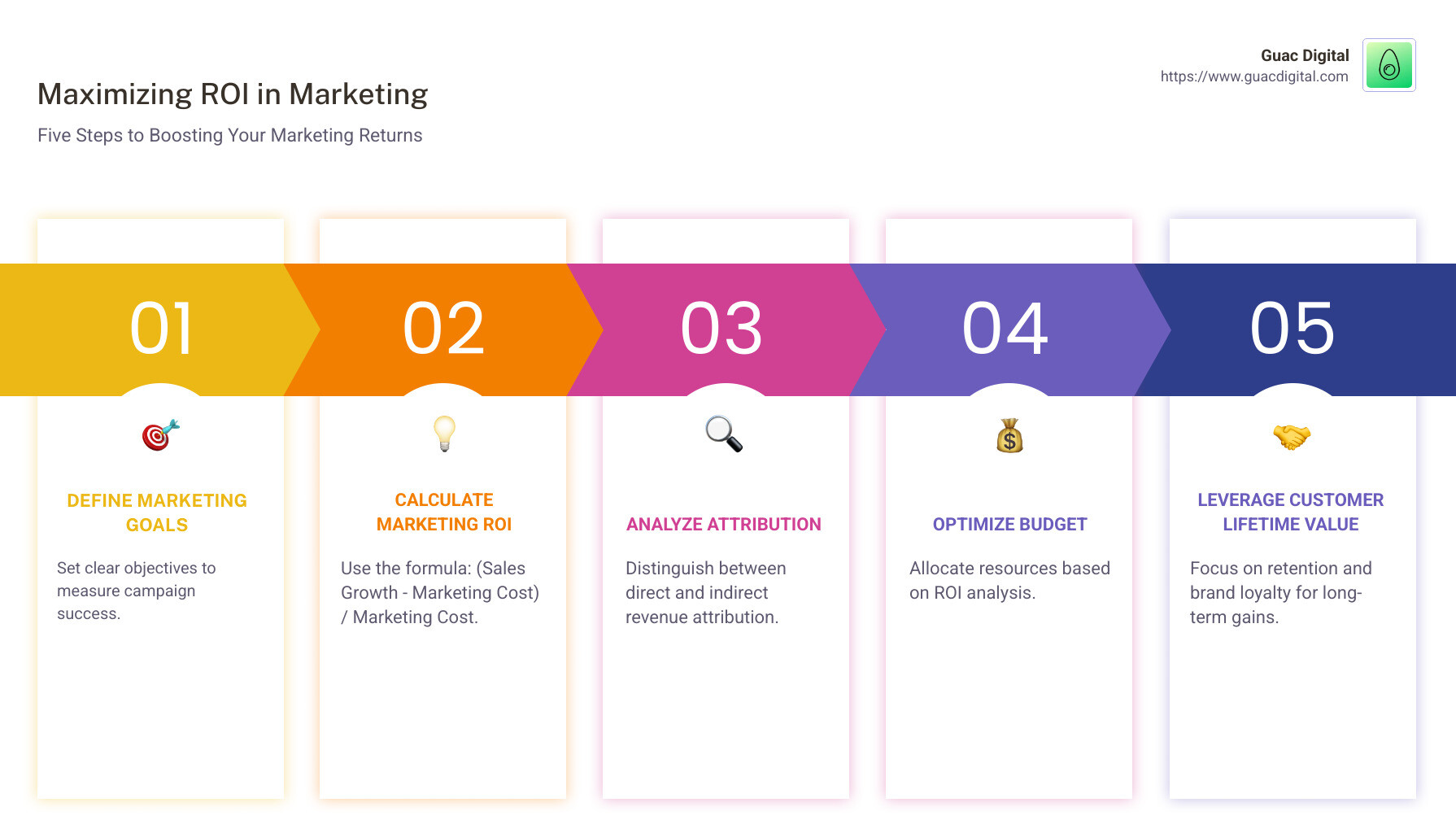
Step 1: Define Your Marketing Goals
Before diving into the numbers, it’s crucial to set clear marketing objectives. Think of these as your roadmap to success. Without clear goals, it’s like trying to score in a game without knowing where the goalpost is!
Why Set Marketing Objectives?
Direction and Focus: Objectives help you stay on track. Whether you’re aiming to increase brand awareness or boost sales, having a clear goal keeps your team aligned and motivated.
Measuring Success: With objectives, you can measure campaign success. Did you achieve what you set out to do? If not, it’s a chance to learn and adjust.
Data-Driven Strategies: Objectives allow you to leverage data-driven strategies. By analyzing past performances and market trends, you can tailor your campaigns for better outcomes.
How to Set Effective Marketing Objectives
Be Specific: Instead of saying “increase sales,” aim for “increase sales by 20% in Q1 2024.”
Make Them Measurable: Use metrics like click-through rates, conversion rates, or customer acquisition costs to quantify your goals.
Achievable and Realistic: Set goals that challenge your team but are still within reach.
Time-Bound: Set a deadline. This creates urgency and helps track progress.
Real-Life Example
At Guac Digital, we helped a client define their marketing objectives by focusing on increasing their customer lifetime value. By targeting existing customers with personalized campaigns, we boosted retention rates by 15% over six months.
Tools for Setting Objectives
- Surveys: Gather customer feedback to understand what they value.
- Analytics Platforms: Use tools like Google Analytics to track progress and adjust strategies.
By defining your marketing goals, you lay the foundation for a successful roi marketing strategy. Next, we’ll explore how to calculate and maximize your return on investment.
Step 2: Calculate Marketing ROI
Once you’ve set your marketing goals, it’s time to calculate your ROI marketing. This helps you see if your marketing campaigns are paying off. Let’s break it down into simple steps:
Understanding the ROI Formula
The basic formula for calculating Marketing ROI is:
[ \text{ROI} = \frac{(\text{Sales Growth} – \text{Marketing Cost})}{\text{Marketing Cost}} ]
This formula helps you figure out how much profit you gain for every dollar spent on marketing.
Key Components
Sales Growth: This is the increase in revenue that can be attributed to your marketing efforts. It’s crucial to isolate the sales that come specifically from your campaigns. For example, if your sales grew from $10,000 to $15,000, your sales growth is $5,000.
Marketing Cost: This includes all expenses related to running your marketing campaigns. Think of costs like media buys, creative development, and any agency fees. For example, if you spent $2,000 on your campaign, that’s your marketing cost.
Example Calculation
Let’s say you spent $2,000 on a campaign, and your sales grew by $5,000. Plugging these numbers into the formula:
[ \text{ROI} = \frac{(5,000 – 2,000)}{2,000} = 1.5 ]
This means for every dollar spent, you earned $1.50 in profit. A good rule of thumb is aiming for a 5:1 ratio for a strong return. An exceptional ROI would be around a 10:1 ratio.
Real-Life Case Study
A fashion magazine wanted to boost subscriptions using social media. By investing in targeted ads, they tracked how many free trial users converted to paid subscribers. This direct attribution allowed them to calculate a precise ROI, showing that the campaign was worth the investment.
Tools for Calculation
- Analytics Software: Platforms like Google Analytics can help track sales growth and marketing costs.
- ROI Calculators: Use online tools to quickly plug in your numbers and get results.
Calculating your Marketing ROI provides a clear picture of your campaign’s effectiveness. Next, we’ll dig into how to analyze both direct and indirect attributions for a comprehensive understanding of your marketing impact.
Step 3: Analyze Direct and Indirect Attribution
Understanding the impact of your marketing efforts can be tricky. That’s where direct and indirect attribution come into play. These methods help you see how each marketing touchpoint contributes to your revenue.
What is Direct Attribution?
Direct attribution is like giving all the credit to the last person who scored in a team sport. It attributes all the revenue from a sale to the last marketing interaction before the purchase. For example, if a customer clicks on an ad and makes a purchase, that ad gets all the credit for the sale.
Pros:
– Simple and easy to track.
– Great for campaigns with a clear call-to-action.
Cons:
– Ignores the influence of earlier touchpoints in the customer journey.
What is Indirect Attribution?
Indirect attribution spreads the credit across all marketing touchpoints. Think of it as sharing the trophy with the whole team. This method considers all the interactions a customer had before making a purchase, like seeing a social media post, reading an email, and then finally clicking an ad.
Pros:
– Provides a holistic view of the customer journey.
– Recognizes the contribution of every touchpoint.
Cons:
– Can be complex and require advanced analytics tools.
Revenue Attribution: The Bigger Picture
Revenue attribution helps you understand which marketing efforts are actually driving sales and contributing to your bottom line. By combining direct and indirect attribution, you get a clearer picture of your marketing impact.
Case Study: Social Media Campaigns
A fashion magazine used both direct and indirect attribution to analyze their social media campaigns. While direct attribution showed that the final ad led to a purchase, indirect attribution revealed that earlier posts and email newsletters also played a significant role in nurturing the lead. This comprehensive analysis led to a more balanced marketing strategy.
Tools for Attribution Analysis
- Multi-Touch Attribution Models: These models help in distributing credit across multiple touchpoints.
- Customer Relationship Management (CRM) Systems: Tools like HubSpot can track and attribute revenue to specific campaigns.
Analyzing both direct and indirect attribution gives you a complete understanding of your marketing efforts. This insight is crucial for optimizing your campaigns and ensuring your budget is well-spent. Next, we’ll explore how to optimize your marketing budget for maximum impact.
Step 4: Optimize Your Marketing Budget
Optimizing your marketing budget is like fine-tuning a musical instrument. You need to allocate resources wisely to hit the right notes and achieve harmony in your campaigns.
Budget Allocation: The Key to Success
Think of budget allocation as dividing a pie. You want to ensure each slice is just the right size for each marketing channel.
Assess Your Channels: Start by evaluating the performance of each marketing channel. Which ones are delivering the best ROI? Channels that consistently show a high return might deserve a bigger budget slice.
Set Priorities: Not all marketing activities are created equal. Prioritize high-impact campaigns that align with your business goals. For instance, if email marketing is driving more sales than social media, consider reallocating funds accordingly.
Monitor and Adjust: Regularly review your budget allocation. The marketing landscape changes quickly, and staying flexible allows you to seize new opportunities.
Marketing Spend: Getting the Most Bang for Your Buck
Your marketing spend should be strategic, not random. Here’s how to ensure every dollar works hard for you:
Track Everything: Use tools like Google Analytics or CRM systems to monitor where your money goes and what it brings back. This data-driven approach helps identify waste and opportunities for improvement.
Test and Learn: Experiment with small portions of your budget on new campaigns or platforms. Use the results to guide larger investments. If a new tactic shows promise, it might be worth scaling up.
Avoid Over-Spending: Be cautious of overspending on trendy channels that don’t align with your audience. Stick to what’s proven to work for your business.
Resource Distribution: Balancing the Load
Efficient resource distribution means ensuring your team and tools are in sync and optimized:
Leverage Technology: Invest in marketing automation tools to streamline processes and reduce manual workload. This frees up your team to focus on strategy and creativity.
Cross-Train Your Team: Equip your team with skills across multiple areas. This flexibility allows them to pivot quickly and cover gaps when needed.
Outsource Wisely: Sometimes, it’s more cost-effective to hire external experts for specialized tasks. This can boost quality without straining internal resources.

Optimizing your marketing budget is a continuous process. By wisely allocating your budget, strategically spending, and efficiently distributing resources, you set your business up for sustained success. Up next, we’ll explore how to leverage customer lifetime value to maximize your marketing returns.
Step 5: Leverage Customer Lifetime Value
Leveraging customer lifetime value (CLV) is like nurturing a garden. The more care you give, the more fruitful the relationship becomes. Let’s explore how you can use CLV to boost your roi marketing efforts.
Understanding Customer Lifetime Value
Customer lifetime value is the total worth of a customer to your business over the entire period of their relationship with you. It’s a critical metric because acquiring new customers is often more expensive than retaining existing ones.
Calculate CLV: Start by determining the average order value and multiplying it by the repeat purchase rate. This gives you an estimate of how much revenue a customer can bring over time.
Track Purchases: Look at how often and how much each customer buys. This data helps in predicting their future spending and informs marketing strategies.
Boosting Retention Rate
A high retention rate means customers are sticking around and continuing to buy from you. Here’s how to keep them coming back:
Loyalty Programs: Implement programs that reward repeat customers. Points systems, discounts, or exclusive offers can encourage continued engagement.
Personalized Communication: Keep in touch with your customers through personalized emails and offers. This makes them feel valued and more likely to remain loyal.
Excellent Customer Service: Ensure every interaction with your brand is positive. Happy customers are more likely to stay and spread the word about your business.
Building Brand Loyalty
Brand loyalty is the emotional connection customers have with your brand. It’s what keeps them choosing you over competitors.
Consistent Branding: Ensure your brand message and values are consistent across all channels. This builds trust and recognition.
Engage on Social Media: Use platforms like Facebook and Instagram to interact with your audience. Responding to comments and messages shows that you care about their opinions.
Quality Products and Services: Delivering high-quality products or services is the foundation of brand loyalty. If customers trust your quality, they’ll keep coming back.
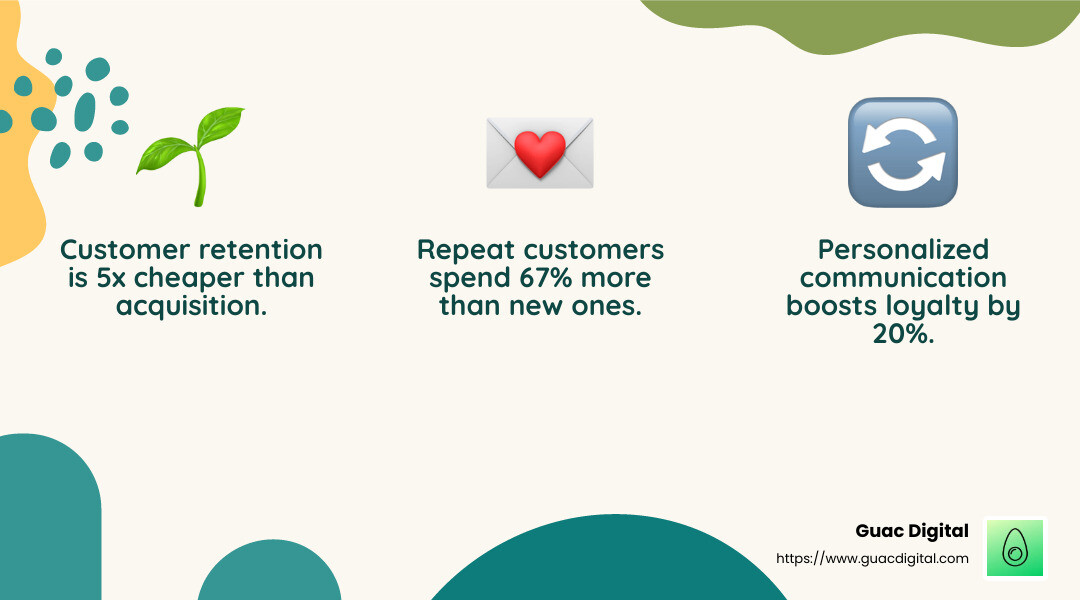
By focusing on customer lifetime value, enhancing retention rates, and building strong brand loyalty, you can significantly improve your marketing ROI. These strategies not only increase revenue but also create a loyal customer base that advocates for your brand.
In the next section, we’ll answer some frequently asked questions about ROI marketing to help you further understand this essential concept.
Frequently Asked Questions about ROI Marketing
What is a Good Marketing ROI?
When it comes to ROI marketing, a good return on investment is often seen as a 5:1 ratio. This means for every dollar spent on marketing, you should aim to get five dollars back in revenue. However, an exceptional ROI would be a 10:1 ratio, which indicates a highly profitable campaign.
But remember, these numbers can vary based on industry and overhead costs. For instance, companies with lower production costs might find a lower ratio acceptable. It’s crucial to know your specific business needs and industry standards to determine what qualifies as “good” for you.
How Do You Measure Marketing ROI?
Calculating marketing ROI might sound tricky, but it boils down to a simple formula:
[ \text{ROI} = \frac{\text{Sales Growth} – \text{Marketing Cost}}{\text{Marketing Cost}} ]
Sales growth should account for the increase in revenue directly linked to your marketing efforts. Don’t forget to subtract organic sales growth, which is the increase in sales that would have happened without any marketing.
To truly understand the marketing impact, consider both direct and indirect contributions to sales. Direct attribution links sales directly to marketing efforts, while indirect attribution considers brand awareness and customer engagement, which might not immediately result in sales but are crucial for long-term success.
Is ROI Marketing Worth It?
Investing in ROI marketing is generally worth it, especially if you aim for a high ROI. A well-planned marketing campaign can be cost-effective and lead to significant returns.
For example, companies that achieve a 5:1 or higher ROI often see substantial profitability. These high returns justify the marketing spend and demonstrate the campaign’s effectiveness.
However, focus not just on immediate sales but also on long-term goals like customer loyalty and brand recognition. By doing this, your marketing efforts will not only pay off now but continue to benefit your business in the future.
By understanding what makes a good ROI, how to measure it, and its overall value, you can optimize your marketing strategies for maximum effectiveness. In our next section, we’ll dive deeper into the conclusion of our discussion on ROI marketing, highlighting how Guac Digital can help tailor strategies for your business.
Conclusion
In ROI marketing, achieving a high return on investment is not just a goal—it’s a necessity for sustaining and growing your business. At Guac Digital, we specialize in crafting personalized strategies that are designed to deliver exceptional ROI for our clients.
Why Choose Guac Digital?
Custom Campaigns: We understand that each business is unique, and so are its marketing needs. Our approach involves creating personalized campaigns that align with your specific goals and target audience. This ensures that every marketing dollar you spend is optimized for maximum impact.
Data-Driven Insights: Leveraging big data is at the core of what we do. We analyze extensive data sets to uncover trends and insights that help us fine-tune your marketing strategies. This data-driven approach allows us to predict consumer behavior and optimize campaigns for better results.
Global Expertise: With a presence in Tampa, Florida, and worldwide, we have the expertise and resources to manage digital campaigns on a global scale. Our experience with diverse markets enables us to create strategies that resonate with audiences across different regions.
High ROI Focus: Our ultimate goal is to help you achieve a high ROI. By focusing on efficient resource distribution and strategic budget allocation, we ensure that your marketing spend translates into tangible business growth.
Long-Term Success: We don’t just aim for quick wins. Our strategies are designed to build long-term customer relationships and improve brand loyalty. This holistic approach ensures that your business not only thrives today but continues to grow in the future.
In conclusion, whether you’re a small business looking to make a big impact or a global brand aiming to improve your digital presence, Guac Digital is here to help. Our personalized strategies and commitment to high ROI make us the ideal partner for your marketing needs. Let’s work together to lift your brand and achieve the success you deserve.