
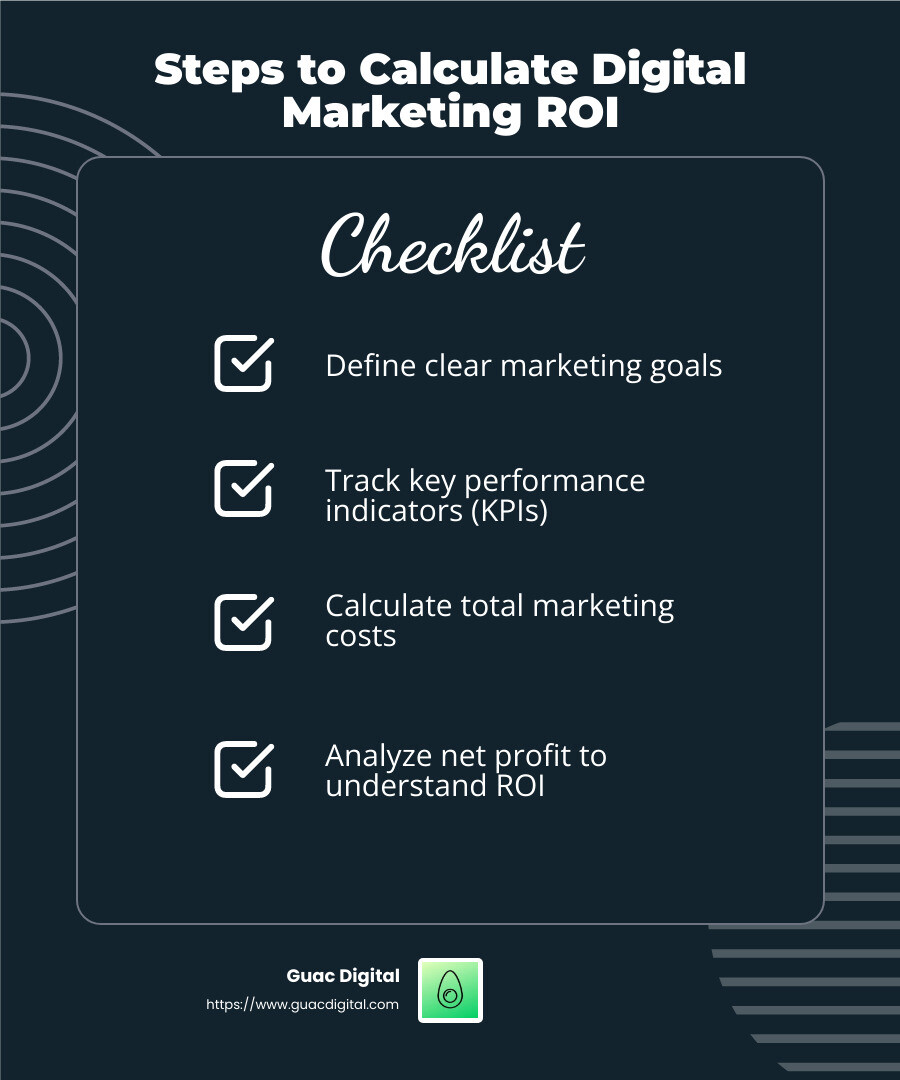
How to calculate digital marketing ROI is a fundamental question for any business looking to improve its online strategy. At its core, ROI (Return on Investment) in digital marketing measures the effectiveness of your strategies by comparing the revenue generated to the amount spent on marketing efforts. Using the formula:
ROI = (Increase in Revenue – Cost of Marketing) / Cost of Marketing,
you can quickly see the impact of your campaigns.
In today’s digital world, understanding how to calculate digital marketing ROI is vital. It helps businesses evaluate their marketing channels’ performance, allocate budgets wisely, and make informed decisions to boost profitability. As reported by many experts, knowing your ROI helps you refine strategies, ensuring every dollar spent works harder for you.
I am Guy Leon, founder and CEO of Guac Digital, where we’ve transformed our clients’ digital marketing landscapes by mastering how to calculate digital marketing roi. Our innovative strategies have boosted client engagement and conversion rates significantly. In the next sections, we’ll dig deeper into calculating and improving your digital marketing ROI to drive success.

What is ROI in Digital Marketing?
ROI, or Return on Investment, in digital marketing, is a crucial metric. It shows how much profit you’ve earned from your marketing activities compared to what you’ve spent. In simple terms, it helps you understand if your marketing efforts are paying off.
Definition and Formula
In digital marketing, ROI is calculated using the formula:
ROI = (Net Profit / Total Digital Marketing Costs) x 100
This formula helps you express ROI as a percentage, making it easy to compare with other investments. For example, if your net profit from a campaign is $25,000 and your total costs were $5,000, your ROI would be:
[ \text{ROI} = \left(\frac{25,000}{5,000}\right) \times 100 = 500\% ]
Alternatively, you can express it as a ratio, like 5:1, meaning you earn $5 for every $1 spent.
Net Profit and Total Costs
Net Profit is the revenue you earn from your marketing efforts minus all your costs. It’s important to accurately calculate net profit to ensure your ROI reflects true profitability.
Total Costs include everything you spend on digital marketing. This can be ad spend, software subscriptions, staff salaries, and any other related expenses. Knowing these costs helps you budget effectively and assess which campaigns are worth the investment.
Why It Matters
Understanding your digital marketing ROI is not just about numbers. It’s about knowing which strategies work and which don’t. It helps businesses fine-tune their marketing strategies, ensuring they invest in the most profitable channels. According to industry standards, a 5:1 ROI ratio is considered good, while a 10:1 ratio is excellent. However, these benchmarks can vary depending on your industry and specific business goals.
In the next section, we’ll explore why measuring ROI is essential for refining your digital marketing strategies and achieving long-term success.
Why Measure ROI in Digital Marketing?
Measuring ROI in digital marketing is like having a compass for your business. It guides decisions and helps ensure your marketing dollars are well-spent. Here’s why it’s crucial:
Effectiveness
Knowing your ROI tells you which campaigns are working. It’s not just about seeing profits; it’s about understanding why they happen. For example, if a social media campaign brings in higher revenue, you know your audience is engaging with that platform. This insight lets you focus efforts where they matter most.
Strategy Refinement
ROI measurement allows you to refine strategies. If a campaign isn’t delivering expected returns, you can tweak it. Maybe the messaging needs adjustment, or perhaps the target audience isn’t right. Continuous improvement based on ROI keeps your marketing relevant and effective.
Funding
When seeking funding, presenting a solid ROI can be persuasive. Investors want to see that their money will be used wisely. Demonstrating past successes through ROI can help secure the resources you need to grow your marketing efforts.
Campaign Success
ROI isn’t just about numbers; it’s about setting and achieving goals. Measuring ROI helps define what success looks like for each campaign. Whether it’s increasing brand awareness or boosting sales, knowing your ROI helps assess if you’re hitting the mark.
In the following section, we’ll dig into the basics of calculating digital marketing ROI and how to ensure you’re getting the most accurate picture of your investment’s performance.
How to Calculate Digital Marketing ROI
Basic ROI Calculation
Calculating digital marketing ROI starts with a simple formula:
ROI = (Net Profit / Total Digital Marketing Costs) x 100
This formula gives you a percentage that tells you how much profit you’ve made from your marketing efforts compared to what you spent. For example, if your net profit is $25,000 and your total digital marketing costs are $5,000, your ROI would be:
[ (25,000 / 5,000) \times 100 = 500\%]
This means for every dollar spent, you’re getting five dollars back, or a 5:1 ROI ratio.
Net Profit is the revenue minus the total costs associated with your digital marketing efforts. Total Costs include all expenses related to your marketing campaigns, such as ad spend, software subscriptions, and even staff costs.
Advanced ROI Calculation
While the basic calculation gives a snapshot, advanced methods provide deeper insights:
Attributable ROI: This method considers organic growth and long-term impact. It’s about understanding which parts of your marketing are directly contributing to revenue. For instance, if organic traffic from SEO efforts leads to sales growth, that should be factored into your ROI.
Long-term Impact: Some campaigns may not yield immediate returns but contribute to brand awareness or customer loyalty over time. These can eventually lead to increased sales, even if they don’t show up as profit right away. Measuring these can involve tracking metrics like customer lifetime value (CLV) and brand search lift over time.
Forecasted ROI: Sometimes, you need to predict ROI before launching a campaign. This involves estimating potential returns and costs. For example, if you expect a return of $30,000 from a $5,000 campaign, your forecasted ROI would be:
[ \left(\frac{30,000 – 5,000}{5,000}\right) \times 100 = 500\%]
Using these methods, you can better understand the full value of your marketing activities, beyond immediate profits. In the next section, we’ll explore tools and techniques to help measure and track your digital marketing ROI effectively.
Tools and Techniques for Measuring ROI
To truly master how to calculate digital marketing ROI, using the right tools and techniques is crucial. These tools help track, measure, and analyze your marketing efforts, providing a clearer picture of what works and what doesn’t. Let’s dive into some essential tools and techniques:
Google Analytics
Google Analytics is a powerhouse for tracking and measuring your digital marketing performance. It offers features like custom goals and ecommerce tracking to monitor specific actions and sales on your site. Setting up custom goals allows you to track conversions, such as form submissions or downloads, custom to your business objectives.
Additionally, attribution models in Google Analytics help determine which marketing channels contribute most to conversions. This can guide you in allocating budget more effectively. For instance, if you find that organic search drives the majority of your sales, you might decide to invest more in SEO efforts.
Call Tracking Software
For businesses that rely on phone calls, call tracking software is invaluable. It tracks offline actions, like phone calls, resulting from online efforts. CallTrackerFX is a popular choice, integrating seamlessly with CRM systems. This integration allows your sales team to see which marketing channels are driving phone inquiries, providing a complete picture of ROI.
Call tracking works by assigning unique phone numbers to different marketing channels, enabling you to see exactly where your calls are coming from. This is crucial for businesses where phone calls are a primary conversion metric.
UTM Parameters
UTM parameters are tags added to URLs to track the performance of different campaigns. They help you understand user behavior by showing how visitors arrive at your site. Google offers a tool to easily create these parameters, making it simple to track campaign performance.
For example, if you’re running an email marketing campaign, you can use UTM parameters to see how many people clicked through to your site from that email. This data flows into Google Analytics, allowing you to analyze traffic sources and user engagement.
Dashboards
Dashboards are essential for performance tracking, providing a visual summary of your marketing efforts. Tools like Google Data Studio and MarketingCloudFX allow you to create customized dashboards that compile data from various sources into one place.
With these dashboards, you can quickly assess the effectiveness of your campaigns and share insights with your team. Whether you’re looking at overall sales performance or the impact of a specific campaign, dashboards make it easy to understand and communicate your results.
By leveraging these tools and techniques, you can gain a comprehensive view of your digital marketing ROI and make data-driven decisions to improve your strategy. Next, we’ll explore the key performance indicators (KPIs) that play a crucial role in measuring and improving your marketing success.
Key Performance Indicators (KPIs) to Track
Tracking the right Key Performance Indicators (KPIs) is essential to understanding the success of your digital marketing efforts. Let’s explore some of the most critical KPIs you should be monitoring:
Unique Visitors
This KPI tells you how many individual people visit your website over a specific period, usually a month. It’s a great indicator of brand awareness and can be segmented by traffic source, such as organic, paid, or social. More unique visitors typically mean a broader reach, but remember, not all visitors are potential customers.
Cost Per Lead (CPL)
CPL measures the cost-effectiveness of your marketing campaigns in generating new leads. It’s calculated by dividing your total marketing spend by the number of leads acquired. This KPI helps you understand the efficiency of your campaigns and is a critical metric for budget allocation.
Cost Per Acquisition (CPA)
While CPL focuses on leads, Cost Per Acquisition (CPA) or Customer Acquisition Cost (CAC) looks at the cost to acquire an actual customer. It’s calculated by dividing your total marketing expenses by the number of new customers gained. Lower CPA means more efficient marketing.
Return on Ad Spend (ROAS)
ROAS measures the revenue generated for every dollar spent on advertising. It’s calculated by dividing the revenue from an ad campaign by the total ad spend. A higher ROAS indicates better ad performance. For example, a ROAS of 400% means you earn $4 for every $1 spent.
Average Order Value (AOV)
AOV is the average amount spent each time a customer places an order. It’s calculated by dividing total revenue by the number of orders. Increasing your AOV can significantly boost revenue without needing more customers.
Customer Lifetime Value (LTV)
LTV estimates the total revenue a customer will generate during their relationship with your business. This KPI helps determine how much you should spend on acquiring new customers. A higher LTV means more revenue per customer, allowing for more investment in customer acquisition.
Lead-to-Close Ratio
This ratio shows the percentage of leads that convert into customers. It’s calculated by dividing the number of closed deals by the number of leads. A higher lead-to-close ratio suggests better lead quality and sales effectiveness.
Branded Search Lift
This KPI measures the increase in searches for your brand over time. A growing branded search lift indicates rising brand awareness and recognition. As people become more familiar with your brand, they are more likely to search for it directly.
Average Position
Average position refers to your website’s ranking in search engine results for targeted keywords. A higher average position (closer to 1) usually means more visibility and traffic. Improving your average position can lead to increased organic traffic and higher conversion rates.
Non-Brand Click-Through Rate (CTR)
Non-brand CTR measures how often people click on your site from search results for non-branded keywords. It’s a good indicator of the effectiveness of your SEO strategies. A higher non-brand CTR suggests that your content is relevant and engaging to users who may not be familiar with your brand.
By focusing on these KPIs, you can gain valuable insights into the performance of your digital marketing efforts. Understanding these metrics will enable you to make informed decisions and optimize your strategies for better ROI. Next, let’s dig into how to measure ROI for different digital marketing strategies.
How to Measure ROI for Different Digital Marketing Strategies
PPC Advertising
Pay-Per-Click (PPC) advertising is a powerful way to drive traffic and generate leads quickly. With platforms like Google Ads, you can target specific keywords and pay only when someone clicks on your ad. The key metric here is Cost Per Click (CPC)—the amount you pay for each click on your ad.
To measure ROI in PPC, focus on Return on Ad Spend (ROAS). ROAS tells you how much revenue you earn for every dollar spent on ads. For instance, if you spend $100 on ads and generate $400 in sales, your ROAS is 400%. A higher ROAS indicates a more effective campaign.
SEO
Search Engine Optimization (SEO) is all about increasing organic traffic to your site. Use tools like Google Analytics to track organic traffic and set custom goals to measure success. For ecommerce sites, integrating with your platform can help track sales directly from organic sources.
The ROI from SEO can be calculated by comparing the revenue generated from organic traffic to the costs involved in optimizing your site. That SEO is a long-term strategy, and results may take time to manifest.
Content Marketing
Content marketing focuses on creating valuable content to attract and engage your audience. Key metrics include consumption (page views, downloads), sharing (social media shares), lead generation (form submissions), and sales.
Though calculating exact ROI can be tricky, an increase in these metrics often signals a successful strategy. Content marketing is a long-term investment, with benefits compounding over time.
Email Marketing
Measure the success of your email marketing campaigns using metrics like open rates, clicks, and unsubscribes. Tools like EmailMarketingFX can help track these metrics and provide insights into campaign performance.
To calculate ROI, compare the revenue generated from your email campaigns to the total cost of running them. A high open rate and click-through rate often correlate with higher sales and a positive ROI.
Social Media Marketing
Social media marketing involves engaging with audiences on platforms like Facebook, Instagram, and Twitter. Key metrics include traffic to your site from social channels, conversions, and in-platform analytics like likes, shares, and comments.
To measure ROI, look at the revenue generated from social media campaigns relative to the costs. While direct sales are important, also consider the value of increased brand awareness and audience engagement.
By understanding how to measure ROI for these different strategies, you can refine your approach and allocate resources more effectively. Next, let’s explore what constitutes a good digital marketing ROI and how to benchmark your efforts against industry standards.
What is a Good Digital Marketing ROI?
When evaluating the success of your digital marketing efforts, understanding what constitutes a “good” ROI is crucial. The ROI (Return on Investment) in digital marketing is a measure of the profitability of your campaigns. But what numbers should you aim for?
Industry Benchmarks
In the digital marketing world, benchmarks can vary by industry, but there are general guidelines that many businesses follow. A common benchmark for a good digital marketing ROI is a 5:1 ratio. This means that for every dollar spent on marketing, you should earn five dollars in revenue.
Aiming for Excellence
While a 5:1 ratio is considered good, achieving a 10:1 ratio is often seen as excellent. This level of ROI indicates a highly effective marketing strategy, where every dollar spent generates ten dollars in revenue. However, reaching this level may depend on factors like your industry, product margins, and marketing channels used.
Company-Specific Goals
What qualifies as a “good” ROI can vary significantly based on your company’s specific goals and circumstances. For instance:
High-Margin Products: Companies with high-margin products may not need as high an ROI to be profitable. A lower ratio might still result in substantial profits.
Growth Objectives: If your company is focused on rapid growth, you might accept a lower ROI in the short term to gain market share and customer base.
Long-Term Strategies: For strategies like content marketing or SEO, which tend to have a longer payoff period, a lower immediate ROI might be acceptable if the long-term benefits are substantial.
Tailoring Your ROI Expectations
Setting realistic and custom ROI expectations involves analyzing your overhead costs, profit margins, and strategic objectives. Understanding these factors will help you determine the right ROI target for your business.
By aligning your ROI goals with industry benchmarks and company-specific objectives, you can better assess the success of your digital marketing efforts. Now, let’s dive into some frequently asked questions about digital marketing ROI to further clarify this essential metric.
Frequently Asked Questions about Digital Marketing ROI
What is the average ROI for digital marketing?
A common benchmark for digital marketing ROI is a 5:1 ratio. This means for every dollar you spend on marketing, you should aim to earn five dollars in revenue. This ratio is generally considered healthy across most industries. However, achieving a 10:1 ratio is often seen as exceptional, indicating a very successful marketing strategy. That these benchmarks can vary depending on industry standards, product margins, and specific business goals.
How to calculate profit in digital marketing?
Calculating profit in digital marketing involves understanding your net profit margin. This is the difference between your total revenue and total costs, expressed as a percentage of revenue. Here’s how you can calculate it:
Revenue: Calculate the total income generated from your digital marketing efforts.
Total Costs: Sum up all expenses related to your marketing campaigns, including advertising spend, tools, and personnel costs.
Net Profit Margin: Use the formula:
[
\text{Net Profit Margin} = \left( \frac{\text{Revenue} – \text{Total Costs}}{\text{Revenue}} \right) \times 100
]
This will give you a clear picture of the profitability of your digital marketing initiatives.
What is the formula for calculating ROI?
The basic formula for calculating ROI in digital marketing is straightforward:
[
\text{ROI} = \left( \frac{\text{Net Profit}}{\text{Total Digital Marketing Costs}} \right) \times 100
]
Here, Net Profit is the difference between your total revenue and total costs. This formula helps you determine how effective your marketing spend is in generating profit.
For a more advanced calculation, consider factors like organic growth and long-term impacts. This might involve attributing a portion of ongoing sales growth to past marketing efforts or considering the lifetime value of new customers acquired through a campaign.
Understanding these formulas and benchmarks will empower you to evaluate your digital marketing success accurately. Whether you’re aiming for a solid 5:1 ratio or striving for a 10:1, knowing your numbers is key to optimizing your strategy.
Conclusion
At Guac Digital, we pride ourselves on delivering high ROI through personalized digital marketing strategies. Our approach is rooted in programmatic marketing, leveraging big data to tailor campaigns that resonate with your target audience. This ensures not only a strong return on investment but also a meaningful connection with your customers.
Our team in Tampa, Florida, and across the globe, is dedicated to crafting digital campaigns that meet your unique business goals. By using data-driven insights, we optimize every aspect of your marketing to achieve exceptional results. Whether you’re looking to improve your brand’s online presence or drive more conversions, our strategies are designed to lift your business to new heights.
Ready to see how we can transform your digital marketing efforts? Explore our services and find how personalized strategies can lead to high ROI and sustainable growth.