
Using the Power of Data-Driven Marketing Strategies
Data-driven marketing strategies are the secret sauce your business needs to improve its digital presence and drive targeted traffic. In simple terms, this involves using data to make informed marketing decisions.
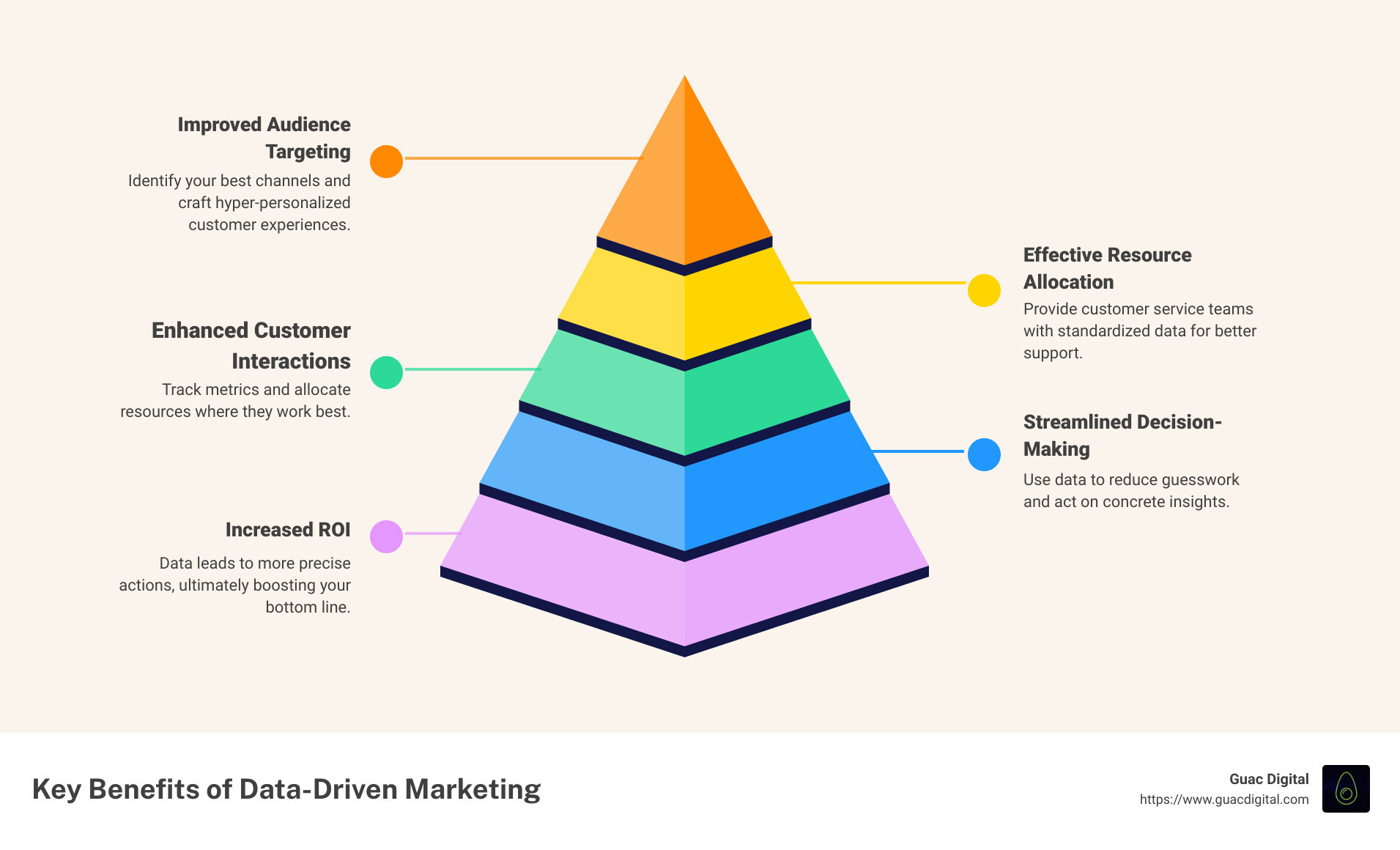
Key Benefits of Data-Driven Marketing:
- Improved Audience Targeting: Identify your best channels and craft hyper-personalized customer experiences.
- Effective Resource Allocation: Track metrics and allocate resources where they work best.
- Improved Customer Interactions: Provide customer service teams with standardized data for better support.
- Streamlined Decision-Making: Use data to reduce guesswork and act on concrete insights.
- Increased ROI: Data leads to more precise actions, ultimately boosting your bottom line.
I’m Guy Leon, Founder and CEO of Guac Digital, an expert in data-driven marketing strategies. Our team has transformed the digital marketing landscape, boosting client engagement and conversion rates significantly.
Next, we’ll explore what data-driven marketing is and why it’s crucial for your business success.
What is Data-Driven Marketing?
Data-driven marketing is a method that uses data to make smarter marketing decisions. By gathering and analyzing data, marketers can understand customer demographics and behaviors better. This enables them to create more personalized and effective marketing campaigns.
Definition
Data-driven marketing involves collecting data about your customers and using it to tailor your marketing efforts. This data can come from various sources like website visits, social media interactions, and email campaigns. The goal is to use this information to make your marketing more targeted and efficient.
Consumer Demographics
Understanding who your customers are is the first step. Demographics provide essential details like age, gender, and location. For instance, a company like Lego finded that their adult audience was growing. They adapted their strategy and launched the “Adults Welcome” campaign, spending over $900K in the U.S. alone. This campaign was custom specifically to adult Lego fans, focusing on relaxation rather than play.
Behaviors
Customer behavior data tells you how people interact with your brand. Are they visiting your website but not making purchases? Are they abandoning their shopping carts? This information is crucial for fine-tuning your marketing strategies. For example, emailing customers about products they’ve left in their online carts can significantly increase conversion rates.
Personalized Customer Experience
Personalization is key to making customers feel valued. By using data, you can tailor your messages to individual needs and preferences. Spotify Wrapped is a great example of personalized content. It provides users with a unique summary of their listening habits, making the experience more engaging and personal.
Canva also excels in personalization. During signup, they ask for your name and what you’ll use the platform for. This allows them to send more relevant emails and provide custom support, enhancing the overall user experience.
By leveraging data, businesses can create more personalized and effective marketing campaigns, ultimately leading to higher customer satisfaction and loyalty.
Next, we’ll dive into the top five data-driven marketing strategies you can implement to take your marketing efforts to the next level.
Top 5 Data-Driven Marketing Strategies
Data-driven marketing strategies are essential for modern businesses. They help create more effective campaigns and improve customer experiences. Here are five top strategies to consider:
1. Share Data Across Different Channels
Customers interact with brands on multiple channels. Sharing data across these channels helps create a unified customer profile.
For example, if a customer views a product on social media, they should easily find it on your website. This seamless experience is crucial for omnichannel marketing.
Pro Tip: Use data from one channel to inform another. If a CTA works well in emails, try it on social media or your website.
2. Use Demographic Data to Plan Campaigns
Demographic data includes age, gender, income, and location. This information helps tailor your marketing campaigns to specific audiences.
Fact: According to McKinsey, personalized marketing can deliver five to eight times the ROI on marketing spend and lift sales by 10% or more.
3. Personalize the Customer Journey
Personalized experiences make customers feel valued. Use customer data to tailor interactions and offers.
Example: McKinsey found that 71% of consumers expect companies to deliver personalized interactions. Companies like Philips use AI to analyze customer data and provide personalized experiences.
4. Target Better with Predictive Analytics
Predictive analytics uses historical data to predict future behaviors. This helps target the right customers at the right time.
Case Study: Adobe Analytics uses AI for predictive insights, helping businesses make informed decisions based on customer data.
5. Deepen Audience Insights with Data Onboarding
Data onboarding involves integrating offline data with online data. This provides a more complete view of your customers.
Example: Retailers can use purchase history from physical stores to personalize online shopping experiences.
By implementing these data-driven marketing strategies, you can create more effective campaigns and improve customer satisfaction. In the next section, we’ll explore the benefits of data-driven marketing in more detail.
1. Share Data Across Different Channels
In data-driven marketing, sharing data across different channels is crucial. Today’s customers rarely engage with a brand on just one platform. They might visit your website, follow you on social media, and even read your emails. This is where omnichannel marketing comes in.
Omnichannel marketing ensures a seamless customer experience across all platforms. But to achieve this, you need to break down data silos. Data silos occur when data is isolated within different departments or systems. This makes it hard to get a full view of your customer.
Here are some steps to overcome data silos and create unified customer profiles:
Integrate Your Tools: Make sure your CRM, email marketing, social media, and other tools are connected. This integration helps to centralize your data and provides a single source of truth.
Share Data Between Channels: If a customer views a product on your social media, they should see that product when they visit your website. Sharing data helps you create a consistent experience.
Analyze Unified Data: Use the combined data to understand customer behavior better. For example, if certain keywords work well in your emails, try them in your social media posts.
Real-World Examples
Vodafone Italy automated the acquisition of data into a single database, linking online activities with offline sales and leads. This integration allowed them to identify upselling opportunities and reduce churn.
Philadelphia 76ers used historical weather data and game attendance records to predict future game attendance. This helped them plan better and invest in advertising when needed.
Colgate-Palmolive centralized their data from over 20 countries. This allowed them to identify better-performing ads and optimize campaigns in real-time.
By sharing data across different channels, you can create a unified customer profile, ensuring a seamless experience. This is crucial for successful data-driven marketing strategies.
In the next section, we’ll explore how to use demographic data to plan campaigns.
2. Use Demographic Data to Plan Campaigns
Using demographic data to plan your marketing campaigns is a game-changer. This data includes information like age, race, income, education, job title, and marital status. By understanding these details, you can build detailed customer profiles and design more effective, targeted marketing campaigns.
Collecting Demographic Data
You can gather demographic data from various sources:
- Social Media Accounts: Platforms like Facebook and LinkedIn provide rich demographic insights.
- Form Fills: Collect data through sign-up forms or surveys on your website.
- Public Data Sources: Use resources like the U.S. Census Bureau, American Community Survey, or Current Population Survey for publicly available demographic data.
Creating Customer Profiles
Once you have the data, build customer profiles. These profiles help you understand your audience better and tailor your campaigns to meet their specific needs. For example:
- High-Income Neighborhoods: If you’re marketing a high-end furniture brand, focus on zip codes with higher income levels.
- Age Groups: Tailor your products and messaging to different age groups. For instance, promote college-related products to younger audiences.
Designing Targeted Campaigns
With detailed customer profiles, you can design targeted marketing campaigns. Here’s how:
- Personalized Ads: Use demographic data to create ads that speak directly to your audience’s interests and needs.
- Localized Campaigns: Focus your resources on specific neighborhoods or regions where your target demographic is concentrated.
- Optimized Messaging: Adjust your marketing messages to resonate with different demographic groups. For instance, use a more formal tone for older audiences and a casual tone for younger ones.
Case Study: High-End Furniture Brand
Imagine you’re advertising a high-end furniture brand to an entire city but not getting many leads. By using demographic data, you identify which neighborhoods have higher income tiers. You then focus your advertising efforts on these zip codes. As a result, your campaign’s performance improves significantly, and you receive more qualified leads.
Benefits of Using Demographic Data
- Improved Targeting: Reach the right audience with the right message.
- Higher ROI: Spend your marketing budget more effectively.
- Better Customer Understanding: Gain deeper insights into your customers’ preferences and behaviors.
By leveraging demographic data, you can make your marketing campaigns more precise and effective. This approach ensures you’re not just casting a wide net but targeting the right people with the right message.
Next, we’ll dive into how to personalize the customer journey to improve customer experiences and drive better results.
3. Personalize the Customer Journey
Personalizing the customer journey is more than just adding a customer’s name to an email. It’s about using customer data to create unique experiences that resonate on a personal level.
Why Personalization Matters
According to McKinsey, 71% of consumers expect companies to deliver personalized interactions, and 76% get frustrated when this doesn’t happen. This shows that personalization is not just a nice-to-have; it’s essential.
How to Personalize the Customer Journey
Here are some effective ways to personalize the customer journey:
1. Personalized Product Recommendations
Use data from recent product views and purchases to recommend similar or complementary products. For example, if a customer buys a camera, suggest accessories like lenses or tripods. This can be done on your website, in emails, or through paid ads.
2. Personalized Discounts
Offer discounts on items left in the cart or send special discount codes for birthdays. This not only incentivizes purchases but also makes customers feel valued.
3. Personalized Messaging
Beyond just using names in emails, personalize messages based on customer behavior. For instance, if a customer frequently buys running gear, send them content about new running shoes or upcoming marathons.
Real-World Examples
Amazon is a master at personalization. They use algorithms to show customers products they’re likely to buy based on past purchases and browsing history. This has significantly boosted their sales.
Netflix uses viewing history to recommend shows and movies, keeping users engaged and subscribed.
The Impact of Personalization
Personalized experiences can significantly impact your bottom line. Growing companies drive 40% more of their revenue from personalization efforts. This is because personalized marketing not only improves customer satisfaction but also increases conversion rates.
Using data-driven marketing strategies to personalize the customer journey ensures you’re meeting customer expectations and driving better results.
Next, we’ll explore how to target better with predictive analytics to further refine your marketing efforts.
4. Target Better with Predictive Analytics
Predictive analytics can revolutionize how you target your marketing efforts. By using machine learning and advanced statistical models, you can analyze customer data, identify patterns, and predict future behaviors.
What is Predictive Analytics?
Predictive analytics involves using historical data to forecast future outcomes. It leverages machine learning algorithms to sift through large data sets, identifying trends and patterns that might not be obvious through manual analysis.
Benefits of Predictive Analytics
Creating Better Customer Profiles: Predictive analytics helps you build detailed customer profiles by analyzing various factors like industry, company size, and purchase history. This helps in targeting the right audience with the right message.
Identifying Better Accounts: It monitors behavioral patterns to determine which accounts are most likely to convert. This ensures you focus your efforts on high-potential leads.
For example, a report from Gartner found that marketing analytics influence only 53% of decisions, highlighting the potential for improvement through better use of predictive analytics.
Real-World Example: Philips
Philips used predictive analytics to optimize their digital marketing. By integrating data management platforms and AI, they continuously tested how customers responded to content. This real-time data allowed Philips to deliver the right message at the right time, increasing conversions. For instance, implementing a slide-in call to action (CTA) boosted newsletter signups by 635%, and removing auto-play on videos improved product views by 15.85%.
How to Implement Predictive Analytics
Collect Quality Data: Ensure your data is up-to-date and accurate. Poor data quality can negatively affect your predictive models.
Use Machine Learning Tools: Leverage tools that can handle large data sets and provide actionable insights.
Monitor and Adjust: Continuously monitor the performance of your predictive models and adjust them as needed to improve accuracy.
By targeting better with predictive analytics, you can make more informed decisions, allocate resources more efficiently, and ultimately drive better marketing results.
Next, we’ll dive into how to deepen audience insights with data onboarding to further refine your strategies.
5. Deepen Audience Insights with Data Onboarding
Data onboarding is the process of transferring offline customer data to online platforms. This might include customer contact details, in-store purchases, or even loyalty program information. Once onboarded, this data can be used for various marketing purposes, enhancing your overall strategy.
Why Data Onboarding Matters
Offline data provides a wealth of information about how customers interact with your brand away from their devices. By bringing this data online, you can gain deeper audience insights and create more personalized marketing campaigns.
For example, if you know a customer frequently buys in-store, you can target them with online ads for similar products. This increases the relevance of your ads and helps in crafting personalized experiences.
The Process of Data Onboarding
Collect Offline Data: Start by gathering customer data from offline sources. This could be anything from purchase history to loyalty program details.
Anonymize PII: Any personally identifiable information (PII) must be anonymized to ensure privacy compliance. This step is crucial for maintaining customer trust and adhering to regulations like GDPR.
Transfer Data Online: Use data onboarding services to move this anonymized data to your online platforms. This makes it accessible for your digital marketing efforts.
Benefits of Data Onboarding
Improved Targeting: With a complete view of your customer’s online and offline behavior, you can target them more effectively. For instance, if someone bought a winter coat in-store, you could target them with online ads for winter accessories.
Improved Personalization: Knowing how customers behave offline allows for more custom marketing messages. This leads to better user experiences and higher conversion rates.
Increased Ad Relevance: Data onboarding helps ensure your ads are seen by the right people. For example, Philips saw a 635% increase in newsletter signups by using data to optimize their call-to-action strategies.
In summary, data onboarding is a powerful way to deepen your audience insights and refine your marketing strategies. By integrating offline data into your digital campaigns, you can create more personalized and effective marketing efforts.
Next, let’s explore the benefits of data-driven marketing and how it can lift your brand.
Benefits of Data-Driven Marketing
Enable Effective ABM Campaigns
Account-based marketing (ABM) becomes much more effective with data-driven strategies. ABM relies on targeting specific high-value accounts, and data helps you identify and understand these accounts better. For instance, using advanced data analytics, you can select accounts that are more likely to convert, increasing your ROI.
Create Accurate Attribution Models and ROI Reporting
Accurate attribution models are crucial for understanding which marketing actions lead to conversions. Data-driven marketing allows you to track the customer journey and assign value to each touchpoint. This visibility helps you understand which interactions are most effective, making your ROI reporting more precise. For example, multi-touch attribution models can show you how different channels work together to drive sales.
Identify the Best Channels
Knowing where your audience spends their time is essential. Data-driven marketing helps you identify the best channels for your content. By analyzing which platforms your audience interacts with the most, you can focus your efforts where they’ll have the most impact. Without this data, your content strategy is like shooting in the dark.
Develop Memorable Customer Experiences
Personalization is key to creating memorable customer experiences. Data allows you to tailor your marketing efforts to individual preferences and behaviors. According to McKinsey, companies that excel at personalization generate 40% more revenue from those activities than average players. Hyper-personalized experiences turn prospects into loyal customers and brand advocates.
Empower Customer Service Teams
Data doesn’t just help your marketing; it also empowers your customer service teams. By providing standardized data, customer service reps gain context for complaints and can offer better support. This leads to faster resolutions and happier customers. For example, knowing a customer’s purchase history and previous interactions can make a huge difference in resolving issues quickly.
In summary, data-driven marketing offers numerous benefits, from enabling effective ABM campaigns to empowering customer service teams. These advantages not only improve your marketing efforts but also significantly impact your bottom line. As more brands adopt data-driven strategies, collecting and using your data will soon become standard practice.
How to Implement Data-Driven Marketing Strategies
Set Goals and Collect Data
Before diving into data collection, set clear goals. Ask yourself: What do you want to achieve? Is it more sales, better customer engagement, or something else? Your goals will guide what data you need.
Metrics to consider:
– SEO metrics: organic traffic, keyword rankings
– Social media metrics: followers, engagement rate
– Email marketing metrics: open rate, click-through rate
– Content marketing metrics: time on page, conversion rate
– Website engagement metrics: bounce rate, average session duration
– Advertising metrics: return on ad spend, cost per click
Next, identify data sources. These could be Google Analytics, social media platforms, CRM systems, or third-party tools like Semrush.
Analyze Data and Develop a Strategy
Once you’ve collected the data, it’s time to analyze it. Use tools like Adobe Analytics to get insights. For example, you can see which channels drive the most traffic or what content gets the most engagement.
Steps to analyze data:
1. Organize your data using a platform.
2. Look for patterns and trends.
3. Identify insights that align with your goals.
Use these insights to develop a marketing plan. For example, if you notice that a certain type of content gets more engagement, plan to create more of it.
Launch Campaigns and Measure Performance
With a solid strategy in place, you can now launch your campaigns. Whether it’s an email campaign, a social media push, or a PPC ad, make sure everything aligns with your data-driven strategy.
KPI tracking is crucial. Use tools to monitor:
– Campaign performance: Are you hitting your targets?
– Engagement metrics: Are people interacting with your content?
– Conversion rates: Are visitors becoming customers?
Optimize Based on Data Insights
Finally, use A/B testing to optimize your campaigns. For example, test different subject lines in an email campaign to see which one gets a higher open rate.
Optimization is a continuous process. Regularly review your performance metrics and make adjustments as needed. This could mean tweaking your ad copy, changing your targeting, or even reevaluating your entire strategy.
By following these steps, you can ensure your marketing efforts are always improving and aligned with your business goals.
Data-Driven Marketing Case Studies
Philips Crafts a New Digital Identity
Philips faced a significant challenge: maintaining a consistent digital presence across 79 markets and 38 languages. To tackle this, they turned to a robust data management platform and advanced AI tools.
By leveraging analytics, Philips was able to continuously test, measure, and deploy modular content across their global sites. This data-driven approach ensured that customers received the right messaging at the right time, optimizing conversions.
For instance, they finded that implementing a slide-in call to action (CTA) boosted newsletter signups by 635%. Similarly, removing auto-play on videos increased product views by 15.85%. These decisions, backed by concrete data, allowed Philips to make informed content marketing choices that significantly improved their digital identity.
LiberEat x Semrush
LiberEat, a tech company for food businesses, needed a sustainable user acquisition strategy. They used Semrush’s Market Explorer tool to understand how competitors were driving traffic. The data revealed that organic search played a crucial role.
Using the Organic Research tool, LiberEat analyzed their competitors’ Google rankings. This led to targeted keyword research, focusing on terms with high business potential but lower keyword difficulty scores (KD %).
By prioritizing relevant keywords and creating content around them, LiberEat could effectively drive organic traffic. Without these data-driven insights, their marketing team would have been left guessing which channels to focus on and which keywords to target.
Banner Health
Banner Health needed to deliver personalized experiences across diverse patient populations. They turned to Invoca, a HIPAA-compliant platform, to transform their patient journey.
Invoca helped Banner Health track the number of appointment calls each marketing campaign drove, allowing them to measure true ROI. This data-driven approach enabled them to double down on successful campaigns and cut spending on underperforming ones.
Additionally, Invoca’s platform allowed Banner Health to segment audiences into loyal patients, intermittent visitors, and new patients. This segmentation informed their bidding strategy, helping them prioritize acquisition efforts for new patients while maintaining engagement with loyal ones.
As Chris Pace, Chief Digital Marketing Officer at Banner Health, noted, “Invoca has been a game-changer for our team. It allows us to maximize one of our most valuable resources: our marketing dollars.”
These case studies highlight the power of data-driven marketing strategies. By leveraging data management platforms, AI, and analytics, companies like Philips, LiberEat, and Banner Health have made informed decisions that drive significant results.
Frequently Asked Questions about Data-Driven Marketing Strategies
What are data-driven marketing strategies?
Data-driven marketing strategies use data to improve marketing efforts. Instead of guessing what works, marketers rely on data to make informed decisions. This data can come from various sources like social media, websites, and customer surveys.
For example, by analyzing customer demographics (age, gender, location) and behaviors (purchase history, website visits), marketers can create targeted campaigns. This means each marketing effort is more likely to reach the right audience and achieve better results.
What is a data-driven go-to-market strategy?
A data-driven go-to-market strategy uses data to plan how a product or service will be launched and marketed. This involves understanding the target market and customer segments.
For instance, if you’re launching a new fitness app, you might look at data to identify who is most likely to use it. Are they young professionals? Fitness enthusiasts? By knowing your audience, you can tailor your marketing campaigns to speak directly to them.
What is an example of data-driven content marketing?
An example of data-driven content marketing can be seen in an ecommerce store. Let’s say the store sells various products and notices that many visitors are looking at a specific product page but not making a purchase.
By analyzing this data, the store can send out sale alerts or personalized emails to those visitors, encouraging them to complete their purchase. This targeted approach can significantly increase conversion rates.
By focusing on data-driven marketing strategies, companies can create more personalized and effective marketing campaigns. Whether it’s through understanding customer demographics or targeting specific market segments, the use of data ensures that every marketing effort is backed by solid insights.
Conclusion
At Guac Digital, we believe in the power of data-driven marketing to transform your business. By using data to understand your customers and personalize your marketing strategies, you can achieve significantly higher returns on investment (ROI).
Data-driven marketing is not just a buzzword; it’s a proven approach that helps businesses create more effective and personalized campaigns. By leveraging customer data, we can craft messages that resonate on a personal level and address specific needs. This leads to higher engagement and better conversion rates.
One of the key benefits of data-driven marketing is the ability to deliver personalized strategies. Imagine knowing exactly what your customers want before they even tell you. With the right data, we can create marketing campaigns that speak directly to your audience’s preferences and behaviors.
At Guac Digital, we use advanced tools and techniques to gather and analyze data. This allows us to make informed decisions and optimize your marketing efforts continuously. From predictive analytics to real-time marketing, our strategies are designed to keep you ahead of the competition.
Ready to take your marketing to the next level? Partner with Guac Digital and see how data-driven marketing can deliver a high ROI for your business. Request your free marketing plan from our experts today and start your journey towards more effective and personalized marketing.
By focusing on data and personalization, we help you create memorable customer experiences that drive growth and loyalty. Let us show you the power of data-driven marketing.
For more insights and personalized marketing strategies, visit our services page.