
How to Choose a Marketing Agency in 2026: The Complete Data-Driven Guide
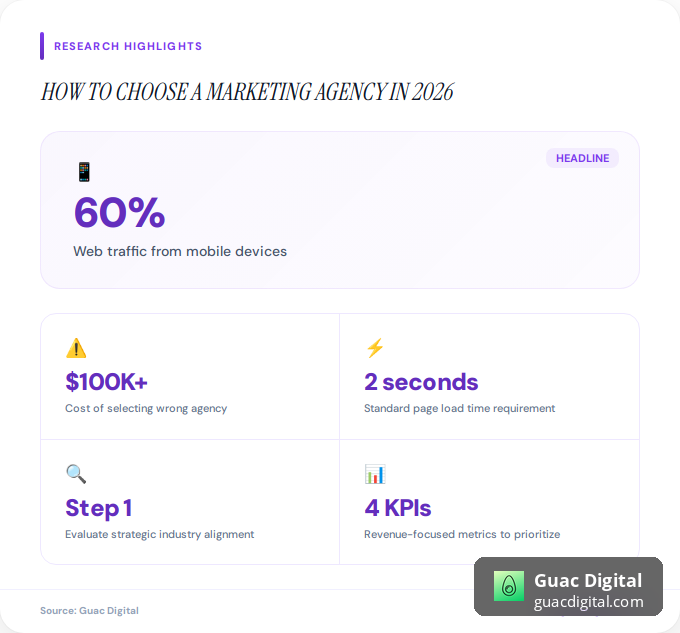
In 2026, over 60% of web traffic comes from mobile devices, AI search engines are reshaping how consumers discover brands, and privacy regulations have fundamentally changed digital attribution. Yet most businesses still choose a marketing agency based on outdated criteria like “years in business” or glossy portfolio presentations. The stakes have never been higher: selecting the wrong marketing agency can cost you six figures and a full year of lost momentum in an increasingly competitive digital landscape.
The modern marketing agency landscape has evolved dramatically. Leading firms like GUAC Digital now integrate AI-powered workflows with human oversight, build first-party data strategies to navigate privacy laws, and deliver sub-2-second page load times as standard practice. This comprehensive guide will show you exactly how to identify, evaluate, and select a marketing agency that can drive measurable revenue growth in 2026 and beyond.
Why Does Choosing the Right Marketing Agency Matter More Than Ever in 2026?
The digital marketing ecosystem has undergone fundamental shifts that make agency selection critical to business survival. Industry experts emphasize that 2026 presents unique challenges: AI-driven search experiences have changed how content gets discovered, third-party cookies are gone, and consumers expect seamless omnichannel experiences.
The right marketing agency becomes a strategic partner capable of navigating these complexities. They understand Answer Engine Optimization (AEO), ensuring your brand appears in AI-generated responses from ChatGPT, Perplexity, and Gemini. They’ve already adapted to privacy regulations by building robust first-party data collection strategies.
The wrong agency, however, can drain your budget while delivering vanity metrics that look impressive in reports but generate zero revenue. With marketing budgets under increasing scrutiny and CMOs expected to demonstrate clear ROI, there’s no room for partnerships that don’t deliver measurable business outcomes.
What Should You Look For in a Marketing Agency in 2026?
Selecting a marketing agency requires evaluating criteria that actually predict success rather than impressive-sounding credentials. Start with strategic alignment: does the agency understand your specific industry, target audience, and business model? Generic expertise rarely translates into results for specialized sectors like healthcare, legal services, or B2B SaaS.
Next, examine their approach to audience research. Top-tier agencies begin with deep audience exploration, developing detailed personas, mapping customer journeys, and identifying gaps in your current funnel before recommending tactics. If an agency leads with solutions before understanding your challenges, that’s a warning sign.
Revenue-focused KPIs separate exceptional agencies from mediocre ones. Look for partners who prioritize:
- Customer Acquisition Cost (CAC) rather than just lead volume
- Pipeline growth and closed-won deals instead of website traffic
- Marketing mix modeling (MMM) to understand true channel contribution
- Incrementality testing versus platform-reported ROAS that inflates results
Data transparency is non-negotiable. The agency should provide live dashboards showing real-time performance metrics, not just monthly PDF reports that obscure underperforming campaigns. You should own all creative assets, data, and audience lists, ensuring you’re never held hostage if the relationship ends.
“In 2026, agencies must disclose AI use for content drafting and ensure human accountability for brand voice and accuracy. Lack of a human-in-the-loop policy is a red flag that should immediately disqualify a vendor from consideration.”

How Important Is AI Integration When Selecting a Marketing Agency?
AI integration has become table stakes for competitive marketing agencies, but implementation quality varies dramatically. The critical question isn’t whether an agency uses AI, it’s how they balance automation with human oversight to maintain strategic thinking and brand authenticity.
Sophisticated agencies leverage AI for efficiency gains in research, content drafting, data analysis, and campaign optimization. However, they maintain human accountability at every decision point. When evaluating AI capabilities, ask these specific questions:
- Who reviews AI-generated content before publication?
- How do you prevent AI hallucinations or factual errors?
- What processes ensure brand voice consistency across AI-assisted content?
- How do you stay current with AI search optimization (AEO) best practices?
Leading agencies understand that AI search engines like ChatGPT and Perplexity cite authoritative sources with structured data. They create content specifically designed to earn these citations through detailed tables, FAQ sections, and data-rich analysis. This technical SEO expertise directly impacts visibility in 2026’s search landscape.
Be wary of agencies that either completely reject AI (indicating they’re behind the curve) or rely on it without transparency. The best marketing partnerships feature open discussions about AI workflows, with clear documentation of where automation assists human strategists rather than replacing them.
| Capability Area | What Good Looks Like in 2026 | Red Flags to Avoid |
|---|---|---|
| AI Integration | Human review for all output, clear accountability documentation | Fully automated content with no oversight or complete AI rejection |
| Data Reporting | Live dashboards, first-party data strategy, MMM analysis | Monthly PDFs only, reliance on platform ROAS, data ownership restrictions |
| Technical Standards | Sub-2-second load times, mobile-first design, Core Web Vitals optimization | Desktop-first approach, slow page speeds, ignoring technical SEO |
| Strategic Approach | Deep audience research before tactics, 90-day milestone plans | Immediate tactical recommendations, one-size-fits-all strategies |
| Proof of Expertise | Industry-specific case studies, strong owned content presence | Generic portfolio, poor agency website/blog, no niche expertise |
How Do You Verify a Marketing Agency’s Track Record and Results?
Portfolio presentations and testimonials are easy to manipulate. Smart buyers dig deeper to verify actual performance through independent verification channels and structured case study analysis.
Start with third-party review platforms like Clutch, which provide verified client feedback with specific ratings across communication, quality, and value. Top agencies consistently maintain 4.5+ star ratings with detailed reviews that describe specific challenges and outcomes. Be suspicious of agencies with only perfect 5-star reviews, as this often indicates selective publishing rather than authentic feedback.
When reviewing case studies, demand specificity. Look for:
- Quantified results: “Increased revenue by 147%” rather than “significantly improved performance”
- Timeline context: How long did it take to achieve results?
- Starting conditions: What was the baseline before the agency began work?
- Industry relevance: Do they have proven success in your sector?
Request references from clients in similar industries with comparable challenges. During reference calls, ask pointed questions about communication cadence, how the agency handled underperforming campaigns, and whether they’d hire them again. Pay attention to hesitation or qualified praise, which often reveals hidden concerns.
Examine the agency’s own digital presence as proof of expertise. If they can’t rank their own website, generate leads for their services, or maintain an active thought leadership presence, how can they do it for you? The best agencies practice what they preach, demonstrating their capabilities through their own marketing success.

What Technical Capabilities Must a Modern Marketing Agency Possess?
Technical execution separates agencies that drive results from those that simply create content. In 2026, technical standards have become non-negotiable as Google’s algorithms and user expectations continue to evolve.
Mobile-first design is mandatory given that over 60% of web traffic originates from mobile devices. The agency must demonstrate expertise in responsive design, mobile user experience optimization, and mobile conversion rate optimization. Request examples of mobile sites they’ve built and test them yourself on multiple devices.
Page speed directly impacts both search rankings and conversion rates. Agencies must consistently deliver sites with sub-2-second load times that pass Core Web Vitals assessments. Ask to see Lighthouse scores or PageSpeed Insights results from recent projects. If they can’t quickly produce these metrics, they likely don’t prioritize technical performance.
Answer Engine Optimization (AEO) represents a critical 2026 capability. The agency should understand how to structure content for AI citation, implement schema markup, create FAQ sections that AI models extract, and build the type of authoritative, data-rich content that ChatGPT and Perplexity reference. This goes beyond traditional SEO, requiring content specifically designed for AI consumption.
Privacy-compliant tracking and first-party data strategies are essential. With third-party cookies gone, agencies need sophisticated approaches to attribution, audience building, and conversion tracking that respect user privacy while maintaining measurement capability. This technical expertise in data architecture separates modern agencies from outdated ones.
Which Marketing Agency Model Best Fits Your Business Needs?
Marketing agencies operate under different service models, each with distinct advantages depending on your organizational maturity, resources, and objectives. Understanding these models helps you identify the right partnership structure.
Full-service integrated agencies provide 360-degree capabilities spanning strategy, creative, media buying, technology implementation, and analytics. These work best for lean teams lacking internal marketing integration or companies needing comprehensive transformation. Agencies like FINN Partners, VaynerMedia, and VML exemplify this model, offering seamless execution across all channels without requiring you to manage multiple vendor relationships.
Specialized agencies focus on specific disciplines like PPC management, SEO services, or social media. They deliver deep expertise in their niche but require you to orchestrate integration with other marketing functions. This model suits companies with strong internal marketing leadership capable of managing cross-channel strategy.
Fractional or embedded agencies integrate directly into your team, functioning as an extension of your marketing department. They attend team meetings, use your tools, and align closely with company culture. This model provides flexibility and deep collaboration but requires clear communication frameworks to work effectively.
Consider your internal capabilities when selecting a model. If you lack marketing leadership, a full-service agency provides the strategic guidance necessary for success. If you have strong strategists but need execution support, specialized agencies or fractional arrangements may deliver better value. The right model aligns with your organizational structure and growth stage.
What Are the Biggest Red Flags When Evaluating a Marketing Agency?
Certain warning signs reliably predict problematic partnerships. Recognizing these red flags early saves time, money, and frustration.
Guaranteed results represent the most obvious red flag. No ethical agency can guarantee specific rankings, traffic levels, or conversion rates because marketing outcomes depend on factors outside their control including product-market fit, competitive dynamics, and economic conditions. Promises of “first page Google rankings” or “guaranteed ROI” indicate either inexperience or dishonesty.
Lack of transparency about methods, pricing, or performance signals trouble. Reputable agencies openly discuss their approaches, provide detailed proposals with clear pricing, and offer real-time access to performance data. “Proprietary systems” that prevent you from seeing campaign details usually mask poor performance or inflated costs.
One-size-fits-all strategies demonstrate the agency hasn’t invested time understanding your unique situation. If initial proposals contain generic recommendations that could apply to any business, they’re not conducting proper discovery. Expect customized strategies based on thorough audience research, competitive analysis, and funnel mapping.
Poor communication during the sales process foreshadows worse communication after contract signing. If they’re slow to respond, miss scheduled calls, or provide vague answers during courtship, expect these issues to intensify once you’re committed. Communication standards should be discussed and documented before engagement.
Resistance to questions about AI use, data ownership, or past client results indicates the agency has something to hide. Professional partners welcome due diligence and provide thorough, specific answers. Defensiveness or evasion when asked about processes, tools, or results should immediately disqualify a vendor.
How Should You Structure Your Marketing Agency Vetting Process?
A systematic vetting process ensures thorough evaluation while preventing decision-making based on presentation quality rather than substance. Follow this structured approach to identify the best marketing agency for your needs.
Phase 1: Internal Preparation. Before contacting agencies, clearly define your goals, budget, timeline, and success metrics. Document current marketing performance as a baseline. Identify specific challenges you need the agency to solve. This preparation enables productive conversations and helps agencies provide relevant proposals.
Phase 2: Initial Screening. Research 8-10 potential agencies through third-party review sites, their own content marketing, and client case studies. Narrow to 4-5 candidates worth detailed exploration. Request initial consultations where you present your situation and evaluate their understanding and interest.
Phase 3: Proposal Review. Ask finalists for detailed proposals addressing your specific challenges. Evaluate proposals based on strategic depth rather than production value. Look for customized audience insights, funnel analysis, recommended tactics with rationale, realistic timelines, and clear pricing.
Phase 4: Deep Due Diligence. For top 2-3 contenders, conduct reference calls with similar clients. Review their technical capabilities through site audits. Discuss AI workflows, data transparency, and reporting processes in detail. Request to see sample client dashboards and reporting. Ask about team structure and who specifically will work on your account.
Phase 5: Trial Period. Consider starting with a 90-day pilot engagement before committing to annual contracts. This limited trial allows both parties to assess fit, communication effectiveness, and initial results before making a long-term commitment. Clear milestones for the trial period should be established upfront.
Throughout this process, trust your instincts about cultural fit and communication style. Technical capabilities matter, but partnership quality depends on mutual respect, shared values, and compatible working styles. If something feels off during vetting, it rarely improves after contract signing.
Key Takeaways
- Prioritize strategic alignment and industry expertise over generic credentials like years in business or client roster size. A marketing agency with deep understanding of your sector delivers better results than one with impressive but irrelevant experience.
- Demand revenue-focused KPIs including CAC, pipeline growth, and closed-won deals rather than vanity metrics like traffic or impressions. Insist on live dashboards and first-party data strategies that provide true performance visibility.
- Verify AI integration with human oversight. The best agencies leverage AI for efficiency while maintaining human accountability for strategy, brand voice, and content accuracy. Avoid both AI-rejecting agencies and those using fully automated workflows.
- Confirm technical capabilities meet 2026 standards including mobile-first design, sub-2-second load times, Core Web Vitals optimization, and Answer Engine Optimization for AI search visibility.
- Conduct thorough due diligence through third-party reviews, reference calls, and examination of the agency’s own digital presence. If they can’t successfully market themselves, they cannot market your business effectively.
- Watch for red flags including guaranteed results, lack of transparency, one-size-fits-all strategies, poor communication, and resistance to questions about processes or performance.
- Structure a systematic vetting process with clear phases from internal preparation through trial engagement. Never skip reference calls or technical capability verification regardless of impressive presentations.
Conclusion: Making the Right Marketing Agency Decision for 2026 and Beyond
Choosing the right marketing agency in 2026 requires balancing technical sophistication with strategic thinking, AI capabilities with human oversight, and impressive credentials with verified results. The digital landscape continues evolving rapidly, making partner selection more critical than ever to business growth and competitive positioning.
The agencies that drive measurable outcomes understand Answer Engine Optimization for AI search, build privacy-compliant first-party data strategies, deliver mobile-first experiences with exceptional technical performance, and tie their work directly to revenue rather than vanity metrics. They demonstrate these capabilities through their own marketing success, provide transparent real-time reporting, and maintain clear human accountability across all AI-assisted workflows.
Your vetting process should be thorough and systematic, moving beyond slick presentations to verify actual capabilities through reference calls, technical audits, and detailed case study analysis. Start with clear internal goals and success metrics, then evaluate candidates against these specific criteria rather than generic “best agency” standards that may not align with your needs.
Ready to partner with a marketing agency that delivers measurable results? GUAC Digital combines cutting-edge AI capabilities with strategic human oversight, transparent reporting, and proven expertise across social media, PPC, SEO, and integrated marketing. Schedule a consultation today to discuss your specific challenges and discover how the right partnership can transform your marketing performance in 2026.
Frequently Asked Questions
Marketing agency costs vary significantly based on scope, industry, and agency tier. Small businesses typically invest $3,000 to $10,000 monthly for specialized services like PPC or SEO, while mid-market companies allocating $15,000 to $50,000 monthly for integrated campaigns see the best results. Enterprise engagements with full-service agencies often exceed $100,000 monthly for comprehensive programs across multiple channels.
Timeline expectations depend on tactics and starting conditions. Paid advertising campaigns typically show initial results within 30 to 60 days, while SEO and content marketing require 90 to 180 days before significant organic traffic growth appears. Most agencies recommend evaluating overall partnership success after six months, as this allows time for strategy refinement and momentum building across channels.
Geographic proximity matters less in 2026 than communication quality, industry expertise, and proven results. Remote agencies with strong video collaboration practices and clear communication protocols often outperform local agencies lacking relevant experience. That said, businesses in highly localized industries like restaurants or retail may benefit from agencies with deep knowledge of their specific market and community connections.
Most successful agency partnerships involve six-month to one-year initial contracts with quarterly performance reviews and clear exit clauses. Avoid agencies requiring multi-year commitments before proving value. Consider starting with a 90-day pilot engagement that includes specific milestones, then transition to longer-term contracts once the partnership demonstrates results and strong working dynamics.
Ethical agencies practice transparency about their methods, avoid black-hat SEO tactics, disclose AI usage with human oversight, provide clear data ownership terms, and never guarantee specific rankings or results. Ask detailed questions about their approaches to link building, content creation, and paid media targeting. Request they explain how they stay compliant with privacy regulations and platform policies across all channels.
Related: Best SEO Agency Services: What to Expect in 2026
Related: How to Improve Website Conversion Rate: 12 Proven Tactics
Related: How to Choose an SEO Agency: A Complete 2026 Buyer’s Guide
Related: When to Hire a PPC Agency: Signs Your Business Is Ready
Reputable agencies provide complete data portability and asset ownership upon contract termination. Before signing, confirm in writing that you will receive all creative files, audience lists, conversion tracking data, campaign history, and access credentials to platforms and tools. Avoid agencies with vague data ownership clauses or those claiming proprietary rights to assets created during your engagement.
While some agencies work across both B2B and B2C, the strategies, channels, and buying cycles differ significantly. Agencies with proven success in your specific model typically deliver better results than generalists. B2B marketing emphasizes longer nurture sequences, thought leadership content, and account-based approaches, while B2C focuses on broader reach, emotional messaging, and shorter conversion paths.