
Website SEO Analysis: The Complete 2025-2026 Guide to Auditing and Optimizing Your Site
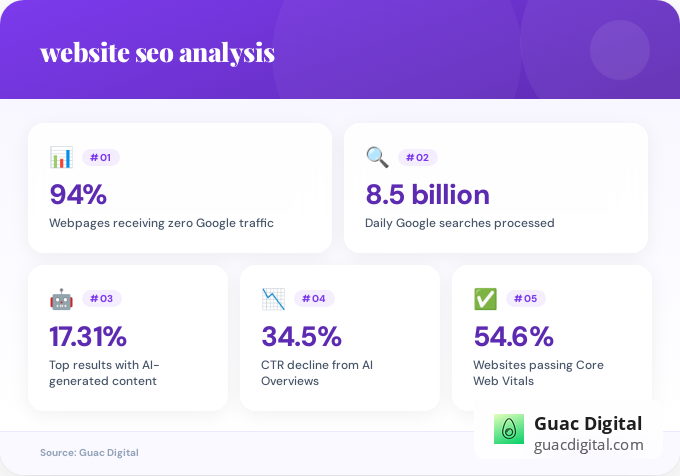
Did you know that 94% of all webpages receive zero traffic from Google? In 2025, as Google processes approximately 8.5 billion searches daily, the vast majority of websites remain invisible in search results. The reality is even more sobering: with AI-generated content now comprising 17.31% of top Google search results and AI Overviews causing a 34.5% decline in CTR for top-ranking pages, website SEO analysis has never been more critical. Understanding where your site stands in this rapidly evolving landscape is the first step to reclaiming your share of organic traffic.
A comprehensive website SEO analysis reveals the hidden factors preventing your content from ranking, identifies technical issues sabotaging your performance, and uncovers opportunities your competitors are missing. Whether you’re a business owner trying to increase visibility or an SEO professional managing multiple clients, the right analysis approach can mean the difference between obscurity and dominance in search results.
What Is Website SEO Analysis and Why Does It Matter in 2025?
Website SEO analysis is the systematic evaluation of a website’s performance, technical health, content quality, and competitive positioning in search engines. This process examines hundreds of ranking factors to identify strengths, weaknesses, and opportunities for improving organic visibility.
In 2025, the stakes have never been higher. Google dominates search with an 89.9% market share, but the landscape is dramatically shifting. AI-powered search features now mean that 60% of searches result in zero clicks, as users find answers directly in AI Overviews without visiting websites. Meanwhile, organic traffic now accounts for 46.98% of all website traffic, down 3.65% from the previous year.
For digital marketers and businesses, this means traditional SEO strategies no longer guarantee results. A thorough website SEO analysis helps you understand not just where you rank, but why. It reveals whether your site meets Google’s Core Web Vitals standards (currently only 54.6% of websites pass), whether you have the backlinks needed to compete (remember, 94-95% of webpages have no backlinks), and whether your content can compete with the growing tide of AI-generated content.
How Does Website SEO Analysis Work?
Website SEO analysis operates through a multi-layered approach that combines automated tools, manual review, and competitive intelligence. The process typically begins with crawling, where specialized software systematically examines every accessible page on your website, just as search engine bots do.
During this crawl, the analysis tool collects data on hundreds of factors: page load speeds, mobile responsiveness, HTML structure, internal linking patterns, content quality signals, and technical configurations. Modern analysis platforms cross-reference this data against known ranking factors and industry benchmarks to generate actionable insights.
The most effective website SEO analysis frameworks examine four critical dimensions:
- Technical SEO: Site architecture, crawlability, indexability, page speed, mobile optimization, and structured data implementation
- On-Page SEO: Content quality, keyword optimization, meta tags, header structure, and internal linking
- Off-Page SEO: Backlink profile, domain authority, brand mentions, and competitive positioning
- User Experience: Core Web Vitals, engagement metrics, conversion paths, and accessibility
Professional SEO agencies like Guac Digital combine automated analysis tools with human expertise to interpret results in the context of your specific business goals and competitive landscape. This hybrid approach catches nuances that automated tools miss while processing data at a scale impossible for manual review alone.

What Metrics Should You Track in Your Website SEO Analysis?
Not all SEO metrics deserve equal attention. Focus on indicators that directly correlate with search visibility and business outcomes. Here are the essential metrics every website SEO analysis should include:
Ranking Position and Click-Through Rates
Position matters enormously. The first organic search position achieves a 39.8% click-through rate (CTR) on desktop, followed by 18.7% for position two, 10.2% for position three, and 7.4% for position four. According to recent SEO statistics, this dramatic drop-off means ranking just one position higher can nearly double your traffic.
However, CTR isn’t just about position anymore. Search result titles with 40 to 60 characters achieve the highest CTR, and URLs containing target keyword terms earn 45% higher CTR than those without keyword relevance. Your website SEO analysis should track both rankings and CTR to identify optimization opportunities.
Core Web Vitals Performance
Google’s Core Web Vitals have become non-negotiable ranking factors. Track these three metrics rigorously:
- Largest Contentful Paint (LCP): Should occur within 2.5 seconds
- First Input Delay (FID) / Interaction to Next Paint (INP): Should be less than 100 milliseconds
- Cumulative Layout Shift (CLS): Should be less than 0.1
Remember, only 54.6% of websites meet overall Core Web Vitals standards as of November 2025, creating a significant opportunity for those who prioritize technical performance.
| Metric Category | Key Performance Indicator | Target Benchmark | Industry Average |
|---|---|---|---|
| Click-Through Rate | Position 1 CTR | 35-45% | 39.8% |
| Page Speed | Largest Contentful Paint | Under 2.5 seconds | 3.2 seconds |
| Backlink Profile | Referring Domains | 50+ quality domains | 0 (94% of sites) |
| Organic Traffic | Monthly Sessions | Growth of 10%+ YoY | 46.98% of total traffic |
| Content Quality | Pages with 10+ Clicks/Month | 20%+ of total pages | 1% of all pages |
Backlink Quality and Authority
Your backlink profile remains one of the strongest ranking signals. During website SEO analysis, examine not just the quantity of backlinks, but their quality. Metrics to track include domain authority of linking sites, relevance of linking pages, anchor text distribution, and the ratio of dofollow to nofollow links.
Given that 94-95% of webpages have no backlinks, even a modest number of quality links can provide a competitive advantage. Focus on earning links from authoritative sources within your industry rather than pursuing volume.
Which Tools Deliver the Best Results for Website SEO Analysis?
The right tools transform website SEO analysis from guesswork into data-driven decision-making. While dozens of platforms claim to offer comprehensive analysis, a few stand out for accuracy, depth, and actionable insights.
Enterprise-Grade Analysis Platforms
Professional SEO teams rely on platforms like SEMrush, Ahrefs, and Moz Pro for their comprehensive data sets and sophisticated analysis capabilities. These tools provide competitive intelligence, keyword research, backlink analysis, and technical audits in a single platform. They’re particularly valuable when managing multiple client sites or large-scale content operations, similar to how PPC agencies use specialized tools for campaign management.
SEMrush, for example, tracks over 20 billion keywords across 130 countries and monitors backlinks from 43 trillion URLs. This massive database enables accurate competitive analysis and opportunity identification that smaller tools simply can’t match.
Free Website SEO Analysis Tools
For businesses just beginning their SEO journey or those with limited budgets, several free tools provide valuable insights:
- Google Search Console: Essential for understanding how Google views your site, tracking impressions and clicks, and identifying indexing issues
- Google PageSpeed Insights: Provides Core Web Vitals data and specific recommendations for improving page speed
- SEOptimer: Offers free basic audits covering technical SEO, mobile optimization, and performance
- Screaming Frog SEO Spider: Free for up to 500 URLs, excellent for technical audits and identifying broken links, redirect chains, and crawl issues
According to industry research, 99% of marketing leaders still incorporate non-AI tools in their SEO strategies, recognizing that comprehensive analysis requires multiple data sources and perspectives.
“The most effective website SEO analysis combines automated tool data with human interpretation. Tools tell you what’s broken, but experienced SEO professionals tell you what matters most for your specific business goals and competitive landscape.”
AI-Powered Analysis Tools
The emergence of AI has introduced new analysis capabilities. Tools like MarketMuse and Clearscope use natural language processing to evaluate content comprehensiveness and topical authority. They compare your content against top-ranking competitors and identify semantic gaps that could improve rankings.
With AI Search traffic surging 527% year-over-year and AI Overviews reaching 2 billion monthly users, understanding how AI interprets and ranks content has become crucial. Modern website SEO analysis must account for both traditional search algorithms and AI-powered search experiences.

How to Perform a Comprehensive Website SEO Analysis
Conducting a thorough website SEO analysis requires a systematic approach. Follow this proven framework to uncover every opportunity and issue:
Step 1: Technical Foundation Audit
Begin by examining your site’s technical infrastructure. Crawl your entire website using tools like Screaming Frog or SEMrush Site Audit to identify:
- Broken links and 404 errors
- Redirect chains and loops
- Missing or duplicate meta tags
- Indexability issues (robots.txt blocking, noindex tags)
- XML sitemap errors (remember, 23% of websites have pages not linking to their XML sitemap)
- HTTPS implementation and mixed content warnings
- Mobile responsiveness issues
Pay particular attention to Core Web Vitals. With only 54.6% of websites meeting these standards, this represents a significant opportunity for competitive advantage.
Step 2: Content Quality Assessment
Evaluate your content against both user intent and search engine requirements. For each major page or content category, assess:
- Keyword targeting and semantic relevance
- Content depth and comprehensiveness
- Readability and user engagement signals
- Freshness and update frequency
- Duplicate or thin content issues
- Internal linking structure and anchor text optimization
Consider that nearly 74% of keywords generate 10 or fewer searches monthly. Your content strategy should balance high-volume competitive terms with long-tail opportunities that drive qualified traffic. This strategic approach mirrors how effective businesses approach improving Google Ads performance through targeted keyword selection.
Step 3: Backlink Profile Analysis
Examine your backlink profile for both opportunities and risks. Key factors to evaluate include:
- Total referring domains and their authority scores
- Link velocity (rate of new link acquisition)
- Anchor text distribution (avoid over-optimization)
- Toxic or spammy links requiring disavowal
- Competitor backlink gaps (links they have that you don’t)
- Lost backlinks that need reclamation
Given that over 17% of sitemaps contain redirecting URLs, also audit your internal link structure to ensure link equity flows efficiently throughout your site.
Step 4: Competitive Intelligence Gathering
Your website SEO analysis isn’t complete without understanding your competitive landscape. Identify your top 5-10 organic search competitors and analyze:
- Their ranking keywords and search visibility
- Content gaps you can exploit
- Their backlink acquisition strategies
- Technical advantages they possess
- Content formats and topics driving their traffic
Tools like SEMrush and Ahrefs excel at competitive analysis, revealing opportunities your competitors haven’t capitalized on yet.
Step 5: User Experience Evaluation
Modern SEO extends beyond traditional ranking factors to encompass the entire user experience. Analyze:
- Site navigation and information architecture
- Mobile usability and responsive design
- Conversion path optimization
- Accessibility compliance (WCAG standards)
- Engagement metrics (bounce rate, time on page, pages per session)
Remember that with users 47% less likely to click traditional search results when AI Overviews appear, the traffic you do attract needs to convert at higher rates to maintain business performance.
What Common Issues Are Revealed During Website SEO Analysis?
Comprehensive website SEO analysis consistently reveals patterns of issues across most sites. Understanding these common problems helps you recognize and address them faster:
Technical Configuration Errors
The most frequent technical issues include improper robots.txt implementation, missing or incorrect XML sitemaps, duplicate content caused by URL variations, and inadequate mobile optimization. Based on current data, 23% of websites have pages not linking to their XML sitemap in robots.txt, a fundamental error that prevents proper indexing.
Canonical tag misuse is another widespread problem. Many sites either omit canonical tags entirely or implement them incorrectly, causing duplicate content issues that dilute ranking potential.
Content Quality Deficiencies
Analysis often reveals thin content that fails to satisfy user intent, keyword cannibalization where multiple pages compete for the same terms, and outdated content that no longer serves current search queries. With AI-generated content now comprising 17.31% of top Google search results, the bar for content quality has risen significantly.
Many sites also suffer from poor internal linking structures that fail to distribute link equity effectively or guide users through logical conversion paths. According to recent analysis, this represents a significant missed opportunity for most websites.
Performance and Speed Issues
Page speed problems remain pervasive. Common culprits include unoptimized images, render-blocking JavaScript and CSS, inadequate server response times, and lack of browser caching. Given that only 54.6% of websites meet Core Web Vitals standards, addressing performance issues offers immediate competitive advantage.
Backlink Profile Weaknesses
The starkest finding in most website SEO analyses is backlink deficiency. Remember, 94-95% of webpages have no backlinks at all. Even sites with some backlinks often suffer from low-quality link sources, over-optimized anchor text that triggers penalties, or toxic links that damage authority.

How to Prioritize SEO Fixes Based on Your Analysis
Website SEO analysis typically reveals dozens or even hundreds of issues. Attempting to fix everything simultaneously leads to paralysis and wasted effort. Instead, prioritize using this impact-versus-effort framework:
High Impact, Low Effort (Quick Wins)
Start with issues that deliver significant results with minimal investment:
- Fixing broken links and 404 errors
- Adding missing meta descriptions and title tags
- Implementing proper canonical tags
- Correcting robots.txt and XML sitemap errors
- Optimizing image alt text and file sizes
These fixes often require just hours or days but can immediately improve crawlability, indexation, and user experience.
High Impact, High Effort (Strategic Priorities)
Next, tackle substantial issues that require significant investment but drive major results:
- Comprehensive Core Web Vitals optimization
- Complete site architecture redesign for better UX and crawlability
- Content creation to fill major keyword gaps
- Strategic backlink acquisition campaigns
- Mobile experience overhaul
These initiatives might take weeks or months but fundamentally transform your search visibility. Consider that nearly 35% of Gen Z people in the U.S. use AI chatbots for information searches, making comprehensive content updates increasingly critical.
Low Impact, Low Effort (Nice to Have)
Address these when time permits:
- Minor formatting improvements
- Updating old blog post publish dates
- Adding schema markup to non-critical pages
- Optimizing less important internal links
Low Impact, High Effort (Deprioritize)
Generally avoid or postpone these tasks:
- Perfect optimization of low-traffic pages
- Pursuing backlinks from low-authority sources
- Over-optimization of already well-performing elements
Focus your resources where they’ll generate measurable business outcomes. For service businesses, this might mean prioritizing local SEO elements that drive qualified leads, similar to how businesses optimize for location-based searches like those seeking specialized services.
Key Takeaways
- Website SEO analysis is essential in 2025 as 60% of searches result in zero clicks and AI Overviews cause a 34.5% decline in CTR for top-ranking pages, making every ranking position and optimization opportunity critical.
- Focus on Core Web Vitals since only 54.6% of websites meet Google’s standards, providing a significant competitive advantage for those who prioritize technical performance and page speed optimization.
- Backlink acquisition remains crucial with 94-95% of webpages having no backlinks at all. Even a modest number of quality backlinks can dramatically improve your competitive positioning in search results.
- The first position achieves 39.8% CTR on desktop, nearly double the second position’s 18.7%. Small ranking improvements deliver exponential traffic gains, making precise optimization critical.
- Use multiple analysis tools as 99% of marketing leaders incorporate non-AI tools in their strategies. Combine automated platforms with human expertise for the most actionable insights.
- Prioritize fixes using impact-versus-effort analysis rather than attempting to address every issue simultaneously. Quick wins like fixing broken links and meta tags deliver immediate results.
- Monitor AI search trends closely with AI Search traffic surging 527% year-over-year and AI-generated content comprising 17.31% of top results. Your SEO strategy must adapt to this rapidly evolving landscape.
Frequently Asked Questions
Conduct a comprehensive website SEO analysis quarterly for most sites, with monthly technical audits to catch critical issues quickly. High-traffic sites or those in competitive industries should perform full analyses monthly. After major site changes, algorithm updates, or traffic drops, run an immediate analysis regardless of your regular schedule.
The terms are often used interchangeably, but technically a website SEO analysis is broader and ongoing, examining performance trends over time. An SEO audit is typically a one-time deep dive into your current state, producing a detailed report of issues and recommendations. Both serve similar purposes: identifying optimization opportunities and technical issues.
Free tools like Google Search Console and PageSpeed Insights provide valuable and accurate data for their specific domains, especially for technical issues and Core Web Vitals. However, they lack the comprehensive competitive intelligence, backlink data depth, and keyword research capabilities of paid platforms. For small businesses or initial assessments, free tools offer a solid starting point.
Related: How to Improve Website Conversion Rate: 12 Proven Tactics
Technical fixes like improving page speed or fixing broken links can show results within days to weeks once Google recrawls your site. Content updates and backlink acquisition typically require 2-6 months to demonstrate significant ranking improvements. Major site restructuring or recovering from penalties may take 6-12 months for full results to materialize.
No single metric tells the complete story, but organic traffic qualified by conversion rate provides