
How to Improve Website Conversion Rate: 12 Proven Tactics
Quick Answer
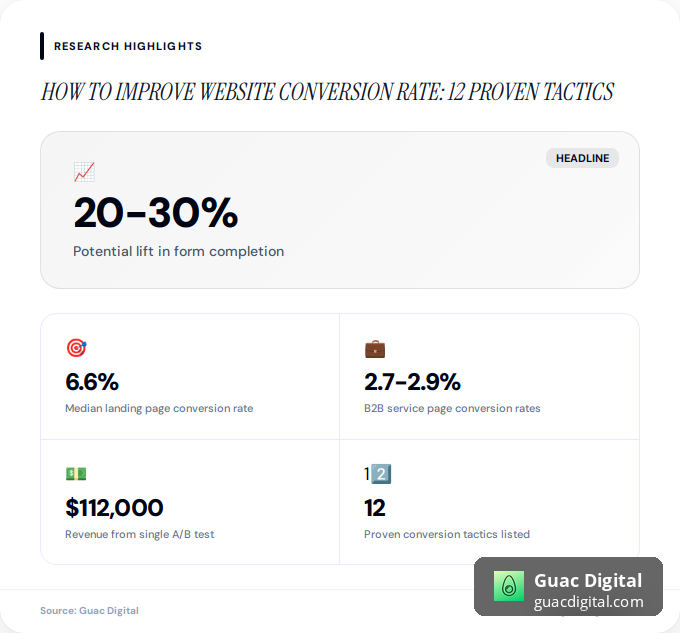
Improving website conversion rates requires implementing data-driven tactics like personalization, speed optimization, and trust signals, which can yield 20-30% lifts in form completion and significantly reduce cart abandonment. Current benchmarks show median landing page conversion rates at 6.6%, with B2B service pages converting in the low single digits (2.7-2.9%), making even small optimizations critical for revenue growth. By focusing on high-intent pages with simplified forms, mobile-first design, and AI-powered personalization, businesses can outperform traffic acquisition strategies in 2026’s filtered search landscape.
Did you know that one single A/B test generated $112,000 in revenue in just 30 days through minor copy changes on a high-traffic product page? That’s the power of conversion rate optimization (CRO) in action, and it’s why forward-thinking ecommerce brands and startups are prioritizing how to improve website conversion rate over simply driving more traffic in 2026.
With AI-powered search engines like ChatGPT and Perplexity filtering casual browsers before they even reach your site, the visitors landing on your pages are deeper in the funnel and more qualified than ever. This shift makes conversion optimization not just valuable, but essential for sustainable growth.
This comprehensive guide reveals 12 proven tactics to improve website conversion rate, backed by real data from 2026 benchmarks and expert insights. Whether you’re running an ecommerce store, leading a startup, or managing digital strategy for an enterprise brand, these strategies will help you turn more visitors into customers.
Why Website Conversion Rate Optimization Matters More Than Ever
The digital landscape has fundamentally changed. As AI search engines filter traffic before it reaches your site, businesses are seeing more qualified visitors but fewer overall clicks. This makes every site visit exponentially more valuable.
In 2026, CRO outperforms traditional traffic acquisition strategies because you’re optimizing for intent-aligned visitors who are already considering your solution. Rather than spending more on ads to compensate for poor conversion, smart brands are extracting maximum value from existing traffic.
The math is simple: improving your conversion rate from 3% to 4% delivers a 33% revenue increase without spending another dollar on acquisition. For a site generating 10,000 monthly visitors at an average order value of $100, that single percentage point represents an additional $100,000 in annual revenue.
What Are Current Conversion Rate Benchmarks in 2026?
Understanding where you stand is the first step in knowing how to improve website conversion rate. According to recent industry benchmarks, median landing page conversion rates stand at 6.6% across all industries.
However, these numbers vary dramatically by business model and page type. B2B product and service pages typically convert in the low single digits at 2.7-2.9%, while high-intent bottom-of-funnel pages can reach double-digit conversion rates when properly optimized.
| Page Type | Average Conversion Rate | Top Performer Benchmark | Priority Optimization |
|---|---|---|---|
| B2B Service Pages | 2.7-2.9% | 5-7% | Form simplification, trust signals |
| General Landing Pages | 6.6% | 10-12% | Value prop clarity, mobile speed |
| Ecommerce Product Pages | 3-5% | 8-10% | Reviews, shipping clarity, images |
| Checkout Pages | 35-45% | 65-75% | Guest checkout, digital wallets |
These benchmarks highlight a crucial insight: small improvements on high-traffic, high-intent pages outperform large improvements on low-traffic assets. At Guac Digital, we’ve seen clients achieve 20-30% lifts in form completion simply by reducing form fields and adding calendar booking functionality.

Tactic 1: Optimize Page Speed for Mobile-First Performance
Page speed is no longer optional in 2026. With most users browsing on mobile devices, every additional second of load time directly impacts your conversion rate. Studies consistently show that pages loading in under 2 seconds convert at significantly higher rates than slower alternatives.
Mobile-first design means more than responsive layouts. It requires optimizing images, minimizing JavaScript, leveraging browser caching, and using content delivery networks (CDNs) to serve assets quickly regardless of user location.
“Mobile speed is non-negotiable in 2026. AI search filters have raised the bar for clear authority positioning and lightning-fast mobile experiences. Sites that load slowly simply don’t get the chance to convert qualified traffic.”
Practical steps include compressing images to WebP format, implementing lazy loading for below-the-fold content, and removing unnecessary third-party scripts that slow down initial page render. Tools like Google PageSpeed Insights and GTmetrix provide specific recommendations for your site.
Tactic 2: Implement AI-Driven Personalization
Personalization has emerged as the dominant trend in 2026 conversion optimization. Top-performing sites use AI for behavior-based recommendations, dynamic content adaptation by location or time of day, and traffic-source-specific landing pages.
Modern personalization goes beyond inserting a first name in an email. It means showing different product recommendations based on browsing history, adjusting messaging based on traffic source (paid search versus organic), and even modifying offers based on device type or time of day.
AI-powered tools can analyze thousands of visitor data points in real-time to serve the most relevant experience. For ecommerce brands, this might mean showing winter coats to visitors from cold climates while highlighting swimwear to those in warmer regions. For B2B companies, it could mean different case studies for startup visitors versus enterprise prospects.

Tactic 3: Simplify Forms to Reduce Friction
Form friction is one of the biggest conversion killers, yet it’s also one of the easiest to fix. B2B form completion improvements of 20-30% are common by reducing fields from 12 to 6 and adding calendar booking functionality.
Every field you require is a potential abandonment point. Ask yourself: do you truly need this information upfront, or can it be collected later in the customer journey? For lead generation, name, email, and company are often sufficient for initial contact.
Additional optimization tactics include using smart defaults, implementing autofill for returning visitors, showing progress indicators on multi-step forms, and providing inline validation so users catch errors immediately rather than after submission. Consider replacing lengthy forms with calendar booking tools for demo requests, reducing friction significantly.
Tactic 4: Add Trust Signals and Social Proof
Trust signals reduce perceived risk and accelerate purchase decisions. In an era where consumers research extensively before buying, visible proof of credibility is essential for conversion optimization.
Effective trust signals include customer reviews and ratings, case studies with specific results, client logos (especially recognizable brands), security badges and SSL certificates, money-back guarantees, and third-party certifications or awards.
For ecommerce sites, product reviews are particularly powerful. Display them prominently on product pages, including both star ratings and detailed written feedback. For B2B companies, case studies with quantified results (like “increased revenue by 47% in 6 months”) provide concrete evidence of your value.

Tactic 5: Clarify Your Value Proposition
Visitors should understand what you offer and why it matters within 3 seconds of landing on your page. A unclear value proposition is a silent conversion killer that many businesses overlook.
Your value proposition should answer three questions: What do you offer? Who is it for? Why is it better than alternatives? This messaging should be immediately visible above the fold, using clear language rather than industry jargon.
Test your value proposition by showing your homepage to someone unfamiliar with your business for 5 seconds, then asking them to explain what you do. If they can’t articulate it clearly, your messaging needs work. Focus on benefits over features, and make your unique differentiator obvious.
Tactic 6: Optimize Call-to-Action Placement and Design
Your call-to-action (CTA) buttons are the final step before conversion, making their design and placement critical. High-performing CTAs use action-oriented language, create urgency, stand out visually from surrounding elements, and appear at multiple logical points in the user journey.
Instead of generic text like “Submit” or “Learn More,” use specific, benefit-driven language like “Get My Free Audit” or “Start Saving Today.” Test different colors, sizes, and placements to find what resonates with your audience.
Consider the user’s journey when placing CTAs. A visitor who just arrived needs different messaging than one who has scrolled through product details and reviews. Strategic CTA placement means making conversion opportunities available whenever the user is ready, not just at the bottom of the page.
Tactic 7: Streamline Checkout with Digital Wallets
Cart abandonment is a persistent challenge for ecommerce brands, with checkout friction being a primary culprit. Streamlining your checkout process with digital wallets and one-click purchase options can slash abandonment rates dramatically.
Digital wallets like Apple Pay, Google Pay, and PayPal allow customers to complete purchases with a single tap, eliminating the need to manually enter shipping and payment information. This convenience is especially valuable on mobile devices where typing is cumbersome.
Additional checkout optimizations include guest checkout options (not requiring account creation), displaying total costs upfront (including shipping and taxes), showing security badges near payment fields, and minimizing the number of checkout steps. Auto-saving cart contents for returning visitors also reduces friction.
Tactic 8: Offer Free Shipping to Cut Cart Abandonment
Free shipping remains one of the most effective tactics to reduce cart abandonment in ecommerce. Unexpected shipping costs are consistently cited as a top reason customers abandon their carts before completing purchase.
If offering free shipping on all orders isn’t financially viable, consider alternatives like free shipping thresholds (e.g., “Free shipping on orders over $50”), free shipping for first-time customers, or including shipping costs in product prices to create the perception of free delivery.
Communicate shipping policies clearly on product pages, not just at checkout. Transparency builds trust and sets proper expectations early in the shopping journey. Even if you can’t offer free shipping, clear communication about costs prevents unpleasant surprises that drive abandonment.
Tactic 9: Use Exit-Intent Popups for Recovery
Exit-intent technology detects when users are about to leave your site and presents a last-chance offer or message. When implemented strategically, these popups can recapture high-ROI lost opportunities without being intrusive to engaged visitors.
Effective exit-intent offers include limited-time discounts, free shipping codes, content downloads, email signup incentives, or cart abandonment reminders. The key is providing genuine value rather than just asking users to stay.
Target different messages to different user segments. A visitor who browsed your pricing page might respond to a “Schedule a demo” offer, while someone who added items to cart might convert with a 10% discount code. Use analytics to identify high-value exit points and create targeted interventions.
Tactic 10: Run Disciplined A/B Testing Programs
Data-backed testing trumps one-off changes when learning how to improve website conversion rate. Disciplined optimization in page speed, navigation, and visual appeal compounds results over time.
A/B testing allows you to validate hypotheses before committing to changes site-wide. Test elements like headlines, CTA button colors, form lengths, image choices, and page layouts. Run tests until you reach statistical significance, typically requiring at least 100 conversions per variation.
Prioritize high-impact tests on high-traffic pages. A 10% improvement on a page receiving 10,000 monthly visitors delivers far more value than a 50% improvement on a page with 100 visitors. Document all tests and learnings to build institutional knowledge about what works for your specific audience.
Tactic 11: Improve Site Navigation and User Flow
Confusing navigation frustrates users and increases bounce rates. Clear, intuitive site structure helps visitors find what they need quickly, keeping them engaged and moving toward conversion.
Best practices include limiting top-level navigation items to 5-7 categories, using descriptive labels rather than creative names, implementing breadcrumb navigation on deep pages, and including a prominent search function for sites with extensive content.
Analyze user flow in Google Analytics to identify where visitors get stuck or leave your site. If many users are bouncing from a particular page, investigate whether navigation issues are preventing them from finding their next logical step. Heat mapping tools can reveal how users interact with navigation elements.
Tactic 12: Align Content with Search Intent
AI-powered search in 2026 filters casual traffic, making site visitors deeper in the funnel. This shift demands crystal-clear authority positioning and content that precisely matches search intent.
AI integration now powers voice assistants for lead capture and helps businesses mine call transcripts for high-intent keywords that can inform content strategy.
Ensure your content answers the specific question or need that brought visitors to your page. Informational queries need educational content, navigational queries need clear paths to specific pages, and transactional queries need streamlined purchase processes. Misalignment between intent and content creates immediate bounces.
How to Prioritize and Implement These Tactics
With 12 proven tactics to improve website conversion rate, the question becomes: where do you start? The answer depends on your current performance, resources, and business goals.
Begin with an audit of your current conversion funnel. Identify your highest-traffic pages and those closest to conversion (product pages, checkout, contact forms). Use analytics to pinpoint the biggest drop-off points in your funnel.
Prioritize quick wins with high impact. Form simplification and page speed improvements often deliver immediate results with relatively low implementation effort. These early successes build momentum and stakeholder buy-in for more complex initiatives like AI-powered personalization.
Create a testing roadmap that balances quick wins with strategic long-term improvements. Dedicate resources to ongoing optimization rather than treating CRO as a one-time project. The most successful companies make conversion optimization a continuous practice integrated into their culture.
Key Takeaways
- CRO outperforms traffic acquisition in 2026 because AI search filters visitors before they reach your site, making each visit more valuable and qualified
- Current benchmarks show 6.6% median conversion rates for landing pages, with B2B service pages at 2.7-2.9%, highlighting significant optimization opportunities
- Form simplification delivers 20-30% improvements by reducing fields from 12 to 6 and adding frictionless booking options
- Page speed and mobile-first design are non-negotiable in 2026, with fast-loading sites significantly outperforming slower alternatives
- Personalization using AI-driven recommendations creates relevant experiences that adapt to behavior, location, traffic source, and device type
- Free shipping and streamlined checkout with digital wallets dramatically reduce cart abandonment in ecommerce
- Prioritize high-traffic, high-intent pages for testing because small improvements there deliver more revenue than large improvements on low-traffic pages
People Also Ask
Improve page speed, clarify your value proposition, add trust signals like reviews and case studies, simplify forms, align content with search intent, and run A/B tests to validate changes. Focus on high-traffic pages where small improvements deliver the biggest revenue impact.
Aim above 6.6% for general landing pages, though B2B service pages typically convert at 2.7-2.9%. Ecommerce product pages average 3-5%, while checkout pages should exceed 35-45%. Industry-specific benchmarks vary, so focus on improving your own baseline rather than only comparing to competitors.
AI search engines pre-filter casual browsers in 2026, meaning your site visitors are more qualified and intent-driven. Converting these valuable visitors matters more than driving higher volumes of unqualified traffic, making CRO a more cost-effective growth strategy.
Mobile-first design is critical because most users browse on phones. Sites loading under 2 seconds convert significantly better than slower alternatives. Streamlined checkouts with digital wallets, simplified forms, and fast page speeds specifically address mobile friction points that drive abandonment.
Personalization is the dominant CRO trend in 2026, with top sites using AI for behavior-based recommendations, dynamic content by location or time, and traffic-source-specific landing pages. This creates relevant experiences that match individual user needs, significantly increasing conversion likelihood.
Offer free shipping or clear shipping thresholds, enable guest checkout without forced account creation, integrate digital wallets for one-click purchasing, display total costs upfront, and use exit-intent popups with discount codes. Transparency about shipping and return policies also builds trust that reduces abandonment.
Frequently Asked Questions
Most businesses can achieve 20-30% improvements in form completion through tactical optimizations like field reduction and calendar integration. For overall site conversion rates, a 15-25% lift is achievable within 3-6 months through systematic testing and optimization across high-impact pages.
Quick wins like page speed improvements and form simplification can show results within weeks. More complex initiatives like personalization and comprehensive A/B testing programs typically show meaningful results in 2-3 months. Sustainable CRO is an ongoing practice, not a one-time project.
Prioritize mobile in 2026 since most traffic comes from mobile devices. However, analyze your specific analytics to understand where your traffic and revenue come from. If your audience is primarily desktop users, optimize for their experience first while ensuring mobile functionality.
Essential tools include Google Analytics for traffic and conversion tracking, heat mapping software like Hotjar or Crazy Egg, A/B testing platforms like Optimizely or VWO, and page speed tools like Google PageSpeed Insights. Many businesses also benefit from session recording tools to watch actual user behavior.
Start with high-traffic pages closest to conversion like product pages, pricing pages, and checkout flows. Use Google Analytics to identify pages with high traffic but low conversion rates, as these represent the biggest opportunities. Small improvements on high-traffic pages deliver more revenue than large improvements on low-traffic pages.
Absolutely. Conversion rate optimization is about extracting more value from existing traffic, not increasing ad spend. Many of the tactics in this guide (form simplification, page speed, clear CTAs, trust signals) require minimal financial investment while delivering significant revenue improvements.
AI search engines filter traffic before users reach your site, delivering more qualified visitors who are deeper in the buying journey. This makes conversion optimization more critical than ever. AI also powers personalization engines that adapt content in real-time and helps analyze user behavior patterns at scale to inform testing strategies.
Improving your website conversion rate isn’t about implementing every tactic at once. It’s about understanding your audience, identifying friction points in your current funnel, and systematically testing improvements that align with your business goals.
The 12 proven tactics outlined in this guide provide a comprehensive roadmap to higher conversions, backed by real 2026 benchmarks and data. Whether you’re an ecommerce brand fighting cart abandonment, a startup optimizing for rapid growth, or an enterprise company scaling conversion programs, these strategies deliver measurable results.
Ready to transform your website into a conversion powerhouse? Guac Digital specializes in data-driven conversion rate optimization for ecommerce businesses, startups, and enterprise brands. Our team combines technical expertise with deep understanding of user psychology to deliver systematic improvements that compound over time.
Start by auditing your current conversion funnel, identifying your biggest opportunities, and implementing quick wins that build momentum. The best time to begin optimizing was yesterday. The second best time is today.