
Big data algorithms and the future of advertising: #1
Big Data Is Revolutionizing How We Advertise
Big data algorithms and the future of advertising represent a fundamental shift from the “Mad Men” era of intuition-based campaigns to precision-driven marketing that knows who you are, what you want, and when you want it.
Key Ways Big Data Algorithms Are Changing Advertising:
- Programmatic Advertising: Real-time bidding systems process vast amounts of data to buy ad space in milliseconds.
- Hyper-Personalization: Machine learning analyzes behavioral patterns to predict consumer needs.
- Predictive Analytics: Algorithms shift from reactive retargeting to proactive “pre-targeting” based on intent signals.
- ROI Optimization: Netflix saves $1 billion annually through algorithmic content recommendations and targeted marketing.
- Audience Precision: Advertisers can now target niche audiences with incredible accuracy.
With data volumes doubling every two years, we’ve moved from advertising that interrupts to advertising that serves. Global investments in AI, like China’s $150 billion commitment, signal that algorithmic advertising isn’t the future, it’s the present.
However, this shift brings challenges. Poorly applied data leads to irrelevant ads, like seeing promotions for a toaster right after you’ve bought one. The goal is to bridge the gap between data collection and intelligent application.
The modern advertising world is a convergence of technology and data science, creating experiences that require sophisticated strategy to execute effectively.
I’m Guy Leon, founder and CEO of Guac Digital. We’ve helped clients achieve a 350% increase in engagement by implementing these principles. I’ve seen how a data-driven approach can turn struggling campaigns into conversion machines.
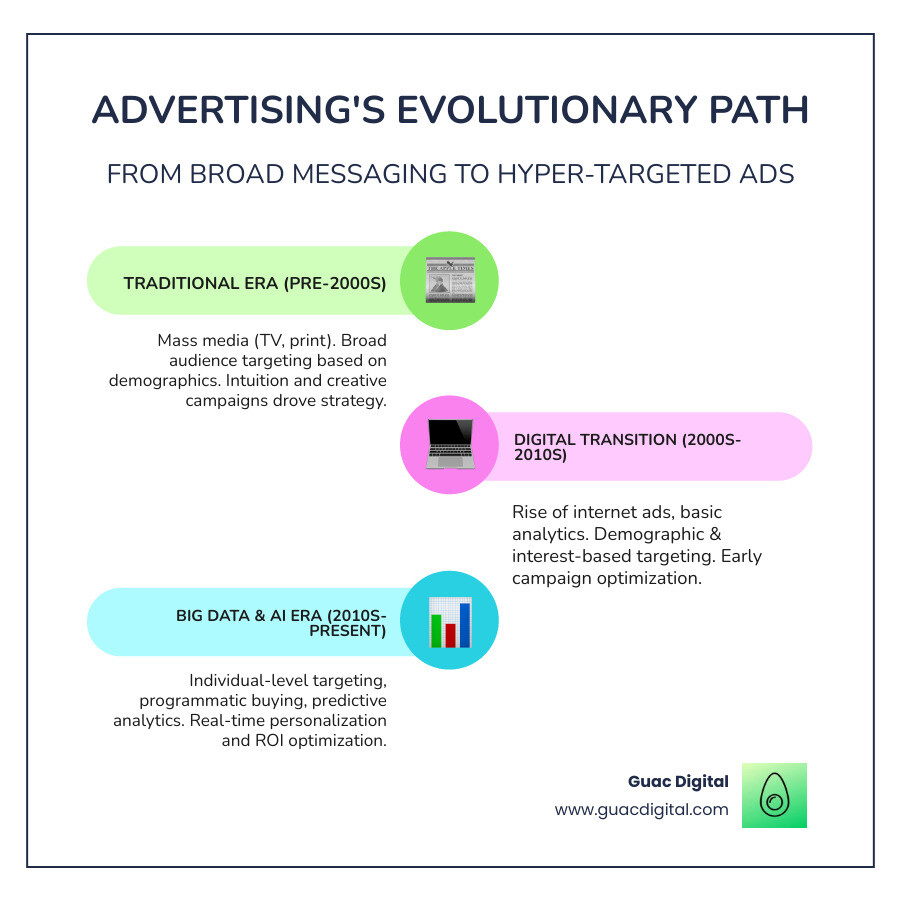
Big data algorithms and the future of advertising terms to learn:
How Big Data and Algorithms Are Redefining the Advertising Business Model
In the past, advertisers bought media space, hoping the right people would see their ad. Today, they buy audiences, knowing exactly who will see it. This is the core change driven by big data algorithms and the future of advertising. Instead of guesswork, today’s model runs on data as the new currency, where every click and scroll informs what you’ll see next. The result is a redefined value proposition focused on measurable actions and a dramatic increase in ROI.
At Guac Digital, we see this firsthand. Our clients often triple their conversion rates when moving from broad targeting to programmatic advertising.
From Broad Strokes to Individual Portraits
Mass marketing is over. We can now create individual portraits of consumers from their digital footprints. Micro-segmentation allows us to target not just “women aged 25-34,” but hyper-specific groups like “women aged 25-34 who love yoga, shop organic, and prefer video content on Tuesday mornings.” This enables one-to-one communication at scale.
Data driven advertising analyzes behavior in real-time to predict the perfect moment and message for an individual. It’s not just about collecting data; it’s about understanding what it means to create advertising that feels helpful, not intrusive.
The Mechanics of Programmatic Advertising
Programmatic advertising is an automated, data-driven system for buying ad space. It’s lightning-fast and incredibly accurate.

Here’s a simplified look at how it works:
- Ad Exchanges: These are huge online marketplaces where ad space is bought and sold.
- Automated Decision-Making: When you visit a website, Demand-Side Platforms (DSPs) instantly evaluate if you match an advertiser’s target criteria.
- Millisecond Auctions: Advertisers compete in real-time bidding (RTB) auctions to show you an ad. The highest bidder wins, and the ad is displayed—all in the time it takes a webpage to load.
This programmatic ad buying process is highly efficient and cost-effective. We buy access to target customers wherever they are online, and every dollar is tracked, measured, and optimized in real-time.
The Power of AI in Crafting Hyper-Personalized Consumer Experiences
How do big data and AI enable hyper-personalization? When an ad pops up for exactly what you’ve been thinking about, it’s not telepathy. It’s predictive analytics and machine learning models at work. These systems analyze your behavioral, demographic, and even geospatial data to map your customer journey and predict your next move. This creates truly personalized marketing solutions that feel less like ads and more like helpful suggestions.
Real-World Examples of Hyper-Personalization
We see this every day with powerful recommendation engines:
- Netflix saves an estimated $1 billion annually by suggesting content you’re likely to love.
- Amazon’s product suggestions seem to read your mind, showing you related items based on your browsing and the behavior of similar shoppers.
- Spotify’s personalized playlists capture your mood and help you find new music effortlessly.
These are just a few big data advertising examples of AI making our digital lives more convenient.

Predictive Analytics: The Shift from Retargeting to Pre-targeting
Traditional retargeting is flawed. It often shows you ads for products you’ve already purchased. The future is pre-targeting, a game-changing approach where AI anticipates consumer needs before they fully form.
By identifying intent signals—subtle digital clues like your search history, article views, and social media activity—algorithms can predict future behavior. For example, if you’ve been researching healthy recipes and local gyms, you might see an ad for meal prep containers. This approach, combined with lookalike modeling to find similar new customers, dramatically increases conversion probability.

At Guac Digital, we use data driven insights to help clients reach customers at the moment decisions are being formed. This is the power of data-driven behavioural algorithms for online advertising: turning advertising from noise into a helpful signal.
The Ethical Tightrope: Navigating Privacy, Regulation, and Consumer Trust
The power of big data algorithms and the future of advertising comes with a heavy responsibility. Using consumer data ethically is paramount. We must steer the tension between providing value and consumer surveillance. Key challenges include algorithmic bias, where AI systems perpetuate historical prejudices, and filter bubbles, which isolate users in ideological echo chambers. Algorithms don’t just predict behavior—they influence it, creating an ethical gray area.
The Line Between Persuasion and Manipulation
Where do we draw the line between persuasion and manipulation? While all advertising aims to persuade, modern algorithms can identify and exploit psychological vulnerabilities. The difference lies in transparency and intent. Ethical marketing builds consumer trust through honesty, while manipulation uses deceptive tactics for profit.
| Aspect | Persuasion | Manipulation |
|---|---|---|
| Intent | To inform and guide | To deceive or exploit |
| Transparency | Open about methods | Hidden motives |
| Consumer Choice | Empowers decisions | Restricts choice |
| Relationship | Builds long-term trust | Erodes trust for short-term gain |
| Outcome | Mutually beneficial | Benefits advertiser at consumer’s expense |
At Guac Digital, we believe transparency in data usage builds stronger customer relationships. Understanding how is big data used in advertising is key to navigating this distinction.
The Role of Regulation in the Age of Big Data
Governments are stepping in. Regulations like the General Data Protection Regulation (GDPR) in Europe and the California Consumer Privacy Act (CCPA) are creating a new era of data protection. These laws give consumers power over their personal information, including the right to access, correct, and delete their data. For advertisers, this makes explicit consent a legal requirement.
With dozens of nations adopting similar laws, corporate accountability is crucial. Technology evolves faster than legislation, so businesses must self-regulate and prioritize ethical practices. The future of data governance requires balancing innovation with privacy. Companies that treat regulation as a framework for building trust will gain a competitive advantage in a privacy-conscious world.
The Evolving Marketer: New Skills for an AI-Driven Landscape
The marketer’s role has evolved from creative director to data interpreter, strategic mastermind, and ethical guardian. In big data algorithms and the future of advertising, we no longer rely on hunches. We analyze behavioral patterns, predict needs, and optimize campaigns in real-time.
AI won’t replace human marketers; it will augment them. This human-AI collaboration allows us to be both strategists and storytellers, using data to craft messages that genuinely connect with people. The future marketer is a translator between what algorithms report and what humans want. This hybrid skill set is essential when maximizing your brand’s reach with media marketing agencies.
Essential Skills for the Modern Marketer
To thrive, marketers need a blend of technical and human skills:
- Data Analysis & Interpretation: Finding the story in the numbers.
- Understanding of Machine Learning Concepts: Knowing how the tools work, not necessarily how to code them.
- Proficiency with Analytics & AI Tools: Comfort with platforms for targeting and personalization.
- Strategic Planning & Critical Thinking: Using data to make smart budget decisions.
- Ethical & Privacy Compliance: Understanding and respecting privacy laws.
- Communication & Storytelling: Translating complex data into clear narratives.
AI Tools Changing the Marketer’s Workflow
At Guac Digital, our proprietary AI tools revolutionize daily work through campaign automation, content ideation, and deep analytics. These tools handle repetitive tasks like bid adjustments and budget allocation, freeing up our team to focus on strategy.
Real-time optimization is a game-changer. Algorithms constantly monitor and fine-tune campaigns for better results. AI-powered analytics dashboards spot patterns humans would miss, enabling data-driven decisions instead of guesswork. These great marketing tools for your biz for 2024 free up marketers to do what we do best: think strategically, solve problems creatively, and build genuine connections. The machines handle the math; we handle the meaning.
The Societal Impact and Future of Advertising with Big Data Algorithms
The big data algorithms and the future of advertising are reshaping society. On the positive side, this leads to more relevant ads, greater economic efficiency, and small business empowerment, allowing local companies to compete with giants. A Tampa bakery can now precisely target local customers searching for birthday cakes.
However, there are downsides, including job displacement risk for traditional marketing roles, a widening digital divide, and the potential for misinformation to be spread through micro-targeting.
What’s Next? Trends Shaping the Future of Advertising
The advertising landscape is constantly evolving. Key trends include:
- The Cookieless Future: A shift toward first-party data as third-party cookies are phased out.
- AI-Driven Creative: Algorithms are now generating compelling ad copy, visuals, and even video.
- Immersive Ads: Augmented Reality (AR) ads allow consumers to virtually try products.
- New Channels: Voice search advertising and Connected TV (CTV) targeting bring digital precision to new formats.
- Custom Algorithms: The move toward how custom algorithms will shape the future of media buying is accelerating, especially for emerging channels.
Preparing for the Future of Advertising with Big Data Algorithms
To prepare, businesses must accept lifelong learning, foster a culture of experimentation, and invest in both technology and talent. Most importantly, we must balance innovation with ethical responsibility. The power of data driven marketing solutions requires us to remember the real person behind every data point. This isn’t just good ethics—it’s good business.
Frequently Asked Questions about Big Data in Advertising
Here are answers to common questions about big data algorithms and the future of advertising.
Will AI and big data make human marketers obsolete?
No. AI won’t replace human marketers; it will empower them. AI handles the number crunching and repetitive tasks, but it can’t replicate human strategy, creativity, or empathy. The role is shifting from manual execution to strategic oversight. Your job won’t be taken by AI, but by someone who knows how to use AI effectively.
How can small businesses leverage big data in advertising?
Big data isn’t just for big companies anymore. Powerful targeting and personalization tools are now accessible and affordable for businesses of all sizes. Platforms from companies like Guac Digital allow small businesses to collect and analyze customer data without a team of data scientists. You can identify your best customers, understand their behavior, and use those insights to run highly targeted campaigns that compete with larger rivals.
Is my personal data safe with advertisers?
It’s a shared responsibility. Regulations like GDPR and CCPA give you significant control over your data, including the right to see, correct, and delete it. Reputable companies invest heavily in security and transparency because their business depends on trust. However, you must also be an active participant. Regularly check your privacy settings and be mindful of the data you share. The goal is a fair and transparent value exchange where you maintain control.
Conclusion: Embracing the Data-Driven Future of Advertising
The shift is permanent: big data algorithms and the future of advertising are now the backbone of modern marketing. We’ve moved from the guesswork of the “Mad Men” era to the precision of the “Math Men” age, where hyper-personalization and predictive analytics drive staggering ROI.
This power demands responsibility. We must steer the ethical tightrope, ensuring that personalization remains helpful, not invasive. Regulations like GDPR are a starting point, but true success lies in building consumer trust through transparency.
The marketer’s role has evolved into a blend of data interpreter, strategist, and ethical steward. At Guac Digital, we’ve seen how this approach delivers results, like a 350% increase in client engagement. We harness the power of data driven marketing solutions by balancing algorithms with human insight.
As we look to a future of cookieless tracking, AI-driven creative, and new ad formats, the path forward is clear. Success requires lifelong learning, experimentation, and a commitment to ethical innovation.
The paradigm shift is here. Big data is the foundation, but human creativity, strategy, and empathy remain the critical ingredients. To thrive, businesses must balance technological power with ethical responsibility.
Ready to harness the power of data-driven advertising for your business? The change is happening now.