
AI SEO: Unlock Success in 2025
Understanding the Power of AI SEO
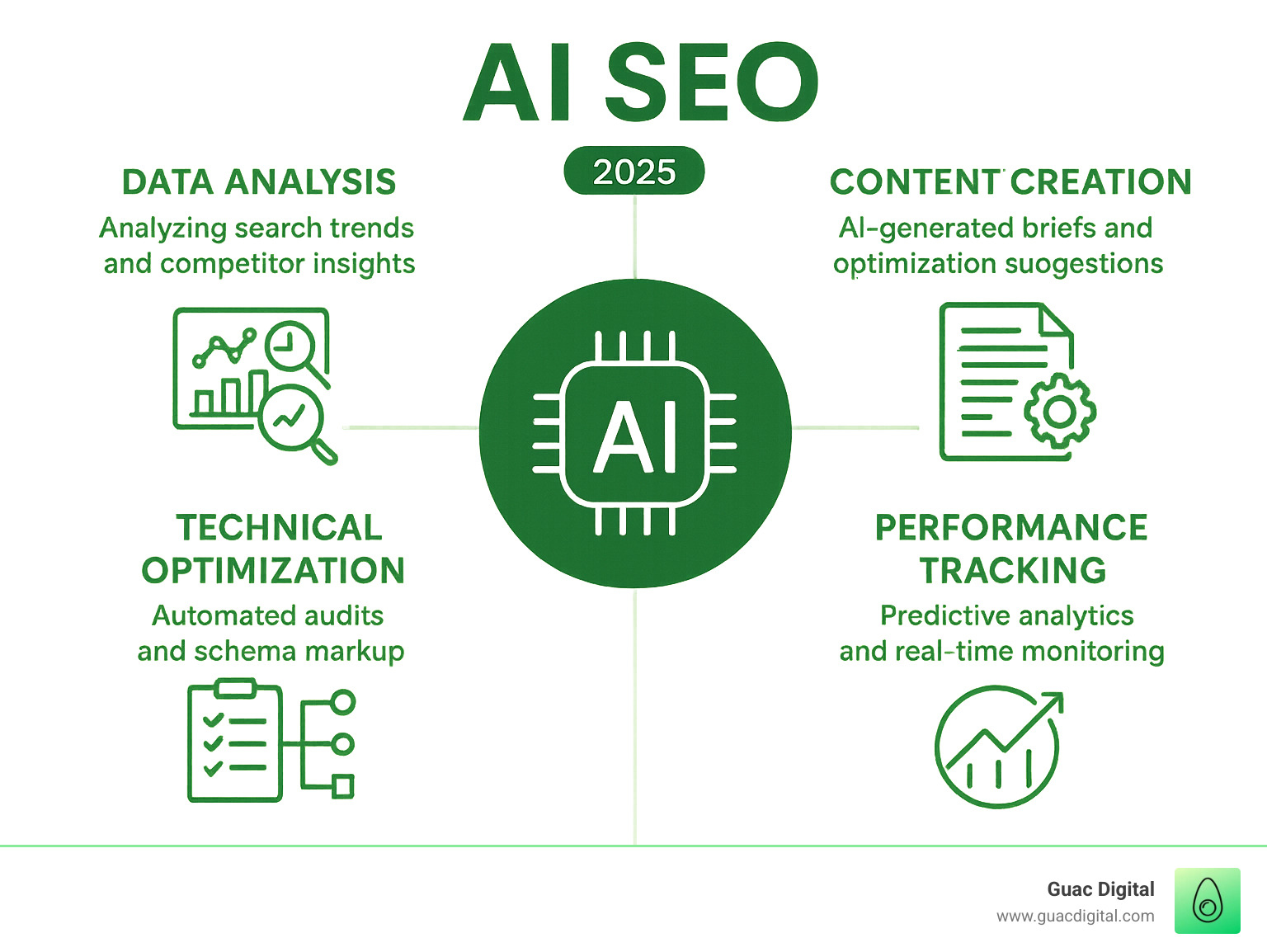
AI SEO is changing how businesses approach search engine optimization by combining artificial intelligence with traditional SEO practices. It uses machine learning and natural language processing to automate tasks, analyze data at scale, and create more effective optimization strategies.
What AI SEO includes:
- Automated keyword research and content gap analysis
- AI-powered content creation and optimization
- Technical SEO audits performed by machine learning
- Predictive analytics for performance tracking
- Natural language processing for better search intent understanding
This shift doesn’t replace human expertise; it improves it. While AI handles data processing, SEO professionals can focus on strategy, creativity, and audience connection.
Industry research shows a significant shift, with many marketers now using AI for keyword research and content ideation. This move from reactive tactics to proactive, data-driven strategies is fundamentally changing What is Search Engine Optimization?.
The core advantage? Speed and scale. AI analyzes vast datasets in seconds, identifying patterns humans might miss and optimizing in real-time. This leads to faster results, better targeting, and more efficient marketing spend.
I’m Guy Leon, founder and CEO of Guac Digital. With over a decade in digital marketing, I’ve seen the evolution from traditional SEO to today’s AI-powered strategies. At Guac, we’ve used AI SEO to help clients achieve a 350% increase in engagement.
The Evolution of Search: How AI is Reshaping SEO
In the early days of SEO, we focused on keywords and algorithm updates. While those fundamentals still matter, AI SEO has transformed how search engines understand and serve content.

Traditional SEO was about matching keywords to queries, but search engines and user expectations evolved. Semantic search and user intent became key. Now, search engines understand context—distinguishing ‘apple’ the fruit from ‘Apple’ the company. This shift from keywords to meaning was a game-changer.
Major AI breakthroughs drove this evolution. RankBrain (2015) was Google’s first major AI for processing ambiguous queries. BERT (2019) followed, revolutionizing natural language processing by understanding context and nuance. The MUM algorithm (2021) took it further, understanding information across languages and formats to answer complex questions.
These advances led to AI Overviews, which provide instant, AI-generated answers at the top of search results. While helpful for users, this increases Zero-Click Searches, as fewer people click through to websites. This has real business implications, with click-through rates dropping significantly for some queries. However, branded searches can see increased clicks, boosting brand recognition.
At Guac Digital, we adapt by creating expert-level content that goes deeper than AI summaries. This ensures your content remains valuable. The key is not to compete with AI but to work with it. Our expert SEO services help businesses steer these changes and maintain a competitive edge.
The Core Benefits and Potential Risks of Using AI in SEO
AI SEO is like having a brilliant but unpredictable assistant. When it works well, it’s game-changing. Let’s explore both sides of this exciting equation.
The Upside: Gaining Efficiency, Accuracy, and Scale
The efficiency gains from AI in SEO are spectacular. Tasks like keyword research that once took weeks can now be done in hours. AI automates repetitive tasks like keyword analysis and content gap identification, freeing up human experts to focus on strategy, creativity, and client relationships.
AI’s processing speed is mind-blowing, turning weeks of work into minutes. This allows for faster insights and real-time campaign adaptation.
- Data analysis at scale: AI analyzes millions of data points—from search trends to competitor strategies—enabling precision targeting previously impossible, as noted by Capgemini’s research.
- Scalability: AI handles large-scale tasks like generating thousands of product descriptions or auditing massive sites, allowing you to expand reach without a proportional increase in team size.
- Content ideation: AI can brainstorm ideas, create outlines, and draft sections, accelerating the content creation process.
- Competitive analysis: AI tools dissect competitor strategies, identifying top content and keyword gaps, offering a clear view of their playbook.
At Guac Digital, we leverage these advantages to deliver exceptional results. Our focus on data-driven programmatic marketing creates effective, personalized campaigns. See how we use AI to boost ROI with our data-driven marketing solutions.
The Downside: Navigating the Drawbacks and AI SEO Risks

However, AI isn’t perfect, and understanding its limitations is crucial.
- Content quality control: AI can “hallucinate” false information or produce bland content. AI-generated text should be treated as a first draft that requires human fact-checking, editing, and polishing.
- Over-reliance on automation: Ceding too much control to AI without oversight means losing human intuition. A “human-in-the-loop” approach is essential for quality and strategic direction.
- Algorithmic bias: AI models trained on biased data can perpetuate those biases, leading to skewed results.
- Lack of human touch: AI struggles with genuine empathy, storytelling, and emotional nuance. Your brand voice and creativity still require human ingenuity.
- Google’s E-E-A-T guidelines: Google penalizes bad content, not AI content. Since AI can create low-quality content at scale, adhering to E-E-A-T by providing human experience is vital.
- Ethical considerations: The potential for misuse, from misinformation to manipulation, can harm a brand’s reputation. At Guac Digital, we are committed to ethical AI practices.
The key is to find the balance where AI amplifies human capabilities without replacing human judgment.
A Practical Guide to Implementing AI SEO in Your Strategy
Ready to dive into AI SEO? Think of AI as an incredibly smart assistant that helps you refine your existing SEO knowledge, not replace it.
AI-Powered Content and Keyword Strategy
AI has become a trusted advisor in content strategy. Instead of manual keyword lists, AI SEO tools analyze search intent across millions of queries, grouping terms into keyword clusters for comprehensive topic coverage. AI can also spot emerging search trends early, giving you a significant advantage in content planning.
Content gap analysis is simplified as AI compares your content to top competitors, identifying missing topics and generating topic ideation suggestions. AI-generated content briefs are also game-changers, providing target keywords, competitor insights, and readability scores to give every piece of content a strategic foundation.
During writing, AI offers real-time feedback on on-page optimization and can audit your existing content library for update opportunities. At Guac Digital, we blend AI efficiency with human creativity in our SEO copywriting services to create compelling, optimized content.
Streamlining Technical SEO with AI
AI makes the complexities of technical SEO far more manageable.
Automated technical audits are a major benefit. AI crawlers quickly scan large sites, identifying and prioritizing issues like broken links and crawl errors. AI also simplifies schema markup generation, automatically creating structured data that helps search engines understand your content and makes you eligible for rich snippets and AI Overviews.
Other key areas include internal linking automation to improve site structure, log file analysis to optimize your crawl budget, and improved page speed insights based on Core Web Vitals. At Guac Digital, we use these AI capabilities to build a rock-solid technical foundation for our clients. Learn more about our website SEO services.
Measuring Performance and ROI
AI’s analytical power transforms how we measure and optimize SEO performance.
AI-driven performance tracking dashboards offer real-time monitoring of rankings, traffic, and engagement. Predictive analytics is now a reality, with AI forecasting trends and the impact of algorithm updates to enable proactive strategy. Anomaly detection serves as an early warning system, flagging unusual performance changes.
Automated reporting saves time by generating comprehensive reports, while precise ROI calculation connects SEO efforts to conversions and revenue. This demonstrates value through clear Key Performance Indicators (KPIs). Understanding how to calculate digital marketing ROI is simpler when AI handles the data analysis.
Choosing Your Toolkit: General AI vs. Specialized Platforms
Choosing the right AI SEO tools can be overwhelming. Breaking them down into two main categories can make the decision clearer.
| Feature | General AI Tools (e.g., General large language models) | Specialized AI SEO Platforms (e.g., Leading SEO & content platforms) |
|---|---|---|
| Real-time Data Integration | Limited to none; relies on training data | High; integrates with search consoles, ranking data, competitor data |
| SEO-Specific Workflows | Requires extensive prompt engineering | Built-in; custom for keyword research, content briefs, audits |
| Cost | Free versions available; paid tiers for more capacity | Typically subscription-based, higher cost but more features |
| Required Expertise | Prompt engineering; SEO knowledge to validate output | SEO knowledge to interpret data; less prompt engineering needed |
General AI tools, like large language models, are versatile. You can use them to brainstorm ideas, draft content, or summarize articles. Many have free tiers, making them accessible for businesses just starting with AI. Their main limitation is a lack of real-time SEO data. Getting valuable SEO insights from these tools requires strong prompt engineering and human oversight to validate their outputs.
Specialized AI SEO platforms are purpose-built for SEO. They integrate with live data sources to provide current, actionable, data-driven insights. Their workflow integration is designed for specific SEO tasks like content optimization, technical SEO audits, and advanced keyword research. A key emerging category is Generative Engine Optimization (GEO) tools, which focus on optimizing for visibility within AI-generated search results.
While these platforms are typically subscription-based, their value in providing reliable data and streamlined workflows often justifies the cost for businesses serious about SEO.
At Guac Digital, we use a hybrid approach. We leverage general AI for creative brainstorming and specialized platforms for deep analysis and strategic decision-making. This combines creativity with data-driven precision.
The Future of Search and Ethical Guidelines
The pace of change in AI is breathtaking, and the future of search promises even more integration and personalization. As we look ahead, AI SEO is becoming the foundation of digital connection.

Emerging Trends: What’s Next for AI in Search?
The next wave of search evolution is already here.
- Generative Engine Optimization (GEO): As AI Overviews become more common, the focus shifts from clicks to becoming a trusted source for AI-generated answers. This requires creating authoritative, well-structured content.
- Hyper-personalization: Customized search results based on user data will require SEO strategies to focus on individual user journeys.
- Voice search optimization: Growth requires optimizing for longer, conversational queries that reflect natural speech patterns.
- Visual search: With tools that let users search with images, optimizing image alt text, file names, and schema is now crucial.
- Predictive SEO: AI can forecast trends and algorithm changes, enabling a shift from reactive to proactive strategies.
At Guac Digital, we monitor these developments to keep our clients ahead. Our innovative, data-driven strategies prepare us for the future of search. Learn more about our digital marketing agency.
Ethical AI SEO and Google’s Stance
With powerful AI comes greater ethical responsibility. Our AI SEO approach is built on transparency, authenticity, and adherence to search engine guidelines.
Transparency is key. The focus must be on creating helpful, valuable content that builds trust. AI should improve human creativity, not replace the authentic voice that provides true value.
Google’s stance is clear: quality matters, not the creation method. According to their guidance on AI-generated content, they reward helpful, original, user-first content. The Helpful Content System reinforces this by rewarding content that serves user needs and penalizing content created only to rank.
Avoiding spam tactics is crucial. While AI can generate content at scale, we focus on white-hat SEO for sustainable growth, balancing speed with quality control. Our human-in-the-loop approach ensures AI is an assistant, not a replacement for human judgment. Humans provide the strategy, creativity, and emotional intelligence that resonate with audiences, building lasting trust.
Frequently Asked Questions about AI SEO
Let’s address the burning questions we hear from clients every day about AI SEO.
Will Google penalize my site for using AI-generated content?
Google does not penalize content for being AI-generated. Their focus is on whether the content is helpful to users. Google’s algorithms penalize bad content, regardless of its origin. The key question is whether your content is genuinely helpful.
The focus must be on quality, not the creation method. Using AI to create low-value content is risky, but using it as a tool to produce high-quality, helpful content is perfectly acceptable.
Google’s E-E-A-T guidelines are paramount. Content must demonstrate experience and expertise, which makes human review and editing crucial. AI-generated text should be treated as a first draft that needs human refinement, fact-checking, and insight.
Can AI completely replace human SEO professionals?
The short answer is no, AI cannot replace human SEO professionals.
AI is for augmentation, not replacement. It excels at data processing and repetitive tasks but lacks the strategic thinking, creativity, and nuance of a human expert. AI handles data-heavy tasks brilliantly, like competitor analysis and technical audits.
Humans provide the irreplaceable elements: strategic planning based on business goals, brand alignment, relationship building, and critical judgment. The future is human-AI collaboration. Successful SEOs will use AI as a powerful tool, allowing them to focus on strategy and creativity. At Guac Digital, this partnership approach delivers incredible results.
How do I choose the right AI SEO tool for my business?
Choosing the right AI SEO tool means matching its capabilities to your specific needs, budget, and team size.
First, assess your business goals and pain points. Are you focused on content creation, technical SEO, or competitive research? Small businesses might start with versatile general AI tools, while larger teams may need comprehensive, specialized platforms.
Next, check for integration capabilities. Tools that connect with your existing analytics and content management systems save time and provide more accurate insights.
Finally, always use free trials. Test a platform to ensure it fits your workflow and solves your problems before committing to a subscription. The best tool is one your team will use consistently to achieve measurable results.
Conclusion
AI is the most significant catalyst for change in SEO today. AI SEO is not a threat but a fundamental shift that opens up new possibilities for search optimization.
AI acts as a tireless research assistant, handling data analysis so you can focus on strategic thinking, creative problem-solving, and building genuine connections. It’s here to augment the human touch, not replace it.
The power of AI SEO is its ability to turn complexity into actionable insights. It helps us move from reacting to changes to proactively staying ahead of the curve by predicting trends and identifying opportunities.
At Guac Digital, we’ve seen this firsthand. By integrating AI into our strategies, we create a powerful synergy between human creativity and machine intelligence. Our approach uses big data for high-ROI programmatic marketing, always grounded in personalized strategies that meet unique client goals.
The future belongs to those who master human-AI collaboration. The goal is to find the balance where technology amplifies human potential, turning challenges into strategic advantages and data into measurable results.
Your AI SEO journey will be one of continuous learning and adaptation. The evolving landscape is what makes this field so exciting, offering new ways to connect with your audience.
The key is to start now. Whether you’re a beginner or looking to optimize your strategy, taking the first step will lead to improved efficiency, better insights, and stronger results.
Explore our portfolio of AI-driven marketing solutions to see how we help businesses thrive in this new era. The future of search is here.