
Big Data Advertising Privacy: Secure Your 2025
The Digital Surveillance Economy: Why Your Privacy Matters More Than Ever
Big data advertising privacy is a pressing issue in a world where companies collect vast amounts of personal information to power a $200 billion industry. Here’s a quick overview:
Key Privacy Risks:
- Data brokers like Acxiom hold data on 500 million people.
- Identity theft with context allows for highly personalized attacks.
- Political manipulation, as seen with Cambridge Analytica’s access to data from 230 million Americans.
- Discrimination through algorithms that penalize individuals based on demographics.
Your Rights:
- Control who accesses your information (a priority for 74% of Americans).
- Opt out of targeted ads via platform settings.
- Request data deletion under laws like GDPR and CCPA.
- File complaints with data protection authorities.
An 18-minute Facebook outage cost the company $400,000, showing just how valuable your data is to advertisers. This highlights the privacy paradox: we value privacy but trade our data for convenience. While over 40% of users are wary of online forms, companies collect everything from location data to political affiliations, selling it to advertisers without your consent. You become both the product and the consumer.
I’m Guy Leon, founder and CEO of Guac Digital. I’ve spent years helping businesses steer big data advertising privacy by building ethical, data-driven campaigns that respect user rights and balance effective advertising with responsible data practices.
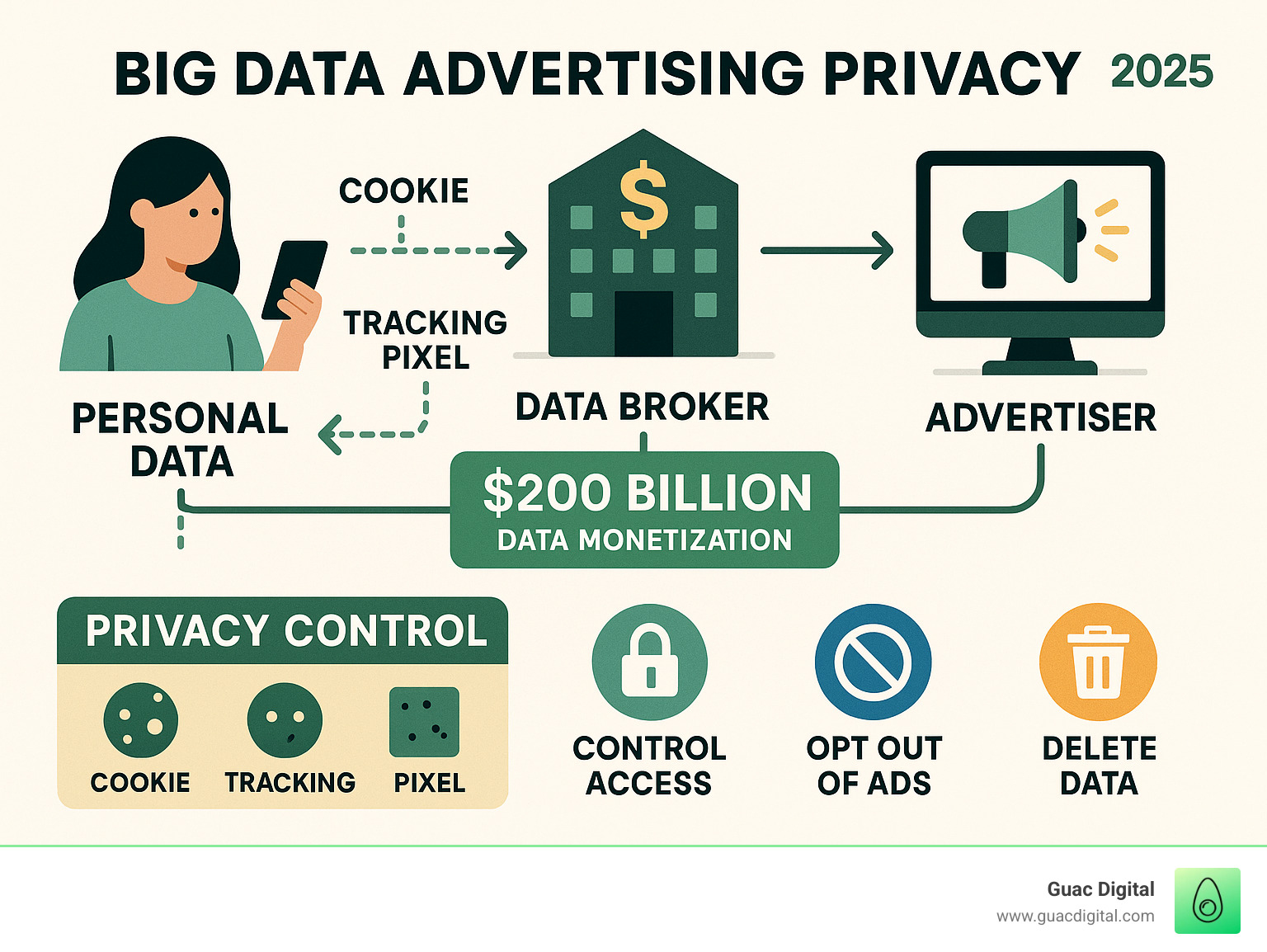
Terms related to big data advertising privacy:
The Unseen Engine: How Your Data Fuels the Advertising World
Ever wonder how an ad for shoes you just viewed follows you online? That’s big data advertising privacy at work. Your digital breadcrumbs—every click and swipe—create a trail for advertisers.
Companies collect these digital notes through cookies that track website visits, tracking pixels in emails, and unique device IDs. Your location data from apps reveals where you go and for how long. This information fuels real-time bidding, a lightning-fast auction where companies bid to show you an ad in the milliseconds it takes a webpage to load.
The ad tech ecosystem is a massive network of companies buying and selling your information. Data brokers like Acxiom, Experian, and Datalogix are central to this, packaging your consumer spending data and selling it to advertisers. This data monetization turns your personal information into cash, billions of times a day. This largely unseen data brokerage industry generates around $200 billion in annual revenue. For a deeper dive, see how is big data used in advertising.
What Personal Data is Most Valuable?

Not all data is equal. Basic demographics are just the start. Marketers crave psychographics that reveal your personality, values, and lifestyle.
Behavioral data is gold. It includes your searches, the videos you watch, and even how long you pause on a page. This helps companies predict what you’ll want next.
Your location history tells a detailed story about your habits, while your purchase history paints a picture of your spending and brand loyalty.
Life-event triggers—like getting married or buying a house—are especially valuable because they signal major shifts in buying behavior. One retailer famously identified a teen’s pregnancy from her shopping patterns before her family knew.
Companies also track your health interests and political affiliation to create highly targeted campaigns that speak to your specific situation.
At Guac Digital, we understand the power of this data for marketing, but we prioritize using it responsibly, keeping big data advertising privacy at the forefront.
The Double-Edged Sword: The Privacy Paradox and Ethical Dilemmas
We worry about online privacy, yet we share our data daily for convenience. This contradiction is the privacy paradox, a core issue in big data advertising privacy. We want personalized services and control over our data, but the digital world makes it hard to have both. For more on these challenges, explore our thoughts on Privacy.
Why We Trade Privacy for Convenience: Understanding the “Privacy Paradox”

When faced with a long terms of service agreement, most of us click “Agree” without reading. Though 74% of Americans say controlling their information is very important, we consistently make these trade-offs. The reason is simple: immediate benefits like a food delivery app or a streaming recommendation feel more tangible than abstract, future risks.
Companies exploit this psychological tendency by making data sharing easy and control difficult. Confusing privacy policies are a feature, not a bug. This leads to digital resignation, where we accept a loss of privacy as the cost of modern life.
Beyond Annoyance: The Real Risks of Big Data Advertising Privacy
The risks of big data advertising privacy go far beyond annoying ads. They threaten democracy, fairness, and personal security.
The Cambridge Analytica scandal revealed how data from a simple Facebook quiz was used to access information from 230 million Americans, aiming to influence elections through psychological manipulation.
Data discrimination is another threat. Biased algorithms used for decisions on jobs, loans, or housing can perpetuate inequality, denying opportunities based on data patterns rather than individual merit.
Frequent data breaches, like the one at Marriott that exposed 500 million guest records, have devastating consequences. Criminals use this detailed information for “identity theft with context,” crafting convincing fraud schemes. Protecting yourself from threats like debit card fraud is more complex than ever.
Finally, there’s the chilling effect: knowing we’re tracked can cause self-censorship, limiting our exploration of sensitive topics. While regulators are imposing massive fines, like the FTC’s $5 billion penalty against Facebook, for many companies, these are just a cost of doing business. The ethical dilemma remains: the same data that improves services can be used to manipulate and harm.
The Global Patchwork of Protection: Are Privacy Laws Keeping Up?
Regulating big data advertising privacy is like enforcing traffic laws for cars that can teleport between countries with different rules. The global privacy landscape is a patchwork of regulations.

Europe’s GDPR requires explicit consent, while California’s CCPA/CPRA offers similar but distinct protections. The EU’s ePrivacy Directive governs cookie banners, and HIPAA protects health data in the US. These laws have increased transparency, but enforcement is a challenge because data flows across borders and technology outpaces legislation. For businesses, understanding Key Privacy Issues in Adtech is crucial.
The Challenge of Enforcing Big Data Advertising Privacy Regulations
Enforcement is complicated by the ad tech ecosystem’s intricate web of players. Distinguishing between a data controller and a processor under GDPR is difficult when dozens of companies are involved in serving one ad. Consent mechanisms are often confusing, with companies relying on vague “legitimate interest” clauses.
While fines can be substantial—British Airways faced a massive GDPR penalty—enforcement is inconsistent. The biggest challenge in the US is the lack of federal privacy law, creating a patchwork of state regulations that is difficult for national businesses to steer.
The Future of Regulation: What’s on the Horizon?
Change is coming. The proposed American Privacy Rights Act could create a comprehensive federal privacy law in the US. A more immediate game-changer is the third-party cookie deprecation by major browsers, forcing the industry to find new, hopefully more private, ways to track users.
Other developments include universal opt-outs, which would let users set privacy preferences once for all platforms. While industry self-regulation exists, it often lacks real enforcement. The tension between innovation and protection will define the next decade of digital advertising.
Reclaiming Your Digital Self: A Guide for Consumers and Businesses
Fighting for big data advertising privacy can feel overwhelming, but you’re not powerless. The key is shifting from reactive panic to proactive control. At Guac Digital, we believe data-driven advertising can be ethical when businesses build trust, not just collect data.
Practical Steps for Consumers to Mitigate Privacy Risks
While complete anonymity is unrealistic, you can significantly reduce your digital footprint.
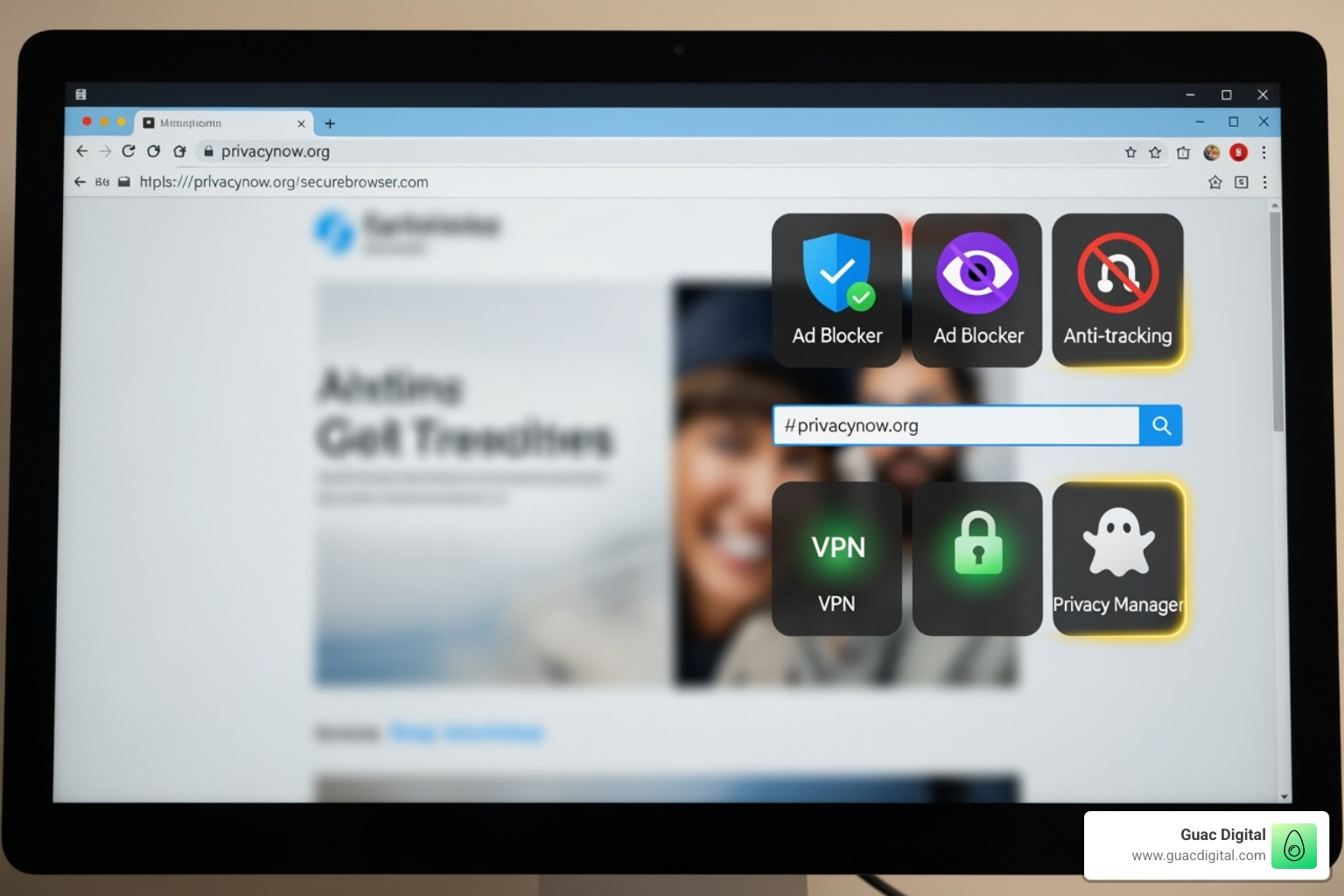
- Use Privacy Tools: Start with privacy-focused browsers like Brave or Firefox and add extensions like uBlock Origin or Privacy Badger. A VPN (Virtual Private Network) encrypts your traffic and masks your location, especially on public Wi-Fi.
- Manage Permissions: Be ruthless with app permissions. Does a flashlight app really need your contacts? Regularly review social media privacy settings to control who sees your information.
- Secure Your Accounts: Enable 2-Step Verification on all important accounts, preferably using an authenticator app instead of SMS.
- Exercise Your Rights: Opt out of data sharing where possible. Under laws like GDPR and CCPA, you can request and delete your data from companies.
- Stay Skeptical: If an online offer seems too good to be true, it probably is. Trust your gut.
An Ethical Playbook for Businesses Using Big Data
For businesses, responsible data handling builds trust and long-term customer relationships.
- Adopt Privacy by Design: Bake privacy into your product development from the start. The Information and Privacy Commissioner of Ontario provides excellent guidance on its foundational principles.
- Practice Data Minimization: Only collect data you absolutely need. If you don’t need it, don’t collect it. Delete it when it’s no longer necessary.
- Anonymize and Secure Data: Use anonymization to gain insights without compromising individual privacy. Employ strong security measures like encryption and conduct regular audits.
- Be Transparent: Write clear, understandable privacy policies. Be honest about what you collect and why.
- Vet Your Vendors: Ensure third-party partners share your commitment to privacy. You are responsible for their practices when you use their services.
By taking these steps, you build a business that customers trust—a powerful competitive advantage.
Frequently Asked Questions about Big Data Advertising Privacy
When discussing big data advertising privacy, the same questions arise. Here are the honest answers.
Can I completely stop companies from collecting my data for ads?
No, complete prevention is nearly impossible if you want to use modern digital services. Even with TOR browsers and VPNs, some data is collected. The digital economy runs on data.
Instead of elimination, focus on data minimization. Like home security, you can’t prevent every threat, but you can become a much harder target. Use privacy tools, limit sharing, and make companies work harder to profile you. The goal is reduction and control, not perfect, unattainable privacy.
Is personalized advertising inherently bad?
Not necessarily. Personalized advertising can be helpful, showing you ads for things you’re actually interested in. This value exchange funds the “free” platforms we use daily. More relevant ads are more effective, keeping services available without subscriptions.
The problem arises when advertising crosses from helpful to creepy—using private conversations to target ads, discriminating in housing or employment, or manipulating emotions for political gain.
Ethical personalization should feel like a helpful suggestion, not surveillance. You should have control, transparency, and the ability to opt out.
What is the single most important thing I can do to protect my privacy online?
If I had to pick one thing, it’s developing critical awareness. This mindset shift is more powerful than any single tool. Question everything. Why does an app need certain permissions? What are you agreeing to in the terms of service? If a service is free, you’re often the product being sold.
There’s no silver bullet for big data advertising privacy. It’s like health; it requires consistent habits. Combine awareness with action: use privacy browsers, review social media settings, enable 2-step verification, and be conscious of the data you share.
Conclusion: Striking a Balance in the Digital Age
The world of big data advertising privacy is a balancing act. We’ve seen how our digital habits fuel a $200 billion industry and how the privacy paradox leads us to trade data for convenience. The risks are significant, from political manipulation by firms like Cambridge Analytica to massive data breaches.
But this isn’t a story of only villains and victims. Big data, when handled responsibly, improves our lives by helping small businesses and enabling research. The key is responsible data stewardship: collecting only what’s needed, protecting it fiercely, and giving people real control.
At Guac Digital, we believe big data advertising privacy shouldn’t be an oxymoron. We help clients steer this landscape by building transparent campaigns with Privacy by Design principles at their core. We prove that effectiveness and ethics can work hand in hand, building the consumer trust that leads to lasting relationships.
The future requires vigilance from us all. With awareness and ethical business practices, we can create a digital world that is both innovative and safe.
Ready to see how ethical data practices can drive real business results? Learn more about How big data analytics is solving big advertiser problems and Explore our data-driven services to see how we help businesses thrive responsibly.