
how is marketing roi calculated: 7 Powerful Ways for 2025 Success
The Real ROI Math: Measuring Your Marketing’s True Value
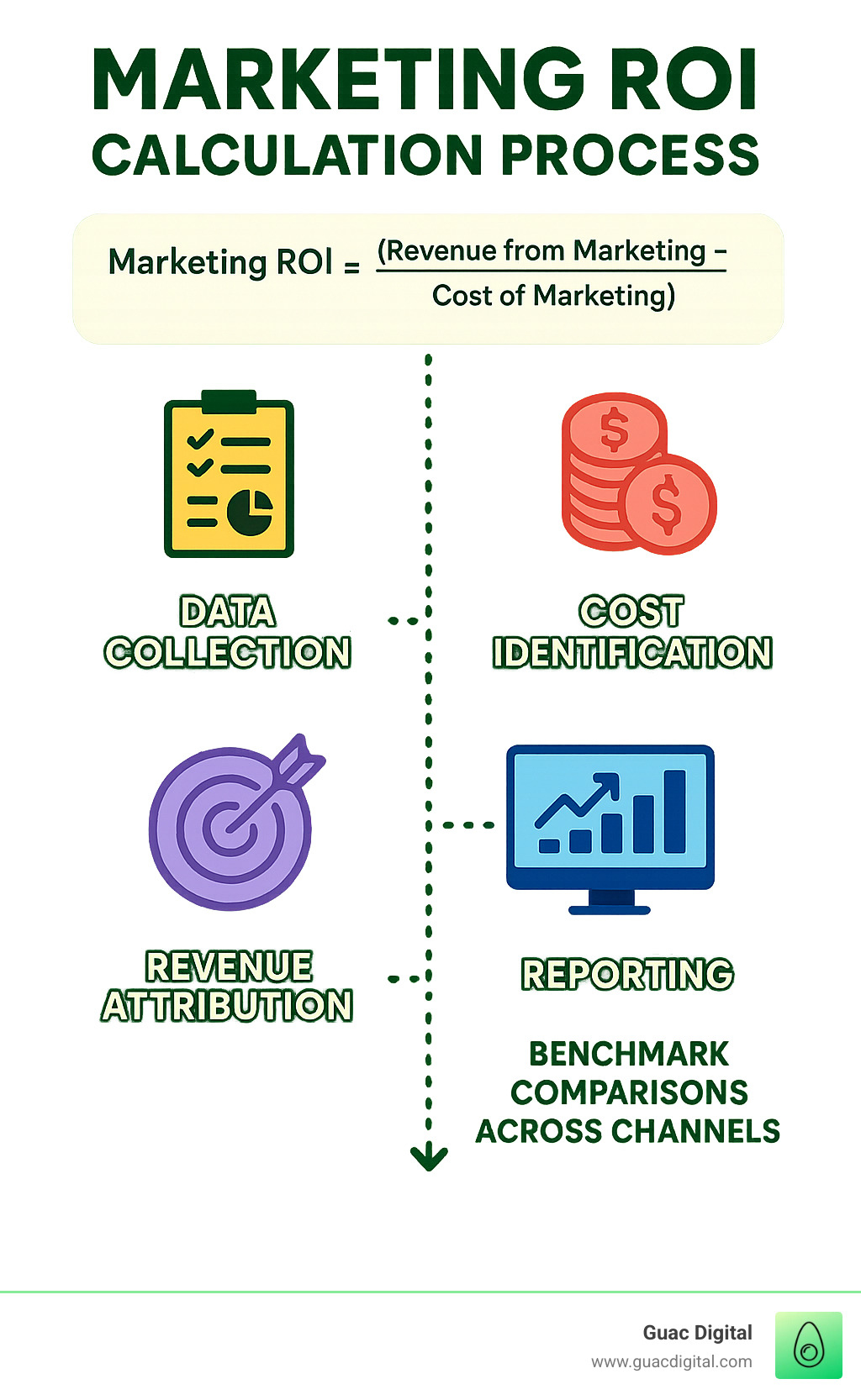
How is marketing ROI calculated? This essential metric tells you whether your marketing dollars are working hard enough. Here’s the quick answer:
Basic Marketing ROI Formula:
Marketing ROI = [(Revenue from Marketing - Cost of Marketing) / Cost of Marketing] × 100%
For example:
* Marketing campaign cost: $10,000
* Revenue generated: $50,000
* ROI = [($50,000 – $10,000) / $10,000] × 100% = 400%
This means for every $1 spent, you earned $5 ($4 in profit plus your original $1).
Marketing ROI isn’t just about numbers on a spreadsheet—it’s about proving the value of your marketing efforts and making smarter decisions about where to invest your budget. Whether you’re justifying spend to stakeholders, comparing channel performance, or planning next quarter’s strategy, understanding ROI calculation is a fundamental marketing skill.
A good marketing ROI is typically considered to be 5:1 (or 400%), though this varies significantly by industry and channel. Email marketing, for instance, boasts an impressive average ROI of 3,800%, while Google Ads averages around 200%, and SEO delivers approximately 825% over three years.
I’m Guy Leon, founder of Guac Digital, where I’ve helped numerous businesses optimize their digital marketing ROI through data-driven strategies and precise ROI calculations. My approach to how is marketing ROI calculated combines both financial metrics and strategic insights to deliver measurable business growth.
How is marketing roi calculated terms to know:
– marketing investment
– romi
– social media roi
Marketing ROI 101: Definition, Importance & Benchmarks
Ever wondered what you’re really getting back from all those marketing dollars? That’s exactly what Marketing ROI answers. At its heart, Marketing ROI (Return on Investment) measures the profit or revenue your marketing efforts generate compared to what you spent. It answers the simple but crucial question: “For every dollar I put into marketing, how many dollars come back to my business?”
Why Measuring Marketing ROI Matters
When I talk with clients, I often hear frustration about proving marketing’s value. That’s no surprise when industry surveys show 53% of large business owners and 43% of small business owners rank ROI as their most important marketing metric. Here’s why it matters so much:
Budget Justification: When the finance team starts looking for budget cuts, concrete ROI data becomes your marketing department’s best defense. Numbers speak louder than concepts.
Resource Allocation: Knowing your highest-performing channels helps you put your money where it actually works. As one marketing director told me: “Without ROI calculation, marketing becomes a cost center instead of a profit center. That’s the difference between growing your budget and fighting for scraps.”
Strategy Refinement: ROI insights are like a compass, pointing toward what’s working and away from what isn’t. This allows you to adapt quickly rather than continuing to invest in underperforming tactics.
Competitive Analysis: Comparing your ROI against industry averages helps you spot opportunities your competitors might be missing.
ROI Benchmarks Across Channels
While a 5:1 ratio (or 400% ROI) is generally considered good marketing performance, the reality varies dramatically depending on where you’re putting your marketing dollars:
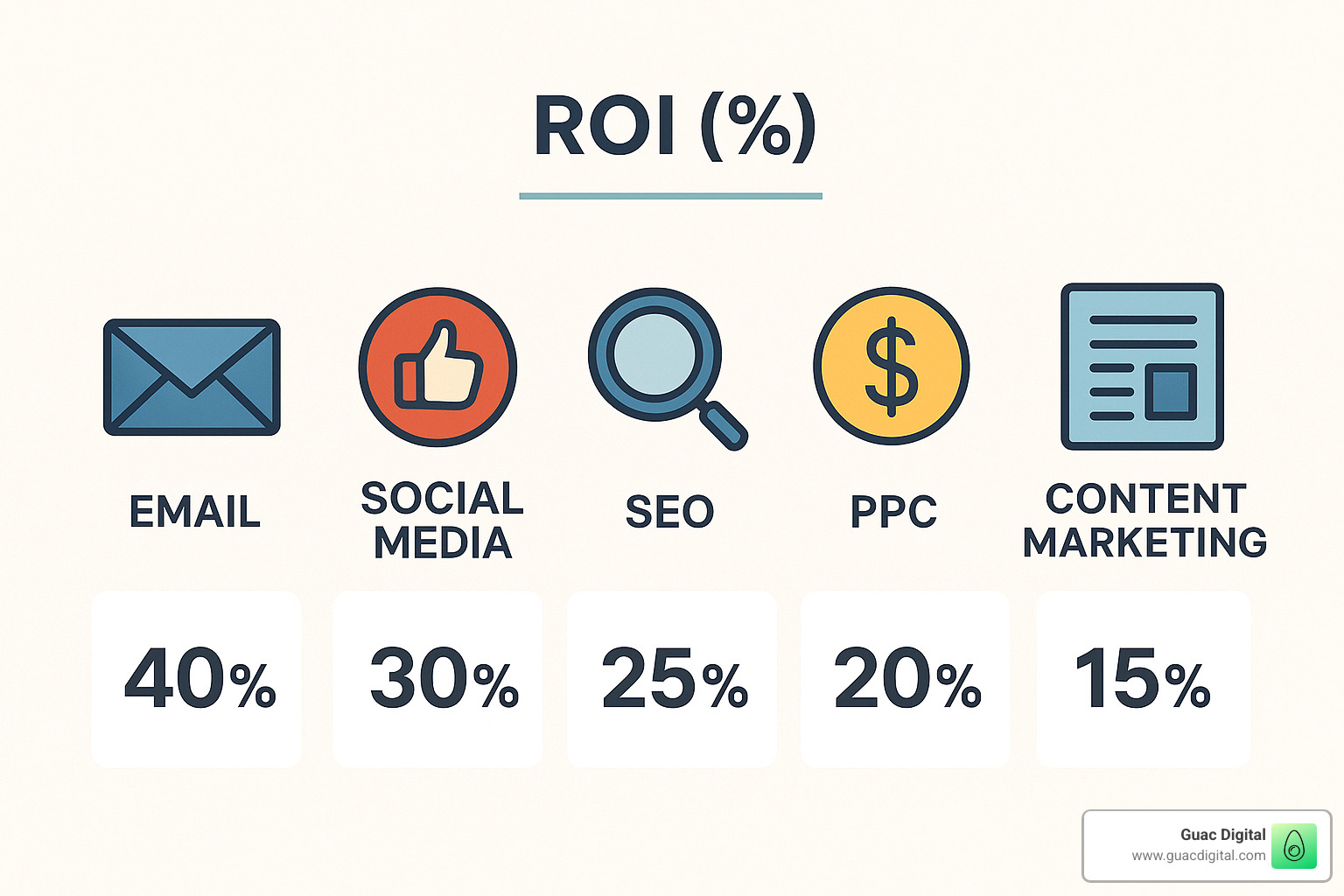
Email Marketing shines brightest with an astounding 3,800% average ROI – that’s $38 back for every $1 spent. No wonder it remains a digital marketing powerhouse despite being one of the oldest channels.
SEO delivers impressive long-term value with an 825% average ROI over three years. It requires patience but pays significant dividends.
Google Ads typically returns about 200% ROI (or $2 for every $1 spent), making it a reliable but less spectacular performer.
Content Marketing shows positive ROI for 82% of marketers who blog consistently, though the returns often build over time.
Social Media results vary widely, typically showing lower immediate ROI but stronger long-term brand benefits.
A truly exceptional marketing ROI would hit 10:1 (900%), while anything below 2:1 (100%) usually signals trouble once all costs are factored in.

Hard vs Soft Returns
Not all returns show up immediately in your bank account. When calculating how is marketing ROI calculated, we consider two types of returns:
Hard Returns
Revenue directly attributed to your marketing activities represents the most obvious return. Profit (revenue minus costs) gives an even clearer picture of actual gain. Market Share growth and improvements in Customer Acquisition Cost also provide tangible evidence of marketing success.
Soft Returns
While harder to quantify, soft returns often drive long-term value. Brand Awareness increases create future sales opportunities. Engagement metrics signal audience interest and potential. Improved Customer Sentiment leads to loyalty and word-of-mouth referrals. And ROMO (Return on Marketing Objective) measures success against specific non-financial goals you’ve set.
The most accurate ROI calculations incorporate both hard and soft returns to show marketing’s complete impact.
Key Variables You’ll Always Need
To calculate marketing ROI accurately, you’ll need five essential data points:
Revenue: The total sales generated from your marketing efforts needs to be tracked carefully.
Marketing Costs: All campaign expenses must be included—not just ad spend, but also labor, tools, and overhead.
Time Frame: Define the specific period you’re measuring, as ROI changes over time (especially for efforts like SEO).
Attribution Method: Decide how you’ll assign credit for conversions across multiple touchpoints.
Data Quality: Ensure your information comes from reliable sources and is properly tracked.
Missing any of these elements leads to incomplete or misleading calculations. As we often tell our clients at Guac Digital, “Your ROI calculation is only as good as your data collection.”
Want to dive deeper into ROI calculation methods? Check out How to Calculate ROI in Marketing [Free Excel Templates] or explore our comprehensive guide to ROI Marketing.
How is Marketing ROI Calculated? (Step-by-Step Blueprint)
Now let’s break down the actual calculation process into manageable steps. The primary formula for marketing ROI is:
Marketing ROI = [(Revenue from Marketing - Cost of Marketing) / Cost of Marketing] × 100%
This can be expressed either as a percentage (400%) or as a ratio (5:1). Both tell the same story—how many dollars you get back for each dollar spent.

Determine Returns (Revenue or Profit)
First, you need to identify what your marketing efforts actually generated. This typically comes in two flavors:
Revenue-Based ROI uses total sales attributed to your marketing. It’s simpler but less precise. The formula looks like this:
ROI = [(Total Revenue - Marketing Cost) / Marketing Cost] × 100%
Profit-Based ROI digs deeper by using gross profit instead. It gives you a clearer picture of your bottom line impact:
ROI = [(Gross Profit - Marketing Cost) / Marketing Cost] × 100%
Here’s why this matters: Imagine your campaign generated $100,000 in revenue with a 30% profit margin (so $30,000 in gross profit). If that campaign cost $10,000:
– Revenue-based ROI would show a whopping 900%
– Profit-based ROI would show a more modest 200%
Quite the difference! Always be clear about which method you’re using when sharing ROI numbers with your team or clients.
Sum Up Investment Costs
Your marketing costs go well beyond just what you spent on ads. For a truly accurate ROI calculation, be thorough about including:
Media Spend covers your direct advertising costs—everything from Google Ads to billboards. Labor means the actual time your team invested (hours multiplied by hourly rates). Don’t forget your Technology costs like software subscriptions and analytics tools.
Also include Production expenses for content creation and design, any Agency Fees if you work with partners like us, and a reasonable portion of Overhead costs.
For example, a typical social media campaign might include $5,000 in ad spend, 40 hours of staff time worth $2,000, $500 in software costs, and $1,500 for video production. That’s $9,000 total—significantly more than just the ad spend.
Skipping these hidden costs leads to overly optimistic ROI figures that can lead you down the wrong path. Trust me, I’ve seen businesses make this mistake repeatedly!
Plug Numbers into Formula — how is marketing roi calculated
With your returns and costs identified, it’s time for the fun part—doing the actual math:
ROI = [(Returns - Costs) / Costs] × 100%
Let’s use our social media campaign example: $9,000 in total costs that generated $45,000 in revenue:
ROI = [($45,000 - $9,000) / $9,000] × 100%
 ROI = [$36,000 / $9,000] × 100%
 ROI = 4 × 100%
 ROI = 400%
This means every dollar you invested returned five dollars—your original dollar plus $4 in profit. In ratio form, that’s a healthy 5:1 ROI.
Account for Organic Growth & Time Lag — how is marketing roi calculated
Basic ROI calculations can be misleading if they don’t consider the bigger picture. Three factors often skew results:
Organic Growth represents sales that would have happened anyway, even without your marketing efforts. Seasonality causes natural ups and downs in your business performance. And Time Lag means some campaigns don’t show their full impact immediately.
To get a more accurate picture, try this refined formula:
Campaign-Attributable ROI = [(Sales Growth - Organic Sales Growth - Marketing Cost) / Marketing Cost] × 100%
Let’s say your business typically grows 4% monthly without special marketing efforts. If a $10,000 campaign generated $15,000 in sales growth:
ROI = [($15,000 - ($15,000 × 4%) - $10,000) / $10,000] × 100%
 ROI = [($15,000 - $600 - $10,000) / $10,000] × 100%
 ROI = [$4,400 / $10,000] × 100%
 ROI = 44%
So the campaign’s true ROI is 44%, not the 50% you’d calculate without accounting for that organic growth. That’s a meaningful difference when you’re making budget decisions!
Sometimes marketing success isn’t about growth at all—it’s about stopping a decline. If your business was losing $1,000 monthly before a $500 campaign reduced that monthly drop to $200, you’ve actually prevented $800 in losses. Your ROI would be 60% because you spent $500 to save $800. That’s successful marketing, even without growth!
Validate with Attribution Checks
Attribution—figuring out which marketing touchpoints deserve credit for conversions—dramatically impacts your ROI calculations. It’s like deciding who on your basketball team deserves credit for winning the game.
Last-Touch Attribution gives all the glory to the final touchpoint before conversion. First-Touch Attribution credits the initial findy moment. Linear Attribution shares credit equally among all touchpoints. Time-Decay Attribution favors touchpoints closer to conversion. And Position-Based Attribution gives 40% credit to both first and last touches, with 20% spread across middle interactions.
A typical customer journey might include finding your brand through an organic search, later clicking a retargeting ad on Instagram, and finally converting through an email campaign. With last-touch attribution, email gets all the credit. With linear attribution, each channel gets an equal share.
At Guac Digital, we’ve found that using multiple attribution models gives clients a more complete picture of their marketing performance. No single model tells the whole story—just like no single metric fully captures your marketing success.
Channel-Specific ROI Math: Digital, Email, PPC, Content & Beyond
Different marketing channels have their own ROI calculation nuances. As someone who’s helped dozens of businesses measure their marketing performance, I’ve seen how these calculations can vary across platforms. Let’s explore the ROI math for the channels you’re most likely using:
Email Marketing Example
When clients ask me about high-ROI channels, email marketing always tops my list. With an average return of 4,200%, email consistently outperforms other digital channels. But how do we actually calculate this impressive number?
Start by adding up all your email costs – your platform subscription, the time spent crafting messages, and any list management expenses. Then track the revenue generated from those emails through direct sales and influenced conversions.
Here’s what this looks like in practice: Imagine sending a weekly newsletter costing $200 to 10,000 subscribers. With a 20% open rate, 10% of those readers click through, and 5% of those clicks convert at an average order value of $120. That’s 10 conversions generating $1,200 in revenue.
How is marketing ROI calculated for this email campaign? Simply apply our formula:
ROI = [($1,200 - $200) / $200] × 100% = 500%
That’s a solid 6:1 return – for every dollar spent, you’re getting six back. Interestingly, while impressive, this is still below the email marketing average, suggesting there’s room to optimize your campaigns further.
PPC & ROAS Snapshot
PPC advertising introduces us to a cousin of ROI – ROAS (Return on Ad Spend). While ROI factors in all marketing costs, ROAS focuses specifically on ad spend:
ROAS = Revenue from Ad Campaign / Cost of Ad Campaign
Let’s say your Google Ads campaign spent $5,000 and generated $15,000 in revenue. Your ROAS would be $15,000 ÷ $5,000 = 3:1 (or 300%). But if you paid an agency $2,000 to manage the campaign, your true ROI would be [($15,000 – $7,000) / $7,000] × 100% = 114%.
This distinction matters when evaluating performance. The average Google Ads campaign delivers a ROAS of about 200%, but I’ve seen this vary dramatically across industries. Legal and insurance keywords often deliver lower returns than specialized B2B products due to competition.
Worth noting is the newer TACoS metric (Total Advertising Cost of Sale), which measures ad spend as a percentage of your total revenue, including organic sales – giving you a more complete picture of advertising efficiency.
Content & SEO Payback
Content marketing and SEO require patience but reward it handsomely – averaging 825% ROI over three years. The challenge is tracking this long-term performance accurately.
I advise clients to carefully track their content and SEO investments – from creation costs to technical implementation expenses. Then measure returns over extended periods, looking at organic traffic value, conversions, and reduced acquisition costs.
The ROI story typically unfolds like this: A company invests $20,000 in content and SEO over six months. The first quarter shows minimal returns ($2,000), creating a negative ROI. By months 4-6, they see $10,000 in revenue, turning slightly positive. But the real magic happens in months 7-12 ($60,000) and year two ($100,000).
This creates a cumulative two-year ROI of 760% – [($172,000 – $20,000) / $20,000] × 100%. The lesson? Short-term ROI measurements severely undervalue content and SEO investments. Good things come to those who measure patiently.
Brand-Awareness Campaigns
“But how do I measure the ROI of brand building?” This question comes up in nearly every client conversation. Brand campaigns present unique measurement challenges because their impact is indirect and often delayed.
I recommend setting proxy KPIs like branded search volume growth, direct traffic increases, social follower growth, and share of voice improvements. Complement these with surveys measuring brand recall, consideration, and purchase intent.
The key is assigning financial value to these improvements. A $50,000 brand campaign might increase branded search by 30%, improve conversion rates by 15%, and reduce acquisition costs by 20%. If these improvements generate an additional $100,000 in profit over the next year, your ROI would be 100% – [($100,000 – $50,000) / $50,000] × 100%.
The beauty of understanding channel-specific ROI is that it allows you to make smarter investments across your marketing mix. Want to learn more about calculating digital marketing ROI across channels? Check out our comprehensive guide on How to Calculate Digital Marketing ROI or explore Determining the ROI of a PPC Agency if you’re working with external partners.
Beyond Basics: Simple ROI vs Campaign-Attributable ROI, CLV & ROAS
When you’re ready to level up your ROI calculations, it’s like graduating from a basic calculator to a financial analytics suite. Let’s explore some more sophisticated approaches that will give you a clearer picture of your marketing’s true impact.
| Metric | Formula | Best For | Limitations |
|---|---|---|---|
| Simple ROI | (Revenue – Cost) / Cost | Quick assessments, single-channel campaigns | Doesn’t account for organic growth |
| Campaign-Attributable ROI | (Revenue – Organic Growth – Cost) / Cost | Isolating marketing impact | Requires historical data |
| CLV-Based ROI | (Customer Lifetime Value × New Customers – Cost) / Cost | Subscription businesses, repeat purchase models | Requires accurate CLV prediction |
| ROAS | Revenue / Ad Spend | Paid media optimization | Excludes non-media costs |
| TACoS | Ad Spend / Total Revenue | Amazon and marketplace sellers | Limited to e-commerce |
Simple ROI Quick Check
Think of Simple ROI as your marketing calculator’s “quick math” function. It’s fast, straightforward, and gives you an immediate sense of performance. While it might not tell the whole story, it’s perfect for:
Speed checks when you need performance data in a hurry. I’ve been in those meetings where someone suddenly asks, “So how did that campaign perform?” – this is your lifesaver.
Comparative analysis between similar campaigns running in parallel. When you’re A/B testing email subject lines or ad creatives, Simple ROI shows clear winners without complex analysis.
Stable channel assessment where baseline performance doesn’t fluctuate much.
For example, imagine you ran two identical email campaigns with different subject lines:
– Campaign A cost $500, brought in $3,000, giving you 500% ROI
– Campaign B also cost $500 but generated $4,000, resulting in 700% ROI
No need for complex models here – Campaign B clearly won the day. The beauty of Simple ROI is in its clarity and immediacy.
Campaign-Attributable ROI Deep Dive
Here’s where things get interesting. Campaign-Attributable ROI is like having X-ray vision that sees through the noise to isolate your marketing’s true impact. It accounts for factors that would have happened anyway:
Organic growth that your business experiences naturally
Seasonal factors like holiday shopping surges
Market trends affecting your entire industry
Competitive activity that might boost or depress results
At Guac Digital, we often use techniques like control groups (where only some customers see your marketing) or geo-testing (running campaigns in certain regions but not others) to measure true incremental impact.
Picture this: Your holiday campaign shows a 20% sales increase, and you’re ready to celebrate. But looking at historical data reveals holidays typically bring 15% growth without extra marketing. Suddenly, your campaign’s impact looks quite different:
Campaign-Attributable ROI = [(20% Growth - 15% Organic Growth - Cost) / Cost] × 100%
This more sophisticated approach reveals the campaign’s genuine contribution, not just coincidental timing with seasonal patterns. How is marketing ROI calculated more accurately? By separating what would have happened anyway from what your marketing actually caused.
Folding in Customer Lifetime Value
Now we’re reaching the summit of ROI sophistication. Incorporating Customer Lifetime Value (CLV) transforms your analysis from a snapshot to a feature film, revealing the complete story of your marketing investment.
CLV represents the total value a customer brings throughout their entire relationship with your business:
CLV = Average Purchase Value × Purchase Frequency × Customer Lifespan
When you combine this with ROI calculation:
CLV-Based ROI = [(CLV × Number of New Customers - Marketing Cost) / Marketing Cost] × 100%
Let me show you why this matters. Imagine your campaign spent $10,000 to acquire 100 new customers. At first glance, if they each made a $70 purchase, your campaign might seem barely profitable.
But looking deeper:
– These customers typically spend $100 per purchase
– They buy from you roughly 3 times yearly
– They stay loyal for about 2 years
– CLV = $100 × 3 × 2 = $600 per customer
– Total value of these 100 customers = $60,000
– CLV-Based ROI = [($60,000 – $10,000) / $10,000] × 100% = 500%
Suddenly, what looked like a break-even campaign reveals itself as a tremendous success! This approach is particularly valuable for subscription businesses, SaaS companies, or any business model where the first purchase is just the beginning of a beautiful friendship.
This more complete view of how is marketing ROI calculated helps you make smarter decisions about customer acquisition investments, often justifying higher upfront costs when the lifetime value makes it worthwhile.
Optimizing & Communicating ROI: Tools, Attribution & Stakeholder Reporting
Let’s face it—calculating ROI is only half the battle. The real magic happens when you translate those numbers into action and communicate them effectively to the people who control the purse strings. I’ve seen brilliant ROI analyses fall flat because they weren’t packaged in a way decision-makers could understand.
Must-Have Tracking & Attribution Tools
The foundation of any solid ROI calculation is reliable data. Without the right tracking infrastructure, you’re essentially flying blind.
Google Analytics 4 has become the backbone of digital marketing measurement, giving you visibility into user journeys across your website and apps. Pair this with a robust CRM system, and you’ll connect those marketing touchpoints directly to revenue—the holy grail of ROI calculation.
Call tracking software fills a crucial gap for businesses that receive phone inquiries. I worked with a home services client who finded their PPC campaign had a negative ROI until we implemented call tracking and revealed it was actually driving 60% of their new business!
Don’t underestimate the power of simple solutions like UTM parameters for tracking campaign sources, or unique promo codes that bridge the gap between digital marketing and offline conversions. Marketing automation platforms tie everything together by connecting your top-of-funnel activities to actual sales.
In our work at Guac Digital, we’ve found that this multi-tool approach typically captures about 85% of marketing-influenced conversions—far better than the 30-40% most businesses track with basic analytics alone.
Using ROI Data to Adjust Budget
ROI data should never gather dust in a spreadsheet. The real value comes from using these insights to make smarter decisions about where to invest your marketing dollars.
Scale your winners by increasing investment in high-ROI channels. When we see email marketing delivering a 600% ROI for a client, that’s a clear signal to pump more resources into that channel.
Fix or eliminate underperformers that drag down your overall marketing performance. A 50% ROI on paid social might warrant scaling back while you optimize the approach, while a negative ROI campaign should typically be paused entirely.
Keep testing new approaches by allocating 10-20% of your budget to experimental channels. I always tell clients, “Today’s experiment is tomorrow’s reliable revenue stream.”
Rebalance your channel mix based on comparative ROI data. This isn’t just about cutting losers and backing winners—it’s about creating a diversified marketing portfolio that balances short-term performance with long-term growth.

Presenting Results to Leadership
Even the most impressive ROI calculations can fall flat if poorly communicated. After years of presenting marketing results to skeptical executives, I’ve learned a few essential principles.
Start with the bottom line before diving into details. Executives want to know the overall return before hearing about individual channel performance or methodology.
Visualize your data with clear, simple charts that tell a story at a glance. A good visualization can convey in seconds what might take paragraphs to explain.
Benchmark appropriately by comparing your results not just to industry standards but also to your own historical performance. Context is everything when interpreting ROI figures.
Be transparent about limitations in your data or attribution model. Nothing undermines credibility faster than overstating certainty in your calculations.
Connect to broader business goals by showing how marketing ROI supports the company’s strategic objectives. This transforms your report from a marketing scorecard to a business growth story.
Always include actionable recommendations. A good executive summary might sound something like:
“Our Q2 marketing initiatives delivered a 320% ROI, generating $1.6M in revenue from a $400K investment—20% above our target and 15% higher than industry average. Email continues to be our highest-performing channel at 750% ROI, while our new influencer program underperformed at 50% ROI. We recommend increasing email investment by 30% and reallocating influencer budget to content marketing, which showed promising growth at 400% ROI.”
This approach answers the key questions every leader asks: How did we do? Why does it matter? What should we do next?
By combining the right tools, strategic budget allocation, and effective communication, you’ll not only calculate marketing ROI accurately but also turn those insights into business growth. For more information about how we approach ROI measurement for our clients, check out our services.
Frequently Asked Questions about Marketing ROI Calculation
What’s considered a “good” ROI across industries?
When clients ask me about good ROI benchmarks, I always start with the 5:1 ratio (or 400%) as a general target. But the truth is, what counts as “good” varies tremendously depending on your specific situation.
If you’re in B2B software, you might be perfectly happy with a lower initial ROI because your customers stick around for years, creating substantial lifetime value. Retail businesses, on the other hand, typically need to see higher immediate returns to justify their marketing spend.
The channel matters enormously too. Your email campaigns should be delivering stellar returns—think 10:1 or better—while brand awareness initiatives might aim for a more modest 2:1 ratio. And let’s not forget that your business stage plays a role too. If you’re a scrappy startup focused on grabbing market share, you might temporarily accept lower or even negative ROI as part of your growth strategy.
One piece of advice I always share with our clients at Guac Digital: the most meaningful benchmark is usually your own historical performance. Are your campaigns delivering better results over time? That improvement trajectory often tells you more than industry averages ever could.
Can I calculate ROI for brand awareness campaigns?
Absolutely you can—though it requires a bit more creativity and patience than calculating ROI for direct response campaigns.
Start by setting crystal-clear objectives for what you want your brand campaign to achieve. Then establish your baselines by measuring where your brand awareness, consideration, and sentiment stand before you launch.
Once your campaign is running, track what I call “proxy metrics”—indirect indicators that your brand efforts are working. These include jumps in direct traffic (people typing your URL directly), increases in branded search volume (folks searching specifically for your company name), and upticks in social media engagement.
I always recommend conducting brand surveys before and after major campaigns. These give you concrete numbers on how your awareness and perception have shifted. The real magic happens when you connect these brand improvements to business outcomes—like a 15% lift in conversion rates across all channels or a 20% drop in customer acquisition costs.
How is marketing ROI calculated for brand campaigns? Here’s a real example: One of our clients ran a brand campaign that showed minimal direct sales but increased branded search by 40%, boosted direct traffic by 25%, and boostd social engagement by 60%. When we analyzed their data, we found these improvements had reduced their customer acquisition costs by 20% across all channels. By calculating the dollar value of those savings, we were able to demonstrate a positive ROI for what initially seemed like a “soft returns” campaign.
How often should ROI be recalculated?
Finding the right frequency for ROI calculations is like finding the right workout schedule—what works depends on your specific situation.
For fast-moving paid search and social campaigns, I recommend monitoring ROI metrics at least weekly, if not daily. These channels let you make quick adjustments, and frequent measurement helps you optimize on the fly.
Most digital channels benefit from a monthly ROI assessment. This timeframe gives you enough data to spot meaningful trends without getting bogged down in day-to-day fluctuations that might just be noise.
Content marketing and SEO are long-game strategies that deserve quarterly evaluation. Measuring too frequently can be misleading since these efforts often take months to show their full impact.
For brand campaigns, I typically recommend measuring pre-launch and post-completion, with periodic pulse checks during longer initiatives.
As one CMO brilliantly put it during a strategy session: “Measure frequently enough to make decisions, but not so frequently that you react to noise instead of signal.” That balance is the sweet spot for effective ROI calculation.
At Guac Digital, we’ve found that creating customized measurement calendars for each client helps ensure they’re getting actionable insights without drowning in unnecessary data points or missing crucial optimization opportunities.
Conclusion
Calculating marketing ROI isn’t just about proving value—it’s about creating it. When you truly understand how is marketing ROI calculated and put these frameworks into practice, you transform from simply spending marketing dollars to strategically investing them for maximum impact.
Throughout this guide, we’ve walked through the essentials that will help you become more confident in measuring your marketing’s true value. The basic formula—[(Revenue – Cost) / Cost] × 100%—serves as your foundation, but as we’ve seen, the real magic happens when you adapt it to your specific situation.
Remember to account for those often-overlooked factors that can dramatically change your results: organic growth that would have happened anyway, the natural time lag between marketing activities and results, and the thorny question of attribution across multiple touchpoints. Getting these right makes the difference between misleading metrics and actionable insights.
Different marketing channels speak different languages when it comes to ROI. Email marketing’s impressive 4,200% average return follows different patterns than the steady build of content marketing or the immediate feedback of PPC campaigns. Each requires its own approach to measurement and its own set of realistic benchmarks.
For a truly complete picture, don’t forget to incorporate customer lifetime value into your calculations. This forward-looking perspective can transform seemingly modest campaigns into long-term winners by revealing the full downstream impact of your customer acquisition efforts.
Once you have solid ROI data, the next challenge is communication. The most sophisticated analysis in the world is worthless if stakeholders don’t understand it or can’t act on it. Clear visualizations, relevant benchmarks, and specific recommendations turn your ROI calculations into business decisions.
At Guac Digital, we leverage big-data programmatic strategies to drive exceptional ROI for our clients. Our approach combines precise ROI calculation with creative execution to ensure every marketing dollar works as hard as possible.
The most successful marketers aren’t just good at spending money—they’re masters at measuring its impact. With the tools and techniques in this guide, you’re now equipped to join their ranks, making smarter decisions that drive stronger results for your business.
Ready to take your marketing ROI to the next level? Learn more about our services and find how data-driven marketing can transform your business results.