
Marketing investment plays a crucial role in the success of any business by ensuring smart allocation of resources to generate substantial returns. If you’re looking to understand marketing investment quickly, here’s what you need to know:
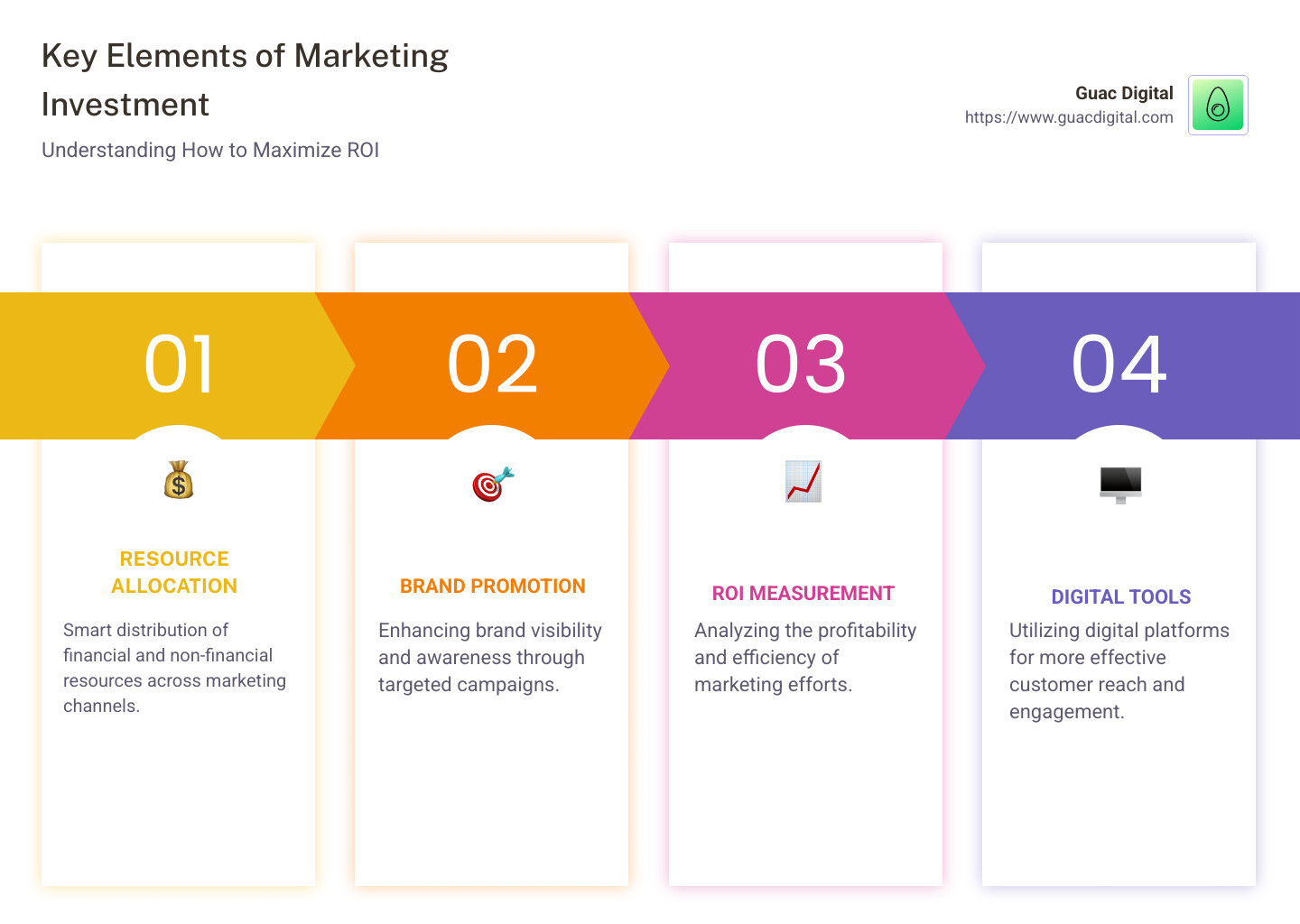
- What is marketing investment? It’s the allocation of both financial and non-financial resources towards marketing initiatives aimed at promoting a brand or product.
- Why is it important? It’s vital for enhancing brand visibility, driving sales growth, and optimizing marketing strategies.
- How does it relate to ROI? The ultimate goal is to achieve a high return on investment (ROI), which measures the profitability of your marketing efforts.
- Examples include: digital ads, social media campaigns, content marketing, and more.
In today’s digital landscape, businesses must invest wisely to stay competitive and attract more targeted traffic online. This is where digital marketing comes in, offering powerful tools and platforms to reach customers effectively.
Having spent years mastering the intricacies of marketing investment, I am Guy Leon, founder and CEO of Guac Digital. My expertise has helped us transform countless digital campaigns, elevating client engagement and conversions significantly.
Marketing investment terms at a glance:
– how to calculate digital marketing roi
– roi marketing
– social media roi
What is Marketing Investment?
Marketing investment refers to the smart allocation of resources—both financial and non-financial—towards marketing activities. This includes everything from advertising and public relations to market research and digital marketing. The aim is simple: promote your brand or product and drive sales growth.
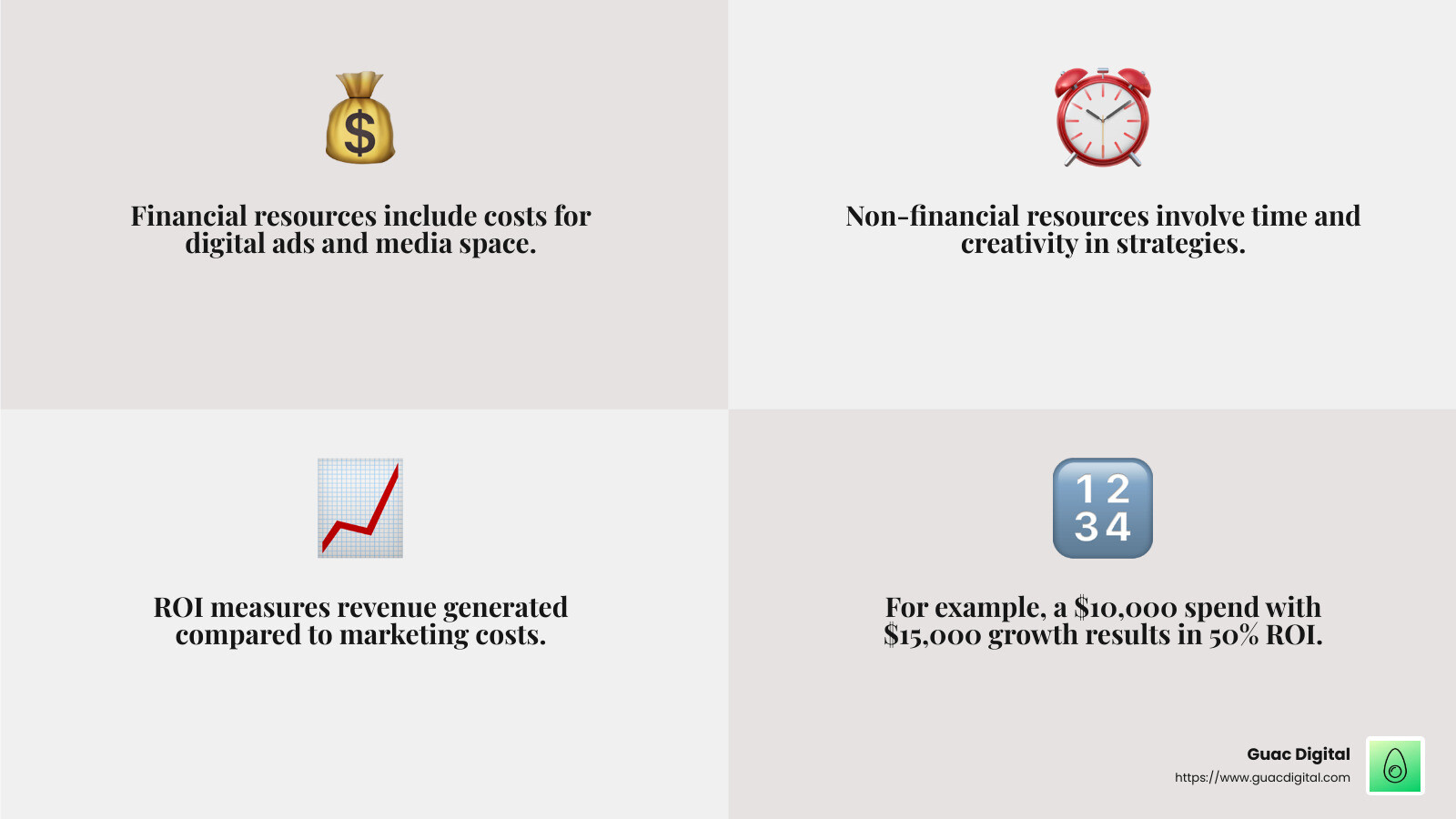
Financial resources involve the actual money spent on marketing efforts. This includes costs for digital ads, hiring agencies, and purchasing media space. Think of it as the dollars you put into campaigns to get your brand noticed.
Non-financial resources are equally important. These include time, effort, and creativity your team invests in developing and executing marketing strategies. It’s about crafting the right message, designing eye-catching visuals, and engaging with your audience.
The ultimate goal of marketing investment is to achieve a high Return on Investment (ROI). ROI measures how much revenue your marketing campaigns generate compared to their cost. A simple formula for calculating ROI is:
[ \text{ROI} = \left( \frac{\text{Sales Growth} – \text{Marketing Cost}}{\text{Marketing Investment}} \right) \times 100 ]
For instance, if a company spends $10,000 on a campaign and sees a sales growth of $15,000, the ROI would be 50%. This means the company gained 50% more than it spent on the marketing campaign.
Marketing investment is crucial for businesses aiming for growth. It helps in enhancing brand visibility, attracting new customers, and retaining existing ones. By investing wisely, companies can optimize their strategies to achieve better results.
At Guac Digital, we understand the nuances of marketing investment. Our personalized strategies have helped numerous clients achieve high ROI and lift their brand presence in the market.
How to Calculate Marketing ROI
Calculating Marketing ROI is essential to understanding the impact of your marketing efforts. It helps you see if your campaigns are truly boosting your sales and justifying the costs involved.
Understanding the ROI Formula
The basic formula for calculating ROI is straightforward:
[ \text{ROI} = \left( \frac{\text{Sales Growth} – \text{Marketing Cost}}{\text{Marketing Cost}} \right) \times 100 ]
This formula tells you how much profit you made from your marketing activities compared to what you spent. But remember, this assumes all sales growth is due to marketing, which might not always be the case.
Breaking Down the Components
Sales Growth: This is the increase in sales revenue during your campaign. It’s essential to separate sales growth directly linked to marketing from organic sales to get an accurate ROI.
Marketing Cost: This includes all expenses related to the marketing campaign. Think of costs for ads, agencies, and even the time your team spends on these efforts.
Incremental Sales: These are the extra sales generated specifically because of your marketing campaign. It’s crucial to identify these to avoid overestimating your ROI.
A Simple Example
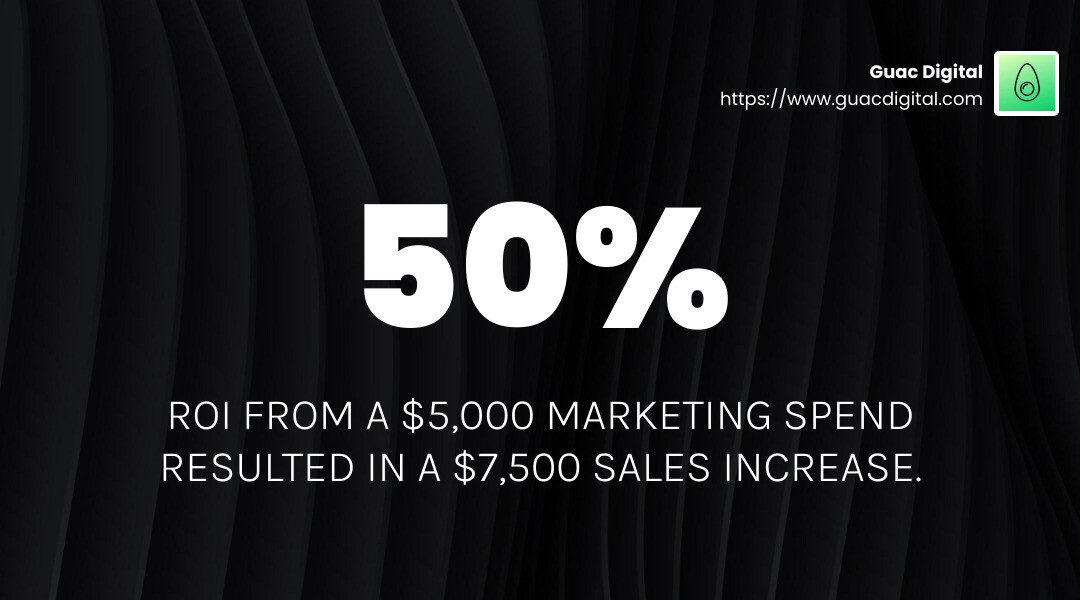
Suppose you spent $5,000 on a social media campaign. As a result, your sales increased by $7,500. Here’s how you calculate your ROI:
[ \text{ROI} = \left( \frac{7,500 – 5,000}{5,000} \right) \times 100 = 50\% ]
This means for every dollar spent, you earned 50 cents in profit. A solid start, but always aim for more as industry standards suggest a 5:1 ratio as strong and 10:1 as exceptional.
Tips for Accurate ROI Calculation
Track Incremental Sales: Use tools to differentiate between sales driven by your campaign and those from other sources.
Adjust for External Factors: Sometimes, external events can affect sales. Be sure to account for these when calculating ROI.
Use Consistent Time Frames: Comparing different campaigns? Make sure you’re looking at the same time periods to get a fair analysis.
By understanding and applying these concepts, businesses can better gauge the effectiveness of their marketing investments. This enables smarter decisions and more strategic planning for future campaigns.
Next, we’ll explore strategies to maximize your marketing investment and ensure you get the best bang for your buck.
Strategies for Maximizing Marketing Investment
Maximizing your marketing investment is about using the right mix of strategies to reach the most customers and see the best returns. Let’s explore some effective tactics.
Diversify Your Strategy
Think of your marketing strategy like a balanced diet. You wouldn’t eat only one type of food, right? Similarly, relying on just one or two marketing channels can be risky. Instead, spread your efforts across multiple strategies.
Use a Mix of Channels: Combine social media, email marketing, content creation, and paid ads. Each has its strengths and weaknesses, and together, they can fill in the gaps.
Adapt to Changes: If one channel underperforms, others can pick up the slack. This reduces the risk of sudden declines in customer engagement or sales.
Gather and Use First-Party Data
With third-party cookies fading away, first-party data is your new best friend. This data is collected directly from your customers, offering valuable insights.
Respect Privacy: Customers appreciate when you respect their privacy. Gather data through website visits, surveys, and social media interactions.
Improve Personalization: Use this data to understand customer preferences and tailor your marketing efforts. Personalized marketing can significantly boost engagement and sales.
Accept Email and Text Message Marketing
Email and text message marketing might seem old school, but they’re still powerful tools. They allow for direct communication and can be highly targeted.
Segment Your Audience: Divide your email list by demographics or behavior. This lets you send targeted messages, increasing the chances of engagement.
Track and Adjust: Monitor open and response rates. Use this data to refine your messages and improve results.
Consider Video Marketing
Video content is king in today’s digital world. It’s engaging and can convey your message quickly and effectively.
Create Compelling Content: Use videos for product demos, tutorials, or storytelling. Platforms like YouTube and TikTok are perfect for reaching a broad audience.
Leverage Social Media: Share videos on social platforms to increase visibility and engagement.
By implementing these strategies, you can ensure your marketing investment is working hard for you. Next, we’ll tackle the challenges of measuring marketing ROI and how to overcome them.
Challenges in Measuring Marketing ROI
Measuring the return on your marketing investment can feel like solving a puzzle with missing pieces. Let’s break down why it’s so tricky.
Numerous Campaigns
In today’s digital world, companies often run multiple marketing campaigns simultaneously. Each campaign might target different audiences or use different channels. This can make it hard to pinpoint which campaign is driving results.
For example, if you see a spike in sales, was it because of the email blast, the social media ads, or the influencer partnership? Without clear tracking, the success of individual campaigns can get lost in the noise.
Lack of Control
Once your marketing message is out there, it can take on a life of its own. People share, comment, and remix content in ways you might not expect. This lack of control can make it challenging to monitor and measure the exact effects of your marketing efforts.
Imagine launching a hashtag campaign. It could go viral in a good way, or it could be misinterpreted, leading to unexpected results. Either way, measuring its direct impact becomes complex.
Multiple Touchpoints
Did you know that it takes, on average, 6-10 touchpoints before a consumer makes a purchase decision? This means your customers interact with your brand in many ways before buying.
Think of a customer who sees your ad on Instagram, reads a blog post, receives an email, and finally visits your store. Each touchpoint plays a role, but which one sealed the deal? Understanding the impact of each touchpoint is crucial but not always straightforward.
Outdated Attribution Models
Traditional attribution models often fall short in today’s omnichannel landscape. They might give too much credit to the last click or interaction, ignoring the journey that led there.
For example, a last-click attribution model might attribute a sale entirely to a Google ad click, overlooking the blog post or social media interaction that initially sparked interest. To get a clearer picture, marketers are turning to more advanced models like multi-touch attribution, which considers the entire customer journey.
By understanding these challenges, you can better steer the complex world of measuring marketing ROI. Next, we’ll explore best practices for making the most of your marketing investment.
Best Practices for Marketing Investment
To make the most of your marketing investment, follow some best practices. These practices will help you allocate resources wisely and ensure that your marketing efforts yield the best possible return.
Benchmarking
Benchmarking is like setting the baseline for success. It’s about comparing your performance against industry standards or competitors. Knowing where you stand helps you set realistic goals and measure progress.
For instance, if you’re in the e-commerce sector, you might benchmark your conversion rates against industry averages. This gives you a clear picture of where you excel and where there’s room for improvement.
Customer Acquisition Cost (CAC)
Understanding your Customer Acquisition Cost (CAC) is crucial. CAC is the total cost of acquiring a new customer, including advertising, marketing, and any other related expenses.
Let’s say you spend $1000 on a marketing campaign that brings in 50 new customers. Your CAC would be $20 per customer. Keeping CAC low while maintaining quality leads is key to maximizing your marketing investment.
Customer Lifetime Value (CLV)
While CAC tells you how much it costs to get a customer, Customer Lifetime Value (CLV) tells you how much a customer is worth over time. CLV is the total revenue you expect from a customer during their relationship with your business.
For example, if a customer spends $100 annually and stays with you for five years, their CLV is $500. A higher CLV means more return on your initial investment, so nurturing customer relationships is vital.
Brand Awareness
Building brand awareness is like planting seeds for future growth. It’s about making sure your brand is recognized and remembered by your target audience.
Think of Coca-Cola. Their brand is so well-known that people recognize it worldwide. This didn’t happen overnight. It took consistent marketing efforts to build that level of awareness. For your business, increasing brand awareness can lead to more customers finding and choosing your products over competitors.
By implementing these best practices, you can optimize your marketing investment and drive better results. Up next, we’ll tackle some frequently asked questions about marketing investment.
Frequently Asked Questions about Marketing Investment
What is an example of investment marketing?
Investment marketing involves strategies that aim to attract and retain customers. Referral programs are a great example. They encourage existing customers to bring in new ones by offering incentives. For instance, Dropbox famously grew its user base by offering extra storage space to both referrers and referees.
Trade shows are another example. They provide a platform to showcase your products, meet potential clients, and network with industry peers. Participating in trade shows can lead to direct sales and valuable connections.
Free consultations also play a role in investment marketing. Offering a free initial consultation can attract potential customers by providing them with a taste of your expertise and building trust.
How do you justify marketing spend?
Justifying marketing spend requires demonstrating its value. One way is through budget allocation. By analyzing which channels bring the best returns, you can allocate funds more effectively. For example, if social media ads drive more conversions than print ads, it makes sense to invest more in social media.
Campaign success is another way to justify spending. Track metrics like sales growth, leads generated, and customer engagement. If a campaign boosts sales by 20%, it’s easier to justify the investment.
Competitive analysis can also help. By understanding what your competitors are doing and how well they’re performing, you can adjust your strategies and justify your spend. If competitors are seeing success with influencer marketing, it might be worth investing in that area.
What is a good marketing ROI?
A good marketing ROI varies by industry, but a common benchmark is a 5:1 ratio, meaning you earn $5 for every $1 spent. This is considered a strong return. An exceptional ROI would be a 10:1 ratio, indicating highly effective marketing efforts.
However, industry standards can differ. For some sectors, a 2:1 ratio might be acceptable due to high product costs. It’s crucial to compare your ROI against industry standards to determine what’s good for your specific market.
Conclusion
At Guac Digital, we believe that personalized strategies are the key to achieving high ROI in marketing investment. Our approach is simple yet powerful: tailor each campaign to the unique needs of our clients. By leveraging big data, we ensure that every marketing dollar is spent wisely, maximizing returns and driving growth.
Our team, based in Tampa, Florida, but serving clients worldwide, focuses on creating digital campaigns that are not only innovative but also deeply personalized. We understand that no two businesses are the same, and neither should their marketing strategies be. This commitment to personalization sets us apart and helps our clients reach their goals efficiently.
High ROI isn’t just a buzzword for us—it’s the core of what we do. We measure success by the results we deliver, whether it’s increasing brand awareness, driving sales growth, or enhancing customer engagement. Our dedication to data-driven strategies means that we are always optimizing and refining our approaches to ensure the best possible outcomes.
If you’re ready to see your marketing investment pay off, partner with us for a custom digital strategy that delivers results. Explore our services to learn more about how we can help your business thrive.
Together, let’s turn your marketing investment into a powerhouse of growth and success.