
How to Start a Digital Marketing Agency: 10 Proven Steps 2025
Why Starting a Digital Marketing Agency is a Golden Opportunity
How to start a digital marketing agency has become one of the most searched business questions of 2024. The digital advertising market is exploding, with global spend expected to hit $667.6 billion this year – a 10.9% jump from 2023.
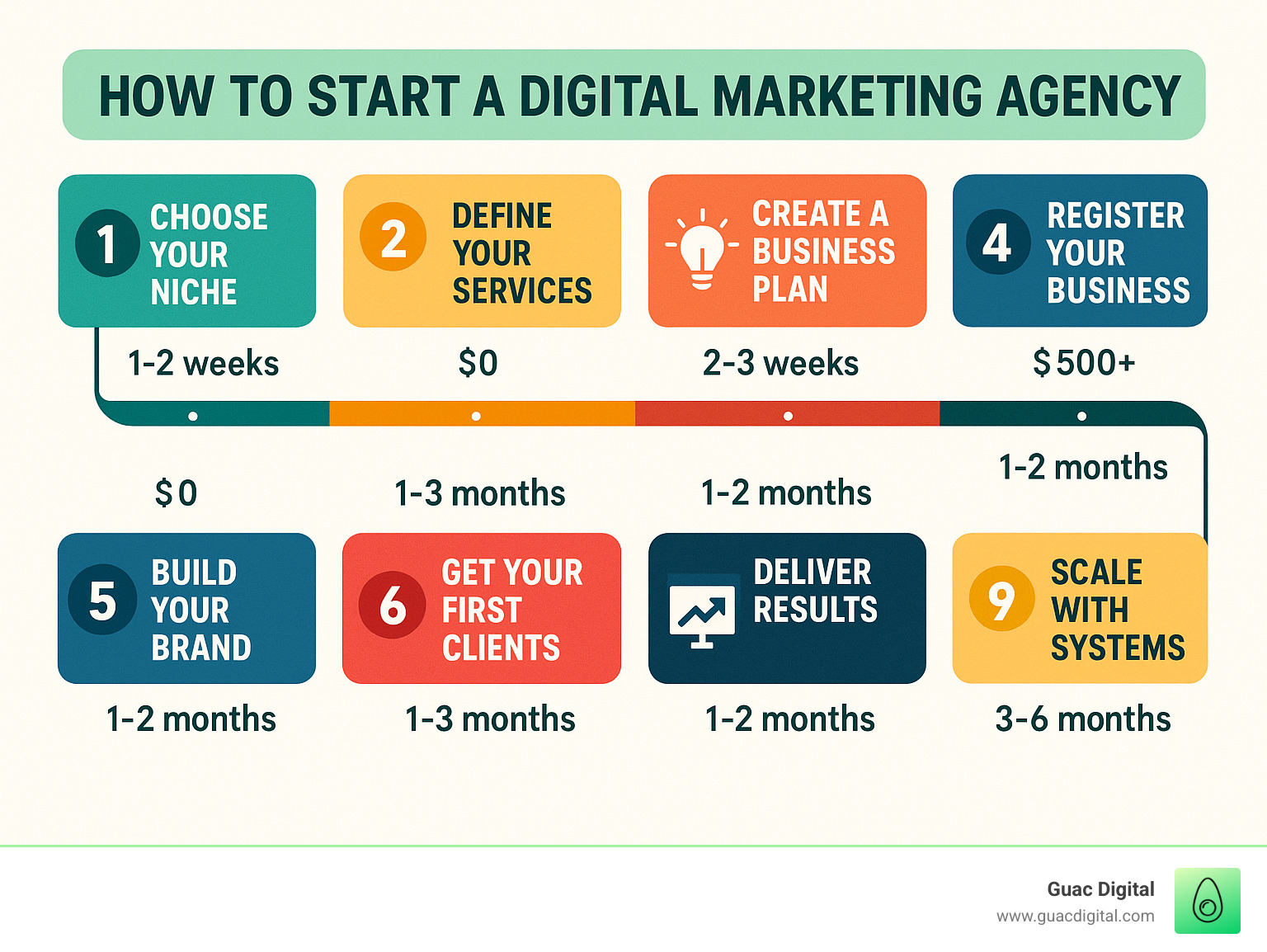
Quick Answer: How to Start a Digital Marketing Agency
- Choose your niche – Focus on specific industries for higher win rates
- Define your services – Start with 1-2 core offerings (SEO, PPC, social media)
- Create a business plan – Include pricing and target market
- Register your business – Set up LLC/Corp, get licenses
- Build your brand – Website, portfolio, social media presence
- Price your services – Choose retainer, project-based, or performance models
- Get your first clients – Use network, cold outreach, freelance platforms
- Deliver results – Focus on measurable outcomes
- Scale with systems – Create SOPs, hire team members
- Optimize and grow – Refine processes, expand services
The barriers to entry have never been lower. You can start with just a laptop and internet connection, yet digital agencies often achieve profit margins up to 40% – far above the industry average of 7.9%.
I’m Guy Leon, founder and CEO of Guac Digital, where we’ve helped transform digital marketing strategies for countless businesses. My experience in how to start a digital marketing agency and scale it to industry leadership gives me unique insights into what actually works.
How to start a digital marketing agency terms to remember:
– how do marketing agencies make money
– how much do marketing agencies charge
– what does a digital marketing agency do
Understanding Digital Marketing Agencies
A digital marketing agency helps businesses promote their products and services through online channels. You’re not just running ads – you’re crafting strategies that drive real traffic, generate quality leads, and create measurable results that impact your client’s bottom line.
Digital agencies can achieve profit margins up to 40% because of the remote-first nature of the work. Compare that to the average profit margin across all industries at just 7.9%, and you can see why entrepreneurs are jumping into this space.
With around 500,000 marketing agencies worldwide, demand keeps growing as businesses allocate bigger chunks of their budgets to digital marketing.
Modern agencies solve real problems: the expertise gap (most business owners lack specialized knowledge), time constraints (marketing requires consistent attention), tool access (premium tools cost thousands monthly), staying current (trends change rapidly), and providing measurable results.
What Services Does a Digital Marketing Agency Provide?
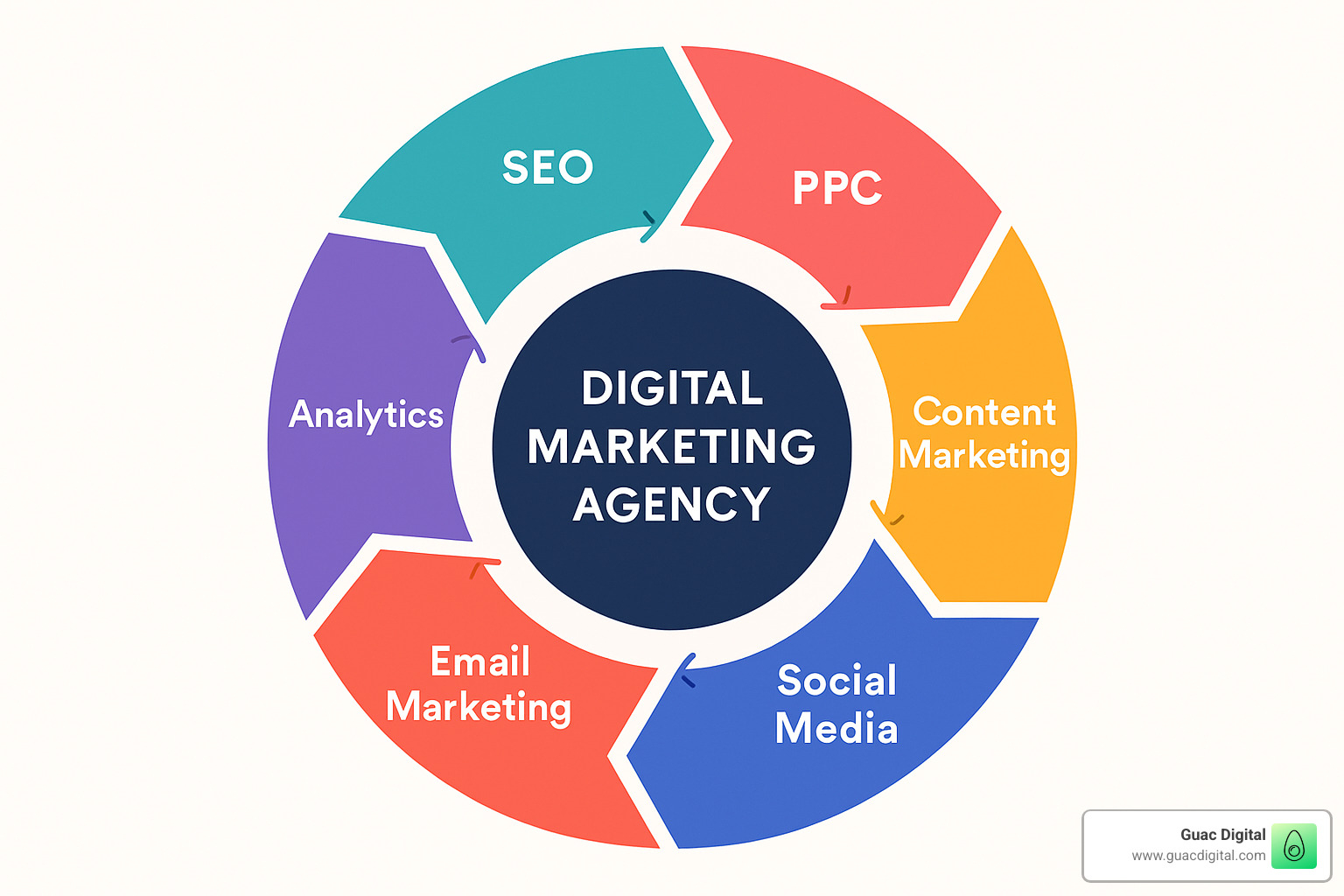
Search Engine Optimization (SEO) improves website rankings through on-page optimization, technical fixes, content creation, and link building. It’s long-term organic growth that keeps delivering results.
Pay-Per-Click Advertising (PPC) provides immediate visibility through managed campaigns on Google Ads, Facebook, and other platforms. It’s instant lead generation while organic presence grows.
Content Marketing creates valuable blog posts, videos, and infographics that attract and engage audiences. Good content solves problems and builds trust.
Social Media Management develops strategies across platforms, including content creation, community management, and paid advertising that converts.
Email Marketing delivers the highest ROI, returning $36 for every $1 spent. It includes automated sequences, newsletters, and targeted campaigns.
Analytics and Reporting track performance and demonstrate ROI through data-driven insights and optimization.
More info about Understanding the Services we provide can help you grasp the full scope of possibilities.
Main Types of Digital Marketing Agencies
Full-Service Agencies handle everything from strategy to execution across all channels. They require more resources but command higher fees and build stronger client relationships.
SEO-Only Agencies focus exclusively on search optimization. The SEO market was valued at $65 billion in 2023 and is projected to reach $170 billion by 2028.
Social Media Marketing Agencies build brand presence across social platforms. US social media ad spend is projected at $76.4 million in 2024.
PPC Advertising Agencies manage paid campaigns and often work on performance-based pricing models.
Specialty Vertical Agencies focus on specific industries like healthcare, legal, or real estate. These agencies see 68% higher proposal win rates compared to generalist agencies.
Specialization becomes more pronounced as you build case studies and industry expertise. It’s easier to become known as “the digital marketing agency for law firms” than “the agency for everyone.”
Step-by-Step: How to Start a Digital Marketing Agency
After talking with over 300 successful agency founders, there’s a clear roadmap that works. Most people get stuck in analysis paralysis, but successful founders start with a solid foundation and learn by doing.
Choose Your Niche & Define the Ideal Client
Agencies that specialize in a niche see 68% higher proposal win rates compared to those trying to serve everyone. The magic happens when you become the go-to expert for a specific type of business.
The most profitable niches include healthcare practices, legal firms, home service companies, e-commerce stores, SaaS companies, and fitness businesses.
Get crystal clear on your Ideal Client Profile (ICP). What’s their annual revenue? Team size? Marketing budget? What keeps them up at night?
At Guac Digital, we focus on businesses generating over $1 million annually because they have the budget for comprehensive strategies and understand the value of data-driven marketing.
Specialization compounds over time. You develop templates, case studies, and industry knowledge that makes you faster and more effective. You speak their language and position yourself as the obvious choice.
More info about choosing a niche can help you make this crucial decision.
Craft Your Business Model & Pricing Strategy
The retainer model is king for predictable revenue. Clients pay a fixed monthly fee for ongoing services, typically $2,000-$20,000+ depending on deliverables and client size.
Project-based pricing works for specific deliverables like website redesigns or SEO audits, ranging from $5,000-$50,000+. Higher margins but inconsistent cash flow.
Performance-based pricing ties compensation to specific results. Only use when you can directly control the outcomes.
| Pricing Model | Best For | Monthly Range |
|---|---|---|
| Retainer | Ongoing services | $2,000 – $20,000+ |
| Project-Based | One-time deliverables | $5,000 – $50,000+ |
| Performance-Based | Controllable results | Varies |
Charge at least $150-$200 per hour for general services, $300+ for strategic consulting. Build in a 20% margin above costs.
How Much Do Marketing Agencies Charge? provides detailed pricing benchmarks.
Key Legal & Administrative Steps
Choose LLC or Corporation for liability protection and tax benefits. Register your business name after checking for trademark conflicts ($50-$300).
Essential paperwork: Articles of Incorporation/Organization, Operating Agreement, EIN from IRS, business licenses, professional liability insurance.
Open a dedicated business bank account and set up accounting systems like QuickBooks. Get general liability, professional liability, and cyber liability insurance.
For California residents, starting an LLC in California provides state-specific guidance.
Build a Winning Team & Workflow
Start with core roles: Digital Marketing Strategist, SEO Specialist, PPC Manager, Content Creator, and Graphic Designer. Begin with freelancers for flexibility, then transition key roles to full-time as you grow.
Standard Operating Procedures (SOPs) are non-negotiable. Document client onboarding, campaign setup, reporting schedules, and quality control processes.
Accept remote work to access global talent while keeping overhead low. Use project management tools and clear communication protocols.
Essential Tools & Tech Stack
CRM: HubSpot (free tier), Pipedrive, or Salesforce
Project Management: Asana, Monday.com, or Trello
SEO Tools: SEMrush, Ahrefs, Screaming Frog, Google Search Console
PPC Management: Google Ads Editor, Facebook Ads Manager
Content Creation: Canva, Adobe Creative Suite, Grammarly
Analytics: Google Analytics 4, Google Data Studio, Hotjar
Automation: Zapier, Buffer, Mailchimp
Expect to spend $500-$2,000+ monthly on tools. Start with free tiers and upgrade as you grow. Choose tools that integrate well and scale with your business.
With digital ad spend expected to hit $667.6 billion this year, professional tools are essential for competing effectively.
Building Authority & Getting Your First Clients
Landing your first clients is often the biggest hurdle. Without a proven track record, you need to get creative and stay persistent. Every successful agency started exactly where you are now.
Start Building Your Portfolio Today: Create mock projects for local businesses. Pick a business with a terrible website and create a redesign. Run SEO experiments on your own site and document traffic growth. These become powerful conversation starters.
Strategic Free Work: Choose 1-2 businesses for case studies and offer services in exchange for testimonials and showcase rights. Look for businesses where you can make measurable impact quickly.
Turn Results Into Stories: Every project should become a case study. Include the client’s challenge, your strategy, implementation process, and specific results with concrete metrics like “increased website traffic by 150% in 90 days.”
Your Network Is Your Net Worth: Start conversations with everyone you know. Personal referrals convert at much higher rates because trust is already established.
Cold Outreach That Works: Research each prospect and offer something specific. “I noticed your website isn’t showing up for ‘Tampa plumbing services.’ I put together a quick analysis showing why and three steps to fix it. Would you like me to send it over?”
Freelance Platforms: While Upwork and Fiverr might not offer premium rates initially, they provide reviews, case studies, and experience with diverse clients.
Free Audit Strategy: Offer complimentary website audits or SEO analyses to qualified prospects. Focus on opportunities rather than criticisms when presenting results.
Video Outreach: Create personalized video messages showing exactly what’s happening with their current marketing and how you’d improve it. This has dramatically higher response rates.
Strategic Partnerships: Connect with web designers, business consultants, and accountants who work with your target clients. These relationships become consistent referral sources.
Speaking Opportunities: Volunteer to speak at local business events or chamber meetings. Teaching positions you as an expert and generates qualified leads.
Consistency beats perfection. Most agencies don’t see momentum until months 6-12, but the relationships you build become the foundation for long-term success.
More info about Creating a Data-Driven Strategy can help you develop compelling case studies that demonstrate real business impact.
Scaling & Profitability
Once you’ve landed your first clients, the real journey begins: scaling into a profitable, sustainable business. The secret sauce? Monthly Recurring Revenue (MRR). When 70-80% of your income comes from retainer clients, you can plan for the future without feast-or-famine cycles.
Systematize everything before you think you need to. Create detailed processes for client onboarding, campaign setup, reporting, and communication. These systems become your agency’s DNA, allowing delegation while maintaining quality.
Hiring versus outsourcing: Hire full-time for core client-facing roles and strategic work. Use freelancers for specialized tasks and overflow work. Outsource administrative tasks and routine execution.
Pricing should evolve as you build expertise and case studies. Position premium pricing as an investment in better results rather than just higher costs.
Service expansion becomes natural once you’ve mastered core offerings. SEO agencies add content marketing and PPC. Social media specialists expand into influencer marketing. Build on existing expertise rather than jumping into unrelated services.
Existing clients are your best growth source through upselling and cross-selling. Regularly review their businesses for additional opportunities based on results you’ve achieved.
Risk management means avoiding over-dependence on any single client. If one client represents more than 30% of your revenue, actively diversify.
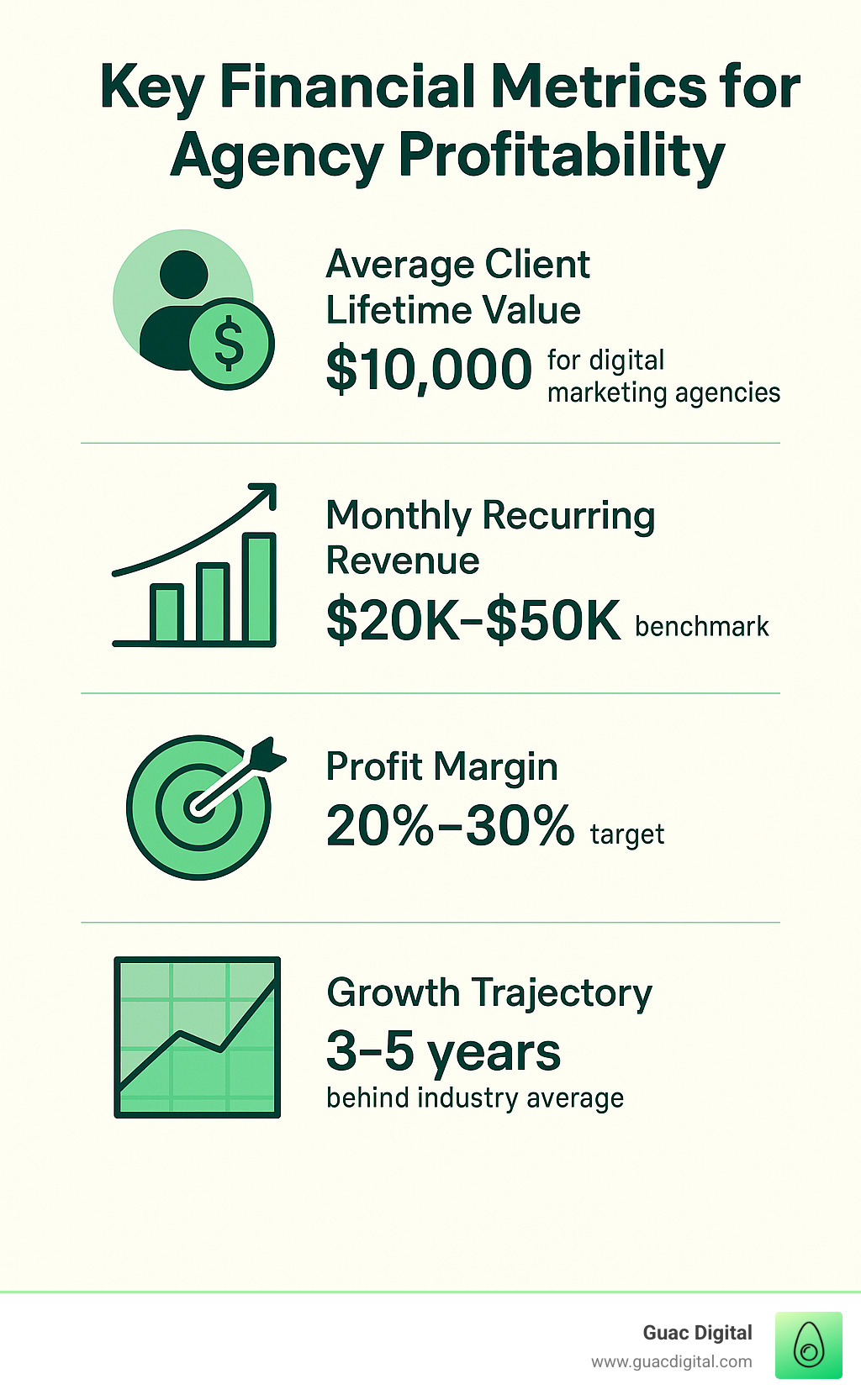
Track financial metrics that matter: Client Lifetime Value (CLV), Customer Acquisition Cost (CAC), Churn Rate, and Profit Margins.
Automation opportunities multiply as you scale. Tools like Zapier handle client reporting, lead nurturing, project updates, and invoice generation.
The most successful agencies focus on building valuable, long-term client relationships rather than constantly chasing new business. When clients see consistent results, they become advocates who refer new business.
At Guac Digital, leveraging big data for programmatic marketing creates a competitive advantage. Our data-driven strategies achieve higher ROI while building a more profitable agency.
According to Oberlo statistics, digital advertising spend continues growing rapidly, creating expanding opportunities for agencies that demonstrate clear ROI.
How Do Marketing Agencies Make Money? provides detailed insights into revenue models and profitability strategies.
Frequently Asked Questions about How to Start a Digital Marketing Agency
What are the biggest challenges new agencies face?
Fierce competition from established players with years of case studies. Attracting first clients without a track record. Keeping up with rapidly changing industry trends. Technology overwhelm from hundreds of available tools. Growing pains around months 6-12 when you’re too busy to handle everything but not profitable enough for full-time staff.
How long does it take to become profitable?
Most agencies see real profitability between months 6-12. Timeline depends on your starting point, niche selection, pricing strategy, and client acquisition effectiveness. Agencies in high-value niches like healthcare or legal often achieve profitability faster.
Should I quit my job to start an agency?
Don’t quit immediately. Most successful founders started as side businesses while maintaining full-time income. Transition when your agency generates consistent monthly revenue covering personal expenses plus a buffer – typically 3-6 months of expenses saved with predictable MRR.
How much does it cost to start a digital marketing agency?
Startup costs typically range from $2,000 to $16,000.
Bootstrapping ($2,000-$5,000):
– Business registration: $500-$1,500
– Essential tools: $200-$500 monthly
– Basic website: $500-$2,000
– Marketing materials: $300-$1,000
– Insurance: $500-$1,200 annually
Comprehensive launch ($8,000-$16,000):
– Advanced tools: $1,000-$2,000 monthly
– Professional branding/website: $3,000-$8,000
– Initial team/contractors: $2,000-$5,000
– Marketing budget: $1,000-$3,000
Ongoing monthly expenses ($3,000-$10,000):
– Tools and software: $500-$2,000
– Team salaries/contractors: $2,000-$6,000
– Marketing and operations: $700-$3,000
Money-saving strategies: Start with free tool tiers, use freelancers initially, work from home, leverage free marketing channels, negotiate annual subscription discounts.
Can I start a digital marketing agency with no experience?
Absolutely! Many successful founders started with zero formal marketing experience.
Free education: Google Digital Garage, HubSpot Academy, Facebook Blueprint, YouTube tutorials, industry blogs.
Gain practical experience: Create mock projects, use your website as testing ground, offer free services to nonprofits, take small freelance projects.
Build credibility quickly: Earn industry certifications from Google, Facebook, HubSpot. Document your learning journey on social media. Attend networking events and find mentors.
Start small and specialize rather than offering everything. Focus on one service you can master quickly – SEO, social media, or PPC are good starting points.
What is the best pricing model for new agencies?
Start with a hybrid approach:
Project-based pricing initially to build portfolio and case studies. Fixed prices for specific deliverables work well for new agencies.
Transition to retainer models once you’ve proven value. Start with smaller retainers ($2,000-$5,000 monthly) and increase as you demonstrate results.
Performance-based pricing can differentiate you from established agencies, but only use when you can directly control outcomes.
Evolve toward value-based pricing where fees reflect business impact rather than time spent. This requires proven case studies and confident positioning.
Ensure pricing covers all costs plus healthy profit margin. Don’t compete solely on being cheapest – clients often associate higher prices with higher quality.
Conclusion
The opportunity to start a digital marketing agency in 2024 is extraordinary. With global digital ad spend hitting $667.6 billion and climbing, businesses everywhere need partners who can steer online marketing complexity.
You now have the complete roadmap for how to start a digital marketing agency. The agencies that thrive specialize rather than generalize, achieving 68% higher win rates. They build systems that scale and focus obsessively on client results.
At Guac Digital, we’ve witnessed how the right combination of strategy and execution transforms businesses. Our approach of leveraging big data for programmatic marketing achieves ROI levels that leave traditional agencies behind. This happens when you combine data-driven insights with genuine care for client success.
The digital marketing landscape rewards persistence and smart thinking. Whether you’re starting with experience or learning from scratch, the opportunity exists to build something meaningful. Every expert was once a beginner who decided to take that first step.
Your potential clients are struggling with digital marketing right now. They’re posting without strategy, running ads that don’t convert, and watching competitors outrank them. They need someone who understands their pain and delivers real solutions.
Starting a digital marketing agency requires dedication, continuous learning, and unwavering focus on client success. But for those who stick with it, the rewards are substantial: financial freedom, creative fulfillment, and the satisfaction of helping businesses grow.
The foundation is here, the opportunity is massive, and the timing couldn’t be better. More info about our services can show you what’s possible when everything comes together perfectly.
The digital marketing revolution is just getting started. Your agency could be part of shaping what comes next.