
The Significance of Data in Modern Marketing
Creating a data-driven marketing strategy is essential for businesses looking to improve their digital presence and drive more targeted traffic to their website. In this guide, we’ll explore why this approach is so crucial and how you can craft a successful strategy.
Here’s a quick overview for those just looking for actionable steps:
– Define clear objectives for your data
– Gather and centralize customer data
– Analyze the collected data for patterns and trends
– Categorize your audience into target groups
– Create custom marketing campaigns for each group
– Measure and optimize continuously
The marketing landscape has evolved significantly, with data playing a pivotal role in shaping strategies. Businesses that harness data effectively can see double-digit increases in sales. Data not only provides insights into customer behavior but also allows for highly personalized marketing efforts, improving ROI.
As Guy Leon, founder and CEO of Guac Digital, I’ve seen how a well-implemented data-driven marketing strategy can transform a business. From boosting client engagement to increasing website traffic, my experience has been rooted in leveraging data to drive success.
Ready to dive deeper? Let’s explore how you can transition from traditional to data-driven marketing, ensuring you reach the right audience with the right message at the right time.
What is Data-Driven Marketing?
Data-driven marketing is the practice of optimizing brand communications based on customer data. Instead of relying on gut feelings or assumptions, marketers use data to predict customer needs, desires, and future behaviors. This approach helps create personalized marketing strategies that deliver the highest possible return on investment (ROI).
Leveraging Customer Data
At its core, data-driven marketing revolves around customer data. This data can come from various sources like CRM systems, web analytics, and customer surveys. By analyzing this information, marketers can gain a deep understanding of their target audience.
For instance, Amazon uses customer data to segment its audience and tailor product recommendations. This strategy not only improves the shopping experience but also significantly boosts sales.
Predictive Analytics
Predictive analytics is another crucial component of data-driven marketing. By analyzing past customer behaviors and trends, marketers can predict future actions. This helps in crafting campaigns that resonate with the audience.
Consider Walmart, which uses predictive analytics to forecast product demand. By analyzing historical data, Walmart can strategically place products, ensuring they meet customer needs efficiently.
Personalized Marketing
Personalization is a game-changer in marketing. By leveraging data, marketers can create highly personalized campaigns. This means delivering the right message to the right person at the right time.
Tom Benton, CEO of the Data and Marketing Association, points out, “The sheer amount of data from a near-infinite combination of media, devices, platforms, and channels allows marketers the opportunity to deliver 1-to-1 customer experiences at a massive scale.”
For example, dynamic content can be adjusted in real-time based on customer interactions. A chatbot on a website can offer personalized responses, enhancing user engagement.
Measuring ROI
One of the biggest advantages of data-driven marketing is the ability to measure ROI accurately. By tracking key performance indicators (KPIs), businesses can see which campaigns are working and which aren’t. This allows for continuous optimization.
The Philadelphia 76ers, for example, use predictive models to forecast game attendance based on weather data. This insight helps them adjust marketing efforts to maximize ticket sales.
Conclusion
Data-driven marketing transforms how businesses connect with their audience. By leveraging customer data, predictive analytics, and personalized strategies, companies can achieve higher ROI and stay ahead of the competition.
Ready to implement your data-driven marketing strategy? Let’s move on to the next step: defining clear objectives.
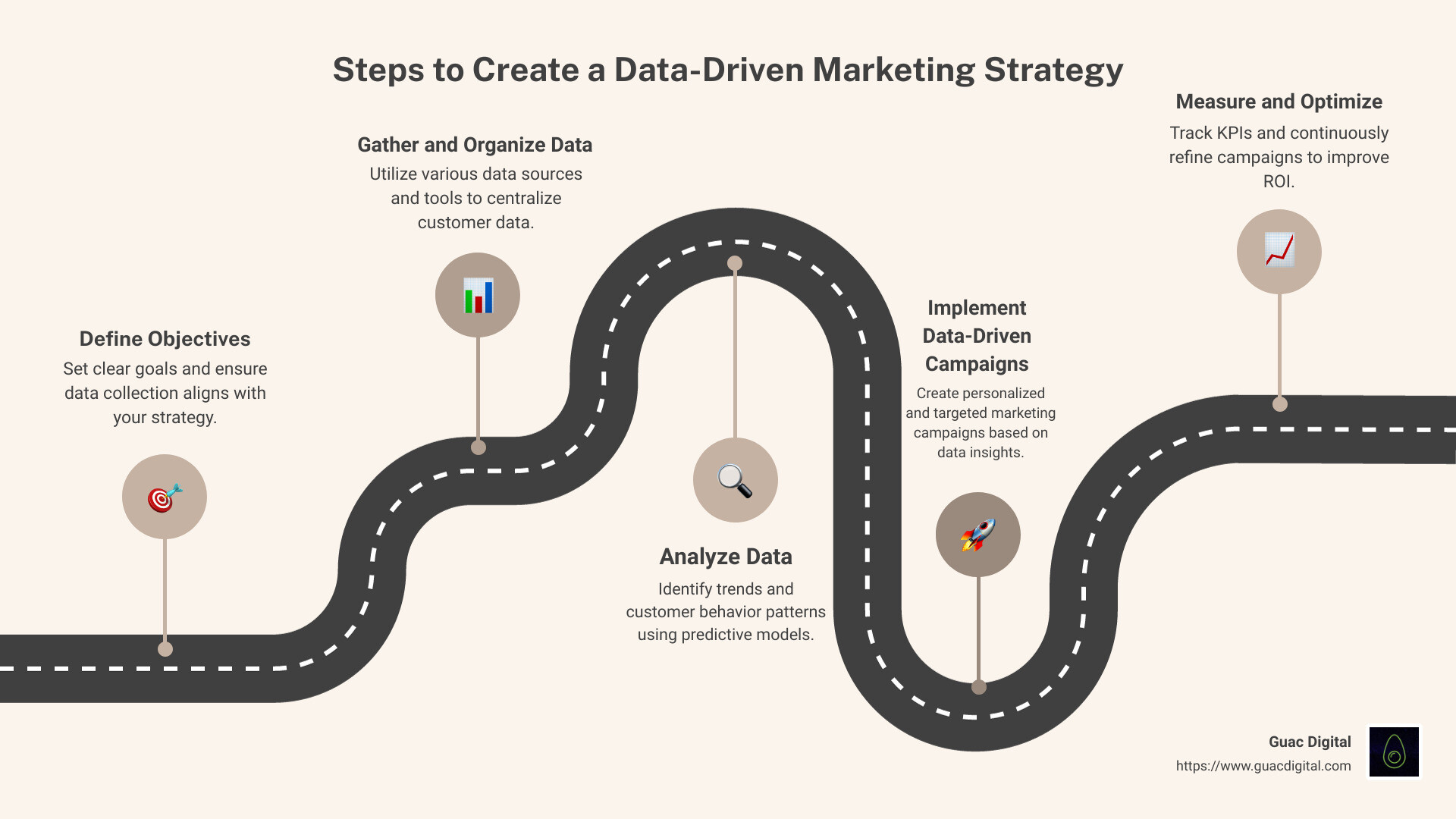
Steps to Creating a Data-Driven Marketing Strategy
Step 1: Define Objectives
Before diving into data collection, it’s crucial to define clear objectives. These goals will guide your entire strategy. Ask yourself: What do you want to achieve with this data? Whether it’s increasing sales, improving customer retention, or enhancing brand awareness, having specific goals will help you determine which data to collect and how to use it.
Step 2: Gather and Organize Data
Once your objectives are set, the next step is data collection. Identify the data sources that will provide the most valuable insights. This could include customer relationship management (CRM) systems, web analytics tools, social media platforms, and more.
Organize the data to avoid data silos, which can hinder your analysis. A centralized data platform, like a CRM, will help streamline this process.
Step 3: Analyze Data
With your data in hand, it’s time to analyze it for trends and customer behavior. Look for patterns that align with your objectives. For instance, if you’re aiming to boost sales, identify which products are most popular among different customer segments.
Predictive models can be incredibly useful here. These models use historical data to forecast future behaviors, helping you make informed decisions.
Step 4: Implement Data-Driven Campaigns
Now, use your insights to implement data-driven campaigns. Personalization is key. According to McKinsey, 71% of consumers expect personalized interactions. Tailor your marketing messages to different customer segments for maximum impact.
Targeted marketing allows you to reach the right audience with the right message at the right time. Real-time adjustments based on ongoing data analysis can further optimize your campaigns.
Step 5: Measure and Optimize
Finally, continuously measure and optimize your efforts. Use key performance indicators (KPIs) to track progress and ROI. Regularly review your data to identify what’s working and what isn’t. This ongoing process of continuous improvement ensures that your strategy remains effective and aligned with your objectives.
By following these steps, you’ll be well on your way to creating a successful data-driven marketing strategy. Up next, let’s look at some key examples of companies that have excelled with data-driven marketing.
Key Examples of Data-Driven Marketing Strategies
Example 1: Amazon
Amazon is a master of customer segmentation and targeted marketing. The company uses vast amounts of data to understand buying behavior and personalize recommendations. When you browse Amazon, the products you see are custom to your past searches, purchases, and even what similar customers bought. This level of personalization is powered by predictive analytics, which helps Amazon anticipate what you might want to buy next.
Example 2: Walmart
Walmart leverages historical data and predictive analytics to optimize its inventory and store layouts. By analyzing past sales data, Walmart can predict which products will be in high demand and strategically place them in stores. This ensures that customers find what they need quickly, enhancing their shopping experience and boosting sales.
Example 3: Philips
Philips faced a unique challenge with its global digital presence. To tackle this, they crafted a new digital identity by integrating a robust data management platform, data analytics software, and AI. This allowed Philips to standardize content across 79 markets and 38 languages. Using real-time data, Philips continuously tests and refines its content, resulting in significant improvements like a 635% increase in newsletter signups and a 15.85% boost in product views.
Example 4: Philadelphia 76ers
The Philadelphia 76ers use predictive models and weather data to forecast game attendance. By analyzing historical attendance data and combining it with weather forecasts, the team can predict how many fans will show up for a game. This information helps them optimize staffing, concessions, and marketing efforts, ensuring a better experience for fans and higher revenues.
Example 5: Vodafone Italy
Vodafone Italy excels in data automation and CRM integration to improve the customer experience. By automating data collection and integrating it with their CRM system, Vodafone can deliver highly personalized marketing messages. This strategy not only improves customer satisfaction but also increases conversion rates and customer loyalty.
By looking at these examples, it’s clear that creating a data-driven marketing strategy can lead to significant improvements in customer engagement, sales, and overall business success. Up next, we’ll explore the benefits of data-driven marketing in more detail.
Benefits of Data-Driven Marketing
Data-driven marketing offers numerous advantages that can significantly improve your marketing efforts. Let’s dive into some key benefits, including personalization, customer insights, improved ROI, and competitive advantage.
Personalization
Personalization is crucial in today’s marketing landscape. According to a study, 74% of customers feel frustrated when they receive irrelevant content from brands. Data-driven marketing allows you to tailor your messages to individual preferences and behaviors.
For example, by using demographic data and past interactions, you can create hyper-personalized experiences. This approach not only helps in building stronger relationships with customers but also turns them into loyal advocates for your brand. Research from InvestP suggests that businesses using personalization see a 5x to 8x higher ROI from their marketing efforts.
Customer Insights
Understanding your customers is the cornerstone of effective marketing. Data-driven strategies provide deep insights into customer behavior, preferences, and pain points. By analyzing customer data, you can identify trends and patterns that inform your marketing decisions.
For instance, Adobe Analytics allows you to gather data from multiple digital channels and provides predictive insights through AI. Such tools enable you to see the complete customer journey, helping you understand what drives loyalty and engagement.
Improved ROI
One of the most compelling benefits of data-driven marketing is the potential for a higher return on investment (ROI). By making informed decisions based on data, you can allocate your marketing budget more effectively.
A study by ZoomInfo found that 78% of organizations reported an increase in lead conversion and customer acquisition through data-driven marketing. Additionally, Forbes notes that 66% of marketing leaders saw an uptick in customer acquisition due to data insights.
Competitive Advantage
In a competitive market, leveraging data can set you apart. Companies that use data-driven strategies are better positioned to understand market trends and customer needs. This allows for more agile and responsive marketing campaigns.
For example, by sharing data across different channels, you can ensure a seamless customer experience. If a customer views a product on social media, they should easily find the same product on your website. This integrated approach not only improves user experience but also boosts your competitive edge.
Conclusion
By focusing on personalization, customer insights, improved ROI, and competitive advantage, data-driven marketing can transform your approach and drive significant business success. We’ll explore the challenges in implementing a data-driven strategy and how to overcome them.

Challenges in Implementing a Data-Driven Strategy
Creating a data-driven marketing strategy can be transformative, but it comes with its own set of challenges. Let’s dive into some of the main problems you might face.
Data Collection
Collecting data sounds straightforward, but it’s often more complex than anticipated. You need to gather data from various sources—social media, CRM systems, website analytics, and more.
For example, Colgate-Palmolive had members spread across over 20 countries. Without automated data collection, understanding ad performance was more wishful thinking than reality. They succeeded only after centralizing and automating their data collection.
Data Silos
Data silos are a significant barrier. When data is stored in separate locations or systems, it becomes difficult to get a comprehensive view.
Shocking but true: Only 8% of companies store all their data in one place. This makes 69% of organizations unable to provide a single customer view. Dispersed data limits your ability to analyze and act on it effectively.
Analysis Complexity
Analyzing large datasets can be overwhelming. It requires specialized skills and tools.
For instance, Vodafone Italy automated data acquisition into a single database. This allowed them to link online activities with offline sales data, revealing new upselling opportunities and reducing churn. Without such sophisticated analysis, you might miss crucial insights.
Organizational Buy-In
Getting everyone on board with a data-driven approach can be challenging. You need buy-in from various stakeholders, which isn’t always easy.
According to The State of the Social Media Industry report, 93% of brands say social data will be a major source of business intelligence in the next three years. Yet, achieving this requires training and resources to ensure everyone is data literate and prioritizes high-impact data collection.
Next, we’ll look at some key examples of data-driven marketing strategies to see how top companies are leveraging data for success.
Frequently Asked Questions about Creating a Data-Driven Marketing Strategy
What is an example of a data-driven strategy?
Amazon and Walmart are two standout examples of companies that excel with data-driven strategies.
Amazon uses customer data to drive its marketing and sales efforts. They segment their customers based on purchasing behavior, which allows for highly targeted marketing. For instance, if you frequently buy books, Amazon will recommend books similar to those you’ve bought before. This level of personalization keeps customers engaged and increases sales.
Walmart leverages predictive analytics to optimize product placement and inventory management. By analyzing historical data, Walmart can predict which products will be in demand and ensure they are strategically placed in stores. This approach not only boosts sales but also improves the customer experience by making it easier to find popular items.
What is the data-driven marketing model?
A data-driven marketing model revolves around the use of customer data to inform marketing decisions. Here are the key elements:
- Customer Data: Collecting data from various sources like CRM systems, social media, and website analytics.
- Personalization: Using this data to create personalized marketing messages and offers.
- Targeted Marketing: Segmenting customers into specific groups based on their behavior and preferences. This makes it possible to target each segment with custom marketing campaigns.
For example, if data shows that a segment of customers frequently abandons their shopping carts, you can create a targeted email campaign to encourage them to complete their purchases.
What is a data-driven go-to-market strategy?
A data-driven go-to-market strategy involves using data to identify the best ways to reach your target market and convert them into customers. Here’s how it works:
- Target Market: Use data to identify and understand your target market. This includes demographics, buying behavior, and preferences.
- Customer Segments: Segment your target market into smaller groups that share similar characteristics.
- Marketing Campaigns: Develop and launch marketing campaigns that are custom to each customer segment. This ensures that your marketing efforts are relevant and effective.
For instance, if you’re launching a new product, you can use data to identify potential early adopters within your target market. Then, create a marketing campaign that speaks directly to their needs and interests.
By leveraging customer data and focusing on personalization and targeted marketing, companies can create more effective and efficient marketing strategies. This not only improves ROI but also improves customer satisfaction and loyalty.
Next, we’ll explore the benefits of data-driven marketing to understand why more companies are adopting this approach.
Conclusion
At Guac Digital, we understand the power of data-driven success. Using data to guide our marketing strategies allows us to create personalized and targeted campaigns that truly resonate with our audience.
When we talk about personalized strategies, we’re not just referring to addressing customers by their first names in emails. We’re talking about understanding their preferences, behaviors, and needs. This deep understanding helps us craft messages and offers that are relevant and timely.
For example, imagine a business selling running shoes. By analyzing customer data, we can differentiate between casual runners and marathon enthusiasts. This allows us to send custom messages that speak directly to each group’s unique needs, leading to higher engagement and conversion rates.
High ROI is one of the most compelling benefits of a data-driven marketing strategy. By making informed decisions based on real-time data, we can allocate our resources more efficiently. This means spending less on ineffective marketing tactics and more on strategies that deliver results.
In fact, companies that adopt data-driven marketing are six times more likely to be profitable year-over-year. This is because data helps us understand what works and what doesn’t, allowing us to optimize our campaigns continuously.
At Guac Digital, we specialize in creating data-driven marketing strategies that drive results. Whether you’re looking to boost your online presence, improve customer engagement, or increase sales, our team of experts is here to help.
Ready to take your marketing to the next level? Contact us today to learn how we can help you achieve data-driven success.
By leveraging the power of data, we can help you not only meet but exceed your marketing goals. Let’s create a strategy that transforms your data into actionable insights and drives your business forward.