
Campaign Management Services: How GUAC’s Data-Driven PPC and Campaign Management Drives Results
Quick Answer
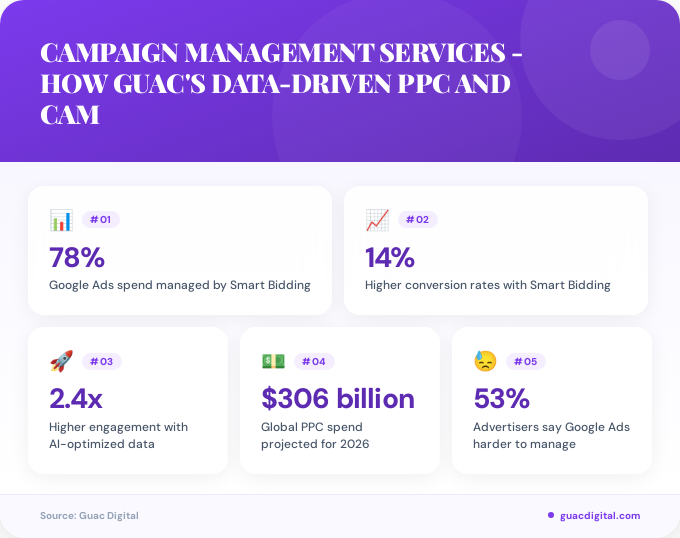
GUAC’s campaign management services drive results by architecting clean, complete business data that trains platform AI, rather than relying on manual keyword tweaks. This approach aligns with industry benchmarks showing Smart Bidding now manages 78% of Google Ads spend and delivers 14% higher conversion rates, while early adopters of AI-optimized data structures see 2.4x higher engagement than accounts still running traditional, unstructured campaigns.
What Are Campaign Management Services?
Campaign management services encompass the strategic planning, execution, optimization, and reporting of paid advertising across search, social, display, and retail media channels. Instead of simply “running ads,” a full-service partner builds the data infrastructure, bidding logic, and creative testing systems that let platforms like Google Ads and Meta perform at their best. Global PPC spend is projected to hit $306 billion in 2026, growing at 11% year-over-year, which means the competition for every click is fiercer than ever.
GUAC’s approach to digital campaign management treats every account as a data system first and an ad account second. That distinction matters because the businesses winning in 2026 are not the ones with the cleverest ad copy, they’re the ones feeding the cleanest, most complete conversion signals into platform algorithms. If you want the foundational mechanics of how campaigns are structured and optimized, our complete guide to running high-performing ad campaigns is a useful companion resource.
Why Is PPC Harder to Manage Now Than It Used to Be?
According to industry research, 53% of advertisers say managing Google Ads is harder today than it was two years ago. The reason isn’t more platforms or more competition alone, it’s that automation has removed the manual levers marketers used to pull, and replaced them with data-quality requirements most teams aren’t prepared to meet.
As one industry analysis of the shift in PPC roles puts it, the AI-driven transformation of PPC management has moved practitioners away from bid-by-bid tactical work and toward architecting the business data that platform algorithms depend on. This means offline conversion imports, hashed email uploads, consent-mode signal governance, and measurement structure now matter more than keyword list curation.
“The PPC manager’s job has fundamentally changed. It’s no longer about adjusting bids every morning, it’s about making sure the algorithm has a complete, accurate picture of what a real customer looks like, from first click to closed sale.”

How Does GUAC’s Data-Driven Approach Differ From Traditional PPC Management?
Traditional PPC management optimizes what’s visible: keywords, ad copy, bid adjustments. Data-driven campaign management, the model GUAC builds every account around, optimizes what’s invisible: the signal quality feeding the machine learning models that now make most bidding decisions.
This shift mirrors what leading marketing research organizations describe as the core principle of modern advertising. As explained in Salesforce’s overview of data-driven marketing, decisions grounded in real customer data consistently outperform decisions grounded in assumptions or historical rules of thumb. GUAC applies this by building out full-funnel measurement, connecting CRM data, call tracking, and offline conversions into a unified feedback loop that trains the algorithm on your actual buyers, not just anonymous web clicks.
Our data-driven advertising framework and data-driven insights reporting layer work together so that every optimization is traceable back to a real business outcome, not a vanity metric like impressions or raw click volume.
| Metric | 2026 Value | Why It Matters |
|---|---|---|
| Global PPC Spend | $306 billion | Growing 11% YoY, more competition per click |
| Smart Bidding Adoption | 78% of Google Ads spend | Automation is now the default, not the exception |
| Smart Bidding Conversion Lift | +14% | Outperforms manual bidding on average |
| AI Search Engagement Lift | 2.4x | Early adopters vastly outperform traditional search ads |
What Does the Data Say About Smart Bidding and Automation?
Smart Bidding now manages 78% of all Google Ads spend, and accounts using it see a 14% average lift in conversion rate compared to manual strategies. The average benchmarks across the platform show a 7.37% click-through rate and a 6.96% conversion rate, with a typical return on ad spend of roughly 200% for accounts managing data well, according to compiled paid search benchmarks from 2026 paid search performance data.
Google’s 62% share of paid search revenue, combined with a U.S. market alone worth $128 billion, means the platform’s AI systems have more training data than any advertiser could realistically replicate manually. GUAC’s role is to make sure your account is sending that AI the highest-quality signals possible, including hashed offline conversion data from calls, form fills, and in-person purchases, so the algorithm optimizes toward revenue instead of just clicks.
- First-party data integration is now a top priority as third-party cookies decline in reliability.
- Privacy-first targeting requires consent mode and server-side tracking to maintain signal accuracy.
- Multichannel expansion spreads risk and captures demand across the full customer journey.
These priorities align with the top trends identified in recent PPC trend analysis, which flags AI-driven automation, privacy-first targeting, and first-party data as the three pillars separating high performers from stagnant accounts in 2026.
When Should You Use Manual Bidding Instead of AI Automation?
Automation isn’t universally superior. Manual bidding still accounts for 22% of ad spend, largely in niche industries, low-volume campaigns, and brand-protection scenarios where algorithms lack enough conversion data to learn effectively.
GUAC recommends reverting to manual bidding, or consolidating campaigns to increase conversion volume, when an account shows more than 25% CPA volatility or spends longer than four weeks stuck in the learning phase. These are clear signals that Smart Bidding doesn’t have enough clean data to make reliable decisions, and forcing automation on a low-signal account often wastes budget rather than saving time.
This is precisely the kind of judgment call that separates a strategic campaign management partner from an account that’s simply been left on autopilot. Understanding platform mechanics at a foundational level also helps; our guide on what pay-per-click advertising actually is breaks down the bidding mechanics behind these decisions.
How Does Multichannel Campaign Management Fit Into the Strategy?
Search alone is no longer the whole picture. The strongest accounts allocate budget across social platforms for reach, retail media for high-intent purchase moments, programmatic display for incremental reach, and influencer or content partnerships for early-stage demand generation.
Research on PPC trends across channels confirms that teams diversifying beyond search see more stable performance as any single platform’s algorithm changes. GUAC layers this multichannel thinking on top of core search campaigns, ensuring your brand shows up at every stage of the buyer journey rather than competing solely for bottom-funnel search intent.
Best For: High-intent conversion
Best For: Mid-funnel nurture
Best For: E-commerce brands
Best For: Brand awareness lift
How Much Do Campaign Management Services Cost?
Campaign management pricing typically ranges from $10,000 to $50,000+ per month in managed spend and service fees combined, though the actual investment depends heavily on ad spend volume, the number of channels involved, the complexity of your conversion tracking setup, and the level of custom reporting and strategy work required.
Businesses running lean, single-channel search campaigns will naturally sit toward the lower end, while brands managing multichannel programs with offline conversion integration, retail media, and programmatic layers will invest more. Pricing varies based on your specific project, and GUAC recommends against choosing a partner based on the lowest quoted rate alone; agencies that under-invest in data infrastructure often cost far more in wasted ad spend than they save in fees. We encourage every prospective client to reach out for a custom quote tailored to your goals and current account maturity.
How Do You Choose the Right Campaign Management Partner?
The right partner should be able to explain, in plain terms, how they’re feeding your business data into platform algorithms, not just which bid strategy they’ve selected. Ask prospective agencies about their approach to first-party data, offline conversion imports, and measurement governance, since these are the levers actually driving performance in 2026.
Best-practice frameworks from data-driven marketing best practices research emphasize that consistent measurement structure and signal governance outperform teams that chase keyword volume without a solid data foundation. GUAC’s team, detailed on our team page, brings this exact discipline to every account, supported by broader SEO and paid media service offerings that ensure your organic and paid strategies reinforce each other rather than compete for the same budget conversation.
You can learn more about our overall philosophy and results on our about page, or visit the GUAC Digital homepage to see the full range of services we offer beyond paid campaign management.
- Smart Bidding now manages 78% of Google Ads spend, making data quality more important than manual bid adjustments.
- Global PPC spend is projected at $306 billion in 2026, growing 11% year-over-year, raising the cost of poor account management.
- 53% of advertisers report Google Ads is harder to manage than it was two years ago, driven by automation complexity.
- Early adopters of AI-optimized data strategies see 2.4x higher engagement than accounts still relying on traditional tactics.
- Accounts with over 25% CPA volatility or 4+ week learning periods should reconsider automated bidding strategies.
- Multichannel diversification, spanning social, retail media, and programmatic, reduces platform-specific risk.
- Pricing for managed campaigns varies widely based on spend, channel count, and data complexity, so custom quotes are essential.
People Also Ask
Why is PPC harder to manage now?
Automation has removed many of the manual levers advertisers once used, shifting the job toward data quality and signal governance. 53% of advertisers say managing Google Ads is harder today than two years ago because success now depends on feeding algorithms clean, complete conversion data.
What is data-driven campaign management?
Data-driven campaign management uses real customer and business data, including offline conversions and CRM signals, to guide platform bidding algorithms rather than relying on manual keyword and bid adjustments. It prioritizes measurement structure and signal quality over legacy tactical work.
Is Smart Bidding better than manual bidding?
On average, Smart Bidding delivers a 14% higher conversion rate than manual bidding and now manages 78% of Google Ads spend. However, manual bidding still suits niche industries, brand campaigns, and accounts with insufficient conversion volume for algorithms to learn effectively.
How much should I budget for PPC management services?
Costs vary widely based on ad spend, number of channels, and data complexity, typically ranging from $10,000 to $50,000+ monthly in combined spend and management fees. A custom quote reflecting your specific goals and account maturity is the most accurate way to budget.
Frequently Asked Questions
What makes GUAC’s campaign management different from other agencies?+
GUAC focuses on architecting clean, complete business data, including offline conversions and CRM signals, so platform AI can make better bidding decisions. This differs from agencies that focus primarily on manual keyword and bid adjustments alone.
Does campaign management only cover Google Ads?+
No, comprehensive campaign management spans search, social, retail media, and programmatic display. Diversifying across channels reduces dependency on any single platform’s algorithm changes and captures demand at multiple stages of the buyer journey.
What is offline conversion tracking and why does it matter?+
Offline conversion tracking uploads hashed data from calls, form fills, and in-store purchases back into ad platforms so algorithms understand the complete conversion funnel. This trains Smart Bidding on real revenue outcomes rather than just website clicks.
How long does it take to see results from PPC campaign management?+
Most Smart Bidding strategies need roughly two to four weeks to exit the learning phase and stabilize performance. Campaigns exceeding four weeks in learning or showing over 25% CPA volatility typically need structural adjustments rather than more patience.
Can small businesses benefit from data-driven PPC management?+
Yes, small businesses often benefit most since they typically waste the highest percentage of budget on poor data hygiene. Even modest investments in proper conversion tracking and signal governance can meaningfully improve return on ad spend.
What ROAS should I expect from a well-managed campaign?+
Industry benchmarks show an average return on ad spend around 200% for data-driven accounts, though results vary by industry, competition, and offer strength. GUAC sets realistic, custom benchmarks based on your specific market and historical performance.
Further reading: Campaign Management Services: How a Data-Driven Agency Runs High-Performing Ad Campaigns
Further reading: How to Choose a PPC Agency: The Complete 2026 Buyer’s Guide