
Campaign Management Services: How a Data-Driven Agency Runs High-Performing Ad Campaigns
Quick Answer
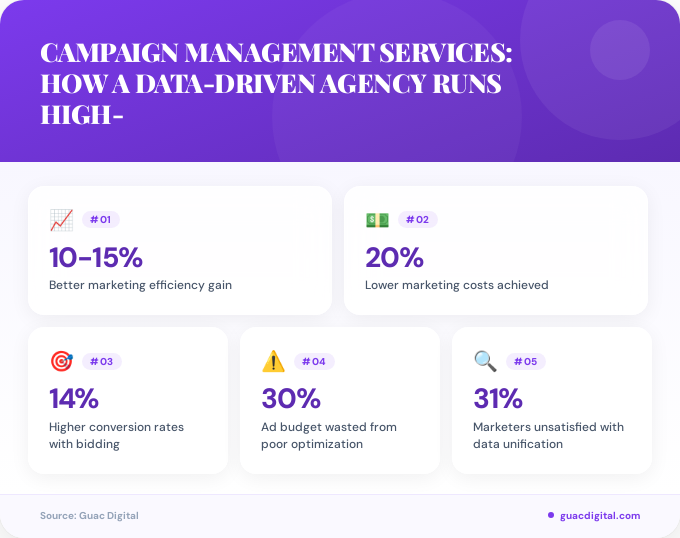
Campaign management services from a data-driven agency combine real-time behavioral data, AI-powered bidding, and precise attribution modeling to eliminate guesswork from paid media. This approach delivers 10-15% better marketing efficiency and up to 20% lower marketing costs compared to intuition-led strategies, while smart bidding alone drives 14% higher conversion rates for advertisers who adopt it.
What if 30% of your ad budget is being wasted right now simply because your agency is optimizing toward the wrong signal? That is not a hypothetical. It is the reality for brands still relying on gut-feel bidding, static targeting, and monthly reporting instead of campaign management services built on real-time data. A truly data-driven agency runs high-performing ad campaigns by replacing intuition with behavioral insights, AI-powered automation, and attribution modeling that shows exactly which dollar produced which result.
The gap between data-driven and traditional agencies is no longer theoretical. It is measurable in conversion rates, cost-per-acquisition, and total marketing spend efficiency. This article breaks down exactly how modern digital campaign management works in 2026, what separates elite agencies from average ones, and what you should expect from any partner managing your ad budget.
What Is Data-Driven Campaign Management?
Data-driven campaign management is the practice of building, optimizing, and scaling paid media campaigns based entirely on measurable customer behavior rather than assumptions. It replaces “we think this audience will convert” with “we know this audience converts at 3.2% because the data confirms it across the last 90 days.” According to Salesforce’s research on data-driven marketing, brands that anchor decisions in customer data consistently outperform those relying on broad demographic assumptions.
This methodology touches every layer of a campaign: audience segmentation, creative testing, bid strategy, budget allocation, and channel mix. A data-driven campaign management approach treats every dollar spent as a data point that informs the next decision, creating a compounding feedback loop rather than a static “set it and forget it” plan.
How Does a Data-Driven Agency Actually Use Data?
The best agencies pull from first-party CRM data, platform-level conversion signals, and third-party market intelligence to build a full picture of the customer journey. This is far more sophisticated than checking a weekly dashboard. It means integrating data-driven insights directly into daily bid adjustments, creative rotation, and audience exclusions.
Data quality is the single biggest differentiator. Research shows 30% of CMOs identify improving data quality as the top lever for marketing performance, and 31% of marketers remain unsatisfied with how well their data sources are unified. Agencies that solve this fragmentation problem, connecting CRM, ad platform, and analytics data into one clean source of truth, consistently outperform those working from siloed spreadsheets, a point reinforced by Improvado’s analysis of data-driven marketing decisions.
“Data-driven attribution isn’t a nice-to-have anymore, it’s the difference between guessing and knowing which channel actually drove the sale. Agencies that still rely on last-click reporting are leaving 10 to 15 percent of efficiency on the table every single month.”

Why Is AI Automation Transforming Campaign Results?
AI has moved from experimental add-on to core infrastructure in campaign management. Smart bidding now controls 78% of all Google Ads spend, a 14-point jump since 2024, and advertisers using it report 14% higher conversion rates on average, according to data cited by Digital Applied’s 2026 PPC statistics report.
On the creative side, 61% of marketers now use AI to draft ad copy, 45% use it for campaign optimization, and 37% apply it to performance analysis. PPC managers have gone even further: 92% use AI tools for ad copy generation and 56% have adopted AI-generated responsive search ads. This is not automation replacing strategists, it is automation freeing strategists to focus on the decisions machines cannot make: brand positioning, offer design, and creative direction.
- Bid automation: AI adjusts bids in milliseconds based on likelihood-to-convert signals.
- Creative generation: AI drafts and tests dozens of ad variations simultaneously.
- Budget pacing: Machine learning reallocates spend toward top-performing segments daily, not monthly.
- Predictive audience building: Lookalike and intent models identify buyers before they even search.
How Does Attribution Modeling Improve ROI?
Attribution modeling answers the question every marketing leader actually cares about: which touchpoint deserves credit for the sale? Data-driven attribution models deliver 10-15% better marketing efficiency compared to simplistic last-click or first-click models, because they weigh every interaction across the customer journey rather than crediting a single click. This is central to how data-driven advertising is structured at the campaign level.
Precise attribution also explains why PPC continues to dominate ROI conversations. 72% of advertisers report PPC as their highest-ROI channel, and PPC visitors convert 50% more often than organic visitors, based on findings from Digital Applied’s paid search data analysis. Without proper attribution, agencies cannot prove this, and clients end up cutting budget from channels that are actually working. If you’re still unclear on the fundamentals, this complete guide to pay-per-click advertising covers the mechanics in depth.
Data-Driven vs. Traditional Campaign Management
The contrast between old-school and modern campaign management is stark once you line up the numbers side by side.
| Approach | Traditional Method | Data-Driven Method |
|---|---|---|
| Bid Strategy | Manual bidding, adjusted weekly | Smart bidding, adjusted per auction |
| Attribution | Last-click reporting | Multi-touch, data-driven attribution |
| Creative Testing | A/B testing over months | AI-driven multivariate testing in weeks |
| Cost Efficiency | Baseline spend, minimal optimization | Up to 20% lower marketing costs |
Why Are Agencies Changing Their Business Models?
The agency world itself is being restructured by this data revolution. Industry analysts describe a shift from the “age of the agent” to the “age of the purveyor,” where agencies increasingly sell products, technology, and measurable data outcomes instead of billable hours, a trend detailed in Forrester’s 2026 predictions on marketing agencies.
By 2026, principal media, where agencies take on inventory risk and resell it with margin, is projected to account for nearly 33% of total agency billings. At the same time, automation is expected to drive a 15% reduction in agency jobs, pushing firms to restructure into vendors, merchants, affiliates, and strategic partners, as noted in industry commentary on agency transformation trends. This is also fueling scrutiny: 85% of US B2C marketing executives plan to review their media agencies in 2026, demanding clearer proof of data-rooted results rather than vague promises of “brand lift.”
Conversion lift: 14%
Optimization: 45%
Performance analysis: 37%
AI search ad revenue: $4.2B
Mid-size companies: 45%
How Do You Choose the Right Campaign Management Partner?
Not every agency claiming to be “data-driven” actually operates that way. Ask specific questions before signing a contract: What attribution model do they use? How often are bids and budgets adjusted? What percentage of their team’s time goes toward reporting versus optimization? A team grounded in Customer.io’s guide to data-driven marketing in 2026 will have clear, confident answers to all of these.
Look for agencies that pair paid media with a broader growth strategy, including local SEO services, conversion rate optimization, and content. Campaigns rarely succeed in isolation. A conversion rate optimization audit, for example, often reveals that the ad spend was fine but the landing page was the actual bottleneck.
What Do Campaign Management Services Cost?
Pricing for campaign management services typically ranges from $10,000 to $50,000+ per month depending on ad spend volume, number of channels managed, industry competitiveness, and the sophistication of attribution and reporting required. Agencies managing multi-channel programs across search, social, and programmatic display, with full AI-driven optimization and custom dashboards, generally sit at the higher end of that range.
Pricing varies based on your specific project, industry, and growth goals, so treat any flat quote you see online with skepticism. The right way to evaluate cost is against outcomes: efficiency gains, lower cost-per-acquisition, and revenue attributable directly to the campaign. For an accurate, tailored estimate, it’s best to request a custom quote based on your actual budget and goals.
People Also Ask
What is a data-driven digital marketing agency?
A data-driven digital marketing agency makes campaign decisions based on measurable customer behavior, real-time analytics, and attribution data rather than intuition or industry assumptions. This includes using AI-powered bidding, audience segmentation, and multi-touch attribution to continuously optimize performance.
What is data-driven marketing?
Data-driven marketing is the practice of using customer data, such as behavior, purchase history, and engagement patterns, to guide strategy, creative, and budget decisions. It replaces broad assumptions with measurable insights that improve targeting accuracy and marketing efficiency.
How much does campaign management cost per month?
Costs typically range from $10,000 to $50,000 or more per month depending on ad spend, channel complexity, and reporting requirements. It’s best to request a custom quote since pricing depends heavily on scope and goals.
Is PPC still worth it in 2026?
Yes. 72% of advertisers report PPC as their highest-ROI channel, and PPC visitors convert 50% more often than organic visitors. The global PPC market is projected to reach $380 billion by 2028, reflecting continued strong performance across industries.
Frequently Asked Questions
What makes an agency truly “data-driven” versus just claiming to be?+
A genuinely data-driven agency uses multi-touch attribution, real-time bid adjustments, and unified data sources rather than monthly reports and last-click credit. Ask about their reporting cadence, attribution model, and how often they adjust budgets to verify this in practice.
How does AI improve ad campaign performance?+
AI improves performance through smart bidding, which now controls 78% of Google Ads spend and drives 14% higher conversion rates, plus automated ad copy generation used by 92% of PPC managers. This frees strategists to focus on creative direction and offer strategy instead of manual bid adjustments.
Why is attribution modeling important for campaign management?+
Attribution modeling shows which touchpoints actually drive conversions, delivering 10-15% better marketing efficiency compared to simplistic last-click models. Without it, agencies risk cutting budget from channels that are working simply because they aren’t getting proper credit.
What data sources should a campaign management agency use?+
A strong agency unifies first-party CRM data, ad platform conversion signals, and website analytics into a single source of truth. Data fragmentation is a major issue, with 31% of marketers unsatisfied with their current data unification, so integration quality matters as much as the tools themselves.
How often should ad campaigns be optimized?+
Data-driven agencies optimize continuously, often adjusting bids and budgets daily or even per auction using AI, rather than waiting for weekly or monthly reviews. This responsiveness is a key reason smart bidding campaigns outperform manually managed ones.
Should I combine PPC with SEO for better results?+
Yes, combining paid and organic strategies typically produces stronger overall results since PPC delivers immediate visibility while SEO builds long-term equity. Many brands pair campaign management with local SEO tips for small businesses to capture both short-term leads and sustained organic growth.
Key Takeaways
- Data-driven campaign management delivers 10-15% better marketing efficiency and up to 20% lower marketing costs than intuition-based approaches.
- Smart bidding now manages 78% of Google Ads spend and produces 14% higher conversion rates for advertisers who adopt it.
- AI tools are now standard practice: 92% of PPC managers use AI for ad copy and 56% use AI-generated responsive search ads.
- 72% of advertisers rank PPC as their highest-ROI channel, with PPC visitors converting 50% more often than organic visitors.
- Data fragmentation remains a real challenge, with 31% of marketers unsatisfied with current data unification efforts.
- The agency industry itself is transforming, with principal media projected to reach 33% of agency billings by 2026.
- Pricing for campaign management services varies widely based on scope, spend, and channel complexity, so a custom quote is always the right move.
Running a high-performing ad campaign in 2026 requires more than good creative and a healthy budget. It requires a partner who treats every click as data, every conversion as a signal, and every dollar as an opportunity to optimize further. If your current approach still relies on monthly check-ins and last-click reporting, you are almost certainly leaving performance on the table.
Guac Digital builds campaign management programs around real-time data, AI-powered optimization, and attribution models that actually hold up to scrutiny. Explore our data-driven PPC and campaign management services or reach out to our team for a custom strategy built around your goals.