
Local SEO Tips for Small Businesses: The Complete 2026 Playbook
Quick Answer
The most important local SEO tip for small businesses in 2026 is to fully claim, optimize, and consistently update your Google Business Profile, since it directly powers the three core local ranking factors: proximity, relevance, and prominence. Pair that with consistent citations, active review generation, hyper-local content, and Schema markup to become eligible for citation in Google’s AI Overviews and other AI-driven search results.
Did you know that a business with an incomplete Google Business Profile can lose out on the majority of nearby “near me” searches, simply because Google can’t confidently confirm what it does, where it’s located, or whether real customers trust it? For small businesses competing against national chains and well-funded competitors, local SEO tips for small businesses aren’t a nice-to-have anymore, they are the difference between showing up in the map pack or disappearing entirely from local search results.
In 2026, local search has evolved beyond simple keyword matching. Google’s algorithm now weighs proximity, relevance, and prominence together, while AI Overviews are actively pulling from structured, well-cited local businesses to answer conversational queries. This guide breaks down exactly what’s working right now, backed by current industry data and expert insight, so you can build a local presence that competes and wins.
What Is Local SEO and Why Does It Matter in 2026?
Local SEO is the practice of optimizing your online presence so your business appears when nearby customers search for your products or services. This includes your Google Business Profile, website, citations, reviews, and location-specific content. Unlike traditional SEO, local SEO is tied directly to geography, meaning your rankings shift depending on where a searcher is standing.
According to the U.S. Chamber of Commerce’s breakdown of local SEO benefits, small businesses that invest in local search visibility see measurably higher foot traffic and phone call volume than those relying on organic rankings alone. That’s because most local searches carry high commercial intent: people searching “plumber near me” or “best bakery in [city]” are ready to buy, not just browsing.
The stakes are higher now because AI-driven search results are reshaping the customer journey. Businesses with structured data and consistent digital footprints are increasingly the ones cited as “top-rated providers” in AI Overviews, meaning weak local SEO doesn’t just cost you map pack rankings, it costs you visibility in the next generation of search entirely.
How Do I Optimize My Google Business Profile?
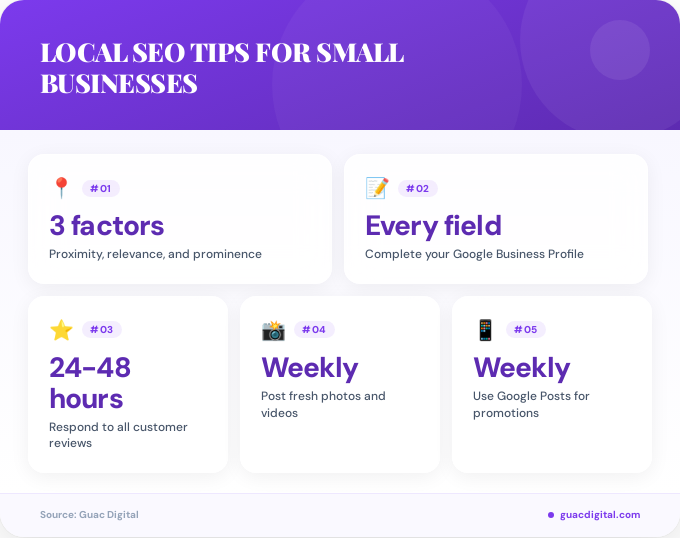
Your Google Business Profile (GBP) is the single most influential asset in local search. It’s free, but most small businesses barely scratch the surface of what it can do. A fully optimized profile directly feeds the “Triple-Threat” ranking dynamic of proximity, relevance, and prominence.
- Claim and verify your listing immediately if you haven’t already, and check it monthly for unauthorized edits.
- Fill out every field: categories, services, products, business description, attributes, and hours (including holiday hours).
- Add fresh photos and videos regularly. Listings updated with new visual content signal an active, trustworthy business.
- Use Google Posts weekly to highlight promotions, events, or new services, keeping your profile “alive” in Google’s eyes.
- Respond to every review, positive or negative, within 24 to 48 hours.
Per BDC’s guidance on ranking higher in local search results, consistency and completeness across your profile are non-negotiable baseline requirements before any advanced tactic will move the needle. If you need a partner to manage this ongoing work, a local SEO specialist can audit and maintain your profile so nothing slips through the cracks.

What Are the Biggest Local SEO Ranking Factors?
Local rankings are driven by a specific, well-documented set of signals. Understanding their relative weight helps small businesses prioritize limited time and budget effectively.
Fixes needed: Complete profile, categories, photos, posts
Fixes needed: Consistent review generation, timely responses
Fixes needed: Matching NAP data across directories
Fixes needed: Location-specific service pages, blogs, FAQs
Fixes needed: Local partnerships, sponsorships, press
Fixes needed: Image compression, hosting, code cleanup
These factors are consistently identified across recent industry breakdowns, including SEOProfy’s local SEO research for small businesses, which confirms that GBP optimization, proximity, relevance, review quality, citation consistency, and local backlinks remain the primary drivers of visibility. Proximity is often described as a “hard ceiling” you can’t change, since you can’t relocate your storefront. But prominence, built through reviews, content, and backlinks, is where small businesses can outmaneuver bigger, better-located competitors.
How Important Are Reviews for Local SEO?
Reviews are one of the strongest prominence signals Google uses, but not all reviews carry equal weight. Feedback from established “Local Guides” and long-standing Google accounts is treated as significantly more trustworthy than reviews from brand-new or anonymous profiles.
That means quality and consistency matter more than sheer volume. A steady drip of authentic reviews, ideally including a mix of star ratings, written detail, and photos, builds a stronger trust signal than a single burst of five-star reviews followed by silence. InMoment’s local SEO research notes that review recency and response rate are now explicitly factored into how prominently a business appears in local packs.
Practical tactics that work in 2026:
- Send automated review requests via text or email immediately after service completion.
- Make responding to reviews a weekly calendar task, not an afterthought.
- Never buy or incentivize fake reviews. Google’s spam detection has gotten dramatically better at flagging unnatural review patterns.
- Highlight your best reviews in Google Posts and on your website’s homepage.
Why Do Hyper-Local Content and Schema Markup Matter?
One of the clearest shifts in 2026 is that targeted, location-specific content now outperforms random backlinks by a long shot for local relevance. Instead of a single generic “Services” page, top-performing small businesses build hyper-specific Service Area Pages, such as “Addison stump grinding” instead of just “stump grinding,” giving both Google and AI search engines granular, citable data.
This is echoed by Knapsack Creative’s analysis of local SEO powering service-based business growth, which found that businesses publishing consistent, neighborhood-specific content saw stronger organic visibility gains than those relying purely on directory citations. Blogs, FAQs, and micro-guides tied to specific neighborhoods or service areas do double duty: they help human searchers and give AI Overviews exact, structured answers to cite.
Schema markup is the technical backbone that makes this content machine-readable. Local business Schema tells search engines and AI systems exactly what your business is, where it operates, your hours, and your review ratings. Without it, you’re relying on Google to guess. If your website needs this level of technical structuring, our AI SEO services are built specifically to make your content citable inside AI-generated answers, not just traditional blue links.
How Does Site Speed Affect Local Rankings?
Core Web Vitals, Google’s measure of load speed, interactivity, and visual stability, remain a confirmed ranking factor for local search in 2026. A slow-loading website can undercut every other optimization you’ve made, because Google prioritizes user experience regardless of how good your content or citations are.
For small businesses, this often means auditing image sizes, choosing reliable hosting, and eliminating bloated plugins or scripts. If you’re evaluating platforms, our guide to the top website builders in 2026 breaks down which platforms perform best on speed and mobile responsiveness, both of which directly affect local rankings.
Pricing for a full technical and local SEO overhaul varies widely based on your website’s current condition, the number of locations you manage, your industry’s competitiveness, and the scope of content needed. Most small businesses investing in comprehensive local SEO services should expect a custom quote reflecting their specific goals rather than a flat, one-size-fits-all number, since a five-location service business requires a very different scope than a single-location boutique.
Local SEO Tactics: Impact Comparison
Not every tactic delivers results at the same speed. Here’s how common local SEO efforts compare on timeline and effort required.
| Tactic | Typical Time to See Results |
|---|---|
| GBP profile completion | 1 to 4 weeks |
| Citation cleanup | 4 to 8 weeks |
| Review generation program | 4 to 12 weeks |
| Hyper-local content and Schema | 2 to 6 months |
| Local backlink building | 3 to 6 months |
This is why patience and consistency matter. As Pronto Marketing’s local SEO guide for small businesses points out, local SEO is a compounding effort: the businesses that win are the ones still actively posting, requesting reviews, and updating content six months from now, not the ones who did a one-time setup and walked away.
What Common Mistakes Hurt Local SEO?
Even well-intentioned small businesses sabotage their own visibility. The most frequent errors include:
- Inconsistent NAP data. Your Name, Address, and Phone number must match exactly across your website, GBP, and every directory listing.
- Ignoring negative reviews. Silence signals disengagement; a thoughtful, professional response actually builds trust with future customers.
- Treating social media as separate from SEO. Social platforms now function as a search amplifier, reinforcing the same signals your website and GBP send.
- Duplicate or thin location pages. Copy-pasted service pages with only the city name swapped out hurt more than they help.
- No mobile optimization. Most local searches happen on mobile devices, so a clunky mobile experience directly costs conversions.
Our small business SEO services are built to catch exactly these gaps through a full audit before any new strategy is launched. And if you’re wondering whether your existing efforts are converting visitors into actual leads, pairing local SEO with a conversion rate optimization audit ensures the traffic you earn actually turns into calls and bookings.
For a broader strategic overview, our core SEO services, technical SEO offerings, and enterprise-level SEO programs all integrate local optimization as a foundational layer, not an afterthought. Every strategy starts at Guac Digital, where local, technical, and AI search visibility are treated as one connected system rather than separate projects.
Key Takeaways
- Fully optimizing your Google Business Profile is the single highest-leverage local SEO action a small business can take.
- Proximity, relevance, and prominence together determine local rankings, and prominence is the lever small businesses can control most.
- Reviews from established Google Local Guides carry more algorithmic weight than reviews from new or anonymous accounts.
- Hyper-local, neighborhood-specific content now outperforms generic backlink building for local relevance.
- Schema markup is essential for making your business data readable by AI Overviews and other AI-driven search tools.
- Core Web Vitals and site speed remain confirmed ranking factors that can undercut otherwise strong optimization work.
- Local SEO compounds over time; consistency in posting, reviews, and content updates outperforms one-time setup efforts.
People Also Ask
How do I know if my local listings are accurate?
Search your business name across Google, Yelp, Bing, and major data aggregators to confirm your name, address, and phone number match exactly everywhere. Tools that scan citations can flag inconsistencies automatically, which is faster than manually checking dozens of directories.
What is the best local SEO strategy for a small business in 2026?
Prioritize a fully optimized Google Business Profile, consistent citations, an active review generation process, and hyper-local content backed by Schema markup. These four pillars address proximity, relevance, and prominence simultaneously.
Does social media actually help local SEO?
Yes, social media now functions as a search amplifier rather than a separate channel. Structured, location-tagged social content reinforces the same relevance and prominence signals that Google uses for local rankings.
Can I improve local SEO without a big budget?
Yes. Claiming and fully filling out your Google Business Profile, requesting reviews consistently, and fixing citation inconsistencies cost little to no money and deliver some of the highest returns in local SEO.
Frequently Asked Questions
What is local SEO and why does it matter for small businesses?+
Local SEO is the process of optimizing your online presence to appear in geographically relevant searches, such as “near me” queries or city-specific searches. It matters because most local searches carry high buying intent, and businesses without strong local SEO miss out on customers actively ready to purchase nearby.
How long does it take to see local SEO results?+
Google Business Profile optimizations can show movement within 1 to 4 weeks, while citation cleanup, review generation, and content strategies typically take 2 to 6 months to fully mature. Local SEO is a compounding effort, so consistent activity over time outperforms a single setup push.
How much does local SEO cost for a small business?+
Pricing varies based on your specific project scope, number of locations, industry competitiveness, and current website condition, so costs can range broadly from a few hundred to several thousand dollars per month. The best approach is requesting a custom quote based on your actual goals rather than relying on a generic average.
Is Google Business Profile really the most important local SEO factor?+
Yes, industry data consistently ranks GBP optimization as the top driver of local visibility because it directly feeds Google’s proximity, relevance, and prominence signals. A complete, active, frequently updated profile outperforms an incomplete one every time, regardless of other efforts.
How do AI Overviews affect local SEO in 2026?+
AI Overviews pull from businesses with structured data, Schema markup, and clear, citable content to answer local queries directly in search results. Businesses without this technical foundation risk being invisible in AI-generated answers even if they rank well in traditional results.
Do I need backlinks for local SEO to work?+
Backlinks still help, especially local ones from community sites, partners, or press, but targeted, location-specific content now outperforms random backlink building for local relevance. Focus first on content and citations, then layer in strategic local link building.
Can I do local SEO myself or do I need an agency?+
Related: Local SEO Services: The Complete 2026 Guide to Ranking, Reviews, and Revenue
Many basics, like completing your Google Business Profile and requesting reviews, can be done in-house with no budget. However, technical elements like Schema markup, citation audits, and hyper-local content strategy often benefit from professional expertise to execute correctly and consistently.
Further reading: Software for SEO: The Complete 2026 Buyer’s Guide to Choosing the Right Platform