
Top Website Builders in 2026: The Definitive Guide to Choosing the Right Platform for Your Business
Quick Answer
The top website builders in 2026 include WordPress (powering 43.5% of all websites), Webflow (best overall for businesses), Wix (best for DIY drag-and-drop with 45% DIY market share), and Shopify (leading ecommerce platform with $7.06 billion in revenue). Your ideal choice depends on whether you prioritize ownership and flexibility (WordPress), design control (Webflow), ease of use (Wix), or selling products online (Shopify).
What Are Website Builders and Why Do They Matter in 2026?
Website builders have evolved from simple page creation tools into comprehensive Digital Experience Platforms (DXP) that power millions of businesses worldwide. In 2026, these platforms represent far more than just drag-and-drop interfaces. They encompass everything from AI-powered design assistance to advanced ecommerce capabilities and sophisticated marketing automation.
The website builder industry has reached unprecedented scale, with WordPress alone powering approximately 43.5% of all websites on the internet. This represents hundreds of millions of active sites spanning every industry imaginable. Beyond WordPress, specialized platforms like Shopify, Wix, and Webflow have carved out substantial market positions by focusing on specific user needs and business models.
The shift toward website builders reflects broader digital transformation trends. Businesses increasingly recognize that their website serves as their primary revenue generator, customer touchpoint, and brand ambassador. As digital marketing strategies become more sophisticated, the platform powering your website directly impacts everything from search engine rankings to conversion rates to customer experience.
Which Website Builders Dominate the Market in 2026?
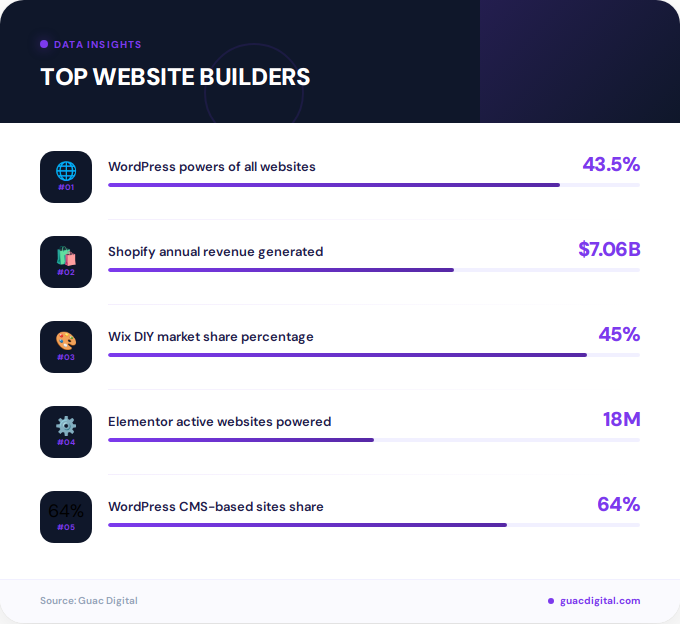
The competitive landscape of top website builders in 2026 reveals clear leaders across different segments. WordPress maintains dominance with 43.5% of all websites and an even more impressive 64% of CMS-based sites, according to recent market analysis from Elementor. This massive market share demonstrates WordPress’s versatility across industries, company sizes, and use cases.
Within the WordPress ecosystem, a fascinating dynamic has emerged. Elementor powers over 18 million active websites, effectively making it one of the largest platforms globally if counted independently. This combination of WordPress as the foundation and Elementor as the operating system has become the most widely adopted solution for businesses seeking ownership and flexibility.
The DIY segment tells a different story. While Wix holds only 3.9% of the total internet market, it commands an impressive 45% share of the specific DIY website builder market, as reported by Site Builder Report’s comprehensive statistics. This distinction highlights how market share statistics can vary dramatically depending on how you segment the market.
Shopify has established itself as the undisputed ecommerce champion, capturing 6.2% of the CMS market with laser focus on online retail. Squarespace rounds out the major players at 3.0% market share, primarily serving creative professionals and portfolio-focused users.

How Do Top Website Builders Compare by Revenue and Market Share?
Revenue figures provide crucial insight into platform sustainability, development resources, and market positioning. The financial performance of top website builders in 2026 reveals dramatic differences in business models and scale.
| Platform | 2026 Revenue | Primary Focus |
|---|---|---|
| Shopify | $7.06 Billion | Ecommerce |
| Wix | $1.56 Billion | DIY Websites |
| Squarespace | $1.01 Billion | Creative Portfolios |
| BigCommerce | $309.4 Million | Enterprise Ecommerce |
| Webflow | $128 Million | Professional Design |
Shopify’s $7.06 billion revenue dwarfs competitors, reflecting its transaction-based business model where the platform benefits directly from merchant success. This creates a virtuous cycle: higher revenue enables better features, which attracts more merchants, generating more revenue. Wix and Squarespace follow with subscription-based models that prioritize user acquisition and retention.
These revenue differences don’t necessarily indicate quality or appropriateness for your specific needs. A rapidly growing startup like Webflow may offer cutting-edge features despite lower total revenue. The key is understanding what each platform’s business model means for your priorities, whether that’s conversion rate optimization, design flexibility, or ecommerce capabilities.
What Are the Best Website Builders for Different Business Needs?
Choosing among the top website builders requires understanding platform specialization. Each leading platform has evolved to serve specific use cases exceptionally well, while potentially falling short in others.
Webflow has emerged as the best overall platform for businesses requiring advanced layout systems and design flexibility. Its visual development approach bridges the gap between designers and developers, enabling pixel-perfect designs without sacrificing performance or SEO capabilities. Professional agencies increasingly recommend Webflow for clients who want custom aesthetics without custom development costs.
Wix dominates the DIY market for good reason. Its intuitive drag-and-drop interface requires zero technical knowledge, allowing entrepreneurs to launch professional websites in hours rather than weeks. The platform’s extensive template library and AI-assisted design tools make it ideal for small businesses focused on speed to market. However, this ease of use comes with trade-offs in customization depth and ownership flexibility.
Shopify remains the definitive choice for ecommerce, particularly for businesses scaling beyond hobby operations. Its robust payment processing, inventory management, and integration ecosystem support everything from dropshipping operations to multi-million dollar retail brands. When combined with PPC advertising campaigns, Shopify stores can rapidly scale revenue while maintaining operational efficiency.
WordPress with Elementor suits businesses prioritizing long-term ownership and unlimited customization. While requiring more initial setup, this combination offers unmatched flexibility for complex sites, membership areas, and custom functionality. It’s particularly powerful when paired with professional SEO services that leverage WordPress’s extensive optimization capabilities.
How Are AI-Powered Website Builders Transforming the Industry?
Artificial intelligence has evolved from a marketing buzzword to a fundamental feature reshaping how websites are built and managed. The AI-powered website builder market was valued at $3.41 billion in 2026 and is projected to reach $14.78 billion by 2035, growing at a remarkable CAGR of 17.7%, according to Custom Market Insights.
North America leads AI adoption with 38% of the global market share, driven by platforms like Wix, Squarespace, and Shopify integrating sophisticated AI features. These capabilities extend far beyond simple chatbots, encompassing design generation, content optimization, SEO recommendations, and predictive analytics.
The emergence of “Agentic AI” represents the next evolution. Rather than merely generating text or suggesting layouts, these systems execute complex tasks autonomously. They can build entire page structures, optimize images, configure integrations, and even debug technical issues without human intervention. This shift transforms website builders from tools requiring constant human guidance into intelligent partners that handle routine tasks while humans focus on strategy and creativity.
For businesses exploring these capabilities, platforms reviewed by Zapier demonstrate how AI integration varies dramatically across providers. Some offer superficial features, while others have deeply integrated AI throughout the entire user experience. Understanding this distinction is crucial when evaluating which AI capabilities truly impact your workflow versus which serve primarily as marketing talking points.
Should You Choose an Ownership Model or SaaS Platform?
One of the most consequential decisions when selecting among top website builders involves the fundamental question of ownership versus convenience. This choice affects not just initial development but long-term flexibility, costs, and strategic options.
SaaS platforms like Wix, Squarespace, and Shopify operate on a rental model. You pay monthly or annual fees for hosting, features, and support bundled together. This offers tremendous convenience: automatic updates, managed security, integrated hosting, and no technical maintenance. However, you’re fundamentally renting your digital presence. If you stop paying, your site disappears. If the platform raises prices or discontinues features, your options are limited.
Ownership models like self-hosted WordPress give you complete control over code, data, and hosting. You can migrate to any provider, customize without restrictions, and aren’t subject to platform policy changes. The tradeoff involves greater technical responsibility. You manage hosting, security patches, backups, and troubleshooting. This model increasingly appeals to businesses viewing their website as a long-term strategic asset rather than a short-term marketing tool.
The middle ground involves managed WordPress hosting, which combines ownership benefits with SaaS-level convenience. Services like WP Engine, Kinsta, and Flywheel handle technical maintenance while you retain full code and data ownership. This approach makes sense for businesses wanting WordPress flexibility without managing servers.
Your optimal choice depends on technical resources, budget structure, and long-term strategy. Startups testing market fit often benefit from SaaS simplicity, while established businesses building complex digital ecosystems may require ownership flexibility. The decision should align with your conversion optimization strategy and overall digital roadmap.
What Performance Standards Should Your Website Builder Meet?
Technical performance has become a non-negotiable aspect of website success, directly impacting search rankings, user experience, and conversion rates. Yet surprisingly, only 53% of websites achieve good Core Web Vitals scores on desktop, and just 41% perform well on mobile. These statistics reveal that platform choice significantly impacts whether your site meets modern performance standards.
Core Web Vitals measure three critical aspects: loading speed (Largest Contentful Paint), interactivity (First Input Delay), and visual stability (Cumulative Layout Shift). Google uses these metrics as ranking factors, making them essential for SEO. Different website builders handle these challenges with varying degrees of success.
WordPress performance depends heavily on hosting quality, theme choice, and plugin efficiency. A poorly configured WordPress site can be painfully slow, while an optimized setup rivals the fastest platforms available. This variability makes WordPress simultaneously one of the best and worst performers, depending on implementation expertise.
Webflow emphasizes performance in its core architecture, automatically generating clean code and optimizing assets. Shopify prioritizes speed for ecommerce, recognizing that every 100ms of delay costs conversions. Wix and Squarespace have improved substantially but still face challenges with bloated code from their visual editors.
The relationship between performance and business outcomes is substantial. Research consistently shows that a one-second delay in page load time reduces conversions by approximately 7%. For an ecommerce site generating $100,000 monthly, poor performance could cost $84,000 annually. These numbers make performance optimization, whether through professional optimization audits or platform selection, one of the highest-ROI investments possible.
How Much Do Top Website Builders Cost in 2026?
Understanding the true cost of website builders requires looking beyond advertised monthly fees to consider total cost of ownership, including hidden expenses and opportunity costs.
Entry-level plans across major platforms typically range from $10 to $30 per month, but these rarely include features serious businesses need. Ecommerce functionality, advanced SEO tools, removal of platform branding, and adequate performance typically require mid-tier or premium plans ranging from $30 to $100+ monthly.
Shopify’s pricing reflects its transaction-based model, with plans from $39 to $399 monthly plus transaction fees if not using Shopify Payments. High-volume merchants can easily spend $2,000 to $10,000+ monthly when factoring in apps, premium themes, and payment processing fees. However, this scales with revenue, making the relative cost manageable for successful stores.
WordPress presents the most variable costs. Hosting ranges from $5 to $500+ monthly depending on traffic and performance requirements. Premium themes cost $50 to $200, while Elementor Pro runs $59 to $399 annually. Quality managed hosting, essential plugins, and professional setup can total $1,000 to $5,000+ initially, plus $100 to $500 monthly ongoing. However, this investment buys complete ownership and unlimited flexibility.
Pricing varies significantly based on your specific requirements, desired features, traffic volume, and business model. We recommend consulting with experienced professionals who can assess your needs and recommend the most cost-effective approach for your situation, balancing immediate affordability with long-term strategic value.
Key Takeaways
- WordPress dominates overall with 43.5% market share, but specialized platforms lead specific niches like ecommerce (Shopify) and DIY building (Wix with 45% segment share)
- Revenue doesn’t equal quality: Shopify’s $7.06 billion dwarfs Webflow’s $128 million, yet Webflow is rated best overall for business websites based on design capabilities and flexibility
- AI-powered builders represent rapid growth, with the market expanding from $3.41 billion in 2026 to a projected $14.78 billion by 2035 at 17.7% CAGR
- Performance matters enormously: Only 41% of websites achieve good mobile Core Web Vitals scores, directly impacting SEO rankings and conversion rates
- Ownership vs. SaaS represents a fundamental strategic decision: WordPress offers complete control and data ownership, while platforms like Wix provide convenience at the cost of flexibility
- Platform specialization matters more than general reputation: Choose Shopify for ecommerce, Wix for simplicity, Webflow for design control, or WordPress/Elementor for ownership and unlimited customization
- Total cost of ownership varies dramatically, ranging from $10 to $10,000+ monthly depending on platform choice, feature needs, traffic volume, and whether you prioritize convenience or control
People Also Ask
What is the most popular website builder in 2026?
WordPress is the most popular website builder globally, powering approximately 43.5% of all websites on the internet and 64% of sites using a CMS. Within WordPress, Elementor has become the leading page builder with over 18 million active websites.
Which website builder is best for beginners?
Wix is widely considered the best website builder for beginners, commanding 45% of the DIY website builder market. Its intuitive drag-and-drop interface, extensive template library, and AI-assisted design tools allow users with zero technical knowledge to create professional websites quickly.
What website builder do professional web designers prefer?
Professional web designers increasingly prefer Webflow for its advanced layout systems, visual development capabilities, and pixel-perfect design control without sacrificing performance. WordPress with Elementor is also popular among professionals who need unlimited customization and client ownership.
Is Shopify only for ecommerce?
While Shopify is primarily designed for ecommerce and generates $7.06 billion in revenue from online retail functionality, it can technically be used for non-ecommerce websites. However, other platforms offer better value and features for sites not focused on selling products.
How do I choose between WordPress and a website builder?
Choose WordPress if you prioritize long-term ownership, unlimited customization, and complex functionality, and have technical resources or budget for professional setup. Choose SaaS builders like Wix or Squarespace if you need immediate simplicity, prefer bundled hosting and maintenance, and don’t require deep customization.
Can I switch website builders later?
Switching between website builders ranges from straightforward to extremely challenging depending on platforms involved. Moving from one SaaS platform to another often requires rebuilding content manually. WordPress offers the most flexibility for future migrations since you own all code and data, making it easier to move to other platforms or hosting providers.
Frequently Asked Questions
What is the difference between a website builder and a CMS?+
A website builder typically offers an all-in-one solution with hosting, templates, and visual editing tools bundled together (like Wix or Squarespace). A CMS (Content Management System) like WordPress is software that manages content but requires separate hosting and more technical setup. Modern platforms increasingly blur these lines, with many CMS platforms adding builder features and website builders adding CMS capabilities.
Do website builders affect SEO performance?+
Yes, website builders significantly impact SEO through factors like page speed, mobile responsiveness, clean code structure, and technical SEO capabilities. WordPress with proper optimization offers the most SEO flexibility, while platforms like Wix have improved substantially but may have limitations. Performance metrics like Core Web Vitals are now ranking factors, making platform choice crucial for search visibility.
Can I use my own domain name with website builders?+
All major website builders allow you to use custom domain names, though this typically requires upgrading from free plans. Most platforms also offer domain registration services directly, or you can connect a domain purchased elsewhere. Custom domains are essential for professional branding and SEO, making them a worthwhile investment regardless of which builder you choose.
How long does it take to build a website with a website builder?+
Timeline varies dramatically based on complexity, platform choice, and experience level. Simple sites using Wix or Squarespace can be launched in hours to days. Professional WordPress sites with custom design and functionality typically require 2 to 12 weeks. Ecommerce sites with extensive product catalogs may take even longer. AI-powered builders are reducing these timelines, with some platforms now generating basic sites in minutes.
What happens if a website builder company goes out of business?+
With SaaS platforms, you could lose your website if the company closes without providing export options, highlighting a key risk of rental models. WordPress and other self-hosted solutions protect against this since you own all files and data. When evaluating platforms, consider their financial stability, revenue figures, and whether they offer export functionality. Established platforms like Shopify ($7.06B revenue) and Wix ($1.56B revenue) have substantial financial backing, reducing this risk.
Do I need coding knowledge to use a website builder?+
Most modern website builders require zero coding knowledge, with platforms like Wix and Squarespace specifically designed for non-technical users. WordPress has a steeper learning curve but extensive resources and community support. Webflow occupies a middle ground, offering visual development that benefits from design knowledge but doesn’t require traditional coding. That said, coding knowledge or access to professional development services expands what’s possible on any platform.
Which website builder is best for online stores?+
Shopify is the definitive leader for ecommerce, with $7.06 billion in revenue and 6.2% market share specifically in online retail. It offers comprehensive features for inventory management, payment processing, shipping, and marketing. WooCommerce (WordPress) provides more flexibility for complex requirements, while Wix and Squarespace serve smaller stores adequately. Your choice should depend on scale, product complexity, and whether you need specialized ecommerce features versus general website capabilities.
Further reading: Local SEO Tips for Small Businesses: The Complete 2026 Playbook