
Social Media Agency for Small Business: What You Need to Know in 2026
Quick Answer
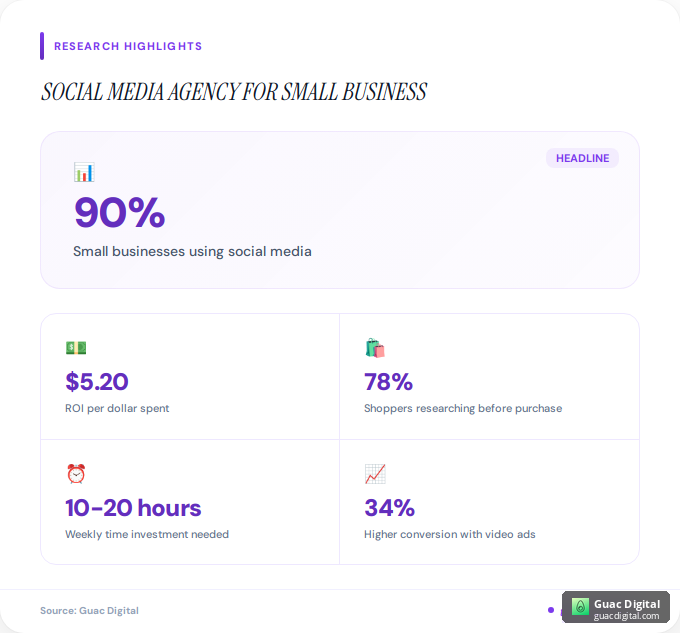
A social media agency for small business provides specialized marketing services including content creation, community management, paid advertising, and analytics across platforms like Facebook, Instagram, and TikTok. With 90% of small businesses using social media for marketing and an average ROI of $5.20 for every $1 spent, agencies help small businesses compete effectively without requiring in-house expertise.
Did you know that 78% of shoppers research social media before making a purchase? For small businesses in 2026, social media isn’t just a marketing channel, it’s the primary way customers discover, evaluate, and engage with brands. Yet navigating the complexities of multiple platforms, algorithm changes, and content creation can overwhelm even the most dedicated business owner.
This is where a social media agency for small business becomes invaluable. With the global social media advertising market projected to reach $270 billion in 2025 and continue growing at 11.71% annually, professional expertise isn’t just beneficial, it’s essential for competing in an increasingly crowded digital landscape.
Whether you’re a local retailer, professional service provider, or growing startup, understanding how social media agencies work and what they can deliver will help you make informed decisions about your marketing investment. This comprehensive guide draws on the latest 2026 industry data to show you exactly what to expect.
What Is a Social Media Agency for Small Business?
A social media agency for small business is a specialized marketing firm that manages, optimizes, and grows a company’s presence across social platforms. Unlike general marketing agencies or DIY efforts, these agencies focus exclusively on social media channels, bringing deep platform expertise and data-driven strategies.
These agencies typically serve as an outsourced social media department, handling everything from strategy development to daily content posting. With 51% of brands outsourcing part of their social media work, this model has become the standard for small businesses seeking professional results without full-time staffing costs.
The scope varies widely based on business needs. Some agencies focus on organic content and community management, while others specialize in paid advertising campaigns. Many offer comprehensive services that bridge both approaches, similar to how digital marketing agencies integrate multiple channels for maximum impact.
Why Should Small Businesses Hire a Social Media Agency?
The case for professional social media management has never been stronger. 92% of businesses use social media for marketing, creating an environment where amateur efforts simply can’t compete with professionally managed accounts. Small businesses face a specific challenge: they need enterprise-level results with limited resources.
Consider the time investment required. Effective social media management demands 10-20 hours weekly for content creation, community engagement, analytics review, and strategy refinement. For most small business owners, this time could be spent on core business operations that generate immediate revenue.
The expertise gap is equally significant. Social media agencies bring specialized knowledge of platform algorithms, content formats that drive engagement, and advertising strategies that maximize ROI. With video-based campaigns generating 34% higher conversion rates than static ads, knowing which formats to prioritize can dramatically impact results.
Small businesses that engage customers on social media see those customers spend 35-40% more on their products and services. This isn’t just about visibility, it’s about building relationships that drive measurable revenue growth.
Financial performance also supports the agency model. Social media marketing delivers an average ROI of $5.20 for every $1 spent in 2026, but achieving this return requires sophisticated targeting, creative testing, and continuous optimization that most small businesses can’t manage internally.

What Services Do Social Media Agencies Provide?
Professional social media agencies for small business offer a comprehensive suite of services designed to build and monetize your social presence. Understanding these services helps you evaluate potential partners and set realistic expectations.
Strategy Development and Planning
Every successful social media program begins with strategy. Agencies conduct competitive analysis, audience research, and platform selection to create a roadmap aligned with business goals. This foundational work determines which platforms to prioritize, what content themes resonate with your audience, and how social media integrates with broader marketing efforts, much like the strategic planning involved in PPC advertising campaigns.
Content Creation and Management
Content is the currency of social media. Agencies produce text posts, graphics, videos, and Stories tailored to each platform’s unique format and audience expectations. With posts containing visual content receiving 10x more engagement than text-only posts, professional design and video production capabilities become essential.
The content calendar approach ensures consistent posting schedules while maintaining flexibility for timely, trending content. Agencies typically batch-create content monthly, then schedule posts strategically based on when your audience is most active.
Community Management
Social media is inherently social, requiring active engagement with followers. Agencies monitor comments, messages, and mentions, responding promptly to build relationships and manage reputation. With 72% of businesses using social media for customer service, this function has evolved from nice-to-have to business-critical.
Paid Advertising Management
Organic reach continues declining across platforms, making paid advertising essential for visibility. Agencies create, target, and optimize ad campaigns across Facebook, Instagram, TikTok, and LinkedIn. They manage budgets, test creative variations, and refine targeting to maximize return on ad spend.
Analytics and Reporting
Data-driven optimization separates professional agencies from amateur efforts. Monthly reporting tracks key performance indicators including reach, engagement, follower growth, website traffic, and conversions. This transparency allows you to see exactly what you’re getting for your investment, similar to the accountability standards in conversion optimization strategies.
| Service Category | Typical Deliverables | Business Impact |
|---|---|---|
| Strategy Development | Platform recommendations, content pillars, competitive analysis | Clear direction and measurable goals |
| Content Creation | 15-30 posts monthly, graphics, videos, captions | Consistent brand presence and engagement |
| Community Management | Daily monitoring, response to comments/messages | Stronger customer relationships |
Which Platforms Should Your Agency Focus On?
Not all social platforms deliver equal value for small businesses. With over 5.42 billion social media users worldwide spread across dozens of networks, strategic platform selection determines campaign success and resource efficiency.
Facebook: The Small Business Workhorse
With 3.1 billion monthly active users, Facebook remains essential for most small businesses. The platform’s robust advertising tools, local business features, and broad demographic reach make it particularly effective for service businesses, retailers, and B2C companies. Facebook’s Marketplace and Groups features also provide unique opportunities for community building and direct sales.
Instagram: Visual Storytelling and Commerce
Instagram’s 2.3 billion monthly active users skew younger and more engaged with visual content. The platform excels for businesses with strong visual assets: restaurants, retail, beauty, fitness, and lifestyle brands. Instagram Reels deliver 35% more engagement than standard video posts, making short-form video content essential for platform success.
TikTok: The Engagement Leader
TikTok has emerged as a powerhouse for brand awareness and engagement. With 1.6 billion monthly active users and an average engagement rate of 5.3% that outperforms all other major platforms, TikTok offers unprecedented organic reach potential. The platform particularly benefits businesses targeting Gen Z and Millennials or those willing to embrace authentic, trend-driven content.
LinkedIn: B2B and Professional Services
For B2B companies, professional services, and businesses targeting decision-makers, LinkedIn provides unmatched targeting capabilities. While not included in the top three by user count, LinkedIn’s professional context and business-focused audience make it essential for certain industries.
The most effective social media agency for small business will recommend a platform mix based on your specific audience demographics, content strengths, and business objectives. Most small businesses achieve best results focusing deeply on 2-3 platforms rather than spreading resources across all available networks, similar to how focused SEO strategies outperform scattered approaches.
How Do Social Media Agencies Measure ROI?
Measuring social media return on investment has evolved from vanity metrics like follower counts to business-critical performance indicators. Professional agencies track both leading indicators (engagement, reach) and lagging indicators (conversions, revenue) to demonstrate value.
Engagement Metrics
Engagement remains the foundation of social media success. Agencies track likes, comments, shares, saves, and click-through rates to measure content resonance. The average social media post engagement rate across platforms is 1.8%, providing a baseline for performance evaluation. Accounts consistently exceeding this benchmark demonstrate effective content strategy.
Traffic and Conversion Tracking
Website traffic from social media and subsequent conversions provide direct business value. Using UTM parameters and platform pixels, agencies attribute specific sales, leads, or other conversion events to social media efforts. This data integration mirrors the approach used in ecommerce conversion optimization, connecting marketing activities to revenue outcomes.
Audience Growth Quality
While follower count alone misleads, quality audience growth indicates expanding reach. Agencies analyze follower demographics, interests, and engagement patterns to ensure growth attracts ideal customers rather than empty numbers.
Customer Acquisition Cost
For paid social campaigns, cost per acquisition (CPA) determines advertising efficiency. Agencies continuously optimize targeting, creative, and bidding strategies to reduce CPA while maintaining lead quality. The $5.20 average ROI across social media marketing demonstrates the channel’s cost-effectiveness when managed professionally.
Best For: TikTok, Instagram Reels, YouTube Shorts
Production: Moderate complexity
Best For: Product demonstrations, testimonials
Investment: Higher production cost
Best For: Brand awareness, viral potential
Time Investment: Quick creation cycles
Best For: All platforms and industries
Accessibility: Easy to produce consistently
Brand Awareness and Sentiment
Softer metrics like brand mentions, sentiment analysis, and share of voice provide context for quantitative data. These indicators help agencies understand how social media shapes brand perception and market position over time.
What Does a Social Media Agency Cost?
Pricing for a social media agency for small business varies dramatically based on scope, platform mix, content requirements, and service level. Understanding the cost structure helps you budget appropriately and evaluate proposals.
Most agencies structure pricing through monthly retainers, which typically range from $2,500 to $15,000+ per month depending on the breadth of services. Basic packages focusing on one or two platforms with organic content only sit at the lower end, while comprehensive programs including multiple platforms, paid advertising management, and custom video production command premium pricing.
Pricing varies based on several critical factors. The number of platforms managed directly impacts cost, as each network requires unique content formats and community management. Content production complexity matters significantly: agencies creating professional video content or custom graphics charge substantially more than those repurposing client-provided assets.
Paid advertising adds another cost layer. Many agencies charge a percentage of ad spend (typically 15-20%) or flat management fees starting at $1,500 to $5,000 monthly for campaign management, separate from the actual advertising budget. For small businesses allocating $2,000-$10,000 monthly to paid social, management fees represent a significant but necessary investment.
Geographic location influences pricing as well. Agencies in major metropolitan markets typically charge 20-40% more than those in smaller cities, though remote work has somewhat leveled this disparity. Industry specialization also commands premiums, agencies with proven expertise in your specific sector bring value that justifies higher rates.
The most important consideration: pricing should reflect the value delivered, not just activities performed. An agency driving 35-40% increased customer spending through effective social engagement delivers ROI that far exceeds monthly fees. When evaluating proposals, focus on projected business outcomes rather than simply comparing hourly rates or deliverable counts, similar to the value-based approach recommended when deciding whether to hire a PPC agency.
How to Choose the Right Social Media Agency
Selecting the right social media agency for small business requires evaluating capabilities, cultural fit, and proven results. With 73% of marketers increasing their social media budgets, competition for quality agencies has intensified, making thorough vetting essential.
Evaluate Industry Experience
Look for agencies with demonstrable experience in your industry or similar business models. An agency that has successfully marketed restaurants understands different challenges than one specializing in professional services. Request case studies showing results for businesses comparable to yours in size, market, and objectives.
Review Their Own Social Presence
An agency’s social media accounts reveal their actual capabilities. Examine their content quality, engagement rates, and community management. If they can’t build their own engaged following, how will they build yours? This practical assessment often reveals more than any sales presentation.
Assess Platform Expertise
Different agencies excel on different platforms. An agency crushing it on TikTok may lack LinkedIn expertise. Ensure their platform strengths align with where your audience lives. With TikTok’s 5.3% engagement rate leading all platforms, an agency claiming TikTok expertise should demonstrate exceptional organic performance.
Understand Their Process
Ask detailed questions about content approval workflows, reporting cadence, and communication protocols. The best agencies balance professional expertise with collaborative partnership. They should welcome your input while also challenging assumptions and bringing fresh perspectives.
Examine Reporting Transparency
Request sample reports from the agency. Quality reporting goes beyond surface metrics, connecting social media activities to business outcomes. Look for clear data visualization, trend analysis, and actionable recommendations. Transparency in reporting demonstrates accountability and strategic thinking, qualities that characterize top-tier marketing agencies across all disciplines.
Verify Paid Advertising Credentials
If paid social is part of your strategy, confirm the agency holds official platform certifications (Facebook Blueprint, TikTok Marketing Partner, etc.). These credentials indicate current knowledge of advertising tools and best practices. Also verify they’ll provide transparent reporting on ad spend and performance.
Test Communication and Responsiveness
The sales process reveals how agencies will treat you as a client. Are they responsive to questions? Do they listen carefully to your goals? Do they offer insights or just agreement? These early interactions predict the ongoing relationship quality.
Key Takeaways
- Social media delivers measurable ROI: The average return of $5.20 for every $1 spent makes professional social media management a cost-effective marketing channel for small businesses willing to invest strategically.
- Platform selection matters more than presence everywhere: With distinct user bases and engagement patterns across Facebook (3.1B users), Instagram (2.3B users), and TikTok (1.6B users), focusing on 2-3 platforms where your audience is most active outperforms scattered approaches.
- Video content dominates performance: Video-based campaigns generate 34% higher conversion rates, short-form video delivers 41% ROI, and Instagram Reels produce 35% more engagement than standard posts, making video capability essential in any agency partnership.
- Professional management addresses resource constraints: With 90% of small businesses using social media but facing time and expertise limitations, agencies provide enterprise-level execution without requiring internal headcount.
- Pricing reflects value, not just activity: Monthly retainers ranging from $2,500 to $15,000+ vary based on platform mix, content complexity, and paid advertising management, but should be evaluated against business outcomes rather than deliverable counts.
- Consumer behavior validates the channel: With 78% of shoppers researching social media before purchases and 58% discovering new businesses through these platforms, social media sits at the critical discovery and evaluation stages of the customer journey.
- Agency vetting requires multiple criteria: Evaluate industry experience, the agency’s own social presence, platform expertise, process transparency, and communication quality to identify partners capable of delivering results specific to your business model.
People Also Ask
A social media agency specializes exclusively in social platform management, content creation, and social advertising, while a marketing agency offers broader services including SEO, email marketing, web design, and traditional advertising. Social media agencies provide deeper platform expertise and stay current with rapidly changing algorithms and trends specific to social networks.
Organic social media typically shows initial engagement improvements within 30-60 days, with meaningful business impact emerging after 3-6 months of consistent execution. Paid social advertising can generate immediate traffic and conversions, though optimization for best ROI requires 60-90 days of testing and refinement. Most agencies recommend committing to at least six months for comprehensive results.
Location matters less for social media management than for services requiring in-person interaction. Remote agencies often provide better value and deeper expertise since you can access specialists anywhere. However, local agencies may better understand regional markets, offer easier face-to-face strategy sessions, and provide faster response for time-sensitive content needs like event coverage.
With 92% of businesses using social media for marketing and customers who engage on social spending 35-40% more, professional management has become essential for competitive performance. While DIY approaches work for minimal budgets, the expertise, consistency, and time investment required for effective social media typically exceed what small business owners can provide while running their core business operations.
Organic social media involves unpaid content posted to your business profiles, building audience and engagement through valuable content and community interaction. Paid social media uses platform advertising to reach targeted audiences beyond your followers, delivering faster visibility and more precise targeting. Most effective strategies combine both: organic content builds community while paid amplification extends reach and drives specific business outcomes.
Reputable agencies avoid guaranteeing specific follower numbers or engagement rates because social platform algorithms and audience behavior fluctuate unpredictably. Instead, they guarantee consistent execution of proven strategies, transparent reporting, and optimization based on performance data. Agencies promising specific follower counts may use questionable tactics like purchased followers that deliver empty metrics without business value.
Frequently Asked Questions
Focus on platforms where your target audience is most active rather than trying to maintain presence everywhere. Facebook remains essential for most small businesses with its 3.1 billion users and robust advertising tools. Instagram works best for visually-oriented businesses, while TikTok delivers the highest engagement rates at 5.3% for brands willing to create authentic, trend-driven content. Most small businesses achieve best results concentrating on 2-3 platforms.
Monthly retainers typically range from $2,500 to $15,000+ depending on the number of platforms managed, content complexity, and whether paid advertising is included. Basic organic management on 1-2 platforms starts around $2,500-$4,000, while comprehensive programs including multiple platforms, custom video content, and paid ad management range from $7,500 to $15,000+. Pricing varies based on your specific goals, industry, and desired service level, so request custom quotes from multiple agencies.
Agencies typically produce 15-30 posts monthly including text captions, graphics, photos, and videos tailored to each platform. Content types include educational posts, promotional offers, customer testimonials, behind-the-scenes content, and trending topic participation. Many agencies specialize in short-form video (Reels, TikToks) since this format delivers 41% higher ROI and video-based campaigns generate 34% higher conversion rates than static content.
Look beyond follower counts to business-impact metrics including website traffic from social, lead generation, customer acquisition cost, and revenue attributed to social campaigns. Quality agencies provide monthly reports showing engagement rates compared to industry benchmarks (1.8% average across platforms), audience growth quality, and conversion tracking. The ultimate measure is ROI, with the industry average being $5.20 returned for every $1 invested in social media marketing.
Yes, you maintain full ownership of your social media accounts and ultimately approve strategy direction. Most agencies operate collaboratively, presenting content calendars for approval before posting and consulting on major strategic decisions. You can typically choose between full approval of individual posts or approving monthly content themes and allowing the agency posting autonomy. The best partnerships balance professional expertise with your business knowledge and brand voice preferences.
A social media manager is typically one person handling your accounts, while an agency provides a team including strategists, content creators, graphic designers, video producers, community managers, and paid advertising specialists. Agencies offer broader expertise, greater capacity for content production, and continuity when team members are unavailable. For small businesses, agencies often deliver better value than hiring a full-time employee, providing enterprise-level capabilities at a fraction of the cost of building an internal team.
Many agencies include basic community management (responding to comments and general inquiries) in standard packages, which is valuable since 72% of businesses use social media for customer service. However, complex customer support issues typically require internal handling due to the detailed product knowledge and system access needed. The best approach combines agency management of general engagement with clear escalation protocols routing service issues to your internal team.