
PPC Advertising Agency Services Overview: The Complete 2026 Guide to What You Get and Why It Matters
Quick Answer
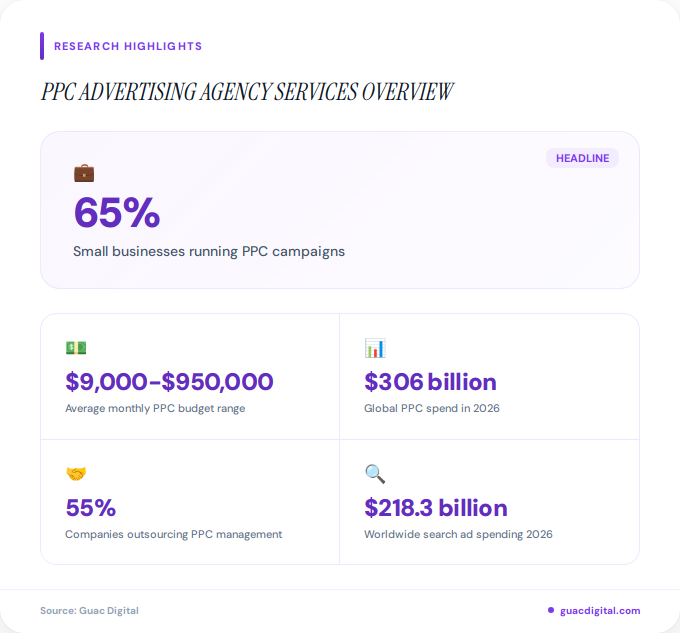
PPC advertising agency services encompass specialized management of pay-per-click campaigns across platforms like Google Ads, Microsoft Advertising, Meta, and Amazon, including keyword research, ad creation, bid optimization, audience targeting, performance tracking, and ROI analysis to maximize ad spend efficiency. Agencies use AI-driven tools and multi-platform strategies, with 65% of small to mid-sized businesses running PPC campaigns and average monthly budgets ranging from $9,000 to $950,000 depending on scope and competitiveness.
Did you know that 55% of companies now outsource their PPC management due to increased campaign complexity from AI-driven changes and privacy regulations? The pay-per-click advertising landscape has transformed dramatically, with global PPC spend reaching $306 billion in 2026, representing an 11% year-over-year growth. As digital advertising becomes more sophisticated and competitive, understanding what PPC advertising agency services actually deliver has never been more critical for business success.
Whether you’re a small business owner wondering if professional PPC management is worth the investment, or a marketing director evaluating agency partners, this comprehensive guide breaks down exactly what you get when you work with a PPC advertising agency in 2026. We’ll explore real data, performance benchmarks, pricing structures, and the cutting-edge technologies that separate exceptional agencies from mediocre ones.
What Are PPC Advertising Agency Services?
PPC advertising agency services overview encompasses the full spectrum of specialized management for pay-per-click campaigns across multiple digital advertising platforms. These services go far beyond simply setting up ads and hoping for the best. Professional agencies provide strategic planning, technical implementation, continuous optimization, and detailed analytics to ensure every advertising dollar generates maximum return.
At their core, PPC agencies handle the complex orchestration of keyword research, competitive analysis, ad creative development, landing page optimization, bid management, audience segmentation, and conversion tracking. According to recent industry data, worldwide search ad spending reached $218.3 billion in 2026, growing at 8.5% year-over-year as businesses increasingly recognize the value of professional campaign management.
Modern PPC agency services integrate artificial intelligence and machine learning tools to automate bidding strategies, predict performance trends, and identify optimization opportunities that human analysts might miss. This technological sophistication explains why 49% of practitioners find campaigns harder to manage than just two years ago, driving the trend toward professional outsourcing.
Why Do Companies Outsource PPC to Agencies?
The decision to partner with a PPC advertising agency stems from several compelling business realities. First, campaign complexity has increased exponentially with the introduction of AI-powered platforms like Google AI Overviews, ChatGPT search integrations, and Perplexity AI. These new search experiences require entirely different optimization approaches than traditional paid search.
Privacy-first data strategies following GDPR, CCPA, and ongoing cookie deprecation have fundamentally changed how advertisers can target and track audiences. Agencies maintain specialized expertise in navigating these regulations while still delivering measurable results. Additionally, the average ROI of 200% on Google Ads (meaning $2 in revenue for every $1 spent) demonstrates the value of expert management.
Companies also recognize that opportunity cost matters significantly. When marketing teams spend excessive time learning platform nuances, troubleshooting tracking issues, or manually adjusting bids, they sacrifice strategic initiatives that could drive greater business impact. At Guac Digital, we see this frequently with growing businesses that hit an inflection point where professional management becomes essential for scaling.

What Core Services Do PPC Agencies Provide?
A comprehensive PPC advertising agency services overview must detail the specific deliverables clients receive. Professional agencies typically bundle these services into tiered packages based on campaign scope and business objectives:
Strategic Planning and Research
Every successful PPC campaign begins with thorough research and strategic planning. Agencies conduct competitive landscape analysis, identifying what competitors are bidding on, which ad copy resonates, and where market opportunities exist. Keyword research extends beyond simple search volume metrics to include search intent analysis, commercial value assessment, and conversion probability scoring.
Account structure design determines campaign organization, ad group segmentation, and bidding hierarchies that maximize Quality Score while maintaining granular control. This foundational work often represents 20-30% of initial setup time but determines long-term campaign efficiency.
Campaign Creation and Management
Agencies handle the technical implementation of campaigns across chosen platforms. This includes ad copywriting that balances persuasive messaging with platform requirements, responsive search ad creation using multiple headlines and descriptions, and display ad design that captures attention while maintaining brand consistency.
Conversion tracking setup ensures accurate attribution, connecting ad clicks to actual business outcomes like purchases, lead submissions, or phone calls. Similar to how conversion optimization in digital marketing requires detailed tracking infrastructure, PPC campaigns depend on properly configured analytics to measure true ROI.
Ongoing Optimization and Testing
The most valuable agency service is continuous performance improvement. Professional teams conduct regular bid adjustments based on performance data, seasonal trends, and competitive dynamics. They implement A/B testing protocols for ad copy, landing pages, audience segments, and bidding strategies.
Negative keyword management prevents wasted spend on irrelevant searches, while search term analysis identifies new opportunities from actual user queries. Quality Score optimization improves ad rankings while reducing cost-per-click through relevance improvements.
Which Platforms Do PPC Agencies Manage?
Modern PPC advertising agency services overview must address multi-platform campaign management, as successful businesses rarely rely on a single advertising channel. Industry data reveals 99% adoption of Google Ads, 79% for Facebook/Meta, and 75% for YouTube among businesses spending $50,000 to $500,000 monthly on advertising.
Revenue: $225 billion (2026)
Avg CTR: 3.17% (search)
Avg CPC: $1.16
Avg CPC: 20-30% lower than Google
Best For: B2B, higher-income demographics
Audience Targeting: Behavior-based segmentation
Best For: E-commerce, visual products
Growth: Part of Big Three (89% share)
Best For: Product sales, e-commerce brands
Premium agencies also manage emerging channels including AI search ads, which created a $500+ million market in 2026 with 2.4x higher engagement rates than traditional search ads. Platforms like ChatGPT, Perplexity, and Google’s AI Overviews represent the frontier of paid search advertising, requiring specialized knowledge that most in-house teams lack.
LinkedIn advertising serves B2B companies targeting specific job titles, industries, or company sizes. YouTube advertising reaches 68.4% of mobile search traffic, while TikTok and Pinterest offer unique opportunities for brands targeting specific demographics.
How Do PPC Agencies Measure Performance?
Understanding what constitutes success requires clear performance benchmarks. According to comprehensive industry research, these metrics provide the foundation for PPC advertising agency services overview performance evaluation:
| Metric | Search Network | Display Network |
|---|---|---|
| Average CTR | 6.42% | 0.58% |
| Average CPC | $2.69 | $0.63 |
| Average Conversion Rate | 3.17% | 0.46% |
| Average ROI | 200% | Varies significantly |
Professional agencies track these metrics across multiple dimensions: by campaign, ad group, keyword, device type, geographic location, time of day, and audience segment. Position-specific performance reveals dramatic differences, with position 1 ads achieving 7.94% CTR compared to just 2.55% for position 3.
The average cost per acquisition across all industries sits at $56.11, though this varies enormously by vertical. Legal services, insurance, and finance typically see CPAs of $100-$500+, while e-commerce might target $20-$50 depending on product margins.
Advanced agencies implement attribution modeling that goes beyond last-click attribution, recognizing that customer journeys often involve multiple touchpoints across different platforms and devices. Multi-touch attribution provides more accurate ROI calculation and informs better budget allocation decisions.
What Does PPC Agency Investment Look Like?
When evaluating PPC advertising agency services overview, understanding investment requirements helps businesses budget appropriately. Pricing varies significantly based on campaign scope, industry competitiveness, geographic targeting, platform selection, and service depth.
Monthly ad spend typically ranges from $9,000 to $950,000+ depending on business size and market position. Small to medium enterprises in competitive markets often invest $9,000-$10,000 monthly ($108,000-$120,000 annually) for meaningful results, while in-house teams at larger companies manage average monthly budgets of $950,000.
Agency management fees typically follow one of three models:
- Percentage of ad spend: Common range of 10-20% of monthly ad budget, scaling down at higher spend levels
- Flat monthly retainer: Fixed fees ranging from $2,500 to $25,000+ monthly based on complexity and scope
- Performance-based pricing: Base fee plus bonuses tied to specific KPIs like cost per acquisition or return on ad spend
Pricing varies based on your specific project requirements, industry competitiveness, number of platforms managed, creative needs, and desired service level. Premium agencies emphasize value creation over cost minimization, focusing on ROI improvement rather than simply reducing management fees. We recommend contacting agencies directly for custom quotes that reflect your unique business objectives.
The PPC software market itself is projected to reach $28.62 billion by 2027, growing at 11.2% CAGR, indicating the sophisticated technology infrastructure that professional agencies leverage on behalf of clients.
What Are the Latest AI and Automation Trends?
The PPC advertising agency services overview for 2026 cannot ignore the transformative impact of artificial intelligence and automation. AI-powered campaign management represents the fastest-growing segment of PPC services, with agencies prioritizing first-party data strategies, creative optimization, and audience refinement through machine learning.
Google’s Performance Max campaigns use AI to automatically optimize ad placement, bidding, and creative selection across Search, Display, YouTube, Gmail, and Discover networks simultaneously. These campaigns require strategic guidance rather than manual management, shifting the agency value proposition from tactical execution to strategic oversight.
Smart Bidding strategies like Target ROAS (Return on Ad Spend) and Target CPA leverage Google’s machine learning algorithms to adjust bids in real-time based on hundreds of contextual signals including device, location, time of day, remarketing list membership, and user behavior patterns. According to recent data, 63% of users click relevant Google ads, highlighting the importance of AI-optimized relevance matching.
Dynamic Search Ads automatically generate ad headlines and landing pages based on website content, while Responsive Search Ads test multiple headline and description combinations to identify top performers. These automation features don’t eliminate the need for human expertise but rather amplify it, allowing strategists to focus on higher-level optimization.
Privacy-first tracking solutions using server-side tagging, conversion APIs, and enhanced conversions help maintain measurement accuracy despite cookie restrictions. Agencies invest heavily in these technical implementations that most businesses lack the expertise to configure properly.
How Do You Choose the Right PPC Agency?
Selecting the optimal PPC partner requires evaluating several critical factors beyond simple cost comparisons. Start by assessing platform-specific expertise in the channels most relevant to your business. An agency specializing in e-commerce Amazon advertising brings different capabilities than one focused on B2B LinkedIn campaigns.
Request case studies demonstrating measurable results in your industry or with similar business models. Look for specifics: What was the starting performance baseline? What strategies were implemented? What results were achieved over what timeframe? Vague claims about “increasing ROI” without supporting data should raise concerns.
Evaluate the agency’s technology stack and partnerships. Premier Google Partner status, Meta Business Partner designation, or Microsoft Select Partner badges indicate platform recognition and access to beta features, dedicated support, and advanced training. Ask about the specific tools they use for bid management, analytics, creative testing, and reporting.
Transparency in reporting and communication separates professional agencies from mediocre ones. You should receive regular performance reports with clear explanations of what’s working, what isn’t, and what changes are being implemented. Look for agencies that provide direct platform access so you can review campaigns independently.
Consider strategic alignment and cultural fit. Your PPC agency becomes an extension of your marketing team, so shared values, communication styles, and business philosophies matter significantly. Initial consultations should feel collaborative rather than sales-focused, with the agency asking detailed questions about your business goals, target customers, and competitive positioning.
Key Takeaways
- PPC spending continues robust growth: Global PPC reached $306 billion in 2026 with 11% YoY growth, driven by increased complexity and AI integration requiring professional management
- Average ROI of 200% demonstrates value: Google Ads delivers $2 in revenue for every $1 spent on average, though results vary significantly by industry, targeting, and optimization quality
- Multi-platform expertise is essential: The Big Three (Google, Meta, Amazon) capture 89% of digital ad spend, requiring agencies to manage coordinated strategies across multiple platforms simultaneously
- AI automation transforms campaign management: Machine learning, Smart Bidding, and AI search ads (generating 2.4x higher engagement) require strategic oversight rather than manual optimization
- Investment ranges from $9,000 to $950,000+ monthly: Competitive SME campaigns typically invest $9,000-$10,000 monthly in ad spend plus agency fees ranging from $2,500-$25,000+ based on scope and complexity
- Privacy regulations increase complexity: 55% of companies outsource PPC due to challenges navigating GDPR, CCPA, and cookie deprecation while maintaining performance
- Continuous optimization drives results: Professional agencies deliver value through ongoing testing, bid adjustments, negative keyword management, and Quality Score improvement beyond initial campaign setup
People Also Ask
What is the difference between PPC and SEO?
PPC (pay-per-click) delivers immediate visibility through paid advertisements where you pay for each click, while SEO (search engine optimization) focuses on earning organic rankings through content and technical optimization. PPC provides instant traffic and precise targeting control but requires continuous investment, whereas SEO builds long-term visibility at lower incremental cost but takes months to show results.
How long does it take to see PPC results?
PPC campaigns can generate immediate traffic within hours of launch, but meaningful performance optimization typically requires 30-90 days of data collection and testing. Initial results appear quickly, but agencies need sufficient conversion data to refine targeting, adjust bids, and identify winning ad variations that maximize ROI over time.
What industries benefit most from PPC advertising?
E-commerce, legal services, healthcare, home services, financial services, and B2B technology companies see particularly strong PPC performance due to high customer lifetime values, clear conversion actions, and competitive search landscapes. Any business with defined target audiences, measurable conversions, and sufficient margins to support acquisition costs can benefit from properly managed PPC campaigns.
Do small businesses need PPC agency services?
Small businesses benefit significantly from PPC agencies when they lack in-house expertise, need to compete in crowded markets, or want to scale quickly without the learning curve of platform mastery. With 65% of small to mid-sized businesses running PPC campaigns, professional management helps maximize limited budgets through expert optimization and avoidance of costly beginner mistakes.
What is Quality Score and why does it matter?
Quality Score is Google’s rating (1-10) of your ad relevance, expected click-through rate, and landing page experience. Higher Quality Scores reduce cost-per-click and improve ad positions, meaning you pay less for better placement. Professional agencies optimize Quality Score through strategic keyword grouping, compelling ad copy, and landing page alignment to maximize advertising efficiency.
Can I run PPC campaigns in-house instead of hiring an agency?
In-house PPC management is possible but requires dedicated personnel with platform expertise, analytical skills, and time for continuous optimization. Companies with average monthly budgets of $950,000 often maintain in-house teams, while those spending less typically find agencies more cost-effective given the specialized knowledge, technology investments, and ongoing training required for competitive performance.
Frequently Asked Questions
What exactly does a PPC agency do on a daily basis?+
PPC agencies monitor campaign performance metrics, adjust bids based on performance data, add negative keywords to prevent wasted spend, test new ad variations, analyze competitor strategies, review search term reports for optimization opportunities, and communicate with clients about results and recommendations. This continuous optimization process ensures campaigns improve over time rather than remaining static.
How much should I budget for PPC advertising to see meaningful results?+
Competitive campaigns for small to medium enterprises typically require $9,000-$10,000 monthly in ad spend to generate sufficient traffic and conversion data for optimization, though this varies dramatically by industry, geographic targeting, and competition level. Highly competitive sectors like legal services or insurance may require $20,000-$50,000+ monthly, while niche B2B markets might succeed with $3,000-$5,000 budgets.
What metrics should I track to evaluate PPC agency performance?+
Focus on business-outcome metrics including cost per acquisition, return on ad spend, conversion rate, and total conversions rather than vanity metrics like impressions or clicks alone. Track Quality Score improvements, impression share in target markets, and compare performance against industry benchmarks like the 3.17% average conversion rate for search campaigns to assess whether your agency delivers competitive results.
Should I use Google Ads, Facebook Ads, or both for my business?+
Google Ads typically performs better for high-intent searchers actively looking for solutions (99% platform adoption among advertisers), while Facebook/Meta excels at building awareness and targeting based on demographics, interests, and behaviors (79% adoption). Most successful strategies use both platforms strategically, with Google capturing bottom-funnel demand and Meta supporting top-and-middle funnel awareness and consideration.
What questions should I ask when interviewing PPC agencies?+
Ask about their experience in your industry, specific case studies with measurable results, platform certifications and partnerships, reporting frequency and detail, contract terms and cancellation policies, who will actually manage your account daily, how they handle underperforming campaigns, and what technology tools they use for optimization and analytics. Request references from current clients in similar business situations.
How do PPC agencies stay current with constant platform changes?+
Professional agencies maintain platform partner certifications requiring ongoing education, attend industry conferences and training sessions, participate in beta testing programs for new features, belong to professional communities sharing insights and strategies, and dedicate staff time specifically to testing and learning rather than only client execution. This continuous learning investment explains why 55% of companies outsource rather than maintaining expertise in-house.
What role does landing page optimization play in PPC success?+
Landing pages directly impact Quality Score, conversion rates, and overall campaign ROI, making them critical to PPC success despite existing outside the ad platform itself. Full-service agencies either provide landing page design and optimization or work closely with your development team to ensure message match, fast load times, mobile responsiveness, clear calls-to-action, and conversion-focused design that turns clicks into customers.