
why big data is a big deal in advertising 2025: Future
Why Big Data is Changing Modern Advertising
Why big data is a big deal in advertising comes down to one simple fact: it transforms guesswork into precision. In today’s digital landscape, big data enables advertisers to understand customers better, target more accurately, and measure results with unprecedented clarity.
Here’s why big data has become advertising’s game-changer:
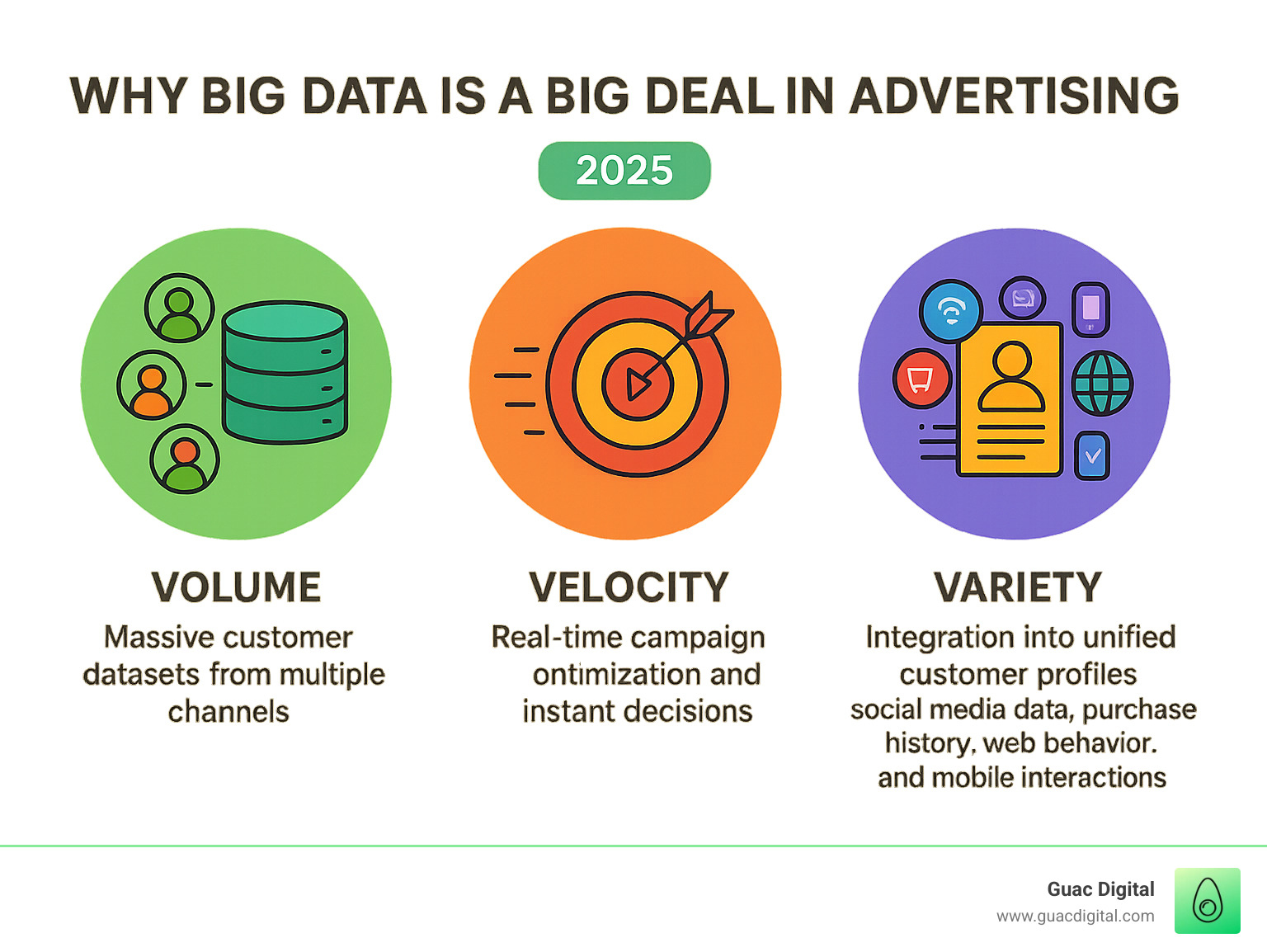
- Volume: Access to massive amounts of customer data from multiple touchpoints
- Velocity: Real-time analysis and decision-making capabilities
- Variety: Integration of structured and unstructured data from social media, web browsing, purchases, and mobile interactions
- Precision Targeting: Move beyond basic demographics to behavioral and psychographic insights
- Predictive Power: Forecast customer behavior and optimize campaigns before they launch
- ROI Measurement: Track attribution across the entire customer journey, not just last-click
The shift from traditional advertising is dramatic. Where marketers once relied on broad assumptions like “girls like pink and boys like blue,” big data now reveals that a customer “returns 40 percent of what she buys online” and “never clicks on banner ads” – insights that drive truly personalized campaigns.
As one Harvard researcher noted: “The big data revolution is that now we can do something with the data.” This isn’t just about collecting more information – it’s about turning that information into actionable insights that boost engagement, increase conversions, and maximize advertising spend.
I’m Guy Leon, founder and CEO of Guac Digital, where we’ve helped clients achieve a 350% increase in engagement through strategic data-driven campaigns that demonstrate exactly why big data is a big deal in advertising. My experience implementing big data solutions has shown me how this technology transforms mediocre campaigns into revenue-generating machines.
Quick why big data is a big deal in advertising terms:
From Guesswork to Precision: Opening up Deeper Customer Understanding
Not long ago, marketing relied on broad assumptions and basic demographics. We’d create campaigns based on educated guesses and hope for the best. Those days are over, and that’s exactly why big data is a big deal in advertising.
Today, we can build incredibly detailed customer portraits. Instead of just knowing a customer’s age and location, we understand their specific behaviors: what they buy, what they return, and how they interact with content. This shift from generalities to specifics has transformed how we connect with audiences.
| Feature | Data of the Past | Big Data of Today |
|---|---|---|
| Customer Profile | General demographics (age, income, location) | Specific behaviors, real-time interests, purchase history |
| Targeting Approach | Broad assumptions and educated guesses | Precise behavioral and psychographic insights |
| Data Sources | Surveys, focus groups, basic web analytics | Social media, mobile apps, IoT devices, transaction data |
| Campaign Timing | Seasonal or demographic-based scheduling | Real-time optimization based on individual behavior patterns |
| Personalization | One-size-fits-all or basic segmentation | Hyper-personalized content for each customer |
This wealth of information allows us to create incredibly detailed buyer personas that go far beyond basic demographics. We can now map the entire customer journey, understanding not just who our customers are, but how they think, when they buy, and what motivates their decisions. The result? Marketing campaigns that feel less like interruptions and more like helpful conversations. This change from guesswork to precision isn’t just nice to have—it’s essential for staying competitive.
How Big Data Revolutionizes Customer Understanding and why big data is a big deal in advertising
The magic happens when we combine all these data streams into a complete picture of each customer. This process, called customer segmentation, has evolved from simple categories to sophisticated, dynamic profiles that update in real-time.
Behavioral segmentation looks at what customers actually do – their browsing patterns, purchase history, and engagement levels. A customer who abandons their cart three times before buying tells a very different story than someone who purchases immediately after viewing a product.
Psychographic segmentation dives deeper into the why behind customer actions. It examines values, interests, lifestyle choices, and personality traits. This helps us understand that two customers with identical demographics might have completely different motivations for buying the same product.
But here’s where it gets really exciting: dynamic segmentation means these profiles aren’t static. As customers’ behaviors and preferences evolve, their segments automatically adjust. A bargain hunter who gets a promotion might gradually shift toward premium products, and our targeting adjusts accordingly.
This sophisticated approach to customer understanding directly feeds into more effective data-driven marketing strategies that deliver measurable results.
The beauty of this system is that it works at scale. Whether you’re targeting 1,000 customers or 1 million, big data tools can create and maintain detailed profiles for each individual, ensuring every interaction feels personal and relevant.
Personalization at Scale: Delivering the Right Message at the Right Time
Here’s where big data really shows its power: delivering hyper-personalization to millions of customers simultaneously. It sounds impossible, but it’s happening every day.
Take Amazon’s recommendation engine – probably the most famous example of personalization at scale. Every product suggestion, every “customers who bought this also bought” recommendation, and every personalized email is generated by analyzing massive amounts of data about your behavior and comparing it to similar customers.
Dynamic Creative Optimization (DCO) takes this concept and applies it to advertising. The same ad campaign can show different images, headlines, and calls-to-action to different viewers based on their profiles. A fitness app might show running shoes to marathon enthusiasts and yoga mats to mindfulness seekers – all from the same campaign budget.
This level of personalization requires AI-centric strategies that can process and act on data faster than any human team could manage. Machine learning algorithms continuously test and optimize creative elements, finding the perfect combination for each audience segment.
The key is avoiding data silos – when different departments or platforms don’t share information. When your email marketing, social media, and website analytics all work together, you create a unified view of each customer that enables truly seamless personalization.
Adobe’s research on personalization at scale shows that companies implementing these strategies see significant improvements in customer engagement and conversion rates.
The result is advertising that doesn’t feel like advertising. Instead of interrupting customers with irrelevant messages, personalized campaigns provide value by showing people exactly what they’re looking for, exactly when they need it.
From Guesswork to Precision: Opening up Deeper Customer Understanding
To us at Guac Digital, understanding the customer is just the first step. The real power comes from using that knowledge to deliver marketing messages that feel tailor-made. This is hyper-personalization, and big data makes it possible at a scale that was once unimaginable.
Instead of manually crafting messages, AI-centric strategies now turn data insights into personalized experiences. A key example is Dynamic Creative Optimization (DCO), a process that uses big data to deliver customized ads in real-time. Rather than showing everyone the same banner, DCO displays different images, headlines, and offers to different viewers based on their profiles, preferences, and context.
This level of personalization requires breaking down data silos—ensuring that information from email, social media, and website analytics is shared. A unified customer view enables a truly seamless experience. As Adobe’s research on personalization at scale shows, companies that master this see significant gains in engagement and conversions.
Amazon’s recommendation engine is a classic example. By analyzing your browsing history and purchase patterns, it predicts what you might want next. This makes you feel understood and valued, driving sales and loyalty. This sophisticated use of data is a prime example of why big data is a big deal in advertising—it creates an intuitive customer experience that builds lasting relationships.
More info about Data-Driven Marketing Strategies
Why Big Data is a Big Deal in Advertising: From Insights to Impact
Gathering data is one thing; using it to predict the future is another. This is where predictive analytics changes marketing from a reactive guessing game into a proactive, strategic powerhouse. The true magic of big data is turning information into smart decisions and powerful actions. This shift empowers marketers to stop guessing and start making precise, data-backed choices that move the needle.
Big data streamlines marketing operations by connecting data sources, automating campaign adjustments, and tracking performance. This allows for constant, real-time optimization and personalization at scale.
More info about Data-Driven Insights
Optimizing Campaigns with Predictive Analytics
Predictive analytics is like a crystal ball powered by algorithms. By analyzing past data, we can forecast customer actions, spot market trends, and anticipate purchasing patterns. This foresight is a cornerstone of why big data is a big deal in advertising.

Here’s how we put it to work:
- Predictive Modeling: Building statistical models that find hidden relationships in data, like identifying customers who are likely expecting a baby based on purchase patterns.
- Lead Scoring: Assigning a score to each lead based on their engagement, allowing sales and marketing teams to focus on the most promising prospects.
- Look-alike Audiences: Finding new people who share the same traits as your best customers, significantly expanding your reach.
- Retargeting and Remarketing: Reminding interested users with customized ads at the right moment to nudge them toward conversion.
- Cross-selling and Up-selling: Smartly suggesting complementary products or upgrades based on past purchases, just like Amazon does.
- Optimizing Ad Spend: Using predictive technology on platforms like Bing Ads and Google Ads to adjust bids in real-time, ensuring you get the most bang for your buck.
This sophisticated use of data makes every advertising dollar work harder. Curious how programmatic advertising uses this? More info about Programmatic Advertising Explained
Measuring What Matters: True ROI and Performance Tracking
Big data has revolutionized performance tracking, turning it from a murky art into a precise science. This clarity is a huge reason why big data is a big deal in advertising when it comes to accountability and optimization. We’ve moved beyond counting clicks to measuring true return on investment (ROI).
A major breakthrough is data-driven attribution. Unlike the old “last-click” model, which was often misleading, these advanced models analyze the entire customer journey. They assign fractional credit to each touchpoint, giving a far more accurate picture of what drives conversions. Traditional measurement tools can miss almost 45% of digital touchpoints, highlighting the need for these models.
At Guac Digital, we leverage two powerful big data-driven approaches for measuring ROI:
- Media Mix Modeling (MMM): This uses aggregated data to understand how different marketing activities influence ROI over time, helping optimize the overall marketing budget.
- Multitouch Attribution (MTA): This provides a complete view of campaign performance by giving credit to multiple touchpoints along the customer journey.
Big data also streamlines operations by integrating online and offline data for a 360-degree customer view, automating campaign management, and enabling constant performance monitoring. This allows us to continuously optimize your marketing spend and improve results.
More info about Programmatic Advertising ROI or find how we can help you achieve your goals: More info about Maximizing ROI with a Digital Marketing Agency
Navigating the Challenges: The Problems and Ethics of Big Data
While big data offers immense opportunities, it’s not without challenges. Understanding why big data is a big deal in advertising means also understanding its complexities and potential pitfalls.

Key challenges include ensuring data privacy and security, integrating data from disparate sources, maintaining high data quality, and bridging the skill gap to find experts who can turn raw data into actionable insights.
The Privacy Predicament: Regulations and Consumer Trust
Today’s consumers are savvy about their data, leading to a wave of privacy regulations. The EU’s General Data Protection Regulation (GDPR) and the California Consumer Privacy Act (CCPA) give individuals significant control over their personal information, with hefty fines for non-compliance.
What is the General Data Protection Regulation (GDPR)?
This makes consent management crucial. We must get explicit permission to use data and make it easy for consumers to manage their preferences. There’s also the “creepiness” factor to consider. While predictive personalization is powerful, it can make consumers uncomfortable if it feels too invasive. Our philosophy is to use data to improve the customer experience, not to make them feel watched, by balancing personalization with a genuine respect for privacy.
Avoiding the Pitfalls: Spurious Correlations and Cognitive Bias
Big data can be misleading. It’s easy to find correlations that are purely coincidental, a phenomenon known as data dredging. Just because two things happen together doesn’t mean one causes the other.
Cognitive bias is another challenge. As Joseph Enever from Gartner wisely noted, “Better data won’t increase marketing analytics’ decision influence alone.” We must address our own biases and foster a data-informed culture.
Gartner’s view on analytics influencing decisions
To build a truly data-informed culture, we focus on cultivating data literacy, challenging assumptions, and concentrating on actionable insights over impressive but irrelevant numbers. This careful approach ensures big data serves as a reliable compass for our advertising strategies.
The Future is Now: Emerging Trends in Data-Driven Advertising
The world of advertising is evolving at lightning speed, and big data is the engine of that change. This constant evolution is why big data is a big deal in advertising—it’s not just changing today’s work, but reshaping tomorrow’s possibilities.

Artificial Intelligence and Machine Learning have moved from buzzwords to essential tools. They spot patterns and optimize campaigns in real-time, solving complex problems far faster than traditional methods. The Internet of Things (IoT) provides a new layer of contextual data from smart devices, while Augmented Reality (AR) uses data to blend digital and physical worlds for immersive, personalized ad experiences.
The Future is Now: Emerging Trends and why big data is a big deal in advertising
The advertising industry is adapting to several key shifts:
- The shift to first-party data is now a survival strategy. With third-party cookies disappearing, brands must build direct relationships with customers to collect their own data.
- The cookieless future is forcing marketers to be more creative with contextual targeting and smarter about using their own customer insights.
- Increased automation is freeing up marketers to focus on strategy and creativity, while AI handles the number crunching.
- Data science teams are becoming essential. As McKinsey points out, we’re entering an era where data, technology, and analytics blend in real-time to create more precise and useful advertising.
The cost of storing information has dropped dramatically, making sophisticated data operations accessible to businesses of all sizes. This democratization means that human-machine collaboration is becoming the standard for successful marketing teams.
This ongoing evolution is exactly why big data is a big deal in advertising and why it will continue to reshape how brands connect with people.
McKinsey’s insights on the future of data-driven marketing
Conclusion: Using the Power of Big Data for Your Brand
We’ve seen how big data has transformed advertising from a guessing game into a precise, results-driven science. It allows for unparalleled customer understanding, deep personalization, and predictive campaign optimization. While challenges like data privacy and quality exist, the benefits of a data-driven approach are undeniable.
At its heart, the reason why big data is a big deal in advertising is simple: it empowers us to move beyond guesswork. It helps us understand, connect with, and convert customers by delivering the right message to the right person at the right time. This isn’t just a nice-to-have; it’s a critical competitive advantage.
Here at Guac Digital, we live this data-driven philosophy. As a digital marketing agency in Tampa, Florida, we leverage big data for programmatic marketing to achieve outstanding ROI for our global clients. Our focus is on personalized strategies that deliver measurable results. We don’t just use fancy tools; we “turn the lights on,” showing you exactly how your advertising budget is performing and how we can make it work even harder for your business.
Ready to harness the power of big data for your brand? Let’s take the next step in your advertising journey together.