
how to set up a social media marketing strategy: 10 proven steps for success 2025
Why Building a Strategic Social Media Presence Matters
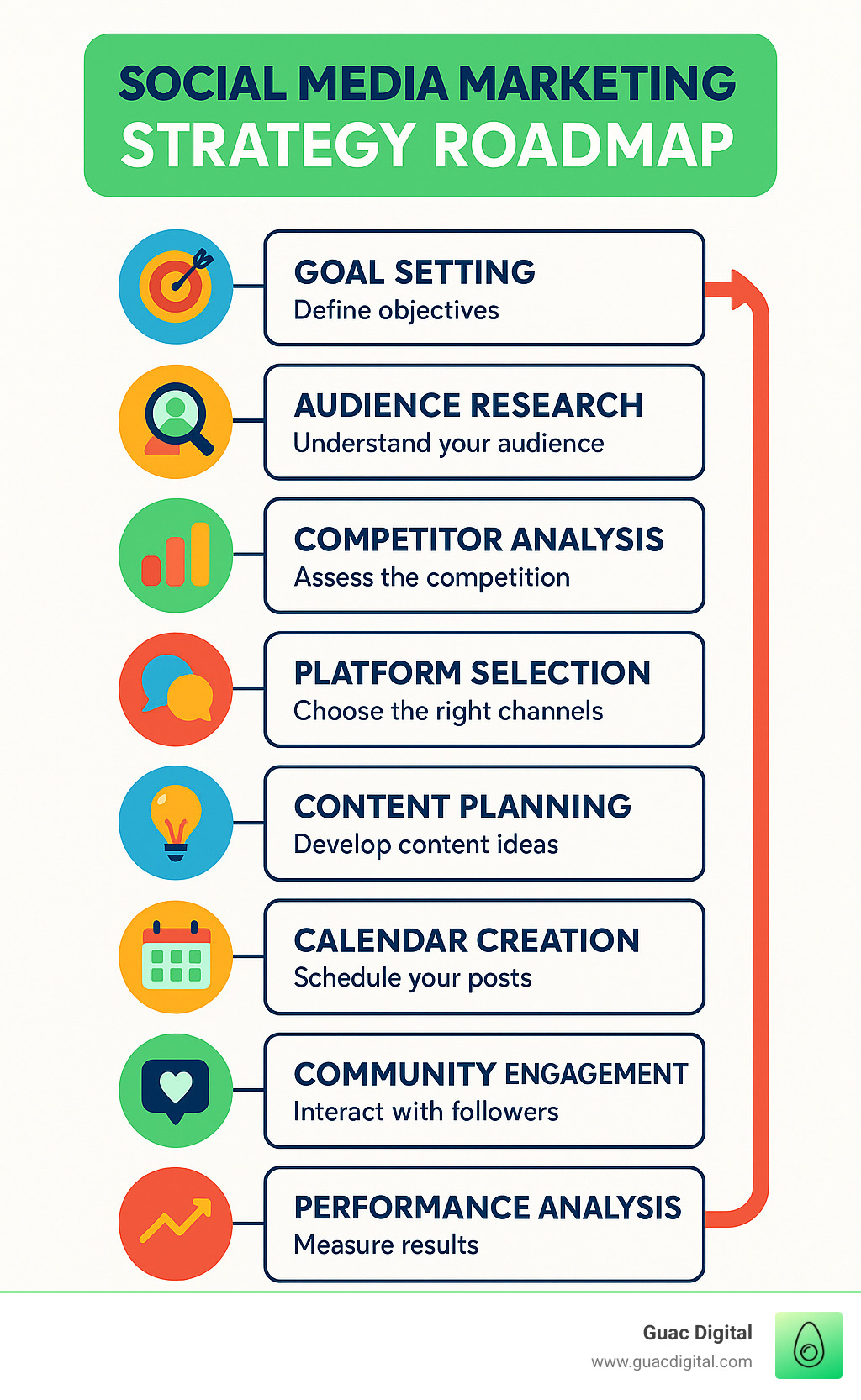
How to set up a social media marketing strategy in 8 simple steps:
- Set SMART goals aligned with business objectives
- Research your target audience thoroughly
- Audit current social profiles and analyze competitors
- Choose the right platforms based on audience demographics
- Develop content pillars and plan your content mix
- Create a content calendar with consistent posting schedule
- Establish engagement protocols for community building
- Track metrics and regularly optimize your approach
Working in social media without a strategy is like throwing together random ingredients, hoping to create a gourmet meal. With nearly 4.6 billion active social media users worldwide (about 60% of the global population) spending an average of 2.25 hours daily across approximately 7.5 platforms each month, the opportunity is massive – but so is the competition.
A well-crafted social media strategy isn’t just a nice-to-have document – it’s the roadmap that transforms random posting into purposeful engagement that drives real business results. The most successful brands understand this, which is why marketers who document their strategies are 538% more likely to report success than those who don’t.
I’m Guy Leon, founder of Guac Digital, where I’ve helped hundreds of businesses transform their approach to how to set up a social media marketing strategy that delivers measurable ROI through data-driven techniques and platform-specific optimization.
Must-know how to set up a social media marketing strategy terms:
– effective social media marketing strategies
How to Set Up a Social Media Marketing Strategy
Social media marketing isn’t about creating pretty pictures and witty captions – it’s about driving real business results through strategic planning and execution. At Guac Digital, we’ve found that the most successful social media strategies balance creativity with data-driven decision making, allowing brands to cut through the noise and connect with their audience in meaningful ways.

A comprehensive how to set up a social media marketing strategy includes setting SMART goals, developing audience personas, conducting competitor audits, selecting the right platforms, creating a content calendar, establishing KPIs, and balancing organic and paid tactics.
| Organic Social Media | Paid Social Media |
|---|---|
| Builds community and trust | Expands reach quickly |
| Slower growth, deeper connections | Faster results, targeted exposure |
| Content-focused approach | Budget and targeting focused |
| Long-term brand building | Short-term campaign objectives |
| Requires consistency and patience | Requires budget and optimization |
Why learning how to set up a social media marketing strategy matters
In today’s digital landscape, social media isn’t just nice to have—it’s essential. Think about it: when was the last time you made a purchase without checking a brand’s social presence first? A thoughtfully crafted strategy helps you:
Build brand awareness in a meaningful way. When people have positive experiences with your business on social media, over 70% will recommend you to friends and family. That’s word-of-mouth marketing on steroids!
Drive measurable ROI by aligning your social efforts with business goals. No more wondering if your posts are making an impact—you’ll know exactly how they contribute to your bottom line.
Guide the customer journey from findy to loyal advocate. Social media touches every stage of how modern customers find, evaluate, and choose businesses they love.
As Brian Solis beautifully puts it: “Social media is about sociology and psychology more than technology.” Understanding this human element transforms your approach from simply posting content to building a community that genuinely cares about your brand.
Step 1: Set SMART Business Goals
The foundation of any effective how to set up a social media marketing strategy starts with clear, measurable goals. Without them, you’re essentially throwing spaghetti at the wall and hoping something sticks.
Your social media goals should follow the SMART framework:
Specific: Instead of vague goals like “increase brand awareness,” aim for “increase Instagram followers by 25%.” The more specific, the better.
Measurable: You need real numbers to track progress. “Generate 50 qualified leads per month from LinkedIn” gives you something concrete to measure.
Attainable: Be ambitious but realistic based on your resources. If you’re a small team, aiming to post 20 times daily across six platforms probably isn’t sustainable.
Relevant: Your social goals should directly support broader business objectives. If your business needs more qualified leads, focus on conversion-oriented content rather than viral reach.
Time-bound: Set deadlines to create urgency and track progress. “Achieve a 15% engagement rate on Instagram by Q3” gives you both a target and a timeline.
According to social media marketing statistics, 46% of marketers plan to calculate the ROI of their social advertising in 2024—showing a growing emphasis on measurable results rather than just posting and hoping for the best.
Step 2: Research & Define Your Audience
Understanding who you’re trying to reach is critical to creating content that resonates. I can’t tell you how many times I’ve seen businesses create beautiful content that completely misses the mark because they don’t truly understand their audience.
Start by developing detailed audience personas that capture:
Demographics like age, gender, location, income, and education give you the basic outline of who you’re talking to.
Psychographics including values, interests, lifestyle, and pain points help you understand what makes them tick.
Behavioral patterns such as when they’re online, what content they engage with, and their purchasing habits tell you how to reach them effectively.
Social listening tools can provide gold mines of insight into what your audience is saying about your brand, industry, and competitors. This real-time feedback helps you understand their needs and preferences better than any demographic report ever could.
One of our Tampa-based clients finded through audience research that their primary customer base was actually different from who they’d been targeting. By adjusting their social strategy to speak directly to this newly identified audience, their engagement skyrocketed by 78% in just three months.
Remember what Jay Baer wisely notes: “Social media is a marathon, not a sprint.” Focus on consistent, audience-focused content that builds relationships over time rather than trying to go viral with every post.
Step 3: Audit Current Presence & Analyze Competitors
Before rushing forward with new ideas, take a good look at where you stand. A thorough audit of your current social media presence is like checking the foundation before building a house—it shows you what’s working, what’s not, and where the opportunities lie.
When auditing your profiles, examine:
– Which posts generated the highest engagement (and why)
– How your audience demographics match up with your target personas
– Whether your brand voice and visuals are consistent across channels
– Any gaps in your content or platform presence that need addressing
Next, put on your detective hat and analyze your competitors. This isn’t about copying them—it’s about learning from their successes and failures. Look at:
Which platforms they dominate (and which they ignore)
What content types spark the most engagement with their audience
How frequently they post and when their audience seems most active
Their messaging tone and how it differs from yours
Hashtags and keywords they’re targeting successfully
As we outline in our Insights into Effective Social Media Agency Strategies, competitive analysis gives you a shortcut to understanding what works in your industry without making all the mistakes yourself.
Mari Smith, a true social media pioneer, puts it perfectly: “Your competitors’ social media presence can be your greatest teacher.” Study their playbook, but focus on what makes your brand uniquely valuable.
Step 4: Select High-ROI Platforms
Not all social platforms are created equal for your business. One of the biggest mistakes I see is brands trying to be everywhere at once, spreading themselves too thin and creating mediocre content across too many channels.
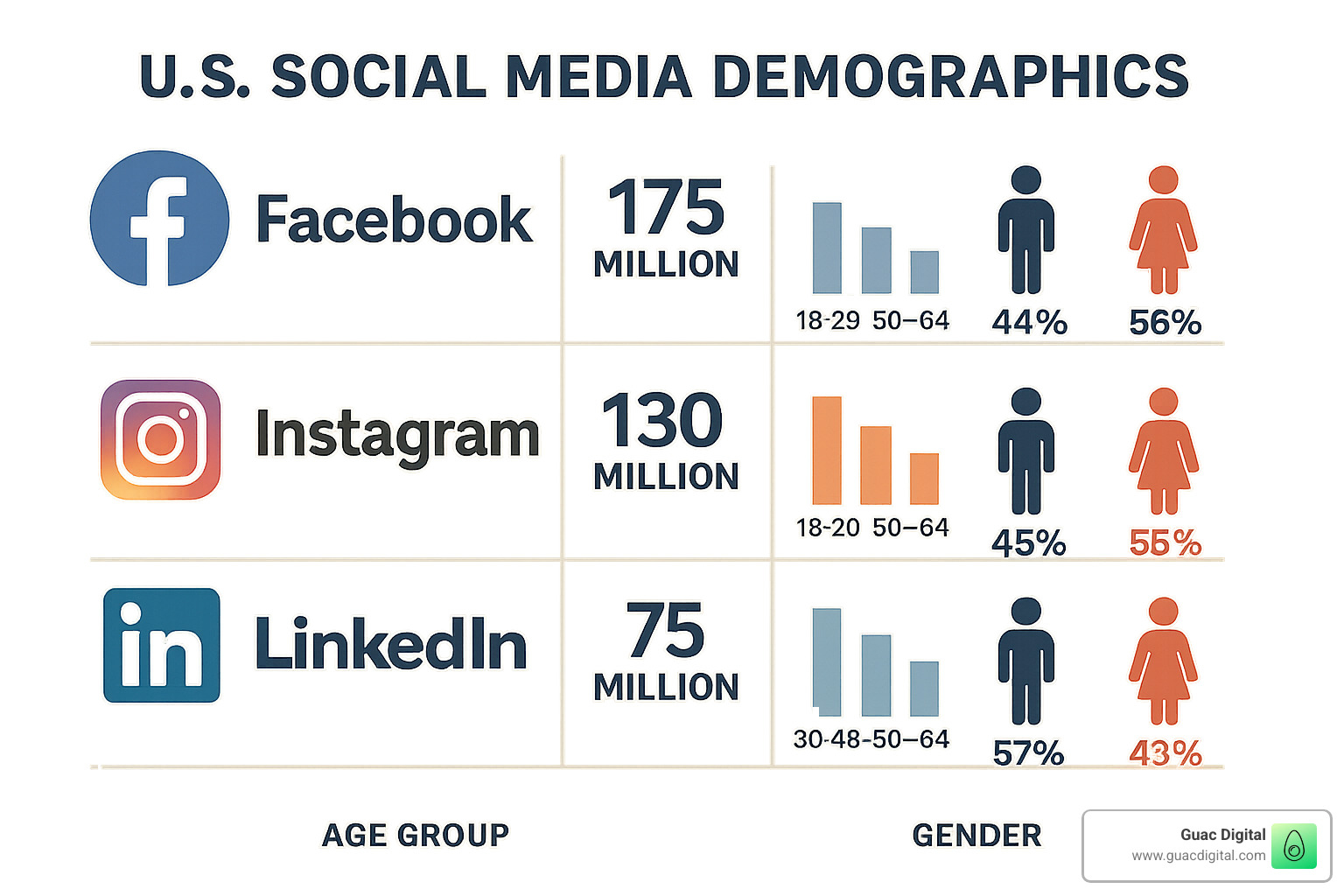
The platform landscape is diverse, with each offering different demographics and engagement styles:
Facebook remains the giant with 2.9 billion monthly active users, strongest with adults 25-54. It’s versatile but increasingly pay-to-play.
Instagram boasts 1.3 billion users with a nearly even gender split (51.8% men, 48.2% women) and dominates the 18-34 age range. Visual brands thrive here.
LinkedIn has 875 million users (56.3% men, 43.7% women) with a professional focus that makes it gold for B2B marketing.
TikTok has exploded to 1 billion users with a nearly equal gender split and dominates the 18-24 demographic. It’s perfect for authentic, creative content.
YouTube serves 2.5 billion users and functions as the second-largest search engine after Google. It’s ideal for educational and how-to content.
At Guac Digital, we’ve consistently found that for most Tampa businesses, focusing on 2-3 platforms well produces far better results than maintaining a mediocre presence everywhere. As Gary Vaynerchuk wisely says, “Content is king, but context is God.” Understanding the unique context of each platform is essential.
For B2B companies targeting decision-makers, LinkedIn should be a priority since 4 out of 5 LinkedIn users drive business decisions. For visually-driven brands targeting younger audiences, Instagram and TikTok might yield higher ROI.
Step 5: Craft Content Pillars & Mix
Once you’ve selected your platforms, it’s time to develop a content strategy that engages your audience and supports your goals. Content pillars—the main themes that define your content—provide structure and consistency to your social media presence.
Most effective how to set up a social media marketing strategy approaches include 3-5 content pillars that resonate with both your audience and business objectives. For example, a local Tampa restaurant might build pillars around:
Mouthwatering food photography that showcases their menu
Behind-the-scenes kitchen content that builds authenticity
Customer spotlights that create community
Local Tampa events and partnerships that establish local relevance
Special promotions and offers that drive business
The 80-20 rule works beautifully for most brands: 80% of your content should inform, educate, or entertain your audience, while only 20% should directly promote your products or services. This approach builds trust rather than making followers feel like they’re constantly being sold to.
Today’s winning content formats include short-form video (which is 2.5× more engaging than long-form according to Sprout Social), user-generated content that builds authenticity, storytelling posts that create emotional connections, and educational content that positions you as an authority.
As content marketing guru Ann Handley perfectly puts it: “Great content is not about what you sell, but the stories you tell.” Focus on creating content that resonates with your audience’s needs and interests, not just your sales goals.
Step 6: Build a Content Calendar
Consistency is the secret sauce of social media success. A content calendar helps you plan, organize, and schedule your posts to ensure regular activity without last-minute scrambling or that dreaded “what should we post today?” panic.
Your content calendar should map out:
– Post dates and times optimized for your audience’s active periods
– Content themes aligned with your pillars
– Copy and visuals prepared in advance
– Platform-specific formatting (what works on Instagram might flop on LinkedIn)
– Hashtags and keywords researched for maximum reach
– Team responsibilities for creation, approval, and engagement
Helpful tools that streamline calendar management include Hootsuite, Buffer, CoSchedule, Trello, Asana, and even good old Google Sheets. The best tool is the one your team will actually use consistently.
When determining your posting cadence, balance platform norms with your resource capacity. While Instagram might benefit from 3-7 posts weekly, LinkedIn might only need 1-5 quality posts per week. TikTok’s algorithm favors 3-5 videos weekly, while Twitter might require multiple daily touchpoints.
At Guac Digital, we love automation tools for streamlining the posting process, but we always leave room for real-time engagement and trending topics. As Jasmine Star wisely notes, “The best social media strategies balance planning with spontaneity.”
Step 7: Engage & Grow Community
Social media was never meant to be a one-way megaphone—it’s a community where conversation drives connection. Engagement isn’t just a nice bonus; it’s the heart of what makes social media work for businesses.
Building a thriving community means:
Responding quickly to comments and messages – nearly 80% of Twitter users feel more positive about businesses that respond to them.
Asking thoughtful questions that spark genuine conversation rather than just likes.
Using interactive features like polls, quizzes, and sliders to involve your audience.
Collaborating with relevant influencers whose audiences align with yours (they don’t need millions of followers—micro-influencers often drive better engagement).
Leveraging local hashtags to join community conversations, especially important for Tampa-based businesses looking to connect locally.
One of our Tampa restaurant clients saw foot traffic increase by 65% after implementing a community engagement strategy that included responding to every comment, sharing customer photos, and creating location-specific hashtags that built local pride.
Jay Baer puts it perfectly: “Social media is a contact sport. You can’t just post and ghost—you need to be present and engaged with your community.” The brands that truly listen and respond are the ones that build lasting loyalty.
Step 8: Measure & Analyze Performance
What gets measured gets managed. Tracking the right metrics helps you understand what’s working, what’s not, and how to optimize your strategy for better results.
The metrics that matter most depend on your specific goals:
For awareness goals: Track reach, impressions, and follower growth to understand how many people you’re reaching.
For engagement goals: Monitor likes, comments, shares, saves, and click-through rates to see how people are interacting with your content.
For conversion goals: Measure lead generation, sign-ups, and purchases to see how social translates to business results.
For customer service: Track response time, sentiment, and resolution rate to ensure you’re providing excellent care.
UTM parameters are absolute game-changers for tracking how social traffic contributes to website goals. According to the Zapier strategy template, “UTM tracking is the difference between guessing and knowing your social media ROI.”
At Guac Digital, we create custom dashboards for our Tampa clients that focus on the metrics that matter most to their specific goals. This focused approach prevents data overwhelm and keeps everyone aligned on what really matters.
As Einstein wisely noted, “Not everything that can be counted counts, and not everything that counts can be counted.” Focus on metrics that directly tie to business objectives rather than vanity metrics that look impressive but don’t drive results.
Step 9: Optimize & Iterate
Social media is never “set it and forget it.” The most successful strategies evolve based on performance data, audience feedback, and platform changes. Think of your strategy as a living document that grows with your business.
Smart optimization includes:
A/B testing different approaches – try varying your content formats, topics, and posting times to see what resonates most.
Regularly surveying your audience about what content they find most valuable.
Conducting quarterly strategy reviews to assess overall performance against goals.
Staying current on platform changes – algorithms and features evolve constantly, and staying ahead of these shifts gives you a competitive edge.
When Instagram shifted to prioritize Reels content, one of our Tampa clients quickly pivoted their strategy to focus on short-form video. This agility resulted in a 112% increase in reach compared to their previous static image approach.
As social media strategist Jon Loomer notes, “The only constant in social media is change.” Embracing this reality and building flexibility into your strategy ensures you stay relevant and effective.
Step 10: Balance Organic & Paid Tactics
While organic content builds community and trust, paid social media amplifies your reach and accelerates results. The most effective how to set up a social media marketing strategy combines both approaches strategically.
Smart paid social tactics include:
Boosting high-performing organic content to expand its reach beyond your existing followers.
Creating targeted ads based on detailed demographic, interest, and behavioral data.
Developing remarketing campaigns to re-engage people who’ve visited your website but didn’t convert.
Running lead generation campaigns with specific conversion goals and compelling offers.

According to social media advertising research, Facebook users click on an average of 12 ads every month, showing the potential of paid social to drive action. However, throwing money at poorly designed ads won’t save you—effective paid social requires strategic targeting and compelling creative.
At Guac Digital, we’ve found that starting with small test budgets and scaling based on performance data is the most effective approach. As Mark Zuckerberg said, “The biggest risk is not taking any risk.” Testing different ad formats and targeting options helps identify what works best for your specific Tampa audience and business goals.
Common Mistakes When Learning How to Set Up a Social Media Marketing Strategy
Everyone stumbles on their social media journey – even the pros! Let’s explore the most common pitfalls I’ve seen businesses fall into when developing their strategies. Trust me, recognizing these mistakes early can save you countless hours and marketing dollars.

I’ll never forget working with a Tampa restaurant that was obsessed with growing their Instagram following. They’d celebrate every thousand new followers with champagne – while their actual bookings remained flat. This illustrates perhaps the biggest mistake I see: focusing on vanity metrics rather than numbers that actually impact your business. 10,000 followers looks impressive, but if they’re not converting to customers, what’s the point?
Another common pitfall is inconsistent branding across platforms. Your social presence should feel cohesive whether someone finds you on LinkedIn or TikTok. I worked with a fitness brand whose Instagram was playful and vibrant while their Facebook was corporate and stiff – customers were confused about who they really were! Your voice, visuals, and values should harmonize across all channels to build recognition and trust.
Are you guilty of ignoring analytics? You’re not alone. Many businesses post content without ever checking what resonates. It’s like throwing darts blindfolded and hoping to hit the bullseye. The data tells a story about what your audience loves (and what they scroll past). At Guac Digital, we make reviewing performance metrics a weekly ritual with our clients – it’s the compass that guides strategy refinement.
The social media graveyard is filled with accounts suffering from sporadic posting syndrome. You know the pattern – a flurry of activity followed by weeks of silence. This inconsistency destroys algorithm favor and audience expectations. Your followers want reliability, not random appearances in their feeds.
I often see eager businesses trying to be everywhere at once, stretching themselves too thin across every platform. One of our most successful client changes came from reducing their presence from six platforms to just two – their content quality skyrocketed, and so did their engagement. Quality always trumps quantity.
Neglecting community management is like hosting a party and ignoring your guests. Social media thrives on conversation! When followers take time to comment or message you, responding isn’t just polite – it’s essential for building relationships. One of our e-commerce clients saw a 28% increase in repeat purchases simply by improving their response time to comments and messages.
Finally, copying competitors might seem like a shortcut to success, but it actually undermines what makes your brand special. Competitor analysis should inspire, not dictate your strategy. Your unique perspective and approach are your greatest assets on social media.
As social media expert Scott Stratten wisely notes, “Don’t focus on having a great social media presence. Focus on having something great to talk about on social media.” The most effective how to set up a social media marketing strategy begins with understanding what makes your brand remarkable, then sharing that authentically with the right audience on the right platforms.
Social media success isn’t about avoiding every mistake – it’s about learning quickly when things don’t work and pivoting accordingly. At Guac Digital, we’ve helped countless Tampa businesses transform their social presence through this adaptive approach.
Tools & Resources to Streamline Your Strategy
Let’s face it – managing social media can feel like juggling flaming torches while riding a unicycle. The good news? There are fantastic tools that can help you put down the unicycle and focus on what really matters: creating meaningful connections with your audience.
At Guac Digital, we’ve tested countless tools (so you don’t have to), and these are the ones we actually recommend to our clients:
When it comes to creating scroll-stopping content, Canva has become our go-to design platform. Its drag-and-drop interface makes creating professional-looking graphics a breeze, even if you think you don’t have a creative bone in your body. Need high-quality images without breaking the bank? Freepik offers a treasure trove of free photos, vectors, and illustrations to lift your visual game.
For video content (which, let’s be honest, is non-negotiable these days), Kapwing simplifies the editing process with intuitive tools that don’t require a film degree to master. And before you hit “post,” run your copy through Grammarly to catch those sneaky typos that can undermine your brand’s credibility.
Managing your content across platforms becomes infinitely easier with the right scheduling tools. Buffer lets you plan and schedule posts across multiple platforms from one dashboard, while Hootsuite takes things a step further with comprehensive management features. For the visually-oriented brands, Later offers a calendar view that helps you plan your aesthetic, and Agorapulse excels at engagement management and reporting.
“The right tool can turn a three-hour task into a 15-minute one,” as one of our Tampa clients finded after implementing our recommended tool stack, freeing up time to focus on strategy rather than execution.
When it comes to knowing what’s working (and what’s not), analytics tools are your best friends. Hootsuite Streams helps you monitor conversations about your brand in real-time, while Sprout Social provides the kind of in-depth analytics that can make you look like a genius in your next strategy meeting. For serious social listening, Brandwatch offers advanced consumer intelligence, and good old Google Analytics remains essential for tracking how your social efforts translate to website traffic and conversions.
For the big-picture strategy work, we’ve created comprehensive resources like our guide to Effective Social Media Marketing Strategies that walks you through proven approaches. Hubspot’s Social Media Workbook offers practical exercises to develop your strategy, while CoSchedule’s Headline Analyzer helps you craft titles that actually get clicked. When you’re hunting for content ideas, Answer the Public reveals questions people are asking about your industry, helping you create content that directly addresses your audience’s needs.
At Guac Digital, we’ve learned that the best tools aren’t always the most expensive or complex – they’re the ones that integrate seamlessly into your workflow and solve real problems. As how to set up a social media marketing strategy continues to evolve with changing platforms and audience behaviors, staying adaptable with your toolset is crucial.
Remember what Abraham Lincoln wisely noted: “Give me six hours to chop down a tree, and I will spend the first four sharpening the axe.” In social media terms, investing time in finding and mastering the right tools pays enormous dividends when it’s time to execute your strategy. The hours you save can be redirected to what really matters: creating meaningful connections with your audience and driving real business results.
Frequently Asked Questions about Social Media Marketing Strategies
How often should I post on each platform?
I get this question all the time from our Tampa clients, and my answer is always the same: it depends on your audience, but I can give you some helpful starting points.
Based on what we’ve seen work at Guac Digital, here are some general guidelines to consider:
For Facebook, aim for 1-2 thoughtful posts each day. On Instagram, 3-7 weekly feed posts keep you visible without overwhelming followers, while you can be more liberal with Stories (5-8 daily). LinkedIn audiences typically prefer quality over quantity, so 1-5 weekly posts is the sweet spot. Twitter moves fast, so 1-5 daily tweets helps maintain presence. For TikTok, 3-5 weekly videos keeps your audience engaged, and Pinterest thrives on volume with 3-5 pins daily being ideal.
Remember though, I’d much rather see you post amazing content twice a week than mediocre content daily. As one client told me recently, “I was posting every day because I thought I had to, but my engagement actually went up when I scaled back and focused on quality.”
The timing question is equally nuanced. Generally, Facebook performs well on weekdays between 9am-3pm, while Instagram has two daily sweet spots: 11am-2pm and again from 7pm-9pm. LinkedIn is very much a business-hours platform (8am-2pm weekdays), Twitter stays active throughout the workday (8am-4pm), and TikTok sees its highest engagement during evenings and weekends when people are relaxing.
What’s the best social network for B2B lead generation?
When it comes to B2B lead generation, LinkedIn is the undisputed champion. The numbers tell the story: 4 out of 5 LinkedIn members drive business decisions in their organizations. That’s a room full of decision-makers!
Our B2B clients in Tampa consistently report that LinkedIn generates 277% more leads than Facebook and Twitter combined. That said, the “best” platform ultimately depends on where your specific audience spends their time. I’ve seen manufacturing companies crush it on YouTube with detailed product demos, while professional services firms dominate on LinkedIn.
For B2B companies looking to maximize LinkedIn, we typically recommend building a strategy around thought leadership content from your executives (people connect with people, not logos), compelling case studies that showcase real results, insightful industry analysis that positions you as an authority, employee advocacy to expand your organic reach, and strategic participation in LinkedIn Groups where your prospects gather.
As one of our Tampa tech clients put it: “We spent a year trying to generate B2B leads on Instagram before focusing on LinkedIn. The difference was night and day – our cost per lead dropped by 68%.”
How do I prove social media ROI to executives?
Ah, the million-dollar question! Proving social media ROI is often the biggest hurdle for marketing teams, but it doesn’t have to be.
Start by aligning your social media goals with broader business objectives. When executives see how your Instagram strategy directly supports the company’s Q3 customer acquisition targets, they’re more likely to see value.
Proper tracking is non-negotiable. Use UTM parameters in all your links, set up conversion tracking in your platforms, and implement attribution models that give social media appropriate credit for its role in the customer journey. One of our healthcare clients wasn’t seeing the ROI until we implemented proper UTM tracking – turns out social was driving 32% of their leads, but they had no way to see it before!
Calculate actual ROI with this simple formula: Revenue generated from social media ÷ Cost of social media investment × 100 = ROI percentage. This speaks the language executives understand.
Don’t forget the qualitative benefits that numbers can’t capture – customer testimonials sparked by social engagement, positive sentiment shifts, and brand advocacy are valuable business outcomes. When presenting to executives, include these alongside your hard data.
Finally, put your social media ROI in context by comparing it to other marketing channels. If your social media efforts generate a 250% ROI while your print ads deliver 180%, that comparative data makes a compelling case.
For a deeper dive into calculating and communicating social media value, check out our detailed guide on Social Media ROI.
As marketing expert Jay Baer wisely notes, “The value of social media is not in the platforms themselves, but in how they help you connect with your audience.” This customer-centric perspective often resonates with executives far more than platform-specific metrics about likes and shares.
Conclusion
Crafting an effective social media marketing strategy isn’t something you do once and check off your list—it’s a living, breathing process that requires ongoing attention and refinement. By following the steps we’ve outlined in this guide, you’re well-positioned to build a social media presence that doesn’t just exist, but actively drives meaningful business results.
Here at Guac Digital, we’ve seen that cookie-cutter approaches simply don’t work. Every business has its unique personality, audience, and goals—which is why we take a deeply personalized approach to developing social media strategies. Our Tampa-based team specializes in leveraging big data for programmatic marketing, helping clients throughout Florida and beyond achieve impressive ROI on their social investments.
The social media landscape never stands still. What’s trending today might be forgotten tomorrow, and what works brilliantly for one platform often falls flat on another. That’s why the most successful social media marketers stay curious, continuously test new approaches, and remain flexible enough to pivot when necessary.
I’ve found that the brands that truly excel at how to set up a social media marketing strategy aren’t necessarily the ones with massive follower counts or unlimited budgets—they’re the ones that genuinely connect with their audience in authentic ways and consistently deliver content that adds real value to their followers’ lives. Keep this truth at the heart of your strategy, and you’ll be amazed at what you can accomplish.
Ready to take your social media marketing from good to exceptional? Explore More info about local social media marketing or reach out to our team to discuss how we can help develop a custom strategy custom to your specific business needs and goals.
In the ever-changing world of social media, it’s not about being everywhere or doing everything—it’s about being intentional, consistent, and authentically you. That’s the real secret to standing out in those crowded social feeds.