
When companies with mid to enterprise marketing budgets ask us about SEO Services, they’re not just asking how to rank higher, they want predictable, measurable revenue growth. At Guac Digital we combine programmatic precision and big‑data insights with classic SEO fundamentals to turn organic search into a reliable growth channel. In this guide we explain what professional SEO Services include, how an engagement typically runs for data‑driven organizations, how pricing and timelines work, and how to pick a partner that will move the needle on revenue.
What Are SEO Services And Why They Matter For Revenue Growth
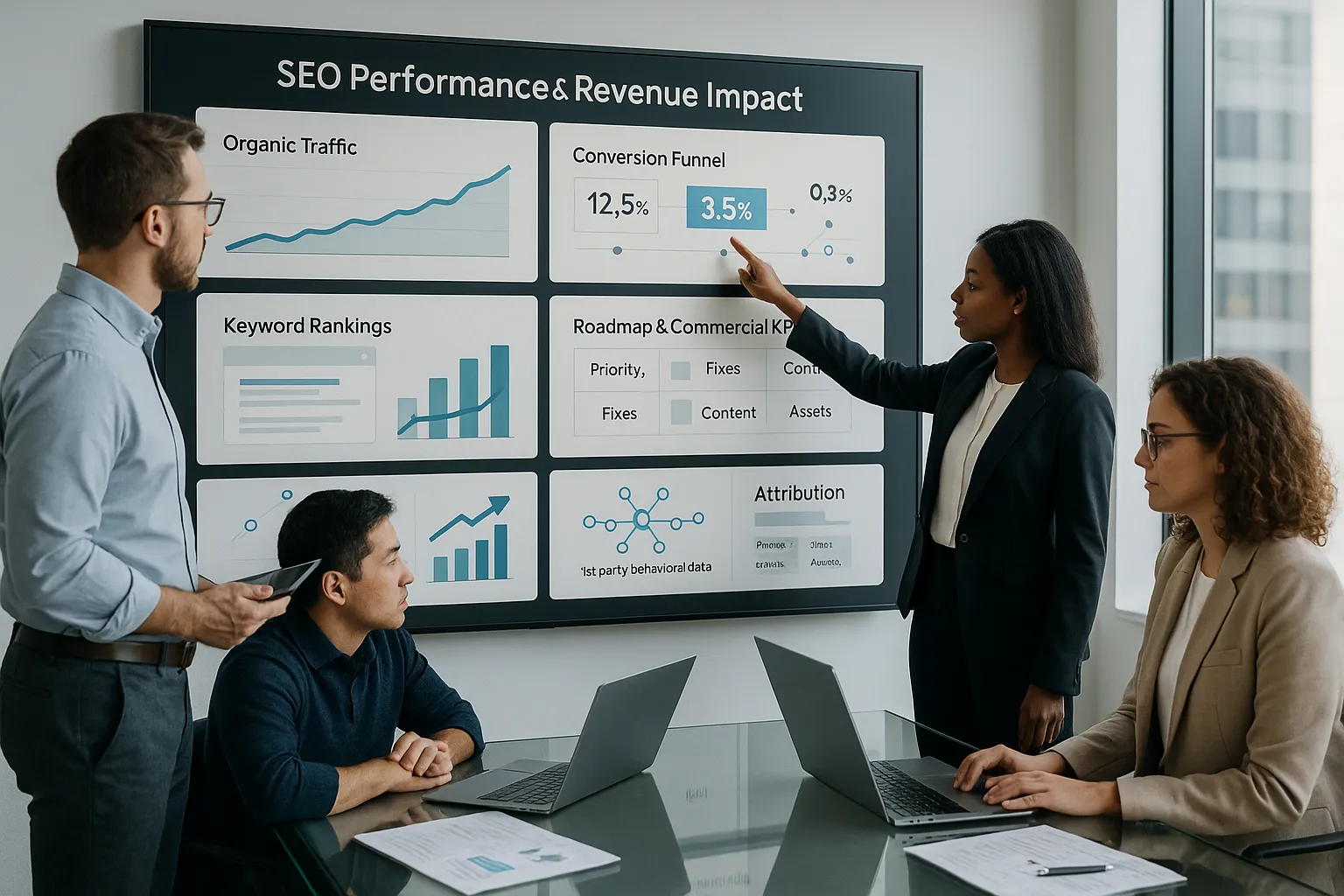
Search engine optimization (SEO) services are the strategic and technical activities that improve a website’s visibility in organic search, attract qualified visitors, and convert those visitors into customers. For companies spending $3,000 to $100,000+ per month on marketing, SEO Services are less about vanity ranking and more about reducing acquisition costs, increasing lifetime value, and improving channel diversification.
Why SEO drives revenue: organic search continues to deliver high‑intent traffic at scale. Unlike paid channels that stop delivering the moment you pause spend, well‑executed SEO compounds, content assets, technical fixes, and authority signals continue to earn clicks and conversions over months and years. For programmatic, data‑oriented marketers, SEO also creates durable first‑party behavioral data and conversion events you can feed into targeting and attribution systems.
What good SEO looks like for revenue growth: a prioritized roadmap tied to commercial KPIs: cross‑team execution (product, engineering, content, growth): and measurement that credits organic contributions to revenue via sensible attribution models. We treat SEO as a revenue engine, not a checkbox.
Core SEO Services You Should Expect

Companies with meaningful marketing budgets should expect a comprehensive stack of services that cover technical, on‑page, off‑page, and modern analytics/automation capabilities.
Technical SEO
Technical SEO is the foundation. It covers site architecture, crawlability, indexation, canonicalization, page speed, structured data, hreflang for international sites, and mobile friendliness. For revenue impact, we prioritize crawl budget issues that block commercial pages, fix redirect chains on high‑value URLs, and carry out server‑side or CDN optimizations to shave milliseconds off load time, because performance directly affects conversion.
On‑Page SEO And Content Strategy
On‑page SEO includes content development, keyword targeting, meta elements, internal linking, and UX signals. A revenue‑first content strategy maps intent to funnel stages: awareness blog posts, comparison content for mid‑funnel prospects, and product/transactional pages with clear CTAs. We combine content briefs driven by keyword opportunity and behavioral data with CRO tactics (A/B testing headlines, CTAs, and layout) so content doesn’t just attract traffic, it converts.
Off‑Page SEO And Link Acquisition
Authority still matters. Off‑page SEO is about building relevant, high‑quality links and brand mentions that improve domain and page authority for commercially valuable queries. For sophisticated budgets we deploy scalable outreach, digital PR, and partnerships, but with strict relevance filters and link velocity management to avoid risky patterns.
Local, E‑Commerce, And Platform‑Specific SEO
Different businesses require different SEO specializations. Local SEO prioritizes Google Business Profile, citations, and localized content. E‑commerce SEO focuses on faceted navigation, canonical issues, rich snippets for product data, and review schema. Platforms such as Shopify, Magento, or headless CMS each have platform‑specific constraints and opportunities that experienced agencies must navigate.
AI, Automation, And Analytics Integration
Modern SEO Services integrate AI for content ideation, automation for repetitive tasks (sitemaps, status tracking), and advanced analytics for attribution. We use machine learning to cluster keywords by intent, automate monitoring for regressions, and connect organic performance to CRM and revenue systems so SEO is part of the programmatic marketing stack.
A Practical SEO Engagement Process For Data‑Driven Companies

SEO engagements succeed when process and data align with business goals. Here’s a proven workflow we use for mid‑to‑enterprise clients.
Discovery And Comprehensive SEO Audit
We begin with a discovery phase: stakeholder interviews, analytics review, tech crawl, content inventory, backlink profile analysis, and competitive benchmarking. The audit generates prioritized issues by business impact, not just severity, so engineering and content teams can act on what moves revenue first.
Keyword Research, Audience Mapping, And Prioritization
Instead of raw lists, we produce clustered keyword sets mapped to audience segments and funnel stages. Prioritization combines search volume, ranking difficulty, conversion value, and strategic fit (e.g., product launches or seasonal campaigns).
Strategy Development And Roadmapping
The strategy ties recommendations to a 6–12 month roadmap, assigned owners, and success metrics. We define quick wins (technical fixes, urgent canonical issues), mid‑term bets (pillar content, site restructures), and long‑term investments (authority building, international expansion).
Execution: Content, Technical Fixes, And Outreach
Execution is cross‑functional. Our team coordinates with engineering to deploy technical patches, with product/content teams to deliver briefs and campaigns, and with outreach specialists for link acquisition. For clients with programmatic marketing operations, we integrate content outputs and behavioral signals into paid campaigns and personalization rules to maximize lifetime value.
Measurement, Reporting, And Continuous Optimization
Reporting focuses on the metrics that matter to stakeholders: organic revenue, assisted conversions, average order value, and ROI. We run regular experiments (content variants, schema changes, page speed optimizations), surface learnings, and iterate the roadmap based on results.
Pricing, Engagement Models, And Expected Timelines
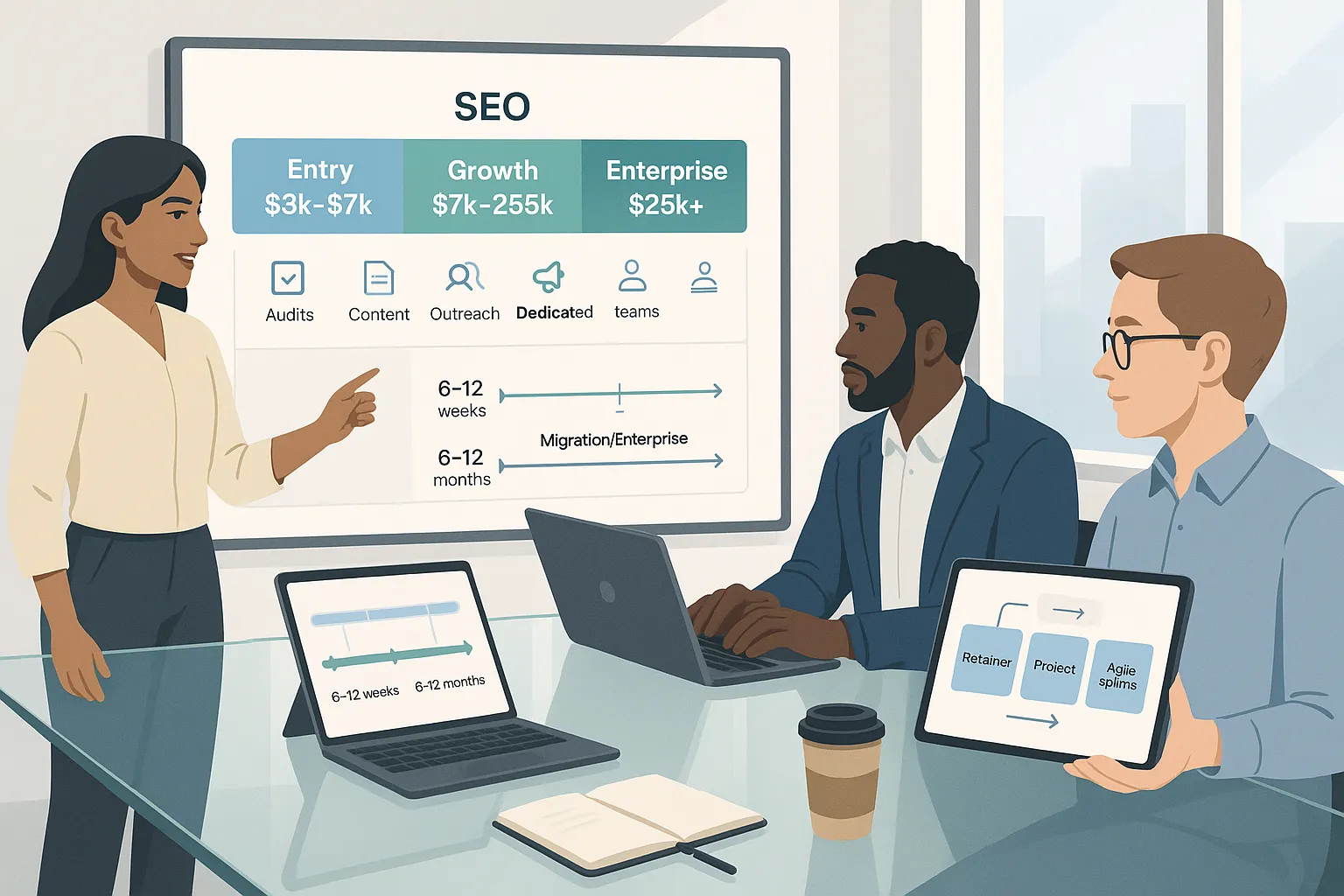
Budgeting and timeline expectations vary, but here are realistic bands and models for organizations in the $3k–$100k+ marketing range.
Typical Pricing Bands And What They Include
- Entry (monthly $3k–$7k): Technical audits, limited content support (1–2 pages/month), monitoring, and basic link outreach. Good for smaller product lines and local businesses.
- Growth (monthly $7k–$25k): Full technical remediation, three to six content assets/month, proactive outreach, analytics integrations, and CRO support.
- Enterprise (monthly $25k+): Dedicated cross‑functional team, large content programs, international SEO, complex e‑commerce optimizations, and direct integration into data warehouses and CRM systems.
Pricing should be viewed as investment tiers aligned to expected outcomes, not flat services. We often structure scopes to show which activities are expected to drive the greatest revenue lift for each band.
Contract Types: Retainer, Project, And Agile Sprints
Retainers are common for ongoing growth work: projects suit migrations or one‑time technical cleanups: agile sprints work well for rapid experiments. For enterprise clients we recommend a hybrid: an initial fixed project to address architectural issues followed by a retainer for continuous growth.
Realistic Timelines And When To Expect ROI
SEO is medium to long term: quick technical fixes and low‑competition content can show results in 6–12 weeks, but most meaningful revenue improvements appear in 6–12 months. Enterprise migrations or large restructures can take longer to stabilize, but when done right, they unlock scaled organic growth for years.
How To Choose The Right SEO Partner For Mid‑To‑Enterprise Budgets
Selecting a partner is as much about process and transparency as it is about expertise.
Key Questions To Ask Prospective Agencies
- Can you show documented revenue outcomes from past engagements?
- How do you prioritize SEO activities when engineering resources are limited?
- What tools and data integrations do you use (GA4, Search Console, data warehouse, CRO platforms)?
- How do you coordinate with paid media, product, and analytics teams?
Red Flags And Promises To Avoid
Avoid agencies that promise guaranteed rankings, rely solely on backlinks without relevance, or lack a clear measurement approach. Also be wary of opaque reporting and one‑size‑fits‑all content mills.
How To Evaluate Case Studies, Tools, And Reporting
Look for case studies that include baseline metrics, interventions, timelines, and business outcomes (revenue or conversions). Verify tool usage (proprietary platforms are fine if they integrate transparently) and demand sample dashboards to ensure the reporting aligns with your internal KPIs.
Measuring Success: KPIs And How SEO Drives Business Outcomes
Good measurement ties organic activity directly to business outcomes.
Traffic, Rankings, And Conversion Metrics That Matter
We track organic sessions, conversion rate, goal completions, revenue, and pages per session, but focus mostly on value metrics: organic revenue, lead quality, and assisted conversions. Rankings matter when they reflect visibility for priority commercial keywords, not every single long tail term.
Attributing SEO To Revenue: Models And Best Practices
Last‑click attribution undervalues SEO. We recommend multi‑touch models and use assisted conversion analysis to surface SEO’s role across the funnel. Where possible, connect organic touchpoints to LTV and cohort analysis in your CRM or data warehouse to quantify lifetime impact.
Continuous Improvement: A/B Testing, Experimentation, And Data Usage
SEO should be experimental: test title tags, schema snippets, content formats, and internal linking structures with iteration based on observed revenue impact. Feed learnings into your programmatic stack so organic signals inform paid targeting and personalization.
Conclusion
SEO Services are a strategic investment for companies that want sustainable organic revenue growth. For data‑driven brands, the most effective SEO programs combine technical rigor, content designed to convert, disciplined link building, and tight integration with analytics and programmatic systems. If your goal is measurable revenue impact rather than rankings for their own sake, pick a partner that ties every recommended activity to business outcomes, prioritizes based on impact, and integrates SEO into your broader marketing and data infrastructure. At Guac Digital we design SEO programs to feed the growth loop: organic performance fuels targeting, personalization, and eventually higher lifetime value, that’s how SEO becomes more than traffic: it becomes a predictable revenue channel.
Frequently Asked Questions about SEO Services
What are SEO Services and how do they drive revenue?
SEO Services are strategic and technical activities—technical SEO, on‑page content, link building, and analytics—that increase organic visibility and attract high‑intent traffic. For mid‑to‑enterprise companies, well‑executed SEO reduces acquisition costs, compounds over time, and feeds first‑party conversion data into revenue and attribution systems.
What core components should I expect from professional SEO Services?
Expect a comprehensive stack: technical SEO (crawlability, speed, indexation), on‑page content strategy and CRO, off‑page link acquisition, platform‑specific optimizations (e‑commerce, local), and AI/analytics integrations to connect organic performance to CRM and revenue systems.
How long until SEO Services deliver measurable ROI for enterprise budgets?
Quick technical fixes and low‑competition content can show improvements in 6–12 weeks, but most significant revenue gains appear in 6–12 months. Large migrations or restructures may take longer to stabilize; continuous optimization yields sustained growth over years.
How should I evaluate and measure SEO Services to ensure they impact business outcomes?
Measure value metrics: organic revenue, conversion rate, assisted conversions, and LTV. Use multi‑touch attribution, cohort analysis in your CRM or data warehouse, and experiment (A/B tests) to link SEO activities to revenue rather than relying solely on rankings or sessions.
Can SEO Services integrate with paid media and programmatic systems?
Yes. Modern SEO Services integrate content signals, behavioral data, and conversion events into paid campaigns and personalization rules. This programmatic integration helps optimize targeting, reduce CAC, and increase lifetime value by feeding organic learnings into broader marketing stacks.