
SEO AI Tool: Unleash Power in 2025
Why AI SEO Tools Are Changing Digital Marketing in 2025
SEO AI tool platforms are revolutionizing how businesses approach search engine optimization. By offering automated solutions, they dramatically reduce the time and complexity of traditional SEO workflows.
Top AI SEO Tools Benefits:
- Automated keyword research and content optimization
- Real-time SEO scoring and recommendations
- Content generation at scale with brand voice consistency
- Competitor analysis and gap identification
- AI search engine tracking (ChatGPT, Perplexity, Google AI Overviews)
- Technical SEO audits with actionable insights
SEO isn’t dead in 2025, but it’s definitely different. As one industry expert noted, \”It’s not just about ranking on Google anymore, but also about showing up on AI search engines and LLMs like ChatGPT and Perplexity.\”
Traditional SEO involves countless hours of manual keyword research, content optimization, and competitor analysis. Modern AI SEO platforms can automate everything from keyword clustering to content creation, freeing up your team to focus on strategy.
Why This Matters for Your Business
AI SEO tools level the playing field, allowing mid-sized businesses to compete with larger companies without needing massive budgets. The key is working smarter, not harder.
I’m Guy Leon, founder and CEO of Guac Digital, where we’ve helped clients achieve a 350% boost in engagement through strategic digital marketing campaigns that leverage SEO AI tool platforms. With over a decade of experience in digital marketing, I’ve seen how AI transforms SEO from a time-consuming challenge into a competitive advantage.

Simple guide to seo ai tool:
What Are AI SEO Tools and How Do They Differ from Traditional Tools?
The difference between traditional and AI-powered SEO is like navigating a city with a paper map versus a GPS with real-time traffic updates. Traditional tools have long been the backbone of digital marketing, but they are primarily data collectors. They show you keyword volumes and backlink counts but leave the complex interpretation to you.
An SEO AI tool changes the game. These platforms use artificial intelligence and machine learning to not just collect data, but to interpret it and serve up actionable insights. For example, while a traditional tool provides a keyword’s search volume, an AI tool can suggest a full content strategy around it, identify related topics, and even generate optimized content.
The intelligence lies in automation and prioritization. An AI tool doesn’t just flag a broken link; it prioritizes the fix based on its actual impact on rankings and user experience. This shift means less time wrestling with data and more time creating brilliant campaigns that move the needle.

Key Features to Look for in an AI SEO Tool
When evaluating an SEO AI tool for our clients at Guac Digital, we look for features that truly transform how SEO gets done. Here’s what separates the game-changers:
- Content Generation & Optimization: Modern platforms can create drafts, outlines, or full articles optimized for search intent. The best tools analyze your content against top-ranking pages in real-time, providing instant SEO scores and suggestions.
- AI Keyword Research: These tools identify keyword gaps, analyze search intent, and cluster keywords to help build topical authority, often using massive databases for insights that would take a human team months to compile.
- Technical SEO Audits: AI tools crawl your site, spot technical issues like broken links or slow pages, and provide prioritized, actionable recommendations.
- Automated Rank Tracking: Keep tabs on your keyword performance across different search engines and locations without lifting a finger, with insights delivered automatically.
- Competitor Analysis: AI can dissect competitors’ strategies, identify their winning keywords, analyze their backlink profiles, and spot content gaps where you can pull ahead.
- Generative Engine Optimization (GEO) Tracking: This new frontier monitors your brand’s visibility in AI-generated answers from platforms like ChatGPT, Perplexity, and Google’s AI Overviews.
- Brand Voice Training: Ensures consistency by training the AI on your specific brand voice and tone, so the content sounds authentically \”you.\”
- Platform Integrations: The most valuable tools connect seamlessly with Google Search Console, Google Analytics, and your CRM, creating a holistic view of your performance and automating workflows.
Best AI Tools for Content Creation and Optimization
Modern content creation AI tools act like a tireless writing partner who has analyzed every top-ranking article in your niche. They perform deep SERP analysis and semantic analysis to understand the concepts search engines expect to see, helping you build topical authority and show Google you’re a legitimate expert.
What’s most exciting is how today’s SEO AI tool platforms blend creativity with data-driven insights. As one leading platform puts it: \”AI that writes like you, but has the insights of an SEO expert.\”
All-in-one content platforms can research, write, and optimize from a single dashboard, providing actionable recommendations that save hours of manual work. Content optimization editors are also game-changers, analyzing top pages to provide real-time SEO scoring and keyword suggestions as you write.
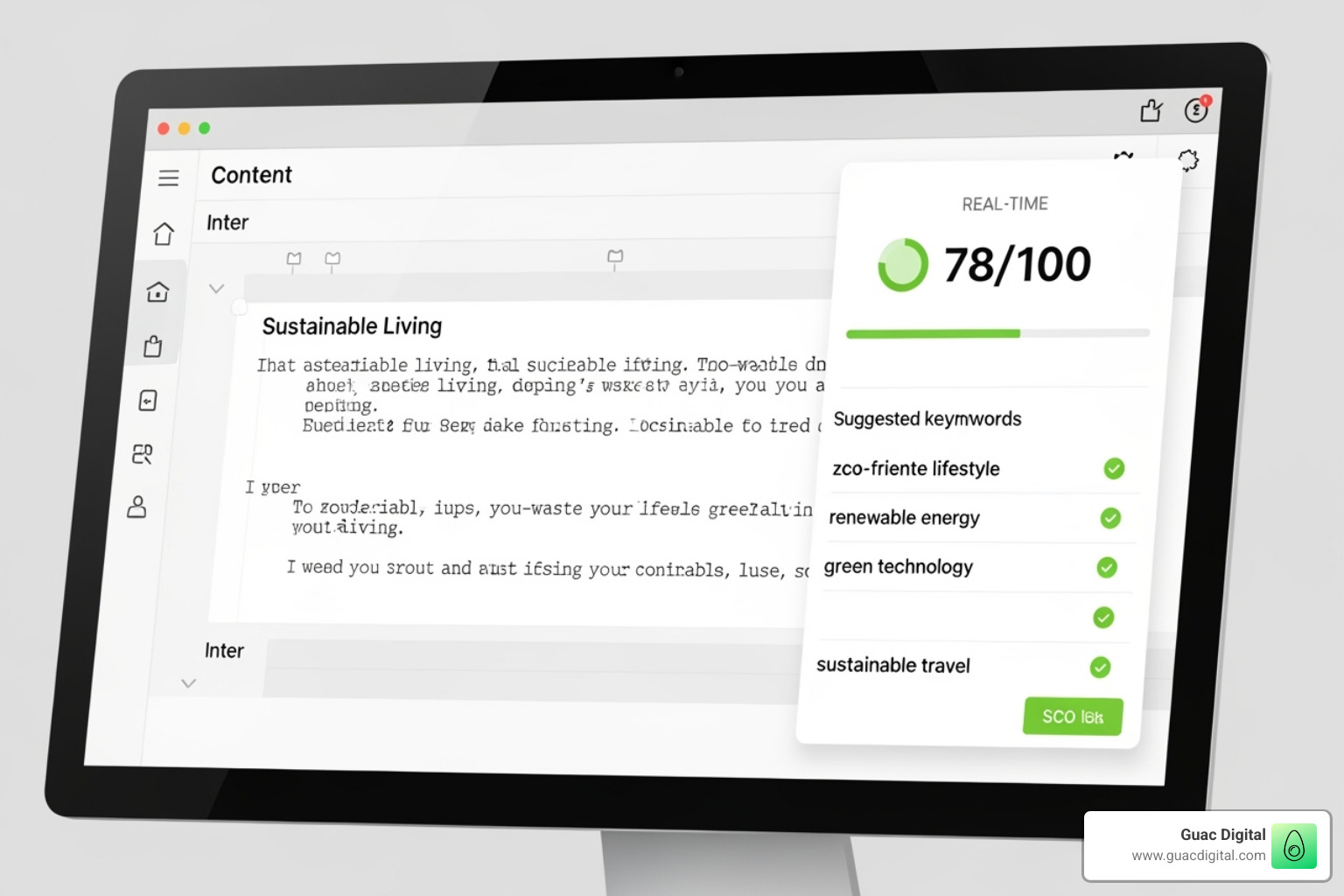
Many AI writing assistants are now embedded within larger SEO suites, creating a smooth workflow from research to optimization, often including automated rank tracking and competitor analysis. Newer specialized tools are particularly impressive for content scalability, creating quality outlines or clustering content to build comprehensive topic coverage that search engines love.
These tools are also adapting to the new search landscape, helping you optimize for both traditional Google results and AI search engines for maximum visibility across all platforms.
How AI Ensures Content Quality and Brand Voice
Will AI-generated content sound robotic? Only if you let it. The best SEO AI tool platforms include sophisticated brand voice training. You can feed them your existing content and style guides, and they’ll learn to write in your unique voice. Custom templates further guide the AI to produce specific content types while maintaining brand standards.
However, the human-in-the-loop review process is crucial. AI should improve human creativity, not replace it. Fact-checking is equally important, as AI can \”hallucinate\” or miss nuances. We always recommend having subject matter experts review AI-generated content before publishing.
Success lies in aligning with E-E-A-T (Experience, Expertise, Authoritativeness, and Trustworthiness). AI can help structure content, but real expertise must come from humans. Google’s own guidance on AI-generated content confirms their focus is on content quality, not how it’s produced. The takeaway is to use AI to create genuinely helpful content for your audience, focusing on value above all else.
Top AI-Powered Tools for Research, Analysis, and Tracking
Beyond content creation, AI revolutionizes how we conduct research, analyze data, and track performance, enabling faster, more accurate data-driven decisions.
For keyword research and analysis, AI tools perform sophisticated tasks like keyword clustering and search intent analysis. Some tools even let you research keywords on platforms beyond Google, such as Reddit, Amazon, and YouTube, to uncover unique insights.
When it comes to technical SEO and website audits, AI tools run automated site crawls to identify issues like broken links or slow page speeds. Some specialized tools focus on indexing automation, ensuring your new pages get found by search engines quickly—a game-changer for new sites.
Competitor analysis is another area where AI shines. These tools perform competitor content gap analysis and in-depth backlink analysis. Some services provide raw, real-time SEO data via API, allowing agencies like ours in Tampa, Florida, to build custom tools for advanced analysis. For link building, other platforms automate outreach or offer community-based approaches for backlink exchanges.
Finally, rank tracking has evolved. A new breed of SEO AI tool now focuses on AI Overviews tracking, monitoring your visibility in AI-generated answers.
Here’s a comparison of how different types of AI SEO tools typically focus their efforts:
| Feature/Category | Content-Focused AI Tools | Analytics-Focused AI Tools |
|---|---|---|
| Primary Goal | Generate, optimize, and improve the quality of written content | Research, analyze data, track performance, and identify technical/strategic opportunities |
| Key Output | Articles, blog posts, outlines, meta descriptions, content briefs, optimized text | Keyword lists, competitor insights, site audit reports, ranking data, backlink profiles |
| Core AI Application | Natural Language Generation (NLG), Natural Language Understanding (NLU), content scoring | Data mining, pattern recognition, predictive analytics, automated crawling, sentiment analysis |
| Main Benefit | Speed up content creation, improve content quality, ensure brand voice, optimize for search intent | Find hidden opportunities, monitor performance, identify technical issues, gain competitive advantage |
| Typical User | Content marketers, writers, small business owners, SEOs focused on content | SEO specialists, agencies, data analysts, technical SEOs, strategists |
| Example Features | AI writer, content editor, outline builder, plagiarism checker, tone adjustment, brand voice training | Keyword research, site audit, rank tracking, backlink analysis, competitor analysis, SERP features tracking |
The Rise of GEO: Tracking Visibility in AI Search Engines
The SEO landscape is shifting toward Generative Engine Optimization (GEO). As we mentioned, \”It’s not just about ranking on Google anymore, but also about showing up on AI search engines and LLMs.\”
GEO is the practice of optimizing your brand’s presence in the AI-generated answers from platforms like ChatGPT, Perplexity, and Google’s AI Overviews. While traditional rankings are less relevant in hyper-personalized AI search, new tools are emerging to address this. Dedicated GEO tools allow you to track brand appearances for specific search terms on these new AI engines. Similarly, some SEO suites include trackers to help you monitor precisely where and how you’re showing up in Google’s AI-generated answers.
Tracking brand mentions in AI answers and understanding your ChatGPT visibility or Perplexity tracking is crucial. With AI Overviews rolling out globally, a significant portion of searchers may get answers without clicking on organic listings. This makes ensuring your content is cited by AI search engines essential for maintaining online presence.

Choosing the Right SEO AI Tool for Your Business
Choosing the right SEO AI tool doesn’t have to be overwhelming. The secret is to start with your needs, not the shiny features. What are your biggest challenges? Content creation, competitor tracking, or technical SEO?
At Guac Digital, we know the right tool depends on the user. The platform that works for a solo blogger in Seattle will be completely different from what a growing e-commerce business in Miami needs.
- Solopreneurs often thrive with content-focused platforms that help them generate blog posts, optimize meta descriptions, and handle keyword research without breaking the bank.
- Agencies and larger businesses need heavy-duty solutions for managing multiple clients, white-label reporting, extensive competitor analysis, and API access for custom builds.
Think ahead about scalability. The best SEO AI tool grows with you. Also, consider integrations; top platforms connect seamlessly with Google Search Console, Google Analytics, and your CMS, saving you from juggling multiple dashboards.
 - seo ai tool")
Evaluating Pricing Models and Value of a Top SEO AI Tool
The pricing landscape for AI SEO tools is varied. Subscription tiers are most common, with basic plans often starting under $150 per month and enterprise features climbing to several hundred dollars. Credit-based pricing is another model, where you pay for specific actions, which can be cost-effective for sporadic use.
Many platforms offer free trials and freemium models. We always recommend taking advantage of these to test a tool before committing. When calculating ROI, consider the time savings. If an SEO AI tool helps you create content twice as fast or identifies opportunities you would have missed, that efficiency translates directly to your bottom line.
Augmentation vs. Replacement: The Role of the Human SEO Expert
Will AI replace SEO experts? Not anytime soon. But it will change how we work. Think of AI as a tireless research assistant that excels at the grunt work: data analysis, initial content drafts, and technical audits. This frees up human experts for the work that truly moves the needle.
Human expertise shines in areas requiring intuition, creativity, and strategic thinking. We understand context, adapt to market shifts, and create content that connects with people on an emotional level. The future belongs to SEO professionals who use AI as a powerful ally, shifting their focus from data processing to strategic direction.
For professionals, upskilling is essential. Learning to prompt AI tools effectively and interpret their outputs critically will become core competencies. However, the fundamentals of good SEO—understanding user intent, creating valuable content, and building authority—remain as important as ever.
The Future of AI in SEO and Ethical Considerations
The future of AI in SEO is about how deeply it will transform our work. We’re witnessing changes that make the shift from desktop to mobile look gradual.
Predictive SEO is emerging, with AI ready to forecast search trends and content opportunities months in advance. We’re also moving toward hyper-personalization, where search results will be customized to individual users, requiring more nuanced SEO strategies. The trend toward fully automated workflows is also accelerating, with AI agents capable of implementing optimizations directly on websites with user approval.
With great power comes great responsibility. The ethical landscape is complex:
- Content Quality and Misinformation: As AI content generation improves, so does the risk of low-quality or fabricated information. AI can misinterpret data or create “hallucinations,” posing serious misinformation risks, especially when users rely on AI for important decisions.
- Data Privacy: Sophisticated AI tools require more user data, making compliance with regulations like GDPR and CCPA essential for maintaining user trust.
- Impact on Organic Traffic: With AI Overviews providing direct answers, users may not click through to websites as often, potentially impacting businesses that rely on organic traffic.
For YMYL topics (Your Money or Your Life), the stakes are even higher. Google’s E-E-A-T guidelines demand human expertise for healthcare, finance, and legal content. An SEO AI tool can assist, but human experts must validate all content in these sensitive areas.
Despite these challenges, the outlook is optimistic. The key is to accept AI’s capabilities while maintaining vigilant human oversight. At Guac Digital, we see this as an opportunity to work smarter, using these powerful tools to create a more helpful and trustworthy web for everyone.
Frequently Asked Questions about AI SEO Tools
We get these questions all the time from clients at our Tampa office and from businesses around the world. Here are some clear answers to common concerns.
Is AI-generated content bad for SEO?
No, AI-generated content isn’t automatically bad for SEO. Google’s focus is on content quality, not its creation method. Content created solely to manipulate rankings is spam, but using an SEO AI tool to produce genuinely helpful, high-quality content is perfectly fine.
The key is adhering to Google’s Helpful Content and E-E-A-T guidelines. As studies have shown, high-quality AI content that meets these standards does not hurt rankings. However, human oversight is crucial for fact-checking, adding unique insights, and ensuring the content is truly valuable to your audience.
How do you choose the right AI tool for SEO?
Choosing the right SEO AI tool depends on your specific needs. Follow these steps:
- Assess Your Goals: Identify your primary need. Is it content creation, technical audits, or competitor research?
- Consider Your Budget: Be realistic about what you can afford. Tools range from free to expensive enterprise solutions.
- Evaluate Your Team: Solopreneurs need simplicity, while agencies require features for managing multiple clients.
- Check for Integrations: Ensure the tool connects with essential platforms like Google Search Console and Google Analytics.
- Use Free Trials: Always test-drive a few options before committing to a subscription.
Can an AI tool guarantee #1 rankings?
No. No tool, service, or expert can guarantee #1 rankings. Anyone who makes this promise either misunderstands or is misrepresenting how SEO works.
SEO is a complex process with hundreds of ranking factors, including content quality, technical health, backlinks, and intense competition. An SEO AI tool provides a significant competitive advantage by offering superior data and automating time-consuming tasks, allowing you to work more efficiently.
It helps you find the best path and execute your strategy more effectively, but success still depends on smart planning, consistent effort, and human expertise.
Conclusion: Work Smarter, Not Harder with AI
The SEO landscape has transformed, and AI is a powerful ally, not a replacement. Think of it as a brilliant assistant that handles data analysis and repetitive tasks, freeing you to focus on the high-impact strategy that truly moves the needle.
The best SEO AI tool platforms amplify human expertise. AI can’t replicate your creative spark, strategic intuition, or deep understanding of your audience. It is not a replacement for strategy; it’s a tool to execute it more effectively. Successful businesses use AI for the heavy lifting—research, drafts, audits—while humans provide the crucial strategic and creative oversight.
The right tool depends on your needs, whether you’re a solo blogger or a large agency. The current market offers a solution for every stage of growth.
Above all, focus on creating value for users. Whether using AI for content or tracking, ensure your output is genuinely helpful. This aligns with Google’s core mission and is the foundation of sustainable SEO.
To leverage big data and AI for a custom marketing strategy that delivers results, the experts at Guac Digital can help. We’ve spent over a decade perfecting the balance between cutting-edge technology and human insight, helping clients achieve remarkable growth through personalized strategies that actually work.