
ChatGPT Ranking: The #1 Winner Revealed 2025
Why AI Model Rankings Matter for Your Business
ChatGPT Ranking has become a critical factor for businesses looking to maximize their digital visibility. With more than 300 million people using ChatGPT weekly, understanding how AI models are ranked can make or break your online presence.
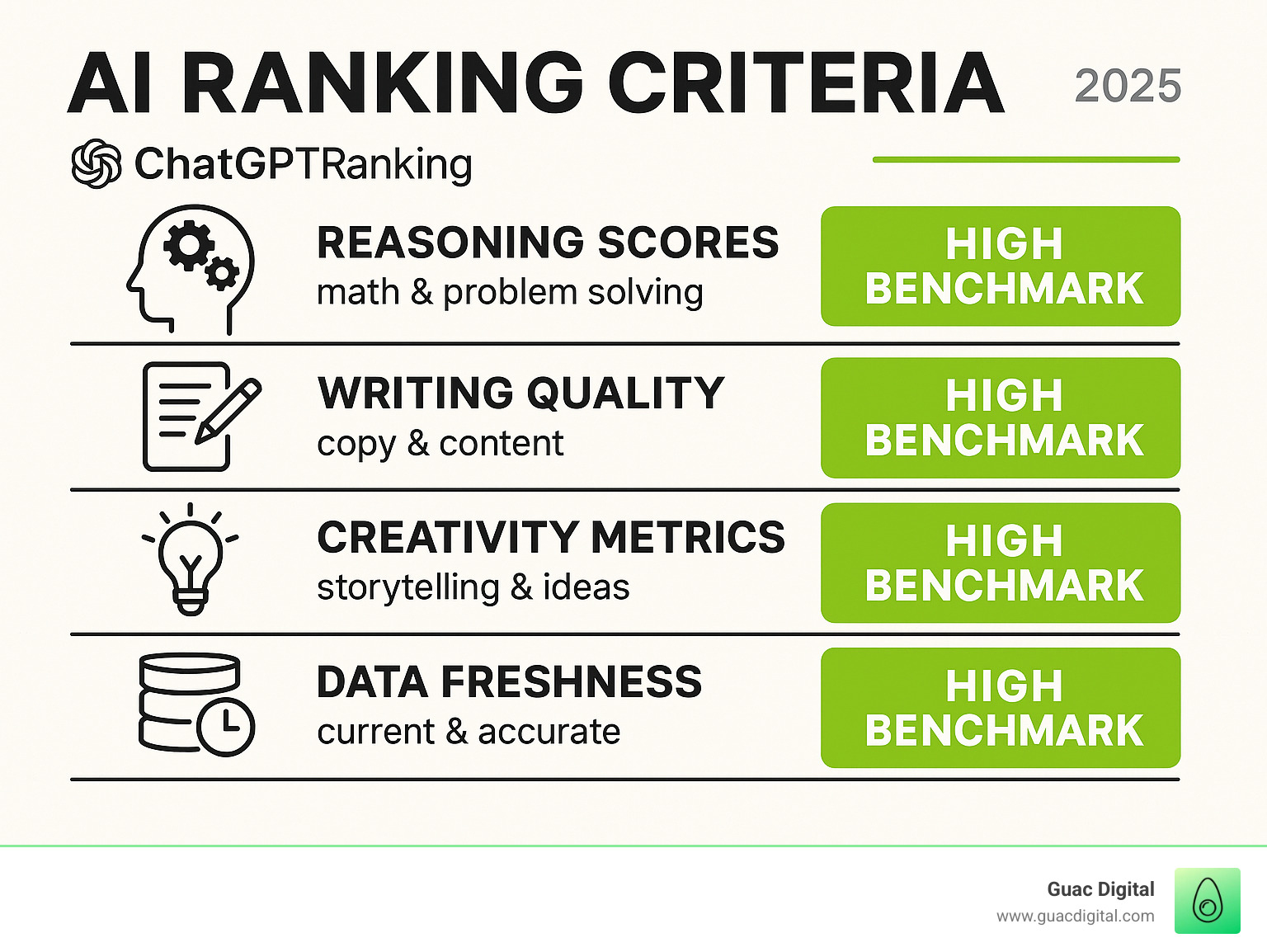
Here’s what determines AI model rankings:
- Reasoning ability – Math, programming, and complex problem-solving
- Writing quality – Copy editing, summarization, and content creation
- Creativity scores – Story writing, role-play, and innovative thinking
- Data freshness – Real-time information and source verification
- User experience – Interface design and conversational flow
The AI landscape is changing fast. ChatGPT’s search results show 73% similarity to Bing’s results, while Google maintains 78% of the search market compared to Bing’s 12%. This shift means businesses need to rethink their digital strategies.
Different AI models excel in different areas. Some prioritize factual accuracy, others focus on creative tasks, and many are built for specialized industries. The “best” AI depends entirely on your specific needs and use case.
I’m Guy Leon, founder and CEO of Guac Digital, where I’ve helped clients achieve a 350% boost in engagement through strategic digital marketing campaigns that leverage emerging technologies like ChatGPT Ranking optimization. My experience with AI-driven marketing solutions has shown me how understanding these rankings can transform a business’s online performance.
Understanding the AI Leaderboard: How Are Models Ranked?
Ever wondered how we decide which AI is actually the “smartest”? It’s not like we can give them all a standardized test and call it a day. The world of ChatGPT Ranking and AI model evaluation is fascinating – and way more complex than you might think.
Think of it like judging the Olympics, but instead of gymnastics and swimming, we’re measuring how well an AI can write poetry, solve calculus problems, or help you debug code. The evaluation process combines rigorous industry benchmarks with something surprisingly human: real people actually using these AI models and rating their performance.
ELO scores play a huge role here – the same rating system that ranks chess players. When an AI model consistently outperforms others in head-to-head comparisons, its ELO rating climbs. Many AI leaderboards use this approach to create fair, comparable rankings across different models.
But here’s where it gets really interesting. The process involves expert human evaluation on a wide range of creative tasks, and the resulting rankings are converted to Elo ratings for comparability. Real humans are sitting down with these AI models, asking them questions, giving them tasks, and scoring their responses. It’s this blend of cold, hard data and warm, human judgment that creates the most reliable rankings.
The Core Attributes of a Top-Tier AI
So what separates the AI superstars from the also-rans? It all comes down to a handful of core abilities that matter in the real world.
Reasoning is the big one – can the AI actually think through problems logically? This means excelling at math (solving complex equations), programming (writing clean, functional code), and tackling complex topics with nuance and accuracy. An AI that can help a student understand calculus and then switch gears to help a developer debug their Python script? That’s gold.
Writing quality goes way beyond just stringing words together. Top-tier AI models shine at copy editing (catching those sneaky grammar mistakes), summarization (turning a 50-page report into key insights), and general content creation that actually sounds human.
Then there’s creativity – arguably the most exciting frontier. Can the AI craft compelling story writing that keeps you turning pages? How about role-play scenarios that feel authentic and engaging? These creative tasks often separate the truly impressive AI models from the merely functional ones.
Don’t overlook non-English fluency either. In our globally connected world, an AI that can seamlessly switch between languages while maintaining quality and cultural understanding is incredibly valuable. At Guac Digital, we work with clients worldwide, so this multilingual capability often makes or breaks a project’s success.
Why Data Freshness and Source Verification Matter
Here’s something that keeps me up at night as a digital marketer: information moves at light speed these days. What was true this morning might be outdated by lunch. That’s why real-time data access is absolutely critical for any AI model that wants to stay relevant.
But fresh data is only half the battle. Source verification is where things get really important. Unlike Google, which shows you a list of websites to check yourself, AI models often give you direct answers. This puts enormous pressure on them to get things right the first time.
The best AI models tackle this by providing clear citations and linking back to authoritative sources. This builds user trust – users can verify the information themselves and dig deeper if they want. It also shows respect for intellectual property, which is becoming increasingly important as AI-generated content floods the internet.
What really sets premium AI experiences apart is the ad-free experience combined with natural conversational interaction. Instead of wading through sponsored results and pop-ups, you get straight answers in a back-and-forth dialogue that feels genuinely helpful. This conversational approach transforms AI from just another search tool into something that feels more like consulting with a knowledgeable colleague.
The Great AI Showdown: ChatGPT vs. The Competition
Think of the AI world as a busy digital colosseum where different models battle it out for supremacy. While ChatGPT might be the gladiator everyone’s talking about, it’s certainly not fighting alone in this arena.

The market landscape is surprisingly diverse, with each AI model bringing its own personality to the table. Some excel at creative writing, others are math wizards, and a few specialize in incredibly specific industries. It’s like having a toolbox where each tool has its perfect job.
What really sets these models apart isn’t just their raw intelligence, but how they handle data sources, user experience, and their approach to solving problems. While general-purpose models try to be good at everything, specialized alternatives often dive deep into specific domains, offering expertise that broader models simply can’t match.
| Attribute | ChatGPT (and similar models) | Other Leading AI Models (General) | Specialized AI Models |
|---|---|---|---|
| Reasoning | Very Strong | Strong | Varies by Specialization |
| Writing Quality | Excellent | Very Good | Good (often technical) |
| User Experience | Highly Intuitive | Good | Functional |
| Data Privacy | Standard protections | Varies widely | Often improved |
How ChatGPT’s Engine Works
Here’s where things get really interesting. ChatGPT’s secret sauce isn’t just its impressive language skills – it’s the powerhouse partnership with Microsoft that makes it tick. Through Bing search integration, ChatGPT can pull in fresh, real-time information that keeps its responses current and relevant.
The numbers tell a fascinating story: ChatGPT’s search results show a 73% similarity to Bing results. This isn’t coincidence – it’s by design. Microsoft’s massive $14 billion investment in OpenAI has created a symbiotic relationship where Bing’s search capabilities fuel ChatGPT’s knowledge engine.
This connection changes everything for businesses. When we optimize content for Bing at Guac Digital, we’re not just targeting Bing users – we’re positioning our clients to appear in ChatGPT Ranking results too. It’s like getting two search engines for the price of one optimization strategy.
The sophisticated data algorithms behind this integration process millions of web pages, news articles, and real-time information. This is where understanding what is programmatic advertising becomes crucial – the automated, data-driven approach mirrors how AI models process and prioritize information.
Evaluating Other Leading AI Models
The AI landscape extends far beyond any single model, and that’s actually great news for users. Different conversational AI systems bring unique strengths that can complement or even surpass mainstream options in specific areas.
Many alternative models shine in factual accuracy, drawing from carefully curated datasets or specialized information feeds. Some prioritize transparency, showing exactly where their information comes from. Others focus on privacy, keeping your conversations completely confidential.
Specialized models are where things get really exciting. Imagine an AI trained exclusively on medical literature, legal documents, or financial data. These focused systems often outperform general models in their specific domains, though they might struggle with casual conversation or creative tasks.
The rise of open-source alternatives has democratized AI access, allowing developers to customize and fine-tune models for specific needs. While these require more technical know-how, they offer unprecedented flexibility and control.
User interface differences can make or break the experience too. Some models excel at long-form conversations, while others are designed for quick, direct answers. The best choice often depends on whether you need a chatty assistant or a focused research tool.
At Guac Digital, we’ve seen how different AI models can serve different business goals. The key is matching the right AI capabilities with your specific needs – whether that’s creative content generation, data analysis, or customer service automation.
Mastering Your ChatGPT Ranking: How to Get Your Website Featured
Getting your website featured in ChatGPT Ranking results isn’t about playing a different game entirely – it’s about playing the existing game much smarter. Think of it as teaching your website to speak AI fluently while maintaining all the qualities that make it valuable to human visitors.

At Guac Digital, we’ve finded that mastering your ChatGPT Ranking requires a three-pronged approach: creating content that AI models love to reference, optimizing for the search engines that feed these AI systems, and building the kind of brand authority that makes AI models trust your expertise. It’s not just about keywords anymore – it’s about becoming the go-to source that AI confidently recommends to users.
The beauty of this approach is that it builds naturally on strong SEO fundamentals. When you focus on content optimization that serves both humans and AI, improve user engagement through genuine value, and strengthen your brand reputation through authentic authority-building, you create a digital presence that naturally rises to the top. For businesses serious about increasing their online presence, this integrated strategy is essential.
Key Content Factors for a High ChatGPT Ranking
Creating content that ranks well with AI models is like having a conversation with the smartest person in the room – you need to be clear, credible, and genuinely helpful. The old tricks of keyword stuffing and thin content won’t work here because AI models are trained to recognize and prioritize quality.
E-E-A-T (Experience, Expertise, Authoritativeness, Trustworthiness) forms the foundation of AI-friendly content. When ChatGPT decides whether to reference your content, it’s essentially asking: “Does this source know what they’re talking about?” This means showcasing real experience through case studies and examples, demonstrating expertise through detailed insights, building authoritativeness through credentials and citations, and establishing trustworthiness through transparency and accuracy.
Content quality and depth matter more than ever because AI models are designed to provide comprehensive answers. Surface-level articles that barely scratch the topic won’t make the cut. Your content needs to thoroughly address the user’s question while maintaining high relevance throughout. AI models can detect when content wanders off-topic or provides incomplete information.
Writing in a natural, conversational tone is crucial because AI models are trained on human conversations. When you write like you’re explaining something to a friend – clear, engaging, and jargon-free – you’re speaking the AI’s native language. This doesn’t mean being casual about accuracy; it means being accessible about expertise.
Fresh, up-to-date content signals to AI models that your site is a current, reliable source. Regular updates with new statistics, recent examples, and evolving insights tell AI that your page deserves to be cited over older, stale content.
Certain content formats consistently perform well with AI models. How-to guides provide the step-by-step clarity that AI loves to synthesize. Well-structured listicles offer digestible information that’s easy for AI to parse and reference. FAQ sections directly answer the questions users are asking, making them perfect for AI responses. Tables and organized data presentations help AI quickly understand and extract key information.
Why Your Bing SEO Directly Impacts Your ChatGPT Ranking
73% similarity between ChatGPT search results and Bing? That’s not a coincidence – it’s your roadmap. Optimizing for Bing has become a direct pathway to improving your ChatGPT Ranking, making Bing SEO one of the most underused strategies in digital marketing today.
Bing Webmaster Tools should be part of your essential toolkit, just like Google Search Console. It’s where you submit your site, monitor performance, and ensure Bing’s crawlers can properly access your content. Since ChatGPT draws heavily from Bing’s index, being invisible to Bing means being invisible to ChatGPT.
Page speed and mobile experience are non-negotiable factors. Both Bing and AI models prioritize fast-loading, mobile-friendly sites. A slow website or poor mobile experience will hurt your rankings across the board. Tools like Google PageSpeed Insights can help you identify and fix performance issues that might be holding you back.
Structured data and clean HTML act like subtitles for AI models, helping them understand exactly what your content is about. When you implement proper Schema markup and maintain well-organized code, you’re making it easier for AI crawlers to parse and understand your pages. This technical foundation might not be glamorous, but it’s essential for AI visibility.
For businesses with physical locations, local SEO optimization becomes even more critical in the AI era. When someone asks ChatGPT for local recommendations, the AI draws from local search data. This makes local SEO for small businesses not just a nice-to-have, but a necessity for local visibility in AI responses.
Leveraging Brand Signals and Off-Page Authority
AI models don’t just look at your content in isolation – they consider your overall reputation and authority in your field. Think of it as AI models asking not just “Is this information accurate?” but also “Is this source trustworthy and well-regarded?”
Digital PR and media mentions carry significant weight in the AI world. When reputable publications, industry blogs, or news sites mention your brand or expertise, it signals to AI models that you’re a recognized authority. These mentions don’t always need to include links – even unlinked brand mentions on high-authority sites contribute to your overall digital reputation.
Quality backlinks remain important, though their role is evolving. High-quality, relevant backlinks from authoritative sites still serve as powerful credibility signals. They tell AI models that other trusted sources vouch for your content and expertise.
User reviews and social proof provide authentic validation of your services. Positive reviews on platforms like G2, industry-specific review sites, or even Google My Business create a pattern of trust that AI models can recognize and factor into their recommendations.
Being featured on affiliate sites, news platforms, and industry directories expands your digital footprint in ways that AI models notice. These established platforms often serve as sources for AI responses, so having a presence there increases the likelihood that your brand will be mentioned or recommended in AI-generated content.
The key is building genuine authority rather than trying to game the system. AI models are sophisticated enough to recognize authentic expertise and trustworthiness, making sustainable, ethical authority-building the only long-term strategy that works.
The Future of Search: Will AI Rankings Replace Traditional SEO?
The million-dollar question that keeps marketers up at night: will AI search completely wipe out everything we know about traditional SEO? Here’s the thing – it’s not quite that dramatic.

At Guac Digital, we’ve watched this evolution unfold with fascination rather than fear. The reality is that “the future is seen as a blend of traditional Google Search powered by AI.” This isn’t about replacement – it’s about evolution. Think of it like upgrading from a flip phone to a smartphone. The core purpose remains the same, but the capabilities expand dramatically.
The shift toward conversational commands is already changing how people search. Instead of typing “best pizza Tampa,” users are asking “Where can I find the best pepperoni pizza near me tonight?” This makes natural language optimization more crucial than ever. Your content needs to sound like how real people actually talk and ask questions.
Voice search is another game-changer that’s reshaping the landscape. When someone asks their smart speaker a question, they expect a direct, conversational answer – not a list of ten blue links. This means your content needs to anticipate these spoken queries and provide clear, concise responses that AI models can easily extract and share.
The rise of AI also brings ethical AI practices into sharp focus. Users are becoming more aware of where their information comes from, and they want transparency. AI models that can cite sources, avoid bias, and maintain accuracy will naturally rise to the top. This creates an opportunity for businesses that prioritize honest, well-researched content.
Link building is evolving too, but it’s not disappearing. Raw link quantity is becoming less important than the quality of your overall digital footprint. AI models are getting smarter at recognizing genuine authority through brand mentions, user reviews, and consistent presence across reputable platforms. It’s about building real relationships and reputation, not just collecting links.
For us at Guac Digital, this evolution is incredibly exciting. Our data-driven marketing strategies have always focused on understanding how technology processes and distributes information. By staying ahead of how AI models evaluate and rank content, we can create campaigns that work beautifully in both traditional search and emerging AI platforms.
The key to thriving in this new landscape is embracing the synergy between human-centric content and AI-driven distribution. Your ChatGPT Ranking success will come from creating genuinely helpful content that real people love, while also making it easy for AI systems to understand, process, and recommend. It’s not about gaming the system – it’s about becoming genuinely valuable in ways that both humans and AI can recognize.
Frequently Asked Questions about AI Model Rankings
Let’s be honest – navigating ChatGPT Ranking can feel like trying to solve a puzzle while the pieces keep changing shape. We get it, and that’s why we’ve compiled the most common questions our clients ask us about AI model rankings.
How does SEO for ChatGPT differ from traditional SEO for Google?
Think of traditional Google SEO as learning to speak robot language – lots of keyword density calculations, backlink counting, and technical tweaks to make sure crawlers can find your content. ChatGPT Ranking is more like having a conversation with a really smart friend who wants to give helpful answers.
The biggest shift? Conversational content becomes king. Instead of stuffing keywords into awkward sentences, you’re writing like you actually talk to people. AI models love content that answers questions naturally, the way you’d explain something to a colleague over coffee.
E-E-A-T signals matter even more in the AI world. When ChatGPT recommends your content, it’s putting its reputation on the line. That means demonstrating clear experience, expertise, authoritativeness, and trustworthiness isn’t just nice to have – it’s essential.
Here’s where it gets interesting: Bing optimization suddenly becomes your secret weapon. 73% similarity between ChatGPT and Bing results? That’s your golden ticket. While everyone else is still focused solely on Google, optimizing for Bing gives you a direct line to ChatGPT visibility.
Structured data also takes on new importance. It’s like giving AI models a roadmap to understand your content. The clearer you make it, the more likely they are to cite you as a reliable source.
How can I track my website’s visibility in ChatGPT?
Here’s the frustrating truth – there’s no “ChatGPT Analytics” dashboard waiting for you. Unlike Google Search Console or Bing Webmaster Tools, tracking your ChatGPT Ranking requires some detective work.
Right now, tracking is mostly manual spreadsheet territory. You’ll need to regularly ask ChatGPT questions related to your industry and see if your website gets mentioned. It’s time-consuming, but it’s the most accurate way to know where you stand.
Brand monitoring tools can help catch some mentions, though they won’t give you the full picture. Some specialized paid platforms are starting to offer experimental AI citation tracking, but the market is still catching up to the need.
The good news? As AI search grows, we expect more sophisticated tracking tools to emerge. For now, it’s about being methodical and patient with your monitoring efforts.
Is optimizing for ChatGPT worth the effort for my business?
The numbers don’t lie – we’re looking at a massive user base with over 300 million weekly ChatGPT users. This platform reached 100 million users faster than any application in history. The keyword “chatgpt” alone generates 21.6 million monthly searches.
But here’s what really matters: this gives you a first-mover advantage. While your competitors are still figuring out what AI search means, you can establish authority and build trust with AI models now. It’s like claiming prime real estate before everyone else realizes the neighborhood is about to boom.
For our clients at Guac Digital, we’ve seen that businesses investing in ChatGPT Ranking optimization now are positioning themselves for long-term success. It’s not just about the current user base – it’s about being ready for the future of search.
Think about it this way: ignoring AI optimization today would be like ignoring mobile optimization ten years ago. You might survive for a while, but eventually, you’ll be playing catch-up while your competitors are already established.
Conclusion: And the AI Ranking Winner Is…
After exploring the fascinating world of AI model rankings, I have to break some news to you: there’s no single champion standing on the podium with a gold medal. The “best” AI model is a bit like asking what the best tool is – it all comes down to what you’re trying to build.
ChatGPT might excel at creative writing and conversational flow, while other models could dominate in mathematical reasoning or factual accuracy. Some specialized AI models are laser-focused on specific industries, making them unbeatable in their niche but less versatile overall. The real winner? It’s the approach that matches the right AI tool to your specific needs.
But here’s where it gets exciting for businesses. The true victory goes to those who accept a holistic digital strategy that adapts to this rapidly changing landscape. Think of it like learning to surf – you can’t control the waves, but you can definitely learn to ride them with style.
This new era demands a different playbook. Your winning strategy needs to focus on creating genuinely helpful, authoritative content that both humans and AI models love to reference. It means building a brand reputation that’s so solid, it shows up everywhere your customers are looking – whether that’s traditional search results or AI-powered conversations.
The connection between Bing optimization and ChatGPT Ranking success is just the beginning. As AI continues to reshape how people find information, the brands that invest in understanding these changes now will have a massive head start over those who wait.
At Guac Digital, we’ve built our reputation on staying ahead of digital marketing trends, from our early adoption of programmatic advertising to our current focus on AI-driven strategies. Our clients in Tampa and around the world are already seeing the benefits of future-proofing their digital presence with AI-optimized campaigns that deliver real results.
The landscape is shifting, but the fundamentals remain the same: create value, build trust, and meet your audience where they are. Today, that increasingly means being visible and valuable in AI-powered search results.
Ready to position your brand for this AI-driven future? Explore our portfolio of AI-driven marketing solutions to stay ahead of the curve.