
Website Conversion Optimization Tools: The Complete 2026 Guide to Boosting Your ROI
Quick Answer
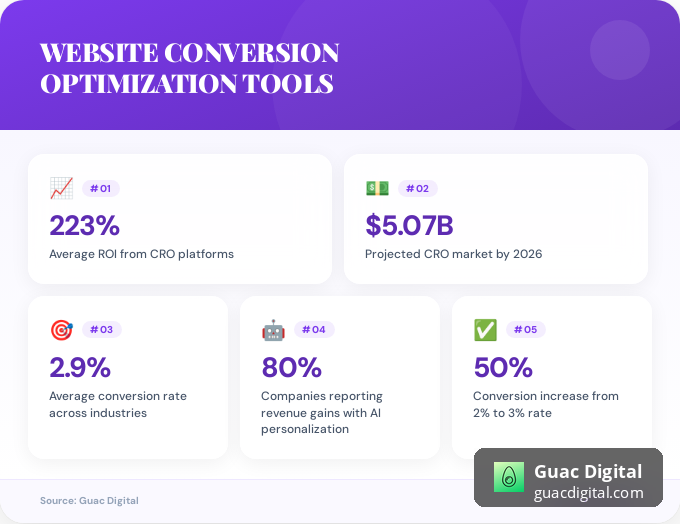
Website conversion optimization tools help businesses analyze user behavior, conduct A/B testing, and personalize experiences to boost conversion rates, with companies reporting an average 223% ROI on dedicated CRO platforms. The market is projected to reach $5.07 billion by 2026, with average conversion rates across industries standing at 2.9%, making these tools essential for competitive digital marketing.
Did you know that a single percentage point improvement in conversion rate can translate to millions in additional revenue for high-traffic websites? Yet the average website conversion rate across all industries hovers at just 2.9%, leaving massive untapped potential on the table.
Website conversion optimization tools have become indispensable for businesses seeking to maximize their digital investments. With the CRO market growing from $3.01 billion in 2019 to a projected $5.07 billion by 2026, these platforms offer sophisticated capabilities that go far beyond basic analytics. From AI-powered personalization to advanced multivariate testing, modern CRO tools provide the data-driven insights needed to transform browsers into buyers.
This comprehensive guide explores the most effective website conversion optimization tools available in 2026, backed by real performance data, expert insights, and proven case studies showing results like 41% conversion rates and 87,381 qualified leads from strategic implementations.
What Are Website Conversion Optimization Tools?
Website conversion optimization tools are specialized software platforms designed to help businesses understand visitor behavior, identify friction points, and implement data-driven improvements that increase the percentage of users taking desired actions on their websites.
These tools analyze how visitors interact with your site, providing quantitative data through analytics and qualitative insights through visual tools like heatmaps and session recordings. They enable teams to test hypotheses through A/B and multivariate experiments, personalize experiences for different audience segments, and continuously optimize the customer journey.
Modern CRO platforms have evolved significantly from simple testing tools. Today’s solutions incorporate machine learning algorithms, predictive analytics, and real-time personalization capabilities that can adapt content dynamically based on user behavior, demographics, and engagement patterns. According to industry research, 80% of companies using AI-powered personalization tools report significant revenue increases.
Why Should Your Business Invest in CRO Tools?
The return on investment for dedicated conversion optimization tools is compelling. Businesses report an average 223% ROI when implementing comprehensive CRO platforms, according to VentureBeat research. This exceptional return stems from the compounding effect of conversion improvements on existing traffic.
Consider the mathematics: if you’re spending $10,000 monthly on advertising to generate 10,000 visitors at a 2% conversion rate (200 conversions), improving that rate to just 3% yields 300 conversions, a 50% increase in results from the same ad spend. Rather than constantly increasing advertising budgets to scale, CRO tools help maximize the value of traffic you’re already generating.
“High-performers integrate CRO with their advertising strategies, creating ‘advertising-ready’ scaling by prioritizing revenue efficiency over traffic volume alone. Even subtle changes yielding 1% conversion lifts can be worth millions for high-traffic sites.”
Real-world case studies demonstrate this impact. An Airbnb assessment using comprehensive CRO tools achieved a 41% conversion rate, while a B2B campaign reached 56.44%, and an interactive calculator implementation generated 87,381 qualified leads. These aren’t theoretical gains but verified outcomes from strategic tool implementation.
Additionally, user-generated content strategies enabled by CRO tools show measurable impact, with 3.2% conversion rate boosts when UGC is present, an additional 3.8% when users scroll through it, and a remarkable 102% increase when they actively engage with it.

What Are the Main Categories of CRO Tools?
Website conversion optimization tools span multiple categories, each serving distinct but complementary functions in the optimization process. Understanding these categories helps businesses build comprehensive CRO technology stacks tailored to their specific needs.
Analytics and Funnel Tracking Tools
These foundational platforms measure baseline performance, identify drop-off points, and track user journeys through conversion funnels. Google Analytics 4 remains the industry standard with event-based tracking and custom funnel creation, earning a 4.5/5 rating on G2. Privacy-focused alternatives like Matomo and Piwik PRO have gained traction in regulated industries requiring GDPR compliance.
Advanced analytics platforms like Mixpanel, Heap, and Amplitude offer cohort analysis, product analytics, and sophisticated segmentation capabilities that go beyond traditional pageview metrics to track actual user actions and engagement patterns.
A/B Testing and Experimentation Platforms
Testing tools enable controlled experiments to validate hypotheses about design changes, copy variations, and user experience modifications. Leading platforms like VWO, Optimizely, Convert.com, AB Tasty, and Kameleoon provide server-side testing capabilities, Bayesian statistical analysis, feature flags, and multi-segment experimentation.
These tools are essential for high-traffic sites where even small improvements compound significantly. As noted by optimization experts, the key is moving beyond simple A/B tests to multivariate experiments that test multiple elements simultaneously.
Behavior Visualization Tools
Heatmap and session recording tools like Hotjar and Lucky Orange provide qualitative insights into how users actually interact with your pages. These platforms reveal where users click, how far they scroll, where their attention focuses, and where they experience confusion or frustration.
Real-time monitoring capabilities enable immediate issue identification, while feedback tools gather direct user input about pain points and preferences.
Personalization and AI Platforms
Modern personalization tools like Personizely, ConvertFlow, Dynamic Yield, Adoric, and Omniconvert enable segment-specific experiences that go beyond one-size-fits-all A/B tests. These platforms use RFM segmentation (recency, frequency, monetary value), AI predictions, and exit-intent technology to deliver dynamically customized content.
The trend toward AI-driven personalization is reshaping CRO, reducing traditional A/B test cycles through predictive modeling based on micro-behavior signals.
What Are the Best Website Conversion Optimization Tools for 2026?
Based on comprehensive testing and analysis from industry reviews and expert evaluations, here are the top-performing website conversion optimization tools across key categories:
| Category | Top Tools | Key Strengths | Best For |
|---|---|---|---|
| Analytics & Funnel Tracking | Google Analytics 4, Mixpanel, Matomo, Piwik PRO, Heap, Amplitude | Event-based tracking, custom funnels, GDPR compliance, cohort analysis | Baseline metrics, drop-off identification; GA4 free with 4.5/5 rating |
| A/B & Multivariate Testing | VWO, Optimizely, Convert.com, AB Tasty, Kameleoon | Server-side experiments, Bayesian statistics, feature flags, multi-segment testing | High-traffic sites where subtle 1% lifts worth millions |
| Heatmaps & Behavior Insights | Hotjar, Lucky Orange | Heatmaps, session recordings, real-time monitoring, feedback tools | Visualizing user interactions, identifying friction points |
| Personalization & AI | Personizely, ConvertFlow, Dynamic Yield, Adoric, Omniconvert | Real-time personalization, RFM segmentation, AI predictions, exit-intent | Segment-specific experiences beyond basic A/B tests |
| All-in-One/Specialized | Clicks Geek, Outgrow | Integrated PPC/CRO, interactive calculators (1,790% lead increases) | Local businesses, eCommerce with lead generation focus |
Google Analytics 4: The Foundation
Experts consistently recommend starting with GA4 for foundational event tracking before layering specialized tools. Its free tier provides robust capabilities for most businesses, including custom event tracking, conversion funnel analysis, and audience segmentation. The platform’s machine learning features predict user behavior and identify trending patterns automatically.
VWO and Optimizely: Testing Powerhouses
For organizations serious about experimentation, VWO and Optimizely represent the gold standard. These platforms handle complex multivariate tests, support server-side experimentation for backend changes, and provide statistical confidence calculations that prevent premature conclusion jumping.
Hotjar: Qualitative Insights Leader
Hotjar bridges the gap between quantitative analytics and qualitative understanding. Its heatmaps reveal where users actually click versus where you expect them to click, while session recordings show the exact journey of confused or frustrated visitors. The feedback polls and surveys enable direct user input about problems and preferences.
Personalization Platforms for 2026
The shift toward AI-driven personalization marks a major trend in 2026. Platforms like Dynamic Yield and Omniconvert use machine learning to automatically segment audiences and serve personalized content without manual configuration. These tools predict user intent based on micro-behaviors like mouse movements, scroll patterns, and time-on-page metrics.

How Do You Choose the Right CRO Tools for Your Business?
Selecting appropriate website conversion optimization tools depends on your business size, traffic volume, technical capabilities, and specific optimization goals. Here’s a strategic framework for making informed decisions.
Assess Your Current Optimization Maturity
Businesses new to CRO should start with foundational analytics and behavior visualization tools before investing in advanced testing platforms. Google Analytics 4 plus Hotjar provides a powerful starting combination that covers both quantitative data and qualitative insights without significant investment.
Organizations with established optimization programs benefit from advanced testing platforms and personalization engines that enable sophisticated multi-segment experiments and AI-driven content delivery.
Consider Traffic Volume Requirements
A/B testing requires sufficient traffic to reach statistical significance within reasonable timeframes. Sites with less than 10,000 monthly visitors may struggle to validate tests quickly, making behavior analysis tools more immediately actionable. High-traffic sites can validate experiments rapidly and benefit from granular segmentation.
Evaluate Integration Capabilities
Your CRO tool stack should integrate seamlessly with your existing marketing technology. Check for native connections with your CMS, email platform, CRM, and advertising channels. API availability enables custom integrations for unique workflows.
Privacy and Compliance Considerations
Organizations in regulated industries or serving European markets should prioritize GDPR-compliant tools like Matomo and Piwik PRO. These privacy-first platforms provide robust analytics without compromising user data protection or requiring complex consent management.
What Are the Best Practices for Implementing CRO Tools?
Successful implementation of website conversion optimization tools requires strategic planning, proper configuration, and systematic testing processes. According to optimization experts, following proven methodologies significantly improves outcomes.
Start with Proper Analytics Configuration
Before testing anything, ensure your analytics accurately track the conversions that matter. Configure event tracking for all meaningful user actions including button clicks, form submissions, video plays, and scroll depth. Create custom conversion funnels that map your actual customer journey.
Many organizations discover their analytics implementation has gaps that prevent accurate measurement. A comprehensive audit before launching optimization initiatives saves months of wasted effort.
Layer Tools Strategically
Experts recommend a phased approach: start with GA4 for baseline metrics, add Hotjar for qualitative insights into user behavior, then implement testing platforms like VWO once you’ve identified high-impact optimization opportunities. This prevents tool overwhelm while building systematic optimization capabilities.
Prioritize Based on Data, Not Opinions
Use behavior data to identify the highest-impact pages and elements for testing. Pages with high traffic but low conversion rates represent the greatest opportunity. Elements where users show confusion (through heatmap dead zones or session recording backtracking) warrant immediate attention.
Develop Hypothesis-Driven Testing Plans
Every test should address a specific hypothesis based on user research or data analysis. Random testing wastes resources and rarely produces meaningful insights. Document your hypothesis, predicted impact, and required sample size before launching experiments.
Integrate CRO with Advertising Strategy
The most successful organizations, as highlighted by conversion research, integrate their CRO efforts with paid advertising. This “advertising-ready” approach ensures traffic quality matches landing page optimization, preventing wasted ad spend on poorly converting experiences.

Key Takeaways
- Market growth is substantial: The CRO tools market is expanding from $3.01 billion in 2019 to a projected $5.07 billion by 2026, reflecting increasing recognition of conversion optimization’s value.
- ROI justifies investment: Businesses report an average 223% ROI on dedicated CRO platforms, with verified case studies showing conversion rates reaching 41% to 56.44% through strategic implementation.
- Start with foundations: Begin with Google Analytics 4 for event tracking and funnel analysis before layering specialized tools like Hotjar for behavior insights and VWO for testing.
- AI-driven personalization is the future: 80% of companies using AI-powered personalization tools report revenue increases, with predictive modeling reducing traditional A/B test cycles.
- Privacy-first tools gain traction: GDPR-compliant platforms like Matomo and Piwik PRO are essential for regulated industries and European markets prioritizing data protection.
- Integration matters: The most effective CRO strategies combine tools across analytics, testing, behavior visualization, and personalization categories rather than relying on single platforms.
- User-generated content boosts conversions: UGC presence increases conversion rates by 3.2%, scrolling through it adds 3.8%, and active engagement produces a 102% lift, making UGC tools valuable additions to CRO stacks.
People Also Ask
The average website conversion rate across all industries stands at 2.9% according to 2025 Ruler Analytics data. However, this varies significantly by industry, traffic source, and device type, with top-performing sites achieving rates of 10% or higher through systematic optimization.
Most experts recommend at least 10,000 monthly visitors to conduct meaningful A/B tests, though the exact requirement depends on your baseline conversion rate and the size of the improvement you’re testing. Smaller sites benefit more from behavior analysis and qualitative research using tools like Hotjar before investing in testing platforms.
Yes, small businesses can achieve significant results with free tools like Google Analytics 4, Hotjar’s free tier, and built-in testing capabilities in platforms like WordPress. As traffic and revenue grow, investing in premium tools provides advanced capabilities like AI personalization and sophisticated multivariate testing.
A/B tests should run until reaching statistical significance (typically 95% confidence) and capturing at least one full business cycle to account for weekly patterns. This usually requires 1-4 weeks depending on traffic volume, though low-traffic sites may need longer periods to gather sufficient data.
CRO focuses specifically on increasing the percentage of visitors who complete desired actions (conversions), while UX optimization aims to improve overall user experience and satisfaction. The two disciplines overlap significantly, as better user experiences typically drive higher conversion rates, but CRO maintains a tighter focus on measurable business outcomes.
Absolutely. Most modern CRO tools provide device-specific insights, allowing you to analyze mobile behavior separately and test mobile-optimized variations. Mobile conversion rates typically lag desktop rates by 30-50%, making mobile-specific optimization a high-priority opportunity for most businesses.
Frequently Asked Questions
Beginners should start with Google Analytics 4 for foundational tracking and Hotjar for behavior visualization. This combination provides both quantitative conversion data and qualitative insights into user behavior without requiring significant investment or technical expertise.
CRO tool budgets vary widely based on traffic and needs. Small businesses can start with free tools and $50-200 monthly for basic paid features. Mid-size companies typically invest $500-2,000 monthly for comprehensive platforms like VWO or Optimizely. Enterprise organizations often spend $5,000+ monthly for advanced capabilities and dedicated support.
Not necessarily. Many comprehensive platforms like VWO and Optimizely handle A/B testing, multivariate testing, and personalization within a single interface. However, specialized tools often provide deeper capabilities in specific areas, so many organizations use a combination of platforms for different testing needs.
While conversion rate is the primary metric, smart CRO practitioners track revenue per visitor or customer lifetime value rather than conversion rate alone. A higher conversion rate means nothing if the quality of conversions decreases, making revenue-focused metrics more meaningful for business outcomes.
Check if tools offer cookie-less tracking, data anonymization, EU-based data storage, and transparent data processing agreements. Privacy-first platforms like Matomo and Piwik PRO are specifically designed for GDPR compliance, while tools like GA4 require proper configuration and consent management to meet regulatory requirements.
Most major CRO tools offer native integrations or plugins for popular ecommerce platforms like Shopify, WooCommerce, Magento, and BigCommerce. These integrations enable revenue tracking, product-level analysis, and cart abandonment insights specific to ecommerce operations.
AI powers predictive analytics, automated personalization, and anomaly detection in modern CRO platforms. Machine learning algorithms can identify patterns in user behavior, predict conversion likelihood, and automatically optimize content delivery without manual configuration. The 80% of companies reporting revenue increases from AI-powered tools demonstrates its significant impact on conversion optimization.
Implementing effective website conversion optimization tools represents one of the highest-ROI investments in digital marketing. With the average business seeing a 223% return and the market expanding to $5.07 billion by 2026, these platforms have moved from optional to essential for competitive digital presence.
The key to success lies in strategic tool selection matched to your optimization maturity, traffic volume, and business goals. Start with foundational analytics, layer qualitative behavior insights, then graduate to advanced testing and AI-driven personalization as your program matures.
Whether you’re running a small local business or managing enterprise-level ecommerce operations, the right combination of CRO tools can transform your existing traffic into significantly more revenue. As one expert noted, high-performers prioritize revenue efficiency over traffic volume, using conversion optimization to maximize the value of every visitor rather than constantly increasing advertising spend.
Ready to implement these tools and boost your conversion rates? Choosing the right optimization partner can accelerate your results and ensure proper implementation from the start.