
Social Media Marketing Strategy for Startups: 10 Powerful Success Tips 2025
Why Social Media Marketing Strategy for Startups is Your Digital Lifeline
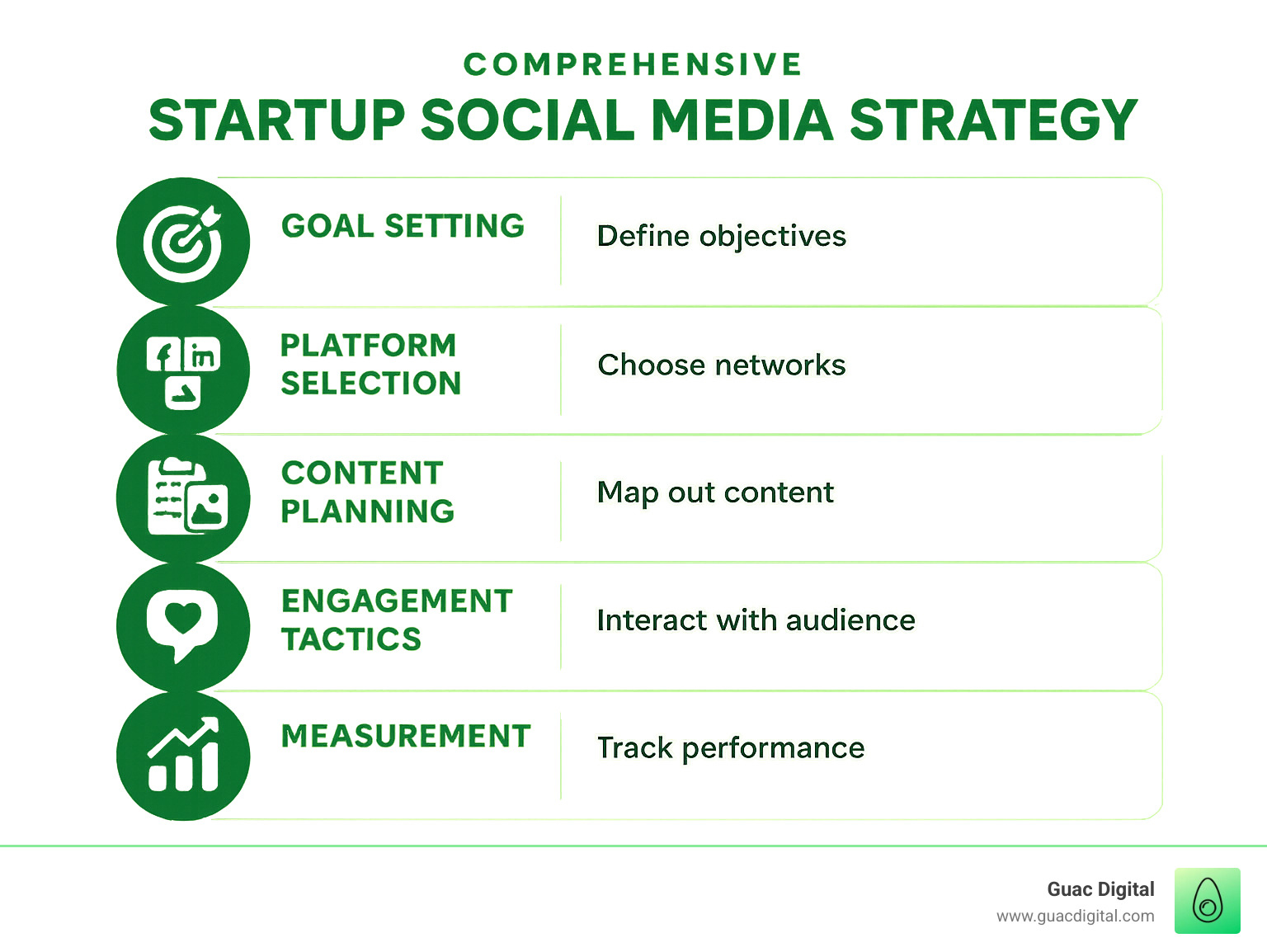
A social media marketing strategy for startups is your roadmap to building brand awareness, engaging customers, and driving growth on platforms where your audience already spends their time. Here’s what every startup needs to know:
Essential Components of a Startup Social Media Strategy:
- Goal Setting: Define SMART objectives (brand awareness, lead generation, customer retention)
- Audience Research: Create detailed buyer personas and identify platform preferences
- Platform Selection: Choose 2-3 channels where your target customers are most active
- Content Planning: Develop 3-5 content pillars using the 80/20 rule (80% value, 20% promotion)
- Engagement Tactics: Build community through authentic interactions and user-generated content
- Measurement: Track key metrics like engagement rate, website traffic, and conversion rates
- Budget Allocation: Start with organic growth, then test paid ads at $10-50 daily spend
The stakes couldn’t be higher. Twenty-two percent of startups fail due to marketing problems, and with the average person having 7 social media accounts, your customers are already online – the question is whether you’re reaching them effectively.
Social media isn’t just about posting content anymore. Seventy-eight percent of consumers say a brand’s social presence impacts their trust, and for Gen Z, that number jumps to 88%. For startups competing against established brands, this trust-building opportunity is crucial.
The challenge? Most startups treat social media as an afterthought rather than a growth engine. They post randomly, chase vanity metrics, and wonder why their 50 followers aren’t converting into customers.
I’m Guy Leon, founder and CEO of Guac Digital, where we’ve helped clients achieve a 12,000% increase in online engagement through strategic social media campaigns. Having developed social media marketing strategies for startups across industries, I’ve seen how the right approach can transform a bootstrap operation into a market leader.
Relevant articles related to social media marketing strategy for startups:
Why Social Media Marketing Matters for Startups
Social media marketing isn’t just another marketing channel for startups – it’s often the difference between obscurity and breakthrough success. When you’re competing against established brands with massive advertising budgets, social media levels the playing field.
Brand awareness is your first hurdle. Without it, even the best products struggle to find traction. Social media gives you access to billions of potential customers without the traditional gatekeepers of advertising. You can build recognition organically through valuable content and authentic engagement.
Trust-building happens through two-way conversations. Unlike traditional advertising where you broadcast messages, social media allows direct interaction with your audience. When customers see you responding to comments, addressing concerns, and sharing behind-the-scenes content, they develop emotional connections with your brand.
This early traction is crucial for startups. Social media provides immediate feedback on your messaging, product-market fit, and customer preferences. You can test ideas, gather insights, and pivot quickly based on real audience responses.
The numbers tell the story. According to our research, 90% of consumers use social media to keep up with trends and cultural moments. If you’re not part of these conversations, you’re invisible to your target market.
Social commerce is revolutionizing how startups sell. Eighty-one percent of consumers use social media to shop around for their next purchase, and 25% of marketers find social shopping tools more effective than traditional e-commerce. This means your social presence directly impacts your bottom line.
Influencer impact can’t be ignored either. Forty-nine percent of consumers make purchases at least once a month because of influencer posts. For startups, partnering with micro-influencers often provides better ROI than traditional advertising.
Employee advocacy multiplies your reach. Posts that employees share have an 8x higher engagement rate than brand content, with 20x greater reach than all organic channels combined. Your team becomes your most powerful marketing asset.
Main Benefits for Bootstrapped Founders
Low-cost reach is perhaps the biggest advantage. While traditional advertising requires significant upfront investment, social media marketing can start with just your time and creativity. You can reach thousands of potential customers without spending a dollar on advertising.
Community loyalty develops naturally through consistent engagement. When customers feel heard and valued, they become brand advocates who defend your startup and recommend you to others. This organic word-of-mouth marketing is incredibly powerful for early-stage companies.
Rapid feedback accelerates your learning curve. You can test messaging, product features, and marketing approaches in real-time. This immediate feedback loop helps you avoid costly mistakes and iterate quickly toward product-market fit.
SEO boost comes from social signals. Search engines consider social media engagement when ranking websites. Active social profiles with engaged followers can improve your search visibility and drive organic traffic to your website.
Funnel leads through strategic content. By creating valuable content that addresses your audience’s pain points, you attract qualified prospects who are more likely to convert. Social media becomes the top of your sales funnel, feeding leads to your website and email list.
Building a Social Media Marketing Strategy for Startups
Creating an effective social media marketing strategy for startups requires a systematic approach. You can’t just wing it and hope for the best – you need a clear roadmap that aligns with your business objectives.
Goal-setting forms the foundation. Without clear objectives, you’ll waste time and resources on activities that don’t drive business results. Your social media goals should directly support your startup’s growth objectives, whether that’s user acquisition, brand awareness, or revenue generation.
SMART KPIs make your goals measurable. Instead of vague objectives like “increase followers,” set specific targets like “grow LinkedIn followers from 500 to 5,000 in six months” or “generate 100 qualified leads per month through social media content.”
Target persona development ensures you’re speaking to the right people. Create detailed buyer personas that include demographics, pain points, platform preferences, and content consumption habits. This research becomes the foundation for all your content and engagement decisions.
Competitive audit reveals opportunities and gaps. Analyze what your competitors are doing well and where they’re falling short. Look for content gaps you can fill and engagement opportunities they’re missing.
Platform fit determines where you’ll focus your efforts. Not every platform makes sense for every startup. B2B SaaS companies might prioritize LinkedIn, while D2C brands focus on Instagram and TikTok.
Brand story differentiates you from competitors. Your unique value proposition should shine through every post, comment, and interaction. Develop a compelling narrative that resonates with your target audience.
Voice consistency builds recognition and trust. Whether you’re posting on LinkedIn or TikTok, your brand voice should be recognizable. This doesn’t mean identical content across platforms, but rather consistent personality and values.
For more detailed strategies, check out our guide on Effective Social Media Marketing Strategies.
Setting Social Media Marketing Strategy for Startups Goals
Reach KPIs measure your visibility and brand awareness. Track metrics like impressions, reach, and share of voice to understand how many people are seeing your content. For startups, initial goals might include increasing monthly reach by 50% or achieving 10,000 monthly impressions.
Conversion KPIs connect social media to business outcomes. Track website traffic from social media, email signups, demo requests, and actual sales. These metrics prove ROI and justify continued investment in social media marketing.
Benchmark data provides context for your performance. Research industry averages for engagement rates, follower growth, and conversion rates. This helps you set realistic goals and measure progress against competitors.
Executive buy-in requires demonstrating business impact. Present social media metrics in the context of business objectives. Show how social media followers translate to email subscribers, how engagement drives website traffic, and how social media leads convert to customers.
Selecting the Right Platforms for Social Media Marketing Strategy for Startups
Facebook remains the largest platform with over 3 billion monthly active users. It’s particularly effective for local businesses and B2C startups targeting older demographics. The platform’s robust advertising tools make it ideal for testing and scaling paid campaigns.
Instagram dominates visual content with 84% of social users having profiles. It’s perfect for product-focused startups, lifestyle brands, and companies with strong visual elements. Instagram Stories and Reels offer additional engagement opportunities.
LinkedIn is essential for B2B startups with 950 million monthly active users. It’s the go-to platform for professional networking, thought leadership, and B2B lead generation. LinkedIn’s organic reach for business content often exceeds other platforms.
TikTok has exploded to 1.2 billion monthly active users, particularly among younger demographics. Its algorithm favors engaging content over follower count, making it possible for startups to go viral quickly.
Pinterest serves as a visual search engine with 250 million monthly active users. It’s excellent for e-commerce startups, especially in fashion, food, home decor, and lifestyle categories.
Threads became the most rapidly downloaded app ever with over 100 million registrations in under a week. As a Twitter alternative, it offers opportunities for real-time engagement and conversation.
| Platform | Best For | Primary Demographics | Content Types |
|---|---|---|---|
| Local businesses, B2C | 25-54 years old | Videos, community posts, events | |
| Visual brands, lifestyle | 18-34 years old | Photos, Stories, Reels | |
| B2B, professional services | 25-54 years old | Articles, industry insights | |
| TikTok | Entertainment, viral content | 16-24 years old | Short-form videos |
| E-commerce, inspiration | 25-44 years old, 60% female | Pins, boards, ideas |
Content & Engagement Playbook

Content pillars provide structure and focus for your social media strategy. Instead of posting random content, develop 3-5 core themes that align with your audience’s interests and your business objectives. For example, a fintech startup might focus on financial education, industry news, company culture, customer success stories, and product updates.
Edutainment combines education with entertainment to create engaging content. This approach works particularly well for startups because it provides value while building brand awareness. Share tips, tutorials, and insights that help your audience solve problems or achieve goals.
User-generated content (UGC) leverages your customers’ voices to build credibility. Encourage customers to share their experiences with your product or service. UGC provides social proof and reduces your content creation burden while building community.
Short-form video dominates engagement across platforms. Whether it’s TikTok videos, Instagram Reels, or YouTube Shorts, video content consistently outperforms static posts. Don’t worry about production quality – authenticity often trumps polish.
Live streams create real-time connections with your audience. Use live video for Q&A sessions, product demos, behind-the-scenes content, and announcements. Live content often receives priority in platform algorithms and generates higher engagement.
Storytelling transforms features into benefits and benefits into emotions. Share your startup’s journey, customer success stories, and the problems you’re solving. People connect with stories, not specifications.
80/20 rule balances value with promotion. Eighty percent of your content should educate, entertain, or inspire your audience, while only 20% should directly promote your products or services. This approach builds trust and prevents audience fatigue.
Hashtags increase findability when used strategically. Research relevant hashtags in your industry and mix popular tags with niche-specific ones. Avoid hashtag stuffing – quality over quantity.
Social SEO optimizes your content for platform search functions. Use relevant keywords in your captions, profile descriptions, and hashtags. Many users now search for information directly on social platforms rather than Google.
Posting Cadence & Algorithm Hacks
Consistency matters more than frequency. It’s better to post high-quality content three times per week consistently than to post daily for two weeks and then disappear. Algorithms favor accounts that maintain regular posting schedules.
Best times vary by platform and audience. Generally, weekdays during lunch hours and early evenings perform well, but test different times to find what works for your specific audience. Use platform analytics to identify when your followers are most active.
Engagement signals tell algorithms your content is valuable. Likes, comments, shares, and saves all indicate quality content. Encourage engagement by asking questions, creating polls, and responding promptly to comments.
For more insights on timing, click here to know the best time to post on different platforms.
Understanding social media algorithms helps you work with platforms rather than against them. Focus on creating content that sparks conversations and encourages meaningful interactions.
Low-Budget Growth Tactics
Micro-influencers offer better ROI than celebrity endorsements. Partner with influencers who have 1,000-10,000 engaged followers in your niche. They often have higher engagement rates and charge less than macro-influencers.
Employee advocacy turns your team into brand ambassadors. Encourage employees to share company content and their own experiences working at your startup. Employee posts often feel more authentic than official brand content.
Giveaways generate buzz and attract new followers. Partner with complementary brands to expand your reach. Require participants to follow your account, tag friends, and share your content to maximize exposure.
Guerrilla marketing creates memorable experiences that people want to share. Think flash mobs, street art, or pop-up events that align with your brand values. These tactics often generate significant social media buzz at low cost.
Partnerships with other startups or established brands can expand your reach. Cross-promote each other’s content, collaborate on projects, or create joint campaigns that benefit both parties.
For location-specific strategies, explore our guide on Boost Your Business with Local Social Media Marketing.
Tools, Automation, Measurement & ROI
Scheduling apps maintain consistency without constant manual posting. Tools like Hootsuite, Buffer, and Later allow you to plan and schedule content in advance. This ensures regular posting even when you’re busy with other startup activities.
Canva democratizes design for non-designers. Create professional-looking graphics, infographics, and social media posts without hiring a designer. Their templates are optimized for each platform’s dimensions and best practices.
Hootsuite analytics provide comprehensive performance insights across multiple platforms. Track engagement rates, follower growth, and content performance from a single dashboard. This data helps you optimize your strategy and prove ROI.
Sprout Social listening monitors mentions of your brand, competitors, and industry keywords. This intelligence helps you join relevant conversations, address customer concerns, and identify content opportunities.
UTM tracking connects social media activity to website conversions. Add UTM parameters to links shared on social media to track which platforms and posts drive the most valuable traffic to your website.
Social listening goes beyond monitoring mentions to understand sentiment and trends. Use tools like Mention, Brandwatch, or even free Google Alerts to stay informed about conversations relevant to your startup.
AI insights help you understand your audience better and optimize content performance. Many platforms now offer AI-powered analytics that identify patterns and suggest improvements to your strategy.
Free vs. Paid Tool Stack
| Tool Category | Free Options | Paid Options | Best For |
|---|---|---|---|
| Scheduling | Later (limited), Buffer (basic) | Hootsuite, Sprout Social | Consistent posting |
| Design | Canva (basic), GIMP | Canva Pro, Adobe Creative Suite | Visual content |
| Analytics | Native platform insights | Sprout Social, Hootsuite | Performance tracking |
| Listening | Google Alerts, Mention (basic) | Brandwatch, Sprout Social | Brand monitoring |
Start with free tools and upgrade as your needs grow. Many startups successfully manage their social media with basic versions of these tools before investing in premium features.
Proving ROI to Investors
Customer Acquisition Cost (CAC) measures how much you spend to acquire each customer through social media. Track ad spend and organic effort investment against new customer acquisitions to calculate social media CAC.
Customer Lifetime Value (CLV) shows the long-term value of social media customers. Compare CLV of customers acquired through social media versus other channels to demonstrate the quality of social media leads.
Earned media value quantifies the value of organic mentions and shares. Calculate what you would have paid for equivalent advertising reach to demonstrate the value of your organic social media efforts.
Sentiment shift tracks how social media impacts brand perception. Monitor sentiment over time to show how your social media strategy improves brand reputation and customer satisfaction.
Dashboards visualize your social media performance for stakeholders. Create clear, visual reports that connect social media metrics to business outcomes. This makes it easier for investors and executives to understand your social media impact.
For more detailed strategies, check out our Insights Into Effective Social Media Agency Strategies.
Adapting & Future-Proofing Your Plan
Trend monitoring keeps your strategy current and relevant. Social media moves fast, and what worked last month might not work today. Set up alerts for industry trends, platform updates, and competitor activities.
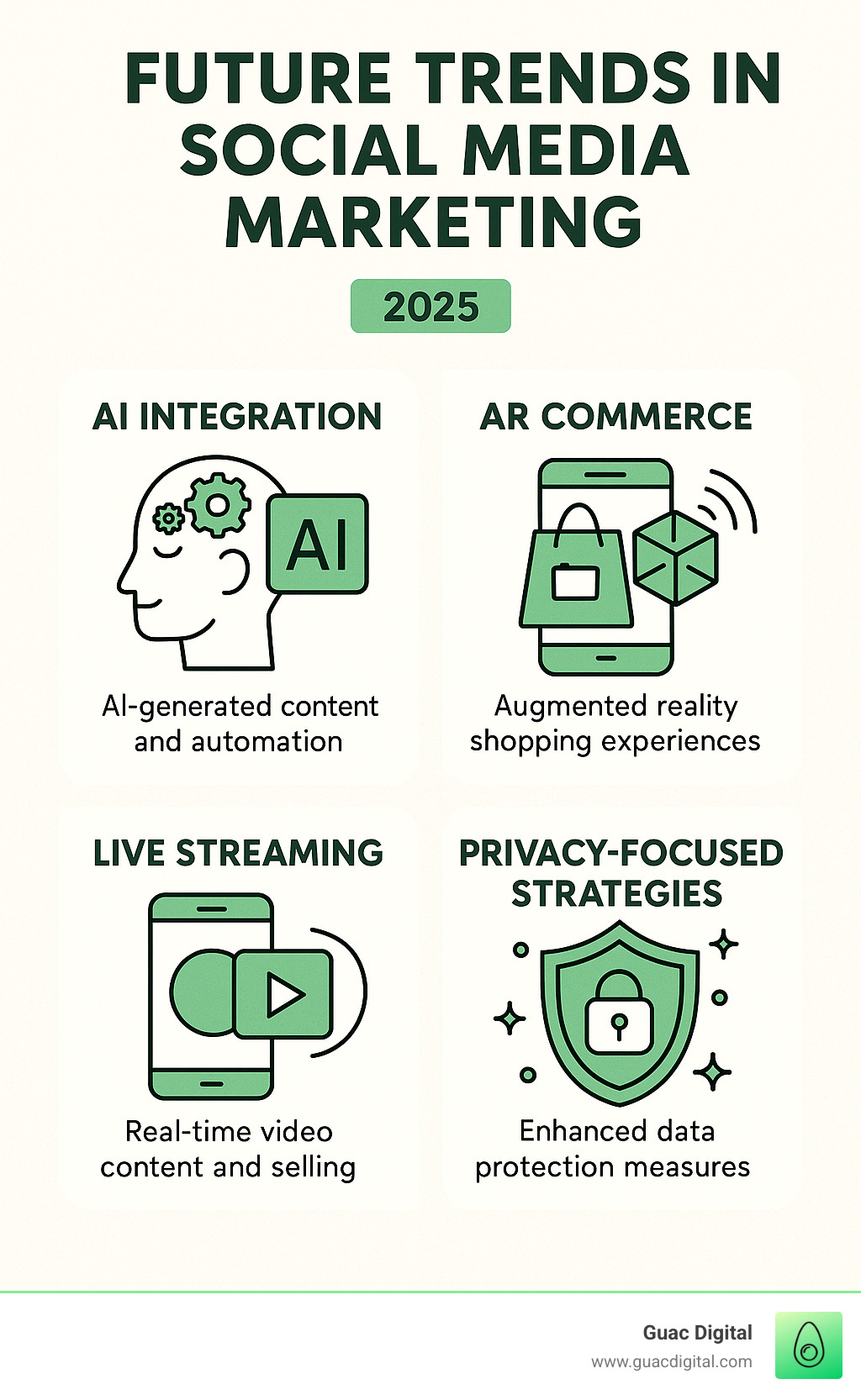
AI content tools are becoming increasingly sophisticated. While maintaining authenticity, explore how AI can help with content ideation, copywriting, and even basic design tasks. Just remember that AI should improve, not replace, human creativity.
AR commerce is changing how customers find and purchase products. Augmented reality filters and try-on experiences are becoming standard features across platforms. Consider how AR might improve your product demonstrations or brand experiences.
Community-first approaches build stronger, more engaged audiences than broadcast-style marketing. Focus on creating spaces where your customers can connect with each other, not just with your brand.
Policy shifts on major platforms can dramatically impact your strategy. Diversify your presence across multiple platforms to reduce risk, and always own your audience through email lists and other direct channels.
Agile sprints allow you to test and iterate quickly. Treat your social media strategy as a living document that evolves based on performance data and market changes.
Scalability should be built into your strategy from the beginning. As your startup grows, your social media needs will evolve. Plan for how you’ll maintain quality and consistency as you expand.
For insights on scaling your social media efforts, explore More info about social media agency growth.
2025+ Trends Startups Can’t Ignore
Social search is replacing traditional search for many users. Eighty-nine percent of marketers say social search is important to their strategies. Optimize your content for findability within social platforms, not just Google.
Shoppable posts eliminate friction in the purchase process. Forty-seven percent of marketers already sell directly within social apps, and this number is growing rapidly. Make it easy for customers to buy without leaving the platform.
Live commerce combines entertainment with shopping. Live streaming sales events and product demonstrations create urgency and social proof that drive conversions.
Short-form dominance continues across all platforms. Video content, particularly under 60 seconds, consistently outperforms other content types. Master short-form video creation to stay competitive.
Data privacy regulations are changing how platforms collect and use data. Stay informed about privacy changes and adjust your targeting and measurement strategies accordingly.
Frequently Asked Questions about Startup Social Strategies
How often should we post and when?
Quality trumps quantity every time. Start with 3-4 high-value posts per week rather than daily low-effort content. Here are platform-specific recommendations:
- Facebook: 1-2 posts per day maximum
- Instagram: 1-2 feed posts per day, 2 Stories per day
- LinkedIn: 1 post per day for companies, 2-3 times per week for thought leadership
- TikTok: 1-4 posts per day if you can maintain quality
- Twitter/X: 3-4 tweets per day
Post timing depends on your audience’s habits. Use platform analytics to identify when your followers are most active. Generally, weekdays during lunch hours (11 AM – 1 PM) and early evenings (5 PM – 7 PM) perform well.
What metrics really matter to early-stage investors?
Focus on metrics that connect to business outcomes:
- Conversion rate: What percentage of social media traffic converts to leads or customers?
- Customer acquisition cost: How much does it cost to acquire a customer through social media?
- Engagement rate: Are people actually interacting with your content?
- Website traffic: How much qualified traffic does social media drive to your site?
- Lead quality: Do social media leads convert at similar rates to other channels?
Avoid vanity metrics like follower count unless you can connect them to business value. A startup with 1,000 engaged followers who convert is more valuable than one with 10,000 passive followers.
How can we pivot if a platform suddenly changes its algorithm?
Algorithm changes are inevitable, so build resilience into your strategy:
- Diversify platforms: Don’t put all your eggs in one basket
- Own your audience: Build email lists and direct communication channels
- Focus on fundamentals: Quality content and genuine engagement survive algorithm changes
- Monitor performance: Track metrics weekly to spot changes early
- Stay flexible: Be ready to adjust content types and posting strategies
- Test quickly: When you notice changes, run small tests to find what works
Algorithm changes often favor authentic, engaging content over promotional posts. If you’re creating valuable content for your audience, you’ll adapt more easily than competitors focused solely on gaming the system.
Conclusion
Data-driven domination isn’t just a catchy phrase – it’s the reality of successful social media marketing for startups. The companies that thrive are those that combine strategic thinking with creative execution, backed by solid performance data.
Let’s recap the essential steps for building your social media marketing strategy for startups:
- Start with clear goals that align with your business objectives
- Know your audience deeply through research and direct engagement
- Choose platforms strategically based on where your customers spend time
- Create valuable content that educates, entertains, and inspires
- Engage authentically to build community and trust
- Measure relentlessly to optimize performance and prove ROI
- Stay agile and adapt to changes in platforms and audience behavior
The beauty of social media marketing for startups lies in its accessibility. You don’t need a massive budget to get started – you need strategy, consistency, and genuine value for your audience.
Encourage experimentation within your strategic framework. Test different content types, posting times, and engagement tactics. The data will tell you what works for your specific audience and business model.
At Guac Digital, our Tampa-based team has helped startups across industries leverage big data and programmatic marketing to achieve exceptional social media ROI. We’ve seen how the right social media strategy can transform a startup’s growth trajectory.
Whether you’re just starting out or looking to scale your existing social media efforts, success comes from understanding your audience, providing value, and staying committed to the process. Social media marketing isn’t a quick fix – it’s a long-term investment in building relationships with your customers.
Ready to take your social media strategy to the next level? Start implementing these strategies today, and don’t be afraid to iterate based on what you learn. Your future customers are waiting to find your startup – make sure they can find you where they’re already looking.
For more location-specific strategies and expert guidance, explore our comprehensive guide on Boost Your Business with Local Social Media Marketing Near Me.