
Conversion Rate Optimization for Ecommerce Websites: 12 Powerful Tips 2025
Why Conversion Rate Optimization for Ecommerce Websites is Your Secret Weapon
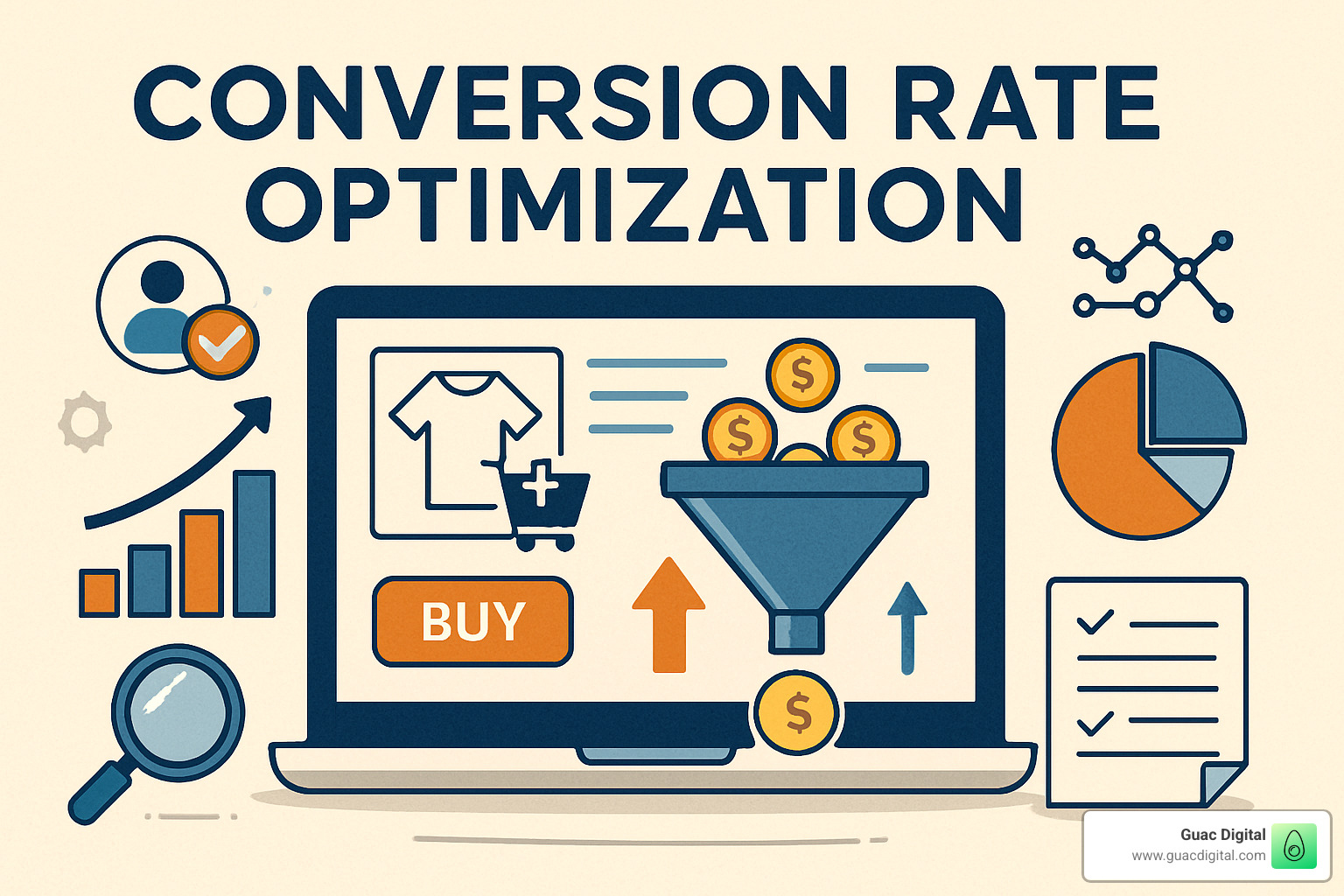
Conversion rate optimization for ecommerce websites is the process of increasing the percentage of visitors who complete desired actions on your online store – like making purchases, signing up for emails, or adding items to cart. Instead of spending more money driving traffic, CRO helps you get more value from visitors you already have.
Quick Answer: Key CRO Strategies for Ecommerce
- Optimize product pages with high-quality images and clear descriptions
- Streamline checkout by reducing form fields and offering multiple payment options
- Add trust signals like reviews, security badges, and return policies
- Use urgency tactics like countdown timers and low-stock alerts
- Improve site speed – pages should load in under 3 seconds
- A/B test everything from headlines to button colors
- Reduce cart abandonment with exit-intent popups and email reminders
The average ecommerce conversion rate sits between 2.5% and 3%, but top-performing stores achieve rates of 5% or higher. Even small improvements make a huge difference – boosting your rate from 2% to 3% means 50% more sales from the same traffic.
I’m Guy Leon, founder and CEO of Guac Digital, where we’ve helped clients boost engagement and conversion rates by 350% through strategic optimization campaigns. My experience with conversion rate optimization for ecommerce websites has shown me that small, data-driven changes often deliver the biggest results.

Conversion rate optimization for ecommerce websites vocabulary:
- conversion rate optimization tools
- conversion rate optimization website design
- what is website conversion optimization
Understanding Conversion Rate Optimization for Ecommerce Websites
Conversion rate optimization for ecommerce websites is your site’s personal trainer – helping you get more results from every visitor instead of just driving more traffic.
What is conversion rate optimization for ecommerce websites?
Conversion rate optimization for ecommerce websites focuses on revenue per visitor instead of just traffic volume. CRO strategies deliver an average ROI of 223% – every dollar spent on optimization puts $2.23 back in your pocket.
CRO isn’t just about completed purchases (macro-conversions). The real gold lies in tracking micro-conversions – smaller actions that signal buying intent like adding items to cart, email sign-ups, or creating wishlists. These micro-conversions are breadcrumbs leading to sales.
How to calculate and benchmark your rate
The math is simple: Conversion Rate = (Number of Conversions ÷ Total Visitors) × 100
The real insight comes from segmenting your data. Your organic search traffic might convert at 4%, while social media traffic converts at 1%. Desktop users often convert differently than mobile users.
Industry averages hover around 2.5% to 3%, but different industries play by different rules:
- Food and beverage: 4.2%
- Fashion and apparel: 1.9%
- Electronics: 2.3%
- Health and beauty: 3.1%
- Home and garden: 2.8%
- Sports and recreation: 2.1%
Top performers in each category often achieve rates 2-3x higher through strategic Conversion Optimization for Ecommerce Website approaches.
High-Impact Areas to Prioritize First
Smart optimization means focusing where you’ll make the biggest difference first. Your product pages are where browsers become buyers, and your checkout flow is where you either seal the deal or watch customers slip away.
Product Pages & Visuals matter for conversion rate optimization for ecommerce websites
56% of shoppers dive straight into your product images and 95% check reviews before buying. Your product pages are silent salespeople working 24/7.
High-quality images aren’t optional – yet only 25% of ecommerce sites get this right. Multiple high-resolution photos from different angles help customers feel confident. 360-degree product views can boost conversions by up to 27%. Video demonstrations can improve rates by up to 86%.
Product descriptions need to tell a story, not just list features. Focus on how your product solves problems. Use sensory language and address specific pain points. Include clear sizing, compatibility, and usage information.
Streamlined Checkout for conversion rate optimization for ecommerce websites
69.57% of shopping carts get abandoned – nearly 7 out of 10 people who were ready to buy just don’t. 18% bail because checkout is too complicated.
The average checkout has 11.8 form fields, but you only need 8. Guest checkout is your secret weapon – let people buy without creating accounts. Multiple payment options are essential – credit cards, PayPal, Apple Pay, Google Pay.
Trust signals become crucial during checkout. Display SSL certificates, security badges, and money-back guarantees prominently. Progress indicators show customers they’re on step 2 of 3. Show shipping costs early – surprise fees cause 21% of cart abandonment.
Proven Strategies & Best Practices (List of 12 Click-Boosters)
These twelve strategies form the backbone of effective conversion rate optimization for ecommerce websites, backed by research and real-world performance data.
Leverage reviews & UGC
95% of shoppers read reviews, but products with mixed 4-star reviews often convert better than all 5-star ratings because they feel authentic. Show average ratings prominently but don’t hide less-than-perfect reviews.
Customer photos and videos in reviews are conversion gold. Respond to negative reviews professionally – potential customers watch how you handle complaints.

Use urgency & scarcity cues
Countdown timers for genuine limited-time offers create real urgency. “Only 3 left in stock!” badges work when they reflect actual inventory. “X people viewing this item” combines social proof with gentle pressure.
The key is authenticity and restraint – use urgency strategically, not everywhere.
Optimize mobile experience
With 62% of ecommerce traffic from mobile, your mobile experience is crucial. Thumb-friendly button sizes, streamlined navigation, and pages loading under 3 seconds are essential. One-click payments like Apple Pay reduce mobile cart abandonment.
Pricing, discounts, incentives
Show original prices alongside sale prices to highlight savings. Tiered pricing guides customers toward higher-value options. Hide coupon fields behind expandable links – visible empty fields cause abandonment as customers hunt for codes.
Free shipping thresholds increase average order values since 62% expect free shipping.
Reduce cart abandonment
Exit-intent popups can recover 10-15% of abandoning visitors. Abandoned cart email sequences have 45% open rates – send within an hour, then after 24 and 72 hours. Save-for-later options reduce decision pressure.
For comprehensive strategies, check out How to Optimize Website for Conversions.
Implement live chat and instant support
Trigger chat invitations based on user behavior – after 3 minutes on a product page or showing exit intent. Use chatbots for common questions with seamless handoff to humans for complex issues.
Personalize the shopping experience
Product recommendations based on browsing history are simple starting points. Dynamic content based on location – local currency, relevant shipping, region-specific products – removes friction.
Optimize site speed and performance
A one-second delay decreases conversions by 27%. Pages loading in 1 second convert at 3.05% vs 1.68% for 2-second loads. Compress images, use CDNs, and enable browser caching.
Add trust signals throughout the funnel
SSL certificates, customer testimonials with photos, industry certifications, and clear contact information build credibility. Professional design signals quality.
Use smart product recommendations
“Customers who bought this also bought” sections work because they’re based on actual behavior. “Recently viewed” helps re-engage browsers. Keep recommendations to 3-5 relevant items.
Implement progress indicators
Multi-step processes should always show progress. Use for checkout, registration, and customization wizards to reduce abandonment.
A/B test continuously
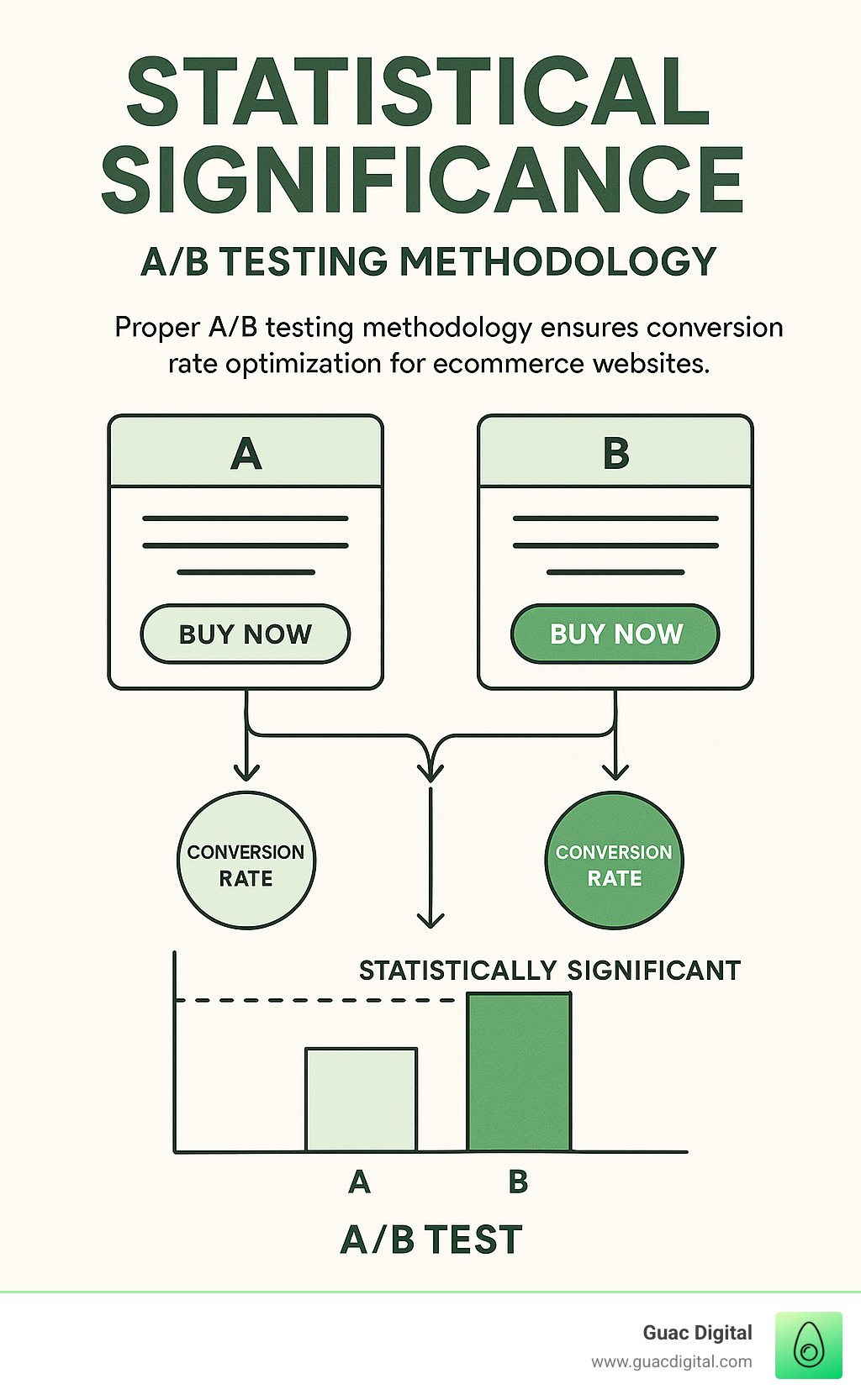
Test one element at a time and achieve statistical significance. Headlines and value propositions have the biggest impact. Call-to-action buttons often yield surprising results.
According to Scientific research on strong business writing, word choice significantly impacts conversion rates.
Data, Testing, and Measurement
Effective conversion rate optimization for ecommerce websites requires measuring what matters and testing systematically.
Setting hypotheses & running A/B tests
Start with clear hypotheses: “If we change [variable], then [outcome] will happen because [reasoning].”
A/B testing best practices:
- Test one variable at a time
- Ensure statistical significance
- Run tests for full business cycles
- Segment results by device and traffic source
- Document learnings from all tests
You need 250-350 conversions per variation for reliable results. Check out these A/B testing case studies for methodology examples.
Tracking micro-conversions & funnels
Key micro-conversions to track:
- Product page views and add-to-cart actions
- Checkout initiations and email sign-ups
- Account registrations and wishlist additions
Essential CRO metrics:
- Overall conversion rate and revenue per visitor
- Average order value and cart abandonment rate
- Customer lifetime value and return on ad spend
- Page load speeds and mobile vs. desktop performance
Future Trends & Advanced Tactics
Staying ahead of trends gives you competitive advantage in conversion rate optimization for ecommerce websites.
AI-powered recommendations
Modern AI recommendation engines analyze browsing patterns, time spent, scroll depth, and mouse movements to predict what customers want. Real-time personalization customizes homepages, product displays, and messaging based on individual behavior.
Machine learning spots patterns humans miss – like customers viewing sites on Tuesday afternoons being 40% more likely to buy luxury items.
Conversational commerce & support
Advanced chatbots use natural language processing for complex shopping journeys. They help find products through conversation, provide instant answers, and handle complaints with empathy – available 24/7.
Voice commerce is expanding as smart speakers become common. Augmented reality try-on experiences reduce return rates in fashion and home goods. Sustainability signals appeal to environmentally conscious shoppers.
Zero-party data collection through interactive quizzes replaces traditional tracking – customers share preferences when it leads to better experiences.
For more insights, check out Data-Driven Marketing Strategies.
Frequently Asked Questions About Ecommerce CRO
What is considered a “good” ecommerce conversion rate?
Here’s the honest truth: asking what’s “good” is like asking how long a piece of string is. Your conversion rate optimization for ecommerce websites success depends on so many factors that industry averages can actually be misleading.
That said, let me give you some realistic benchmarks. Most ecommerce sites fall into these ranges:
1-2% means you’re leaving serious money on the table. There’s significant room for improvement, but don’t panic – this is where many businesses start.
2-3% puts you in average territory. You’re doing okay, but there’s still plenty of opportunity to optimize and grow.
3-5% means you’re performing above average. You’re in good company with successful ecommerce brands that have invested in optimization.
5%+ puts you in the top 20% of ecommerce sites. This is excellent performance that comes from systematic testing and optimization.
But here’s what really matters: your own baseline performance. I’d rather see a client improve from 1% to 2% (doubling their revenue) than obsess over hitting some arbitrary industry benchmark. Focus on consistent improvement rather than comparing yourself to others.
Which metrics besides conversion rate should I track?
Conversion rate tells you how many people buy, but it doesn’t tell you the whole story. You could have a 5% conversion rate but still be losing money if your customers aren’t spending enough or coming back.
Revenue per visitor (RPV) is often more important than conversion rate itself. This metric shows you how much money each visitor brings to your business, regardless of whether they convert immediately. Calculate it by dividing total revenue by total visitors.
Average order value (AOV) reveals how much customers spend per transaction. Sometimes it’s better to have a 2% conversion rate with a $200 AOV than a 4% rate with a $50 AOV. Focus on both metrics together.
Customer lifetime value (CLV) shows the total revenue you’ll get from each customer over their entire relationship with your brand. This metric helps you understand how much you can spend to acquire customers profitably.
Cart abandonment rate highlights how many people start checkout but don’t finish. The average is around 70%, so if you’re higher than that, checkout optimization should be your priority.
Return on ad spend (ROAS) measures how much revenue you generate for every dollar spent on advertising. This connects your CRO efforts directly to your marketing profitability.
Don’t forget about page load speed – pages that load in under 3 seconds convert much better than slower ones. Also track your mobile conversion rate separately, since mobile users behave differently than desktop users.
How often should I run A/B tests?
The answer depends entirely on your traffic volume, and I see too many businesses either testing too aggressively or not testing enough.
High-traffic sites with 10,000+ visitors per month can run multiple tests simultaneously. You have enough data to reach statistical significance quickly, so you can test different elements across various pages at the same time.
Medium-traffic sites with 1,000-10,000 monthly visitors should run 1-2 tests at a time. You’ll need to be more patient – tests might take 4-6 weeks to reach significance, but the results will be reliable.
Low-traffic sites with fewer than 1,000 visitors monthly should focus on implementing proven best practices before testing. You simply don’t have enough traffic to get reliable test results quickly. Instead, implement the strategies we’ve covered in this guide, then start testing once your traffic grows.
Here’s a crucial point: never stop tests early, even if you see promising results after a few days. Statistical significance typically requires at least 2-4 weeks of data. I’ve seen too many “winning” tests that actually hurt conversions when implemented site-wide because they were stopped too early.
The key is consistency over frequency. It’s better to run fewer tests that reach proper statistical significance than to run many tests that don’t give you reliable data. Conversion rate optimization for ecommerce websites is a marathon, not a sprint.
Conclusion
Conversion rate optimization for ecommerce websites isn’t a one-time fix – it’s an ongoing process that compounds over time. Small improvements of 0.5% here and 1% there add up to 50% more sales from the same traffic.
Start with fundamentals: optimize product pages with better images and copy, streamline checkout processes, and add trust signals. Your mobile experience must work flawlessly since over half your customers shop on phones.
Data beats hunches every time. A/B test your assumptions, measure what matters, and let numbers guide decisions. At Guac Digital, we’ve helped clients achieve 350%+ conversion rate improvements by treating optimization as a mindset, not a project.
The core principles remain constant: make buying easy, build trust, and remove barriers between customers and purchase buttons. New technologies like AI personalization and conversational commerce improve these fundamentals.
You don’t have to figure this out alone. If you’re ready to combine these tactics with serious expertise and big data insights, check out How a Digital Marketing Agency Can Skyrocket Your Online Revenue.
Your customers are already visiting your store. Now it’s time to turn more of them into buyers.