
What Is Website Conversion Optimization: 5 Powerful Success Tips 2025
Turning Visitors into Customers: The Power of Optimization
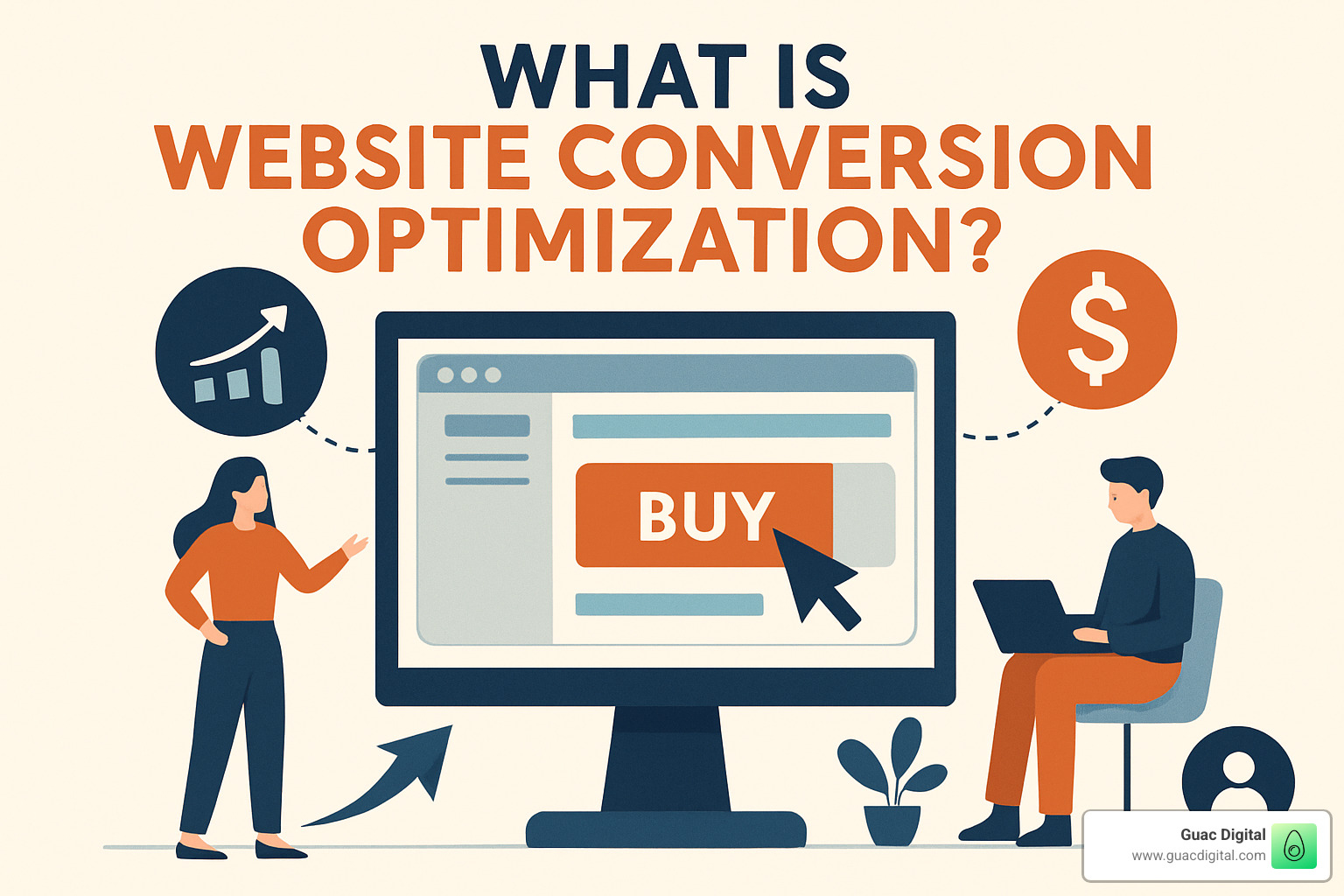
What is website conversion optimization? It’s the systematic process of increasing the percentage of website visitors who take a desired action – whether that’s making a purchase, signing up for a newsletter, or filling out a contact form.
Here’s a quick breakdown of website conversion optimization:
| Key Element | Description |
|---|---|
| Definition | The process of improving your website to increase the percentage of visitors who complete desired actions |
| Goal | Turn more existing traffic into leads, customers, and sales |
| Formula | Conversion Rate = (Number of Conversions ÷ Number of Visitors) × 100 |
| Average Rate | 2-3% for ecommerce; top performers achieve 10%+ |
| Benefits | Increased revenue, lower acquisition costs, better ROI from existing traffic |
Are you spending all your marketing budget driving traffic to your website, only to watch most visitors leave without taking action? You’re not alone. The average website converts just 2.5-3% of its visitors into customers. That means 97% of your hard-earned traffic leaves without converting.
Website conversion optimization changes that equation.
Instead of pouring more resources into acquiring new visitors, conversion optimization focuses on getting more value from the traffic you already have. It’s about making strategic, data-driven improvements to your website that guide more visitors toward completing your desired actions.
As the founder and CEO of Guac Digital, I’m Guy Leon, and I’ve helped businesses increase their conversion rates by up to 350% through strategic what is website conversion optimization techniques that transform underperforming websites into conversion powerhouses.
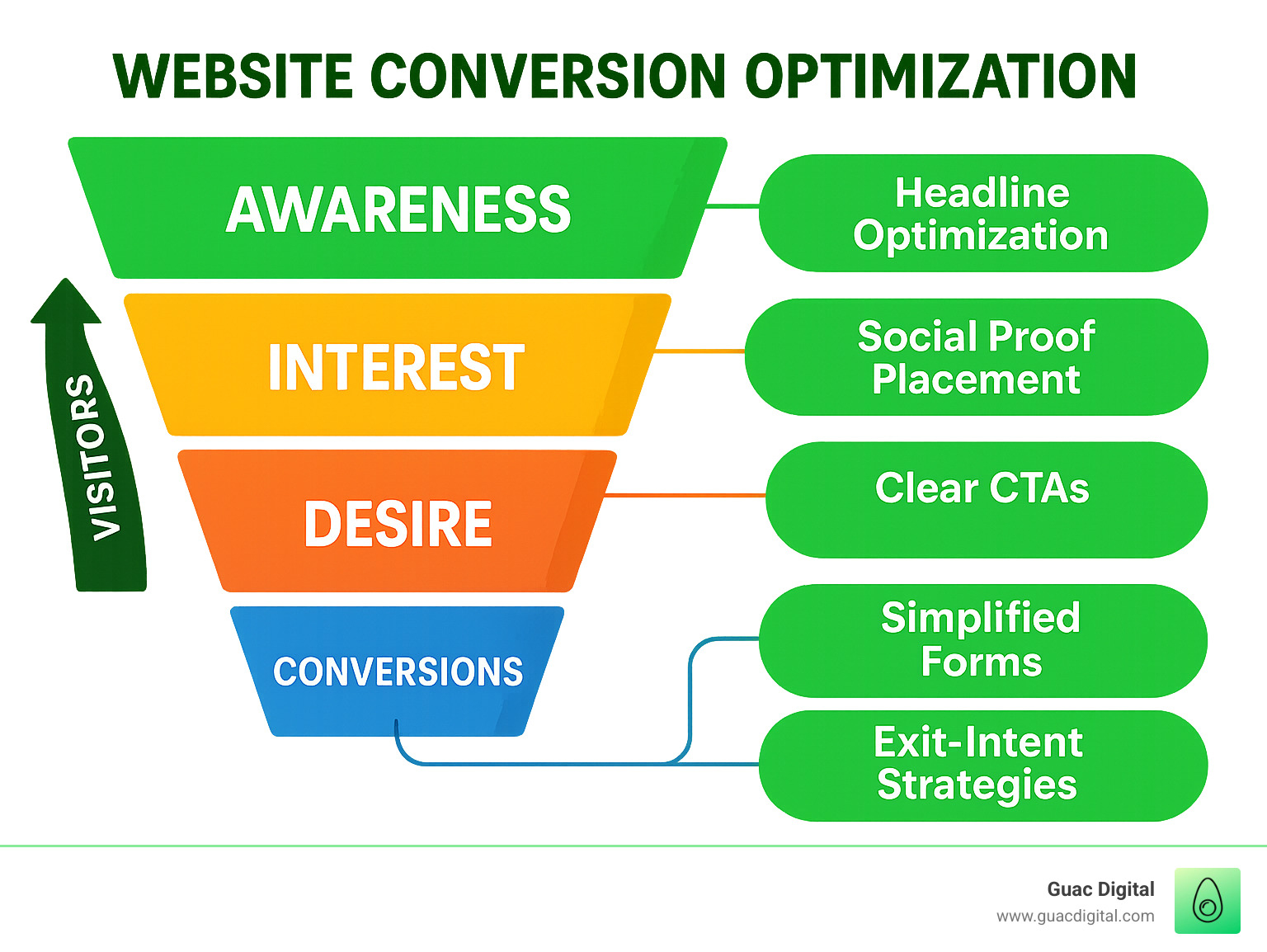
Common what is website conversion optimization vocab:
– conversion optimization for ecommerce website
– conversion rate optimization tools
– conversion rate optimization website design
What Is Website Conversion Optimization?
Website conversion optimization (also known as conversion rate optimization or CRO) is the methodical process of enhancing your website to increase the percentage of visitors who complete desired actions. These actions—called conversions—can range from making a purchase to signing up for a newsletter, downloading a resource, or requesting a demo.
Unlike strategies focused solely on driving more traffic to your website, conversion optimization maximizes the value of your existing visitors. Think of it this way: If your website gets 10,000 monthly visitors with a 2% conversion rate, you’ll generate 200 conversions. By improving your conversion rate to just 4%, you’d double your results to 400 conversions without spending an extra penny on traffic acquisition.
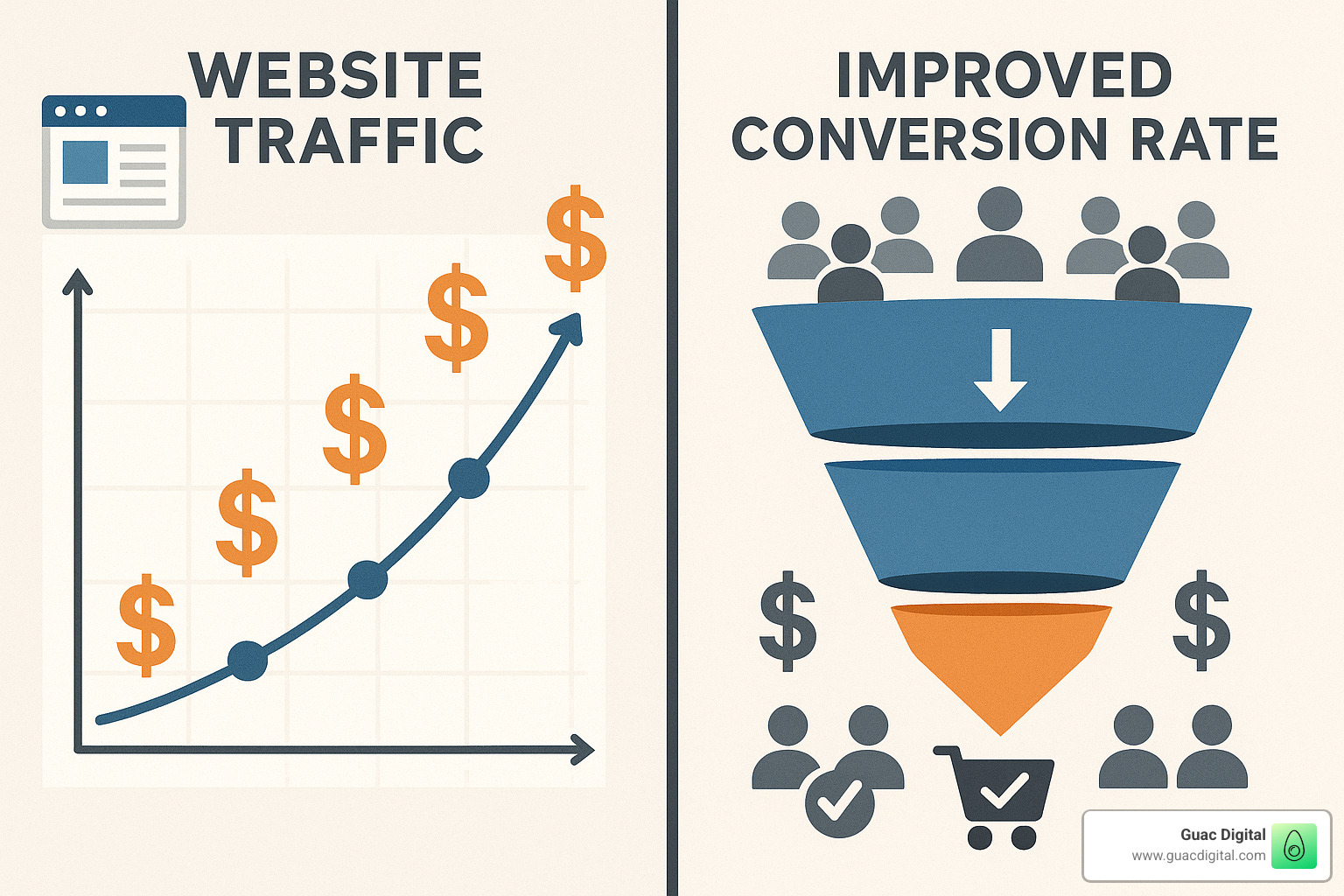
Here’s how traffic generation compares to conversion optimization:
| Approach | Primary Focus | Cost Structure | Time to Results | Long-term Value |
|---|---|---|---|---|
| More Traffic | Increasing visitor count | Ongoing ad spend or content creation | Immediate (paid); Months (organic) | Diminishing returns as costs increase |
| Higher Conversion | Improving visitor value | One-time optimization costs | 1-3 months for testing cycle | Compound returns on all traffic sources |
At Guac Digital, we’ve seen that optimizing for conversions often delivers a significantly higher ROI than simply driving more traffic. It’s like choosing between two paths to grow your business: continuously paying to attract new visitors, or making your current visitors more valuable. The math usually favors the latter.
As marketing expert Tim Ash explains in Landing Page Optimization, “The goal is not to generate traffic, but to generate the right kind of traffic and then convert it efficiently.” We couldn’t agree more!
What is website conversion optimization formula & benchmarks
The basic formula for calculating conversion rate is refreshingly simple:
Conversion Rate = (Number of Conversions ÷ Total Number of Visitors) × 100
Let me break this down with a real-world example. If your website receives 1,000 visitors in a month and generates 25 sales, your conversion rate would be (25 ÷ 1,000) × 100 = 2.5%. Pretty straightforward, right?
But the question I hear most often is: “What’s a good conversion rate?” While there’s no one-size-fits-all answer, here are some helpful benchmarks:
- Average ecommerce conversion rate: 2.5-3%
- Above-average websites: 5-6%
- Top 10% of websites: 10%+ conversion rates
According to a 2023 survey by Ruler Analytics, the average conversion rate across fourteen different industries was 2.9%. So if you’re hovering around 3%, you’re keeping pace with the average. But at Guac Digital, we’re not fans of settling for average!
These benchmarks are just reference points. The most meaningful comparison is against your own historical performance. We help our clients establish baseline metrics and then work to continuously improve upon them through our conversion optimized website strategies.
What is website conversion optimization vs direct-response heritage
Website conversion optimization might seem like a shiny new digital marketing concept, but it’s actually built on principles that are over a century old. It’s like finding your trendy new outfit was inspired by classic fashion from decades past!
CRO as we know it today emerged in the early 2000s after the dot-com bubble burst. As businesses picked up the pieces, they realized having a website wasn’t enough—that website needed to drive actual business results.
A game-changing moment came in 2007 when Google launched Website Optimizer, democratizing A/B testing for marketers without technical expertise. Suddenly, anyone could test different versions of their web pages to see which performed better.
But here’s the fascinating part: the core principles of CRO—testing different approaches, measuring responses, and refining based on results—are essentially digital versions of techniques pioneered by direct mail marketers in the early 20th century. These early marketers would test different headlines, offers, and calls to action in their mailings to determine which versions got more people to respond.
As explained in Conversion Optimization: The Art and Science of Converting Prospects to Customers, modern CRO is a beautiful marriage of these time-tested direct marketing principles with digital analytics, user experience design, and behavioral psychology.
At Guac Digital, we appreciate this rich heritage while embracing cutting-edge technology to help our clients turn more visitors into customers. After all, good marketing principles never go out of style—they just find new expressions in each era.
Why CRO Matters: Business Impact, ROI & Evidence
Ever wonder why some businesses thrive online while others struggle despite heavy traffic? The secret often lies in website conversion optimization. It’s not just a fancy marketing term—it delivers real, measurable benefits that can transform your business results.
When you implement effective conversion strategies, you’re essentially getting more value from what you already have. Think about it: by doubling your conversion rate from 2% to 4%, you’ve effectively doubled your revenue without spending an extra penny on advertising. That’s the magic of optimization.
Website conversion optimization creates a powerful ripple effect across your business. Your customer acquisition costs naturally decrease as more visitors convert into customers. Every marketing channel—from your Google Ads to your organic search traffic—performs better when your website is optimized to convert. And that painful 69.9% cart abandonment rate that plagues most online stores? Strategic optimization can significantly reduce it, recovering revenue that would otherwise vanish.
Perhaps most importantly, conversion optimization and user experience work hand-in-hand. When you optimize for conversions, you’re typically creating a more intuitive, user-friendly experience that leaves customers satisfied and more likely to return.
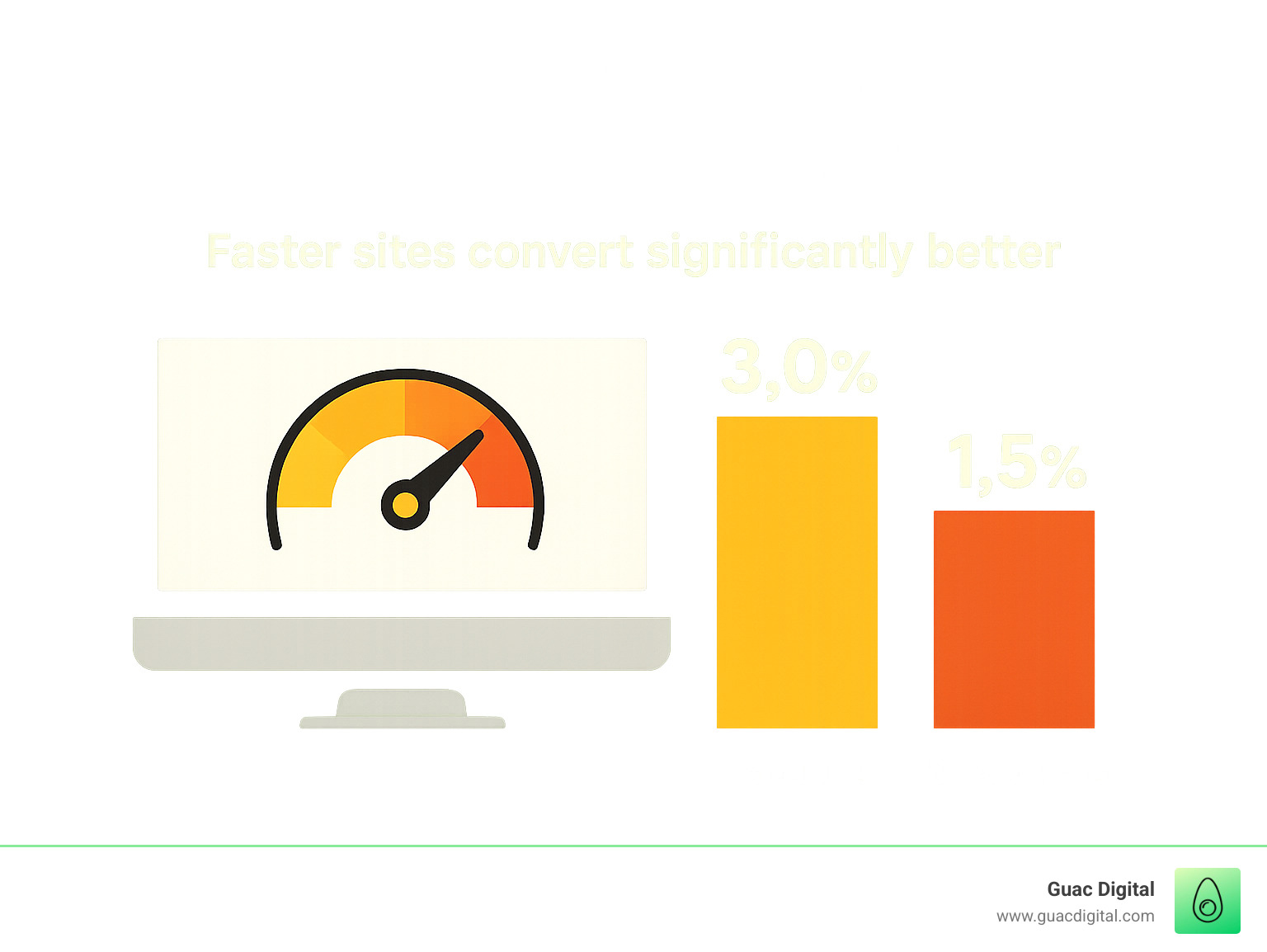
The evidence supporting CRO’s effectiveness is compelling and backed by research. According to scientific research on page speed, websites that load within one second convert at rates 2.5 times higher than those taking five seconds. Similarly, adding social proof elements like customer reviews can boost conversions anywhere from 3% to 37%, depending on the number of reviews displayed.
At Guac Digital, we don’t just implement random “best practices”—we create data-driven marketing strategies that systematically improve conversion opportunities throughout your customer’s journey.
Stat spotlight: Faster sites convert more
The relationship between how quickly your site loads and how many visitors convert isn’t just important—it’s dramatic. The numbers tell a compelling story:
- Sites loading in 1 second achieve conversion rates of 3.05%, while those taking just 1 second longer drop to 1.68%
- A whopping 70% of consumers admit that page speed directly influences their purchasing decisions
- For every second of delay in loading, conversions drop by approximately 7%
- Even tiny improvements matter—businesses have seen conversion rates climb by 1% for every 100ms of improved load time
Even after a visitor abandons your site, optimization opportunities remain. Abandoned cart emails boast an impressive 45% open rate. Of those opened, 21% receive clicks, and half of those clicks result in completed purchases. This simple recovery strategy alone can recapture significant revenue that would otherwise be lost forever.
Benefit breakdown for stakeholders
The beauty of website conversion optimization is how it benefits everyone in your organization—not just the marketing department.
For Marketing Teams, optimization means getting more bang for every marketing buck. Your campaigns deliver better ROI, you generate more leads and sales without increasing traffic, and you gain valuable data-driven insights that inform future strategies. Instead of constantly hunting for more visitors, you maximize the value of those already arriving at your site.
For Sales Teams, optimization translates to higher quality leads who are better aligned with your offerings. This alignment typically shortens sales cycles and improves lead-to-customer conversion rates. There’s also better harmony between what marketing promises and what sales delivers, creating a smoother customer journey.
For Executive Leadership, the benefits are clear on the bottom line: increased revenue without proportional cost increases, competitive advantage in crowded markets, deeper customer insights for strategic planning, and significantly improved return on marketing investments.
For Customers—perhaps most importantly—optimization creates more intuitive experiences that help them find what they need faster. They encounter clearer information that supports confident decision-making and enjoy smoother checkout or conversion processes that respect their time and preferences.
By focusing on conversions rather than just traffic, your business can scale growth without constantly increasing ad spend. This creates a foundation for sustainable success and higher customer lifetime value—the kind of results we love delivering at Guac Digital.
The CRO Framework: Process, Testing & Tools
Successful website conversion optimization isn’t about random changes or following hunches – it’s about following a proven framework that blends science with creativity. At Guac Digital, we’ve refined this process through years of working with clients across industries, and I’m excited to share it with you.
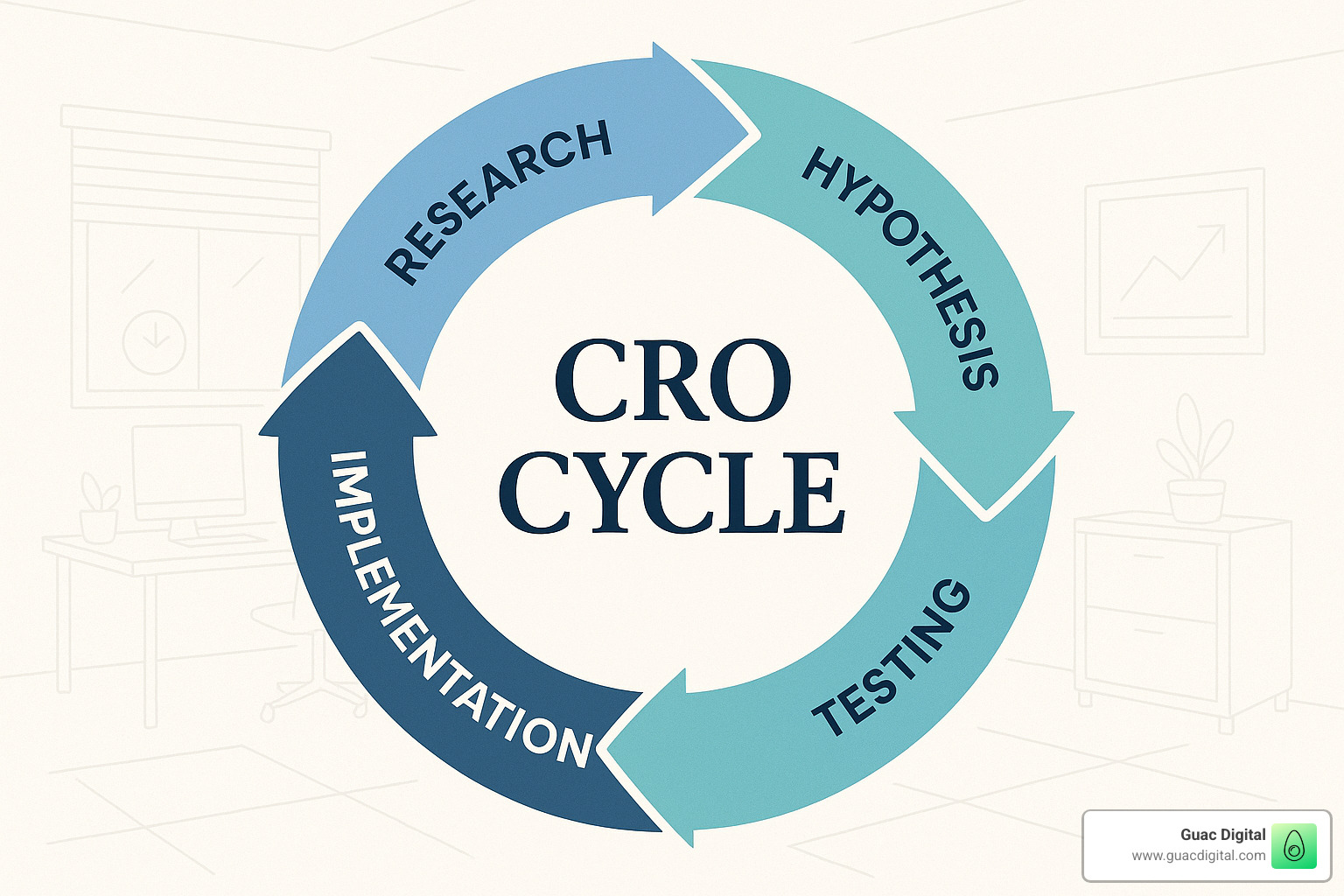
Think of CRO as being a bit like detective work – you gather clues, form theories, test them systematically, and then use what you learn to solve the case of the “disappearing visitors.”
The Core CRO Process
The journey starts with research and analysis – diving into your analytics to see where visitors drop off and complementing those numbers with qualitative insights from actual users. It’s like interviewing witnesses at the scene!
Next comes the fun part – hypothesis formation. This is where you get to say, “I think visitors are leaving because our form is too long” or “People might convert more if we showed social proof earlier.” A solid hypothesis follows a simple formula: “By changing [element], we believe we will achieve [outcome] because [rationale].”
Not all ideas are created equal, which is why prioritization is crucial. We love using the PIE framework – scoring each idea based on its Potential impact, Importance to your goals, and Ease of implementation. This prevents you from chasing shiny objects when there are bigger wins waiting.
Then comes the moment of truth – testing. Whether it’s a straightforward A/B test comparing two button colors, a multivariate test examining several elements at once, or a complete page redesign, this is where your theories meet reality.
After gathering enough data for statistical significance, it’s time for analysis and implementation. The numbers don’t lie – they’ll tell you whether your hypothesis was right, wrong, or somewhere in between. The winners get implemented, and the learnings (even from “failed” tests) become fuel for your next round of optimization.
Iteration is the secret sauce. CRO isn’t a one-and-done project but a continuous cycle of improvement. Each test, regardless of outcome, makes you smarter about your audience and their preferences.
For a deeper dive into this process, check out our comprehensive guide on how to optimize website for conversions.
Step-by-Step: Launching your first what is website conversion optimization experiment
Ready to dip your toes into the CRO waters? Let me walk you through launching your first experiment:
Start by setting a clear goal – what exactly are you trying to improve? Is it email signups, product purchases, or consultation bookings? Being specific helps you measure success accurately.
Next, identify a test opportunity that gives you the best chance of seeing meaningful results. Look for pages with decent traffic but underwhelming conversion rates – your homepage, popular landing pages, product pages, or checkout process are usually good candidates.
Before launching, calculate your required sample size using a tool like Optimizely’s calculator. This tells you how long your test needs to run to be statistically valid. Shooting for 95% confidence is a good standard – it means there’s only a 5% chance your results are due to random chance.
Now for the creative part – creating your variation. For your first test, focus on something high-impact yet straightforward. Maybe it’s rewriting your headline to address a key customer pain point, changing your CTA button from “Submit” to “Get My Free Quote,” reducing your form fields from ten to four, or swapping that stock photo for an image of real customers.
With your variation ready, it’s time to implement the test using your chosen testing tool. These platforms will automatically split your traffic between versions and track which performs better.
The hardest part might be patience – monitoring and analyzing requires letting the test run its full course. Resist the urge to call winners early, as conversion patterns often fluctuate throughout the week.
Finally, implement and iterate based on what you learn. If your variation won, make it the new standard. If it lost or tied, that’s still valuable information about what doesn’t resonate with your audience.
Even tests that don’t produce winners aren’t failures – they’re lessons that guide your next experiment. At Guac Digital, we celebrate these insights just as much as the big wins because they all move us forward.
Essential Tool Stack
Building your website conversion optimization program is a bit like assembling a toolkit for home renovation – you need the right instruments for each job. Here’s what we recommend:
For understanding visitor behavior, analytics tools are your foundation. Google Analytics 4 tracks the overall patterns, Google Tag Manager helps implement specific tracking events, and heat mapping tools like Hotjar or Crazy Egg show you exactly where users click, scroll, and focus their attention. Watching session recordings can be eye-opening – you’ll see real users getting confused by elements you thought were crystal clear!
When it comes to running experiments, testing platforms make the technical side manageable. Google Optimize is perfect for beginners (and free!), while platforms like Optimizely or VWO offer more advanced features for enterprise needs. Unbounce is fantastic if you’re specifically optimizing landing pages.
Don’t forget the importance of user research tools to add the “why” behind the “what” in your data. Simple surveys through SurveyMonkey or Typeform can uncover visitor motivations, while services like UserTesting provide video feedback of real people using your site and verbalizing their thoughts.
To actively improve conversions, consider conversion improvement tools like personalization AI that adapts content based on visitor behavior, chatbots that provide instant assistance when visitors get stuck, and email automation to recover abandoned carts or nurture leads who weren’t quite ready to convert.
The beauty of website conversion optimization is that you don’t need every tool at once – start with the basics and expand as your program matures. At Guac Digital, we help clients choose the right tools based on their specific needs, technical capabilities, and budget.
One fascinating aspect of CRO is how it leverages psychological principles like loss aversion. According to scientific research on loss aversion, people are typically twice as motivated to avoid losing something as they are to gain something of equal value. That’s why limited-time offers, countdown timers, and “only 3 items left” messaging can be so effective – they tap into our deep-seated fear of missing out.
High-Impact Areas, Tactics & Cross-Channel Synergy
When it comes to website conversion optimization, not all website elements are created equal. At Guac Digital, we’ve finded through years of testing that certain areas consistently deliver bigger conversion boosts than others. Let’s explore these high-impact opportunities that can transform your website’s performance.
High-Impact Optimization Areas
Your homepage serves as your digital storefront, making it crucial for conversions. The key is clarity above the fold—visitors should immediately understand your value proposition without scrolling. Keep navigation intuitive, showcase compelling social proof (like client logos or testimonials), and feature one prominent call-to-action that guides visitors toward your primary conversion goal.
Product pages can make or break your ecommerce success. High-quality images showing products from multiple angles help visitors virtually “touch” your products. Write descriptions that are both detailed and scannable—bullet points work wonders here. Customer reviews build trust, while clear pricing and shipping information remove purchase barriers. Don’t forget trust signals like money-back guarantees or security badges that reassure hesitant buyers.
For landing pages, focus is everything. Unlike your main website, landing pages should have a single purpose—getting that conversion. This means removing navigation menus and other distractions that could lead visitors away. Maintain “message match” between your ads and landing page content so visitors feel they’ve arrived at the right place. Compelling headlines addressing specific pain points and supportive visuals will keep visitors engaged.
Your checkout process deserves special attention—it’s where the magic happens…or doesn’t. Every unnecessary form field or extra step can send potential customers running. Offer guest checkout options (not everyone wants to create an account), display security badges prominently, provide multiple payment methods, and eliminate surprise costs that appear at the last minute.
When it comes to forms, less is more. Each additional field reduces your chances of conversion, so stick to collecting only essential information. Use inline validation to provide immediate feedback as users complete fields, and consider multi-step forms for complex information gathering. Progress indicators help users understand how much more time they’ll need to invest—reducing abandonment.
For deeper ecommerce-specific strategies, our guide on conversion optimization for ecommerce website offers additional insights custom to online stores.
Quick wins with CTAs & forms
Looking for fast results? Call-to-action buttons and forms offer some of the quickest conversion wins with minimal effort.
For CTAs that convert, color contrast is your friend—buttons should visually pop against your page design. Use action-oriented, first-person verbs that put visitors in the driver’s seat. “Get My Free Guide” feels more personal and action-oriented than the generic “Download Guide.” Creating a sense of urgency with time-limited offers can also boost click-through rates significantly.
The words you choose matter tremendously. High-converting verbs like “Get,” “Claim,” “Start,” “Try,” and “Join” create momentum and excitement. Position these powerful CTAs at natural decision points throughout your page, and don’t be afraid to test variations in button size, shape, and surrounding white space.
Form optimization can dramatically increase completion rates. The golden rule? Limit required fields to the absolute minimum. Group related fields logically, use clear labels, and implement smart defaults where possible. Helper text can clarify confusing fields, while thoughtful microcopy around your forms—like “We won’t spam you” or “No credit card required”—addresses common objections before they arise.
An often-overlooked opportunity is the text-based CTA. HubSpot research shows that contextual, anchor-text CTAs within content can generate up to 93% of a post’s leads compared to image-based CTAs at the end. These feel more natural and helpful rather than promotional—perfect for content marketing.
Leveraging SEO & CRO together
SEO and CRO might seem like separate disciplines, but they’re actually perfect partners. Think of it this way: SEO brings the right visitors to your site, while CRO ensures those visitors take action once they arrive.
Both disciplines prioritize user experience and site performance, and the insights from each can inform the other. When you align keyword intent with conversion goals, you’re targeting visitors who are actually ready to convert—not just any traffic. This means understanding the difference between informational queries (“what is website conversion optimization”) and transactional ones (“hire conversion optimization agency”).
Message match creates continuity between what visitors see in search results and what they find on your page. When expectations are met, conversions increase. Similarly, schema markup improves your search listings with rich snippets that can boost click-through rates and set proper expectations.
Page speed serves both masters—fast-loading pages rank better and convert better. The research is clear: websites loading within one second convert 2.5 times higher than those loading in five seconds. Every millisecond counts!
Creating content for each funnel stage ensures you’re capturing potential customers wherever they are in their journey—from awareness to consideration to decision. This comprehensive approach builds trust while moving visitors closer to conversion.
At Guac Digital, we believe in this integrated approach to SEO and CRO, helping our clients’ websites both rank well and convert effectively. Learn more about how we combine these powerful strategies in our guide to Boost Your Online Presence with Expert SEO Services.
Conclusion
Turning browsers into buyers isn’t just about tweaking a button color here or testing a headline there. Website conversion optimization is truly about changing your entire digital presence into a smooth pathway that guides visitors toward becoming customers.
I’ve seen how businesses transform when they shift focus from constantly chasing new traffic to making the most of visitors already coming to their site. The math is simple but powerful: converting just 1% more of your existing visitors can dramatically boost your revenue without spending another dollar on ads.
The beauty of conversion optimization lies in its methodical approach. At Guac Digital, we’ve helped clients achieve remarkable results by following a proven process – researching user behavior, forming clear hypotheses, testing thoughtfully, and continuously refining based on real data. This systematic approach eliminates guesswork and replaces assumptions with insights.
When you’re ready to start optimizing, remember to focus your energy where it matters most. Your homepage, product pages, and checkout process typically offer the highest-impact opportunities. These high-traffic, high-potential areas can deliver significant returns when optimized properly.
Website conversion optimization isn’t a one-and-done project – it’s an ongoing journey of findy and improvement. The most successful businesses we work with have acceptd testing as a continuous practice, constantly refining their approach based on visitor behavior and preferences.
For truly transformative results, we’ve found that integration is key. When your conversion strategy works hand-in-hand with SEO, paid advertising, and content marketing, each channel amplifies the others, creating a unified experience that guides visitors naturally toward conversion.
Here at Guac Digital, we pride ourselves on helping businesses in Tampa, Florida and around the world implement data-driven strategies that deliver measurable results. Our approach blends sophisticated analytics with creative marketing expertise to create personalized strategies that drive exceptional ROI for our clients.
Is your website just an online brochure, or is it actively converting visitors into customers? If you’re ready to transform your digital presence into a conversion powerhouse, explore our comprehensive digital marketing services or reach out today for a conversation about your specific goals.
Remember – every person who visits your website represents an opportunity. With thoughtful, strategic conversion optimization, you can turn more of those opportunities into loyal customers and sustainable growth for your business.