
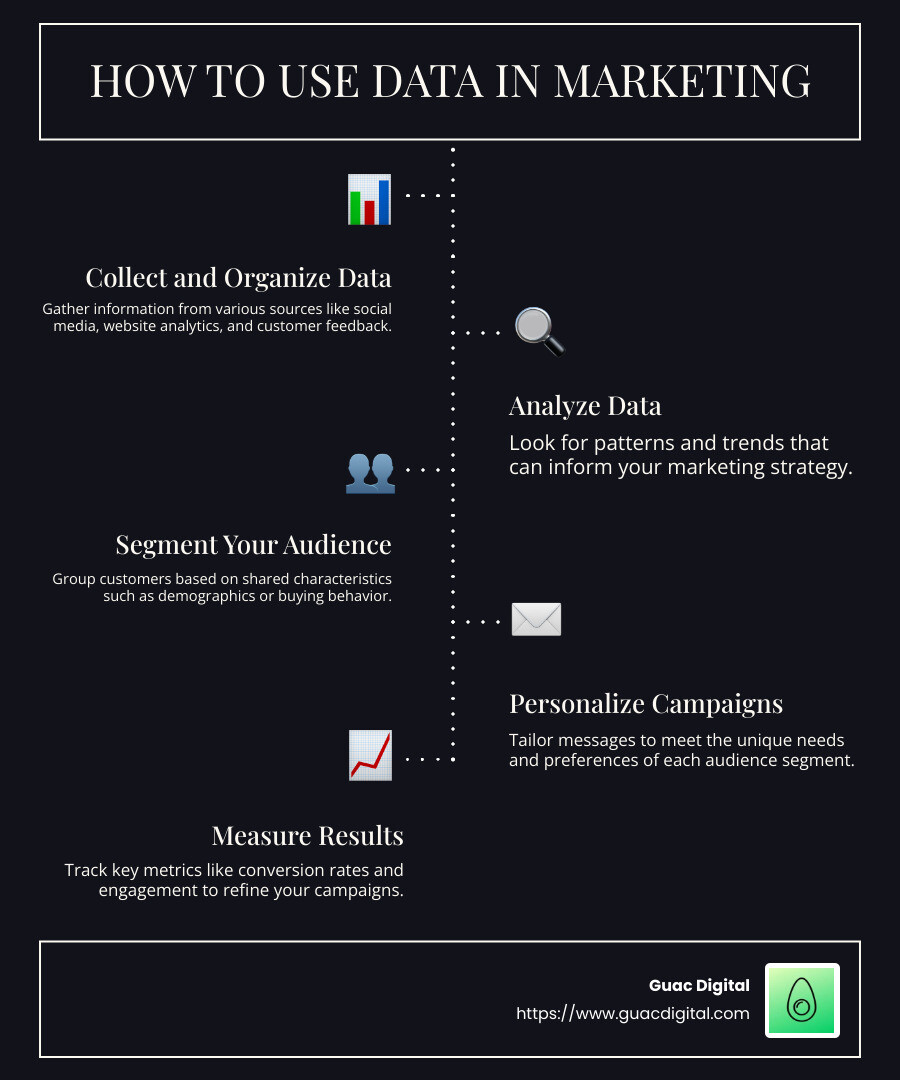
How to use data in marketing? It’s more straightforward than you might think. At its heart, it’s about knowing your audience better and using that understanding to craft smarter campaigns. Here’s a quick rundown:
Collect and organize data: Start by gathering information from various sources like social media, website analytics, and customer feedback.
Analyze data: Look for patterns and trends that can inform your marketing strategy.
Segment your audience: Group customers based on shared characteristics, such as demographics or buying behavior.
Personalize campaigns: Tailor messages to meet the unique needs and preferences of each audience segment.
Measure results: Track key metrics like conversion rates and engagement to refine your campaigns.
In today’s digital landscape, data-driven marketing transforms how businesses connect with potential customers. By leveraging data, companies not only see who their audience is but also understand what they want. This means creating marketing messages that resonate, resulting in increased engagement and conversions.
As the founder and CEO of Guac Digital, I, Guy Leon, have seen the transformative power of data in marketing. Our innovative strategies have boosted engagement rates and helped businesses forge deeper connections with their audiences. In the next sections, we’ll dig deeper into how to harness data’s full potential for your marketing efforts.
Basic How to use data in marketing? glossary:
– How to increase online presence?
– seo copywriting and content optimization services
– small business seo
What is Marketing Data?
Marketing data is the backbone of any successful marketing strategy. It provides the insights needed to understand and connect with your audience effectively. Let’s break down the main types of marketing data you should know about:
Demographic Data
Demographic data is all about knowing who your customers are. It includes:
- Age
- Gender
- Income
- Education level
- Marital status
This information helps tailor your marketing efforts. For instance, targeting a younger audience might mean using social media platforms like Instagram or TikTok, while an older demographic might respond better to email campaigns.
Firmographic Data
For businesses targeting other businesses (B2B), firmographic data is crucial. This data includes:
- Company size
- Industry
- Annual revenue
- Location
Knowing these details allows you to customize your offerings. A software company might offer different solutions based on whether a business is a startup or a large corporation.
Geographic Data
Geographic data pinpoints where your customers are located. This is vital for local marketing strategies. A coffee shop in Tampa might use geographic data to send promotions to nearby residents, while a global brand might tailor content to fit cultural preferences in different regions.
Behavioral Data
Behavioral data tracks how customers interact with your brand. It includes:
- Purchase history
- Website visits
- Social media interactions
This data helps you understand customer preferences and predict future behavior. For example, if a customer frequently buys running shoes, you might target them with ads for new athletic gear.
Survey Data
Survey data comes directly from your customers. It provides insights into customer satisfaction, preferences, and needs. Regular surveys can help keep your marketing strategies aligned with customer expectations.
Chronographic Data
Chronographic data involves timing. It looks at when customers are most likely to engage with your brand. Understanding these patterns can optimize the timing of your campaigns for maximum impact.
By using these various types of marketing data, businesses can create highly targeted and effective marketing campaigns. In the next section, we’ll explore how to implement data-driven strategies to further improve your marketing efforts.
How to Use Data in Marketing?
Implementing data-driven strategies is crucial for effective marketing. Here’s how to leverage data for smarter campaigns:
Goal-Setting
Start by setting clear and measurable goals for your marketing campaigns. Whether it’s increasing brand awareness or boosting sales, having specific objectives helps guide your data-driven strategy. For instance, if your goal is to grow your Millennial audience, you can track engagement metrics on platforms like Instagram or TikTok to measure success.
Data Collection
Collecting the right data is the foundation of a successful strategy. Use a mix of in-house data and third-party data to get a complete picture of your audience. In-house data includes everything from social media engagement to purchase history, while third-party data can fill in gaps, such as interests outside your brand.
Data Analysis
Once you have your data, the next step is data analysis. This involves processing the data to extract valuable insights. Use tools like Google Analytics to track website performance or CRM systems to understand customer interactions. The goal is to identify patterns and trends that can inform your marketing decisions.
Campaign Performance
Monitoring campaign performance is essential to understand what’s working and what isn’t. Track metrics like click-through rates, conversion rates, and customer acquisition costs. This data helps you adjust your strategies in real-time for better results.
Personalization
Personalization is key in today’s marketing landscape. Use customer data to tailor your messages and offers. For example, if a customer frequently purchases athletic gear, send them personalized recommendations for new products. This not only increases conversion rates but also improves customer loyalty.
Targeting
Effective targeting means reaching the right audience with the right message. Use demographic and behavioral data to segment your audience and create targeted campaigns. This ensures your marketing efforts are focused and efficient, reducing wasted spend.
Predictive Analytics
Predictive analytics uses machine learning to forecast future customer behavior. By analyzing past interactions, you can predict what customers are likely to buy next. This allows you to proactively target them with relevant offers, increasing the chances of conversion.
Overcoming Challenges
Implementing data-driven strategies comes with its own set of challenges:
Data Quality: Ensure your data is accurate and up-to-date to avoid targeting the wrong audience. Regularly audit your data to maintain quality.
Security Concerns: Protect customer data with encryption and limited access rights to prevent breaches. A comprehensive data breach response plan is also essential.
Data Silos: Break down silos by centralizing data storage and using tools that facilitate data sharing across teams. This improves collaboration and ensures everyone has access to the same information.
Skill Gaps: Invest in training your team to ensure they have the necessary skills to collect, analyze, and interpret data effectively.
By addressing these challenges and leveraging data effectively, you can improve your marketing strategies and achieve better results.
Top Examples of Data-Driven Marketing Strategies
In today’s competitive landscape, data-driven marketing is no longer optional—it’s essential. Let’s explore some top strategies that leverage data to create smarter, more effective campaigns.
Omnichannel Marketing
Customers interact with brands across multiple platforms. Omnichannel marketing ensures a seamless experience across these channels. By sharing data between platforms, you can create a unified customer profile. For instance, if a customer views a product on social media, they should easily find the same product on your website. This approach not only improves user experience but also increases engagement and conversion rates.
Demographic Targeting
Knowing your audience is key to successful marketing. Demographic targeting uses data like age, income, and education to tailor campaigns. Imagine you’re promoting a luxury watch brand. Instead of targeting everyone, focus on neighborhoods with higher income levels. This precision ensures your marketing dollars reach the most promising prospects, boosting ROI.
Personalized Customer Journey
Consumers expect personalized experiences. According to McKinsey, 71% of consumers expect companies to deliver personalized interactions. Use data to offer custom product recommendations and messaging. For example, if a customer often buys running shoes, suggest related products like socks or fitness trackers. Personalization not only improves customer satisfaction but also drives repeat purchases.
Predictive Analytics
Predictive analytics is a game-changer. By analyzing past data, you can forecast future customer behavior. This allows you to anticipate needs and offer relevant products or services. For example, if data shows customers often buy a phone case two weeks after purchasing a phone, you can target them with case promotions at the right time. This proactive approach boosts sales and customer satisfaction.
Data Onboarding
To harness the full power of data, businesses must excel at data onboarding. This involves integrating offline data (like in-store purchases) with online data to create a comprehensive view of the customer. By doing so, you can better understand customer behavior and preferences across all touchpoints, leading to more informed marketing decisions.
By implementing these data-driven strategies, businesses can create more effective campaigns, improve customer engagement, and ultimately drive higher revenue. Transitioning into these practices might seem daunting, but the benefits far outweigh the challenges.
Benefits of Using Data in Marketing
Data is the backbone of modern marketing, changing how brands engage with customers. Here are some key benefits of using data in marketing:
Improved Targeting
Using data allows marketers to pinpoint exactly who their audience is. Instead of casting a wide net, data helps you focus on the right people. For example, if you’re selling eco-friendly products, data can help identify environmentally conscious consumers. This precision targeting increases the chances of conversion and reduces wasted marketing spend.
Improved Campaign Performance
Data-driven marketing empowers brands to track and measure campaign performance in real time. By analyzing metrics like click-through rates and conversion rates, marketers can quickly identify what’s working and what’s not. This enables them to make data-informed adjustments on the fly, optimizing campaigns for better results.

Competitive Advantage
In a crowded market, standing out is crucial. Using data gives brands a competitive edge by providing insights that drive unique and personalized marketing strategies. Companies that leverage data effectively can anticipate market trends and customer needs, staying ahead of competitors who rely on intuition alone. For instance, brands using predictive analytics can offer products to customers even before they realize they need them.
Higher ROI
Data-driven marketing is not just about better targeting and personalization; it’s also about maximizing return on investment (ROI). According to research, businesses that use data marketing strategies achieve five to eight times higher ROI than those that don’t. By efficiently allocating resources and focusing on high-potential leads, companies can significantly boost their marketing efficiency and profitability.
Incorporating data into marketing strategies is not just beneficial—it’s essential for success in today’s digital landscape. The ability to harness data effectively will continue to separate the leaders from the laggards.
Next, let’s address some common questions about using data in marketing.
Frequently Asked Questions about Using Data in Marketing
How do you use data in marketing?
Using data in marketing is a multi-step process that revolves around goal-setting, data collection, data analysis, and campaign performance.
Goal-Setting: Start by clearly defining what you want to achieve. Are you looking to increase sales, improve brand awareness, or improve customer engagement? Setting specific goals helps in identifying the type of data you’ll need.
Data Collection: Gather relevant data from various sources. This could be demographic data like age and income, firmographic data for B2B marketing, or geographic data to understand where your customers are. Behavioral data, such as purchase history or website interactions, is also crucial.
Data Analysis: Once collected, analyze the data to extract actionable insights. Look for patterns or trends that can inform your marketing strategies. Tools like Google Analytics or CRM platforms can help in organizing and interpreting this data.
Campaign Performance: Use the insights gained to design and execute marketing campaigns. Continuously monitor key metrics like click-through rates or conversion rates to assess performance. This allows you to make informed adjustments and optimize for better results.
What type of data is used in marketing?
Marketing relies on various data types, each serving a unique purpose:
Demographic Data: Includes age, gender, income, and education level. This helps tailor messages to specific audience segments.
Firmographic Data: Pertains to businesses, covering aspects like industry, company size, and revenue. It’s essential for B2B marketers.
Geographic Data: Focuses on the physical location of your audience. This can guide location-based marketing efforts.
Behavioral Data: Tracks customer actions, such as purchase history or online behavior. This data is vital for understanding customer preferences and predicting future actions.
Why do we need data in marketing?
Data is essential in marketing for several reasons:
Customer Understanding: Data provides a window into customer preferences and behaviors, enabling marketers to create personalized experiences that resonate with their audience.
Decision-Making: Reliable data supports informed decision-making. By understanding market trends and consumer needs, marketers can craft strategies that are more likely to succeed.
ROI Optimization: Using data effectively can lead to significant improvements in return on investment. By targeting the right audience and refining campaign strategies, businesses can maximize their marketing spend and achieve better outcomes.
Incorporating data into marketing is not just a trend—it’s a necessity for any brand aiming to thrive in today’s competitive landscape. Up next, we’ll explore some top examples of data-driven marketing strategies.
Conclusion
At Guac Digital, we’ve seen how leveraging data can transform marketing strategies and drive high ROI. Our approach focuses on creating personalized strategies that resonate with individual clients, allowing us to deliver exceptional results.
Personalized Strategies: Personalization is at the heart of what we do. By analyzing data, we tailor our campaigns to meet the unique needs and preferences of each client. This ensures that every marketing effort is not just effective, but also relevant to the target audience. As Blaine Britten, Senior VP of Data Strategy at Stirista, emphasizes, “using data to drive meaningful experiences” is key to reducing waste and enhancing customer engagement.
High ROI: Data-driven marketing is not just about understanding your audience; it’s about optimizing every aspect of your marketing efforts to maximize returns. By using predictive analytics and personalized customer journeys, we ensure that our clients see a tangible increase in their marketing effectiveness. In fact, personalized marketing has been linked to higher business profits, with 90% of marketers attributing it to their success.
Guac Digital’s Expertise: Our team at Guac Digital excels in using big data to craft programmatic marketing campaigns that achieve outstanding results. Whether it’s through our SEO optimization services or other data-driven strategies, we are committed to helping our clients grow their online presence and reach their marketing goals.
When data is king, using it effectively is crucial for staying ahead of the competition. At Guac Digital, we are dedicated to using the power of data to create smarter campaigns that not only meet but exceed expectations. Partner with us, and let’s open up the full potential of your marketing data together.