
Boost Your Digital Presence with Small Business SEO
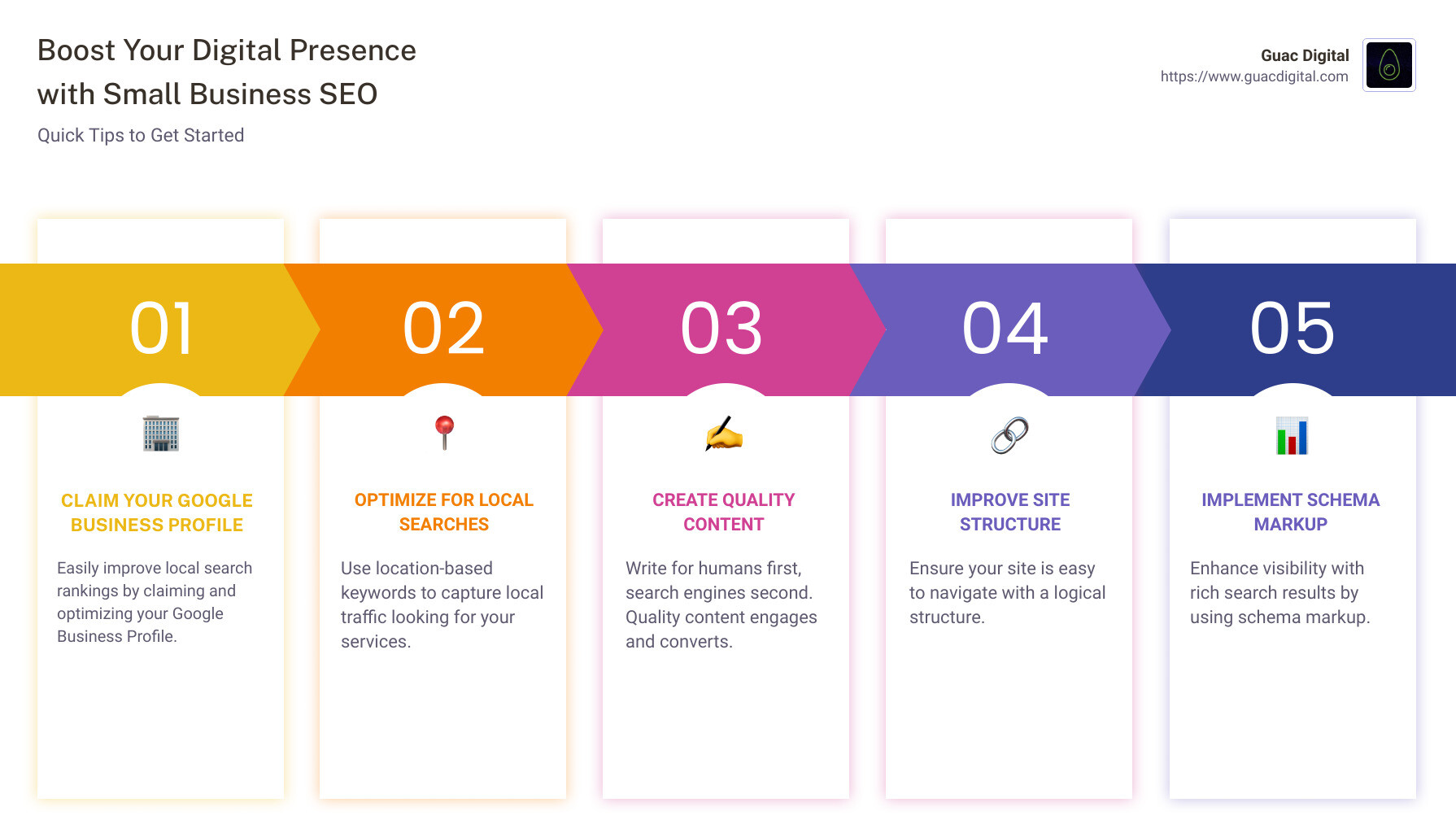
Small business SEO is essential for driving traffic and increasing online visibility. If you’re after quick tips to get started, here’s a snapshot:
- Claim your Google Business Profile: Easily improve local search rankings.
- Optimize for local searches: Use location-based keywords.
- Create quality content: Write for humans first, search engines second.
- Improve site structure: Make navigation simple and logical.
- Implement schema markup: Improve visibility with rich search results.
Small businesses can’t afford to ignore SEO. Simply put, small business SEO helps your site get noticed by the right audience online. Effective SEO strategies improve your brand’s visibility, drive traffic to your website, and increase customer engagement. Imagine your website being like a hidden gem; SEO is the map that guides potential customers right to it.
I’m Guy Leon, the founder and CEO of Guac Digital. Our team has helped numerous businesses boost their online presence and drive engagement through custom SEO strategies. From increasing website traffic by 300% to launching successful digital campaigns, we’re here to help you succeed.
What is SEO and How Does it Work?
SEO, or Search Engine Optimization, is the process of improving your website to increase its visibility when people search for products or services related to your business on search engines like Google. To make it simple, think of SEO as a way to make sure your website shows up when someone types in relevant keywords.
Organic Search Results
When you type a query into Google, the list of results that appears is known as the Search Engine Results Page (SERP). These results are ranked based on their relevance to the search term. Unlike paid ads, these are organic search results, meaning they are not paid for but earned through effective SEO practices.
Keyword Ranking
Keyword ranking refers to your web page’s position in these search results for a specific keyword. For example, if you own a sushi restaurant in Chicago, you’d want your website to rank high for keywords like “best sushi in Chicago.” The higher your keyword ranking, the more likely people are to visit your site.
Backlinks
Backlinks are links from other websites to your site. Think of them as votes of confidence. When reputable sites link to your content, it tells search engines that your site is trustworthy and valuable. However, be cautious: links from spammy sites can hurt your ranking. Regularly check and disavow any harmful backlinks.
Technical SEO
Technical SEO involves optimizing the backend of your website so search engines can easily crawl and index your content. This includes things like your HTML code, site speed, and mobile optimization.
Site Speed
Site speed is crucial. Google favors websites that load quickly because it improves the user experience. If your site takes too long to load, visitors might leave before even seeing what you offer.
Mobile Optimization
Mobile optimization ensures your website looks and functions well on mobile devices. With more people using their phones to search the web, a site that isn’t mobile-friendly will rank lower in search results.
By focusing on these elements, you can significantly improve your small business’s online visibility. SEO might seem complex, but breaking it down into these components makes it easier to understand and implement.
Next, we’ll dive into the importance of small business SEO and how it can benefit your company in the long run.
Importance of Small Business SEO
Brand Awareness
Small business SEO helps increase your brand’s visibility online. When your website ranks higher in search engine results, more people see your brand. According to BrightEdge research, organic search accounts for 53% of all online traffic. This means that appearing in search results can put your business in front of more potential customers, making your brand more recognizable.
Organic Traffic
Organic traffic is the visitors who come to your website through unpaid search results. This is the most valuable type of traffic because these visitors are actively searching for products or services like yours. BrightEdge also found that organic search contributes to 44% of revenue share. By optimizing your site for search engines, you can attract more organic traffic, leading to higher engagement and sales.
Cost-Effective Marketing
SEO is a cost-effective marketing strategy. Unlike paid advertising, where you pay for each click or impression, organic search traffic is free. While there are costs involved in optimizing your website and creating content, these are generally lower than the costs of paid advertising. Plus, the benefits of SEO are long-lasting. Once your website ranks well, it can continue to attract traffic without ongoing costs.
Long-Term Growth
SEO is a long-term strategy. It takes time to see results, but the benefits build up over time. Once your website starts ranking higher, it becomes harder for competitors to outrank you. This creates a solid foundation for sustained growth. According to Sagapixel data, almost half of all searches on Google have local intent, and 72% of consumers who perform a local search visit a store within five miles. This means that good SEO not only brings more traffic but also leads to more in-person visits and sales.
Local SEO
Local SEO is crucial for small businesses that rely on local customers. By optimizing your site for local searches, you can attract customers who are looking for products or services in your area. For example, claiming your Google Business Profile helps you show up in local search results and on Google Maps. This is vital because 97% of search engine users searched online to find a local business, and 50% of local searches resulted in a store visit within a day.
By focusing on these aspects, small business SEO can significantly boost your online presence, drive more traffic to your website, and ultimately increase your sales and revenue.
Next, we’ll explore the key components of small business SEO and how to implement them effectively.
Key Components of Small Business SEO
Keyword Research
Keyword research is the foundation of any successful small business SEO strategy. It helps you understand what your potential customers are searching for and how to target those terms effectively.
Tools to Use:
– Ahrefs: Excellent for finding keyword ideas and analyzing competitors.
– SEMrush: Provides keyword data, competitive analysis, and more.
– AnswerThePublic: Generates questions people are asking about your keywords.
– BuzzSumo: Identifies trending topics and content ideas.
Using these tools, you can identify keywords with high search volumes and low competition, giving you the best chance to rank well in search results.
On-Page Optimization
On-page optimization involves making changes directly on your website to improve its visibility on search engines.
Key Elements:
– Title Tags: Include your main keyword to improve relevance.
– Meta Descriptions: Write compelling descriptions that include your keyword to increase click-through rates.
– Headings: Use H1, H2, and H3 tags to structure your content and include keywords.
– Content Quality: Create high-quality, valuable content that addresses your audience’s needs.
– Internal Linking: Link to other relevant pages on your site to improve navigation and SEO.
Technical SEO
Technical SEO ensures that your website is easy for search engines to crawl and index.
Focus Areas:
– Site Speed: Google favors websites that load quickly. Compress images and use caching to improve speed.
– Mobile Optimization: Ensure your site is mobile-friendly, as more searches are conducted on mobile devices.
– Secure Connection: Use HTTPS to secure your website, which is a ranking factor for Google.
– Header Tags: Properly use header tags to structure your content and make it easier to read.
Backlink Building
Backlinks are links from other websites to yours. They are crucial for improving your site’s authority and ranking.
Strategies:
– High-Quality Backlinks: Aim to get links from reputable sites. These act as “votes of confidence” for your content.
– Internal Linking: Don’t overlook the power of linking to your own content. It helps with navigation and distributes link equity.
– Link-Building Strategy: Reach out to industry blogs, submit to directories, and collaborate with influencers to gain backlinks.
By focusing on these key components, you can effectively boost your small business SEO, driving more traffic and ultimately increasing your sales and revenue.
Next, we’ll dive into the importance of local SEO for small businesses.
Local SEO for Small Businesses
Local SEO is crucial for small businesses that rely on local customers. It helps to make your business more visible in local search results, driving foot traffic and online visits. Let’s explore some key elements of local SEO.
Google Business Profile
One of the first steps in local SEO is setting up your Google Business Profile (formerly Google My Business). This free tool lets you manage how your business appears on Google Search and Maps.
Steps to optimize your Google Business Profile:
1. Claim your business: If it already exists, claim it; if not, create a new profile.
2. Fill out your profile completely: Include your business name, address, phone number (NAP), and business hours.
3. Add photos and videos: High-quality images of your storefront, products, and services can attract more customers.
4. Collect reviews: Encourage satisfied customers to leave positive reviews. According to research, online reviews are a significant ranking factor for local SEO.
Local Search and Local Intent
Local search refers to searches with geographic qualifiers such as “near me” or “in [city name].” People often use these terms when they are ready to make a purchase. For instance, 46% of Google searches are for local businesses or services.
To optimize for local search:
– Use local keywords: Include your city or neighborhood name in your website content, meta titles, and descriptions.
– Create localized content: Write blog posts or articles about local events, news, or community activities related to your business.
Google Maps and “Near Me” Searches
Appearing on Google Maps is essential for local businesses. When people search for terms like “coffee shop near me,” Google Maps results are often the first thing they see.
Tips to optimize your presence on Google Maps:
– Embed a Google Map on your website: This helps Google verify your location.
– Ensure NAP consistency: Make sure your business name, address, and phone number are consistent across all online platforms.
– Get listed in local directories: Directories like Yelp, Bing Places, and Apple Maps can also help improve your local SEO.
Example of Local SEO Success
Consider a small bakery in Salt Lake City. By optimizing their Google Business Profile, using local keywords like “best bakery in Salt Lake City,” and encouraging customers to leave reviews, they saw a 500% ROI from their local SEO efforts. This bakery also appeared in the Local Map Pack, a prime spot that shows the top local businesses for relevant searches.
By focusing on these local SEO strategies, your small business can improve its visibility and attract more local customers.
Next, let’s look at five essential tips to maximize your small business SEO.
Five Tips to Maximize Your Small Business SEO
1. SEO is Not Only for Google
While Google is the big player in search engines, don’t overlook other platforms. Depending on your audience, sites like Amazon, Reddit, Yelp, YouTube, and Instagram can be equally valuable. For example, if you sell products, optimizing for Amazon can help you reach shoppers directly. Determine where your audience spends their time and optimize for those platforms.
2. SEO Strategy is Effective, but Not Instant
SEO is a long-term strategy. Results won’t be immediate, but they are worth the wait. Expect at least six months to see significant changes, especially if you are just starting. Building a solid foundation early on will make it harder for competitors to overtake you. SEO builds upon itself, so the more effort you put in, the better your results will be.
3. Target the Right Keywords
Using the right keywords is crucial. Tools like Ahrefs, SEMRush, AnswerThePublic, and BuzzSumo can help you find the most relevant keywords for your business. For instance, if you run a local bakery, targeting keywords like “best bakery in [Your City]” can help you attract local customers. These tools can guide you in creating content that your audience is searching for.
4. Write for Humans First, Search Engines Second
Your content should be engaging and relevant to your audience. High-quality content keeps visitors on your site longer and encourages interaction. For example, if you run a pet store, writing blog posts about pet care tips can attract pet owners. Avoid stuffing your content with keywords; this can turn readers away and hurt your search visibility. Focus on providing value to your readers, and search engines will reward you for it.
5. Maximize Local Search to Your Advantage
Local search is a goldmine for small businesses. According to Sagapixel, almost half of all Google searches have local intent. Claim your Google Business Profile and optimize it with accurate information and local keywords. Encourage satisfied customers to leave reviews. For instance, a local bakery that optimized its Google Business Profile and encouraged customer reviews saw a 500% ROI. Including your city or state in your keywords can also help you appear in local search results.
By following these tips, you can maximize your small business SEO and improve your online presence. Next, we’ll explore common mistakes in small business SEO and how to avoid them.
1. SEO is Not Only for Google
When we talk about small business SEO, most people think of Google. While Google is a giant in the search engine world, it’s not the only place where you should focus your SEO efforts. Depending on your audience and business type, platforms like Amazon, Reddit, Yelp, YouTube, and Instagram can be equally valuable.
Amazon
If you sell products, Amazon is a crucial platform. Optimizing your product listings with the right keywords can help you appear in Amazon’s search results. For example, using tools like Ahrefs or SEMRush can help you find the best keywords for your products.
Reddit is a community-driven platform where people discuss various topics. By engaging in relevant subreddits and providing valuable content, you can drive traffic to your site. For instance, a small tech gadget store could participate in tech-related subreddits to increase visibility.
Yelp
For local businesses, Yelp is a goldmine. Optimizing your Yelp profile with accurate business information, photos, and reviews can significantly boost your local search rankings. A study by Sagapixel shows that almost half of all Google searches have local intent, and Yelp often appears in these local searches.
YouTube
YouTube is the second largest search engine after Google. Creating high-quality video content that answers common questions related to your business can drive traffic to your site. For example, a small bakery can post baking tutorials and link back to their website.
Instagram is perfect for businesses with visually appealing products. Use relevant hashtags and engage with your audience to increase your visibility. For instance, a small fashion boutique can use Instagram to showcase new arrivals and drive traffic to their site.
By diversifying your SEO efforts across these platforms, you can reach a broader audience and maximize your online presence. Next, we’ll explore common mistakes in small business SEO and how to avoid them.
2. SEO Strategy is Effective, but Not Instant
Implementing an effective small business SEO strategy is like planting a tree. You won’t see it grow overnight, but with consistent effort, it will eventually bear fruit.
Long-Term Strategy
SEO is a long-term investment. If you’re starting from scratch, expect to wait at least six months to see significant results. According to BrightEdge research, organic search accounts for 53% of all online traffic and contributes to 44% of revenue share. This demonstrates the potential impact of a well-executed SEO strategy over time.
Six Months to See Results
Building a strong SEO foundation takes time. In the first few months, focus on:
- Keyword Research: Use tools like Ahrefs, SEMRush, and AnswerThePublic to find the right keywords for your business.
- On-Page Optimization: Ensure your title tags, meta descriptions, and headings are optimized.
- Content Creation: Write high-quality, engaging content that answers popular questions related to your business.
- Technical SEO: Improve site speed, ensure mobile optimization, and secure your site with HTTPS.
The more effort you put into SEO, the harder it will be for your competitors to outperform you.
Continual Process
SEO is not a one-and-done deal. It’s a continual process that builds upon itself. Regularly update your content, monitor your rankings, and adapt to new SEO trends. As Mario Peshev from DevriX suggests, “Updating old content doesn’t take long compared to creating new articles,” and it can give your organic traffic a significant boost.

By committing to a long-term SEO strategy and understanding that results take time, your small business can achieve sustainable growth and increased online visibility. Next, we’ll dive into the common mistakes in small business SEO and how to avoid them.
3. Target the Right Keywords
Targeting the right keywords is essential for small business SEO. It helps connect your content with the audience that’s looking for your products or services.
Keyword Research Tools
To find the right keywords, start with keyword research tools. These tools help you see what terms people are searching for and how competitive those terms are. Some popular tools include:
- Ahrefs: Great for detailed keyword analysis and competitor insights.
- SEMRush: Offers extensive keyword data and tracking.
- AnswerThePublic: Shows common questions people ask about a topic.
- BuzzSumo: Helps identify trending content and keywords.
Using these tools, you can find keywords that have a good balance of search volume and competition.
Relevant Content
Once you have your keywords, the next step is creating relevant content. Your content should answer the questions your audience is asking and provide valuable information.
For example, if you run a sushi restaurant, you might find that people search for “is sushi healthy” or “best sushi near me.” You can create blog posts or pages that address these questions directly. This not only helps with SEO but also engages your audience.
Audience Targeting
Audience targeting means understanding who your ideal customers are and what they need. This helps you create content that speaks directly to them.
For instance, if your audience is health-conscious individuals, focus on keywords related to healthy eating and sushi benefits. If they are food enthusiasts, you might target keywords like “unique sushi recipes” or “sushi making tips.”
The goal is to match your content with what your audience is searching for. This will improve your chances of ranking higher in search results and attracting the right visitors to your site.
By focusing on the right keywords, creating relevant content, and targeting your audience effectively, you can significantly boost your small business SEO. Up next, we’ll explore common mistakes in small business SEO and how to avoid them.
4. Write for Humans First, Search Engines Second
When it comes to small business SEO, one golden rule stands out: always write for humans first, and search engines second. This means creating high-quality content that is engaging, relevant, and valuable to your audience.
High-Quality Content
High-quality content is the foundation of effective SEO. It’s what keeps visitors on your site and encourages them to explore more. Think about what your audience wants to know and provide thorough, accurate information. For example, if you run a local bakery, share recipes, baking tips, or behind-the-scenes stories. This not only builds trust but also keeps readers coming back.
Engaging Content
Engaging content grabs attention and keeps readers interested. Use a mix of text, images, and videos to make your content more dynamic. Answer common questions your customers have or tell stories that resonate with them. For instance, if you own a fitness studio, you could share success stories from clients, workout routines, or healthy recipes.
Also, consider adding interactive elements like quizzes or polls. These can increase the time visitors spend on your site, which is a positive signal to search engines.
Relevant Content
Relevance is key. Your content should align with what your audience is searching for. Use tools like AnswerThePublic or BuzzSumo to find out what questions people are asking in your industry. Then, create content that answers those questions.
For example, if you run a pet grooming business, you might notice people searching for “best dog grooming tips for summer.” A blog post addressing this topic will attract the right audience and improve your search rankings.
Avoid Keyword Stuffing
While keywords are important, stuffing your content with them can do more harm than good. Keyword stuffing makes your content look spammy and unreadable, which turns off visitors and can lead to penalties from search engines.
Instead, use keywords naturally. Focus on creating content that flows well and provides value. For example, instead of repeating “best pizza in town” multiple times, write a detailed review of your top pizza options, mentioning the keyword where it fits naturally.
Conclusion
By focusing on creating high-quality, engaging, and relevant content, you can improve your small business SEO and connect better with your audience. Avoid the temptation to overuse keywords and always prioritize your readers’ experience.
Next, we’ll explore common mistakes in small business SEO and how to avoid them.
5. Maximize Local Search to Your Advantage
Local search optimization is crucial for small businesses. When done right, it can help you attract more nearby customers and increase your visibility in your community.
Optimize Your Google Business Page
Your Google Business Profile is a powerful tool for local SEO. It helps you manage your business information, like your address, phone number, and hours. Here’s how to make the most of it:
- Claim Your Business: Search for your business on Google Business Profile. If it exists, claim it. If not, create a new profile.
- Fill Out All Information: Include accurate details about your business. Add photos and videos to make your profile more engaging.
- Collect Reviews: Encourage satisfied customers to leave positive reviews. Respond to reviews to show you value feedback.
According to a Forbes article, keeping your profile updated with fresh content and reviews can boost your rankings.
Use Local Keywords
Local keywords are phrases that include your location. Think of terms like “best dry cleaner in Salt Lake City” or “vegan bakery near me.” These keywords help you connect with people searching for services in your area.
Tips for Finding Local Keywords:
- Think Like a Customer: What phrases would you use to find your business?
- Use Keyword Tools: Tools like Google Keyword Planner and SEMrush can help you find popular local search terms.
- Analyze Competitors: See what keywords similar businesses in your area are using.
Create Location-Specific Content
Creating content that targets local keywords can help you rank higher in local searches. Here are some ideas:
- Blog Posts: Write about local events, news, or stories related to your business.
- Service Pages: Create pages that target specific locations, like “Plumbing Services in Brooklyn.”
- Customer Stories: Share testimonials from local customers.
Leverage the Google Local Map Pack
The Google Local Map Pack displays three local business results at the top of the search page. To get featured here:
- Optimize Your Google Business Profile: Ensure all information is accurate and up-to-date.
- Get Reviews: More positive reviews can improve your ranking.
- Use Local Keywords: Include them in your business description and posts.
Engage with the Community
Building relationships with other local businesses can also help your local SEO. Consider:
- Partnering with Local Organizations: This can earn you valuable backlinks.
- Sponsoring Events: Local events often link back to sponsors’ websites.
- Networking: Connect with local business owners and share each other’s content.
By focusing on local search optimization, you can make your business more visible to nearby customers. This strategy not only boosts your online presence but also drives more foot traffic to your store.
Next, we’ll explore common mistakes in small business SEO and how to avoid them.
Common Mistakes in Small Business SEO
Even with the best intentions, small businesses often make mistakes that can hurt their SEO efforts. Here are some common pitfalls to avoid:
Keyword Stuffing
Keyword stuffing means overloading your content with keywords in an attempt to rank higher on search engines. This can make your content unreadable and annoying for visitors. For example, instead of writing naturally, you might end up with sentences like this:
“Our small business SEO services are the best SEO services for small businesses looking to improve SEO.”
Search engines like Google penalize keyword stuffing. Always prioritize writing for humans first, then optimize for search engines.
Low-Quality Backlinks
Backlinks are links from other websites to yours. They act as votes of confidence. But not all backlinks are created equal. Low-quality backlinks from spammy or irrelevant sites can actually harm your SEO.
Imagine if a reputable news site links to your business. That’s great! But if a questionable site does, it’s not. Focus on earning high-quality backlinks from trusted sites in your industry.
Ignoring Mobile Optimization
Mobile optimization is crucial. With more people using smartphones to search the web, your site must look and work well on mobile devices. Google uses mobile-first indexing, meaning it primarily uses the mobile version of your site for ranking and indexing.
A site that isn’t mobile-friendly can frustrate users and drive them away. Use responsive design and test your site on different devices to ensure a smooth experience.
Slow Site Speed
Site speed matters. A slow website can frustrate users and lead to higher bounce rates. Google also considers site speed as a ranking factor.
Think about it: If a page takes forever to load, would you stick around? Probably not. Tools like Google PageSpeed Insights can help you identify and fix issues slowing down your site.
Final Thoughts
Avoiding these common mistakes can significantly improve your small business SEO efforts. Next, we’ll discuss how to choose the right SEO services for your business needs.
How to Choose Small-Business SEO Services
Choosing the right SEO service for your small business can feel overwhelming, but it doesn’t have to be. Let’s break it down.
SEO Agencies
SEO agencies offer comprehensive services, from technical audits to content creation. They usually have a team of experts specializing in different areas of SEO. This can be beneficial because you get a well-rounded strategy.
However, agencies can be pricey. It’s essential to compare their offerings and see if they align with your needs.
Flat Rate Contracts
Some agencies offer flat rate contracts. This means you’ll pay a set amount for a specific set of services. This can be a good option if you want to know exactly what you’re getting and how much it will cost.
Pros:
– Clear pricing
– Defined scope of work
Cons:
– Less flexibility
– Might not cover everything you need
Hourly SEO Consultants
If you prefer a more flexible approach, consider hiring an hourly SEO consultant. They can provide guidance, help you set up your strategy, and even train your team.
Pros:
– Flexibility
– Pay only for the time you need
Cons:
– Costs can add up
– Requires more involvement from your side
Quality Recommendations
Regardless of the type of service you choose, you want quality recommendations. Ask potential agencies or consultants the following questions:
- What niches do you specialize in?
- What does your process look like month-to-month?
- How do you track progress?
- Can you provide case studies of similar projects?
Guac Digital
At Guac Digital, we tailor our SEO strategies to fit your specific needs. We focus on increasing your online visibility and bringing you closer to your target audience. Our services range from technical audits to content creation and link building.
Why Choose Guac Digital?
- Experience: We’ve successfully completed over 500 projects.
- Client Retention: We have a 95% client retention rate.
- ROI: Our clients see an average ROI of 3X.
Choosing the right SEO service is crucial for your small business. Whether you go with an agency, a flat rate contract, or an hourly consultant, make sure they offer quality recommendations and align with your business goals.
Next, we’ll tackle some frequently asked questions about small business SEO.
Frequently Asked Questions about Small Business SEO
What is SEO for small businesses?
SEO (Search Engine Optimization) is a strategy to improve your website’s visibility in organic search results. For small businesses, this means showing up higher on search engines like Google when potential customers search for your products or services.
Visibility is key. Higher rankings mean more people will see your website, leading to more clicks and potential customers.
Ranking factors include keywords, backlinks, and site speed. A well-optimized site can help you compete with bigger brands without spending a fortune on ads.
How much should a small business pay for SEO?
SEO costs vary. Monthly budgets for small businesses typically range from $500 to $3,000. Factors influencing the cost include:
- Competition: More competitive industries may require higher budgets.
- Scope: More pages and complex sites need more work.
- Service Provider: Agencies and consultants have different pricing models.
Hourly rates for SEO services usually fall between $75 and $100. Be wary if rates exceed $150 per hour; you might be overpaying.
Is SEO worth it for local businesses?
Absolutely. SEO is crucial for local businesses aiming to attract nearby customers. Here’s why:
- Brand identity: SEO helps build your online presence and brand recognition.
- Long-term growth: Unlike ads, SEO offers sustainable, long-term benefits.
- Low-cost lead generation: SEO can be more cost-effective than traditional advertising.
- Patience and commitment: SEO takes time but yields significant returns.
Local SEO is especially valuable. With 46% of Google searches seeking local information and “near me” searches increasing by 136%, optimizing for local search can drive foot traffic and online sales.
Ready to dive deeper? Let’s continue exploring how small business SEO can transform your online presence.
Conclusion
SEO is crucial for any small business aiming to grow its online presence. It is not just about appearing in search results; it’s about establishing your brand, attracting the right audience, and generating sustainable growth.
Small business SEO is a game-changer. It helps you stand out in a crowded market, driving organic traffic and increasing your brand’s visibility. According to BrightEdge research, organic search accounts for 53% of all online traffic and contributes to 44% of revenue share. This means more eyes on your products or services and more potential customers.
Personalized strategies make all the difference. At Guac Digital, we understand that every business is unique. Our custom SEO strategies are designed to meet your specific needs, ensuring you reach your target audience effectively. We focus on creating high-quality content, optimizing technical aspects, and building strong backlinks to boost your search engine rankings.
High ROI is a significant benefit of investing in SEO. Though it requires time and effort, the returns can be substantial. By consistently optimizing your website and content, you can achieve higher rankings, leading to increased traffic and conversions. This long-term investment pays off by providing sustainable growth and a competitive edge in your industry.
In summary, SEO is not just a marketing tactic; it’s a fundamental part of your business strategy. By investing in small business SEO, you can improve your online presence, attract more customers, and achieve long-term success.
Ready to boost your online presence? Contact us today to get started with our expert SEO services!