
Programmatic Advertising Buying Service: 5 Powerful Benefits 2025
What is Programmatic Advertising Buying Service?
A programmatic advertising buying service is an automated system that purchases digital ad space using data, algorithms, and real-time bidding to target specific audiences efficiently. Here’s what you need to know:
- Definition: Technology that automates the buying, placement, and optimization of digital advertising
- Core Components: DSP (Demand-Side Platform), SSP (Supply-Side Platform), Ad Exchange, DMP (Data Management Platform)
- Benefits: Efficiency, precise targeting, real-time optimization, greater reach, improved ROI
- Market Size: Expected to reach $271 billion in the US by 2025
Programmatic advertising has revolutionized how digital ads are bought and sold. Instead of the traditional process involving RFPs, negotiations, and manual insertion orders, programmatic advertising buying service uses sophisticated algorithms to purchase ad impressions in milliseconds through an automated auction process.
This technology has become the backbone of digital advertising, with 84% of global digital ad spend flowing through programmatic channels in 2022. This figure is projected to reach 87% by 2027, showing just how central these services have become to modern marketing strategies.
I’m Guy Leon, founder and CEO of Guac Digital, where we’ve helped businesses increase engagement by 350% through strategic programmatic advertising buying service implementation and data-driven campaign optimization.
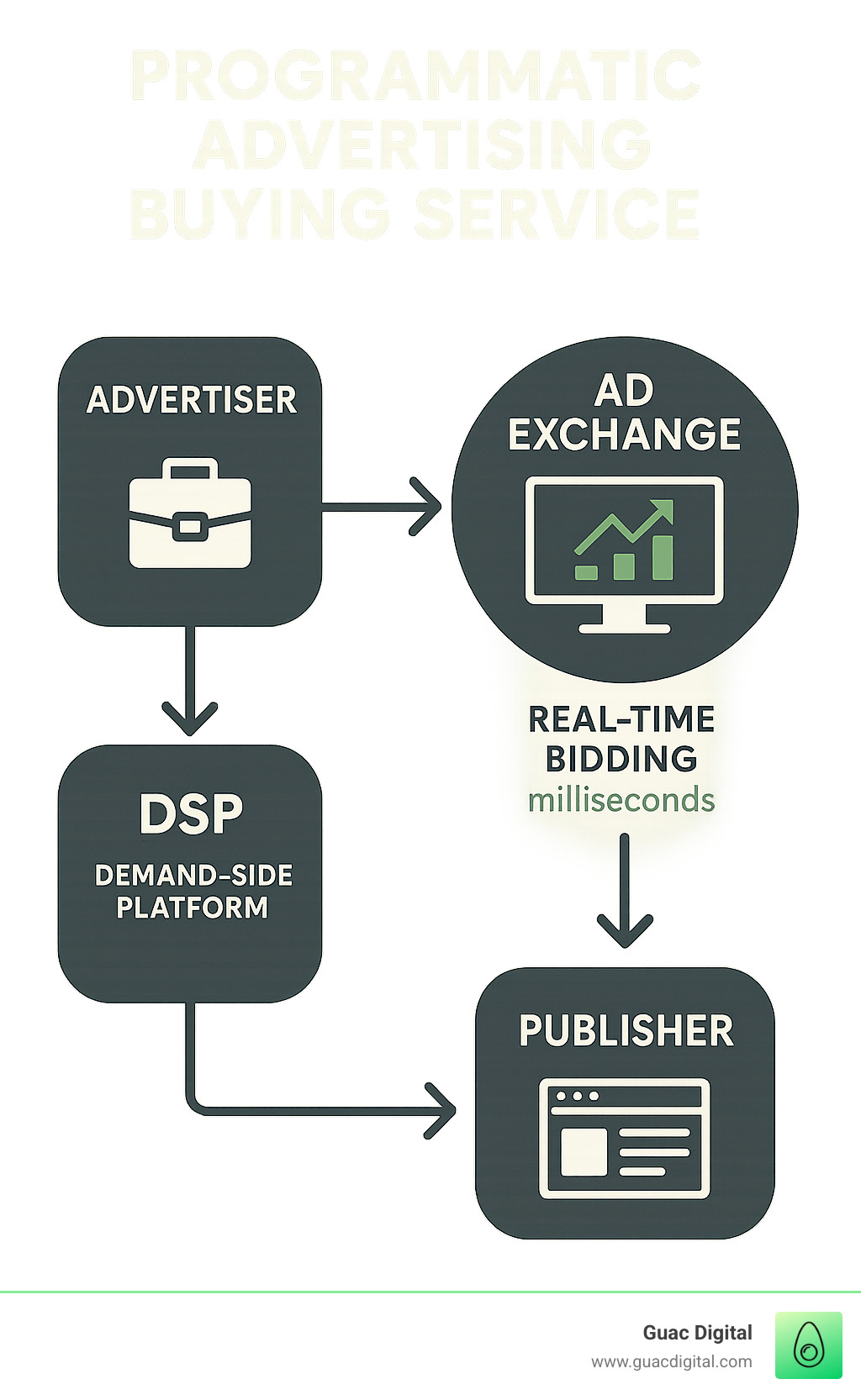
Programmatic advertising buying service terms at a glance:
– programmatic trading
– programmatic dsp
– programmatic video
Programmatic Advertising Buying Service 101
Programmatic advertising has completely transformed the digital ad landscape. Think of a programmatic advertising buying service as your smart assistant that handles all the tedious parts of buying ads online. Instead of endless emails, phone calls, and paperwork, these technologies use clever algorithms to make split-second decisions about which ads to buy and where to place them.
The numbers tell an impressive story – US programmatic spending is expected to surge to $271 billion by 2025, up from $171 billion in 2021.
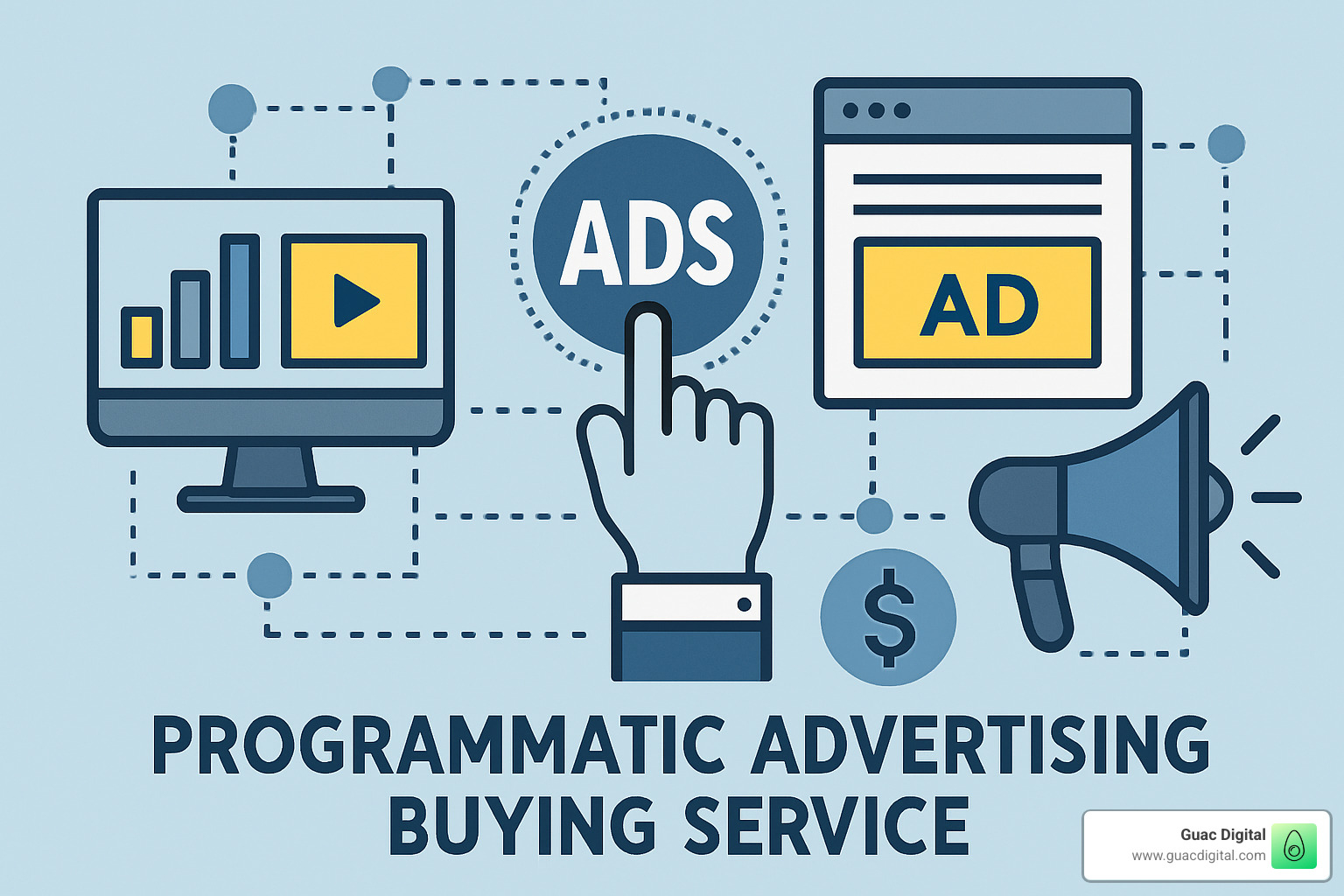
At its heart, programmatic advertising works through a lightning-fast auction system called Real-Time Bidding (RTB). Imagine thousands of tiny auctions happening every second as web pages load across the internet. Each auction determines which ad appears in front of which person – and it all happens faster than you can blink.
What makes Programmatic Advertising Explained so fascinating is how it flips traditional advertising on its head. Instead of buying space on specific websites and hoping the right people see it, you’re essentially buying access to your ideal audience wherever they browse online.
How Does Programmatic Advertising Work?
The magic happens in milliseconds – less than 100 to be exact. When someone visits a webpage with an ad space, a mini-drama unfolds behind the scenes:
First, the publisher’s platform (called an SSP) announces “Hey, I’ve got someone visiting my site!” to an ad exchange. The exchange then shouts out to advertiser platforms (DSPs): “Who wants to show an ad to this person?”
Each DSP quickly checks: “Does this visitor match what my advertisers are looking for?” If there’s a match, they calculate how much they’re willing to pay for this particular person’s attention. Bids fly in, the highest bidder wins, and their ad pops up on the screen – all before the visitor even notices the page is loading.
Key Components of the Ecosystem
Think of the programmatic ecosystem as a well-orchestrated team, with each player having a specific role:
Demand-Side Platform (DSP) is your buying tool – it’s where you set up campaigns, define who you want to reach, and how much you’re willing to spend.
Supply-Side Platform (SSP) sits on the publisher’s side, helping website owners sell their ad space for the best possible price.
Ad Exchange is the digital marketplace where it all comes together – the trading floor where buyers and sellers meet.
Data Management Platform (DMP) is your data warehouse. It collects, organizes, and activates all that valuable audience information that makes your targeting so precise.
Customer Data Platform (CDP) is the newer kid on the block, focused specifically on organizing your first-party customer data for even more precise targeting.
Main Buying Models & Marketplaces
The programmatic world offers several ways to buy ad space, each with its own flavor:
Open RTB (Open Auction) is the wild west of programmatic – it’s open to everyone and offers the widest reach at the lowest prices.
Private Marketplace (PMP) is like the VIP section of the club. Publishers invite select advertisers to bid on their premium inventory.
Preferred Deal is a one-on-one arrangement between you and a publisher with a fixed price but no volume guarantees.
Programmatic Guaranteed offers the most certainty – fixed pricing and guaranteed volume.
Header Bidding is a technique that lets publishers offer their ad space to multiple exchanges simultaneously.
What Sets a Programmatic Advertising Buying Service Apart?
Not all programmatic services are created equal. Here’s what separates the good from the great:
Automation Depth is about how much of the process truly runs on autopilot. The best services automate not just the bidding but also budget management, creative optimization, and performance reporting.
Self-Serve vs. Managed Service is about how hands-on you want to be. Some platforms give you the keys to drive yourself, while others provide a chauffeur.
Reporting Granularity makes the difference between data and insights. Superior services don’t just dump numbers in your lap; they help you understand what’s working and why.
Inventory Access determines where your ads can appear. The best services offer connections to premium publishers across all channels.
Targeting Capabilities are what make programmatic truly powerful. Look for services that can leverage your customer data, create custom audience segments, and access quality third-party data.
Launching & Optimizing Your Programmatic Campaign
Launching a successful programmatic campaign isn’t rocket science, but it does require some strategic thinking and continuous fine-tuning. When you get the approach to Programmatic Ad Buying right, the results can be nothing short of impressive across all your digital channels.
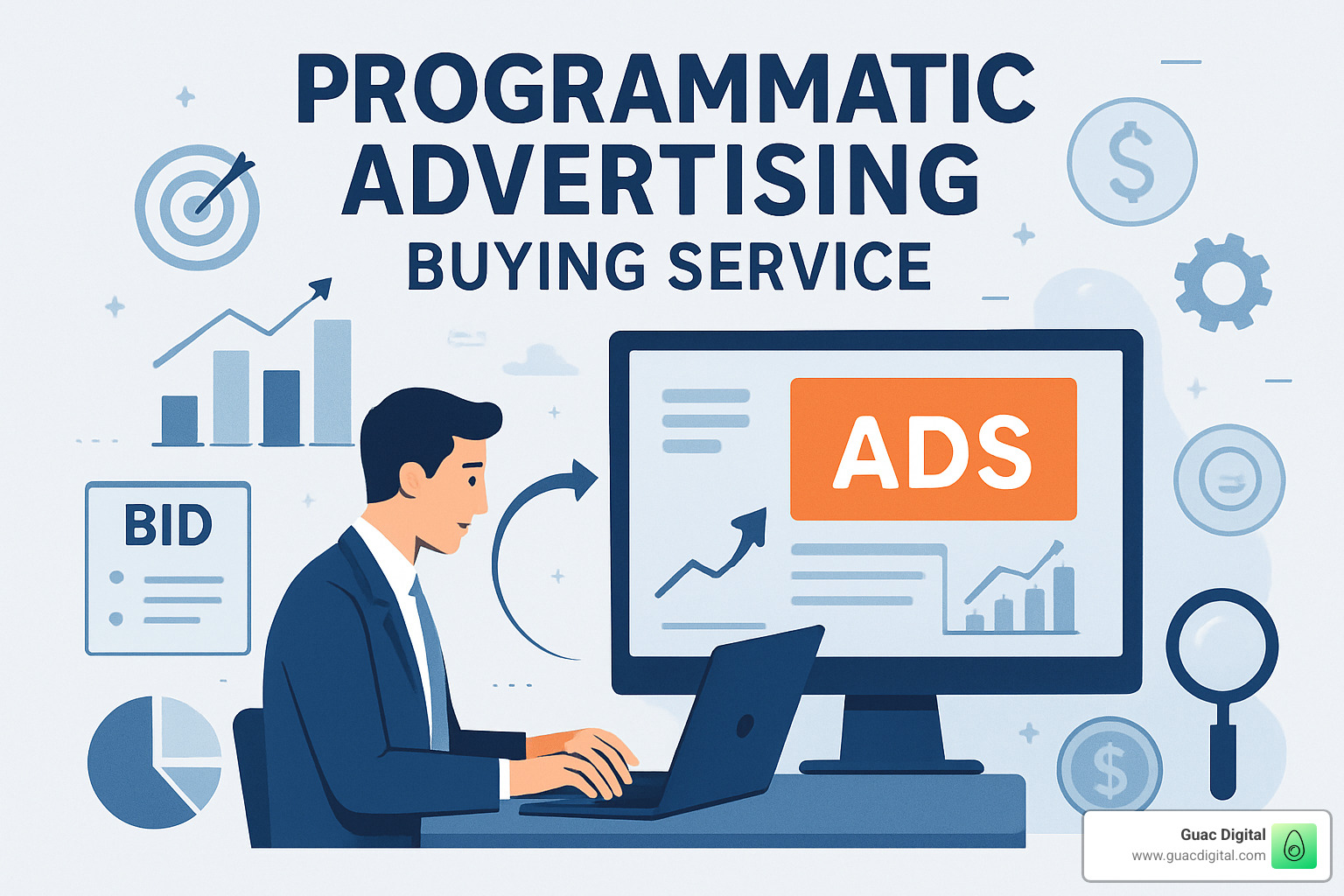
Think of your programmatic campaign as a finely-tuned instrument. The melody comes from precisely defining who you’re talking to, creating ads that resonate, setting smart bidding strategies, and measuring what actually works.
Precision Audience Targeting & Segmentation
The real magic of programmatic advertising is reaching exactly who you want with laser-focused precision. It’s like having a conversation with just the right people instead of shouting into a crowded room.
Starting with demographic targeting gives you a foundation—age, gender, income level—but it’s just the beginning. The real power comes when you layer in behavioral targeting, looking at what people actually do online: the websites they visit, content they consume, and products they browse.
Contextual targeting has made a big comeback as we move toward a cookieless world. Instead of chasing specific users, you’re placing ads next to relevant content.
Retargeting previous website visitors makes perfect sense when you consider they’re 70% more likely to convert than brand new visitors.
Want to find more people like your best customers? That’s where lookalike audiences shine, helping you expand your reach while staying relevant. And in today’s privacy-conscious world, your own first-party data has become digital gold.
Creative & Bid Optimization in Real Time
Once you know who you’re talking to, it’s time to optimize how you reach them—and this is where things get really interesting.
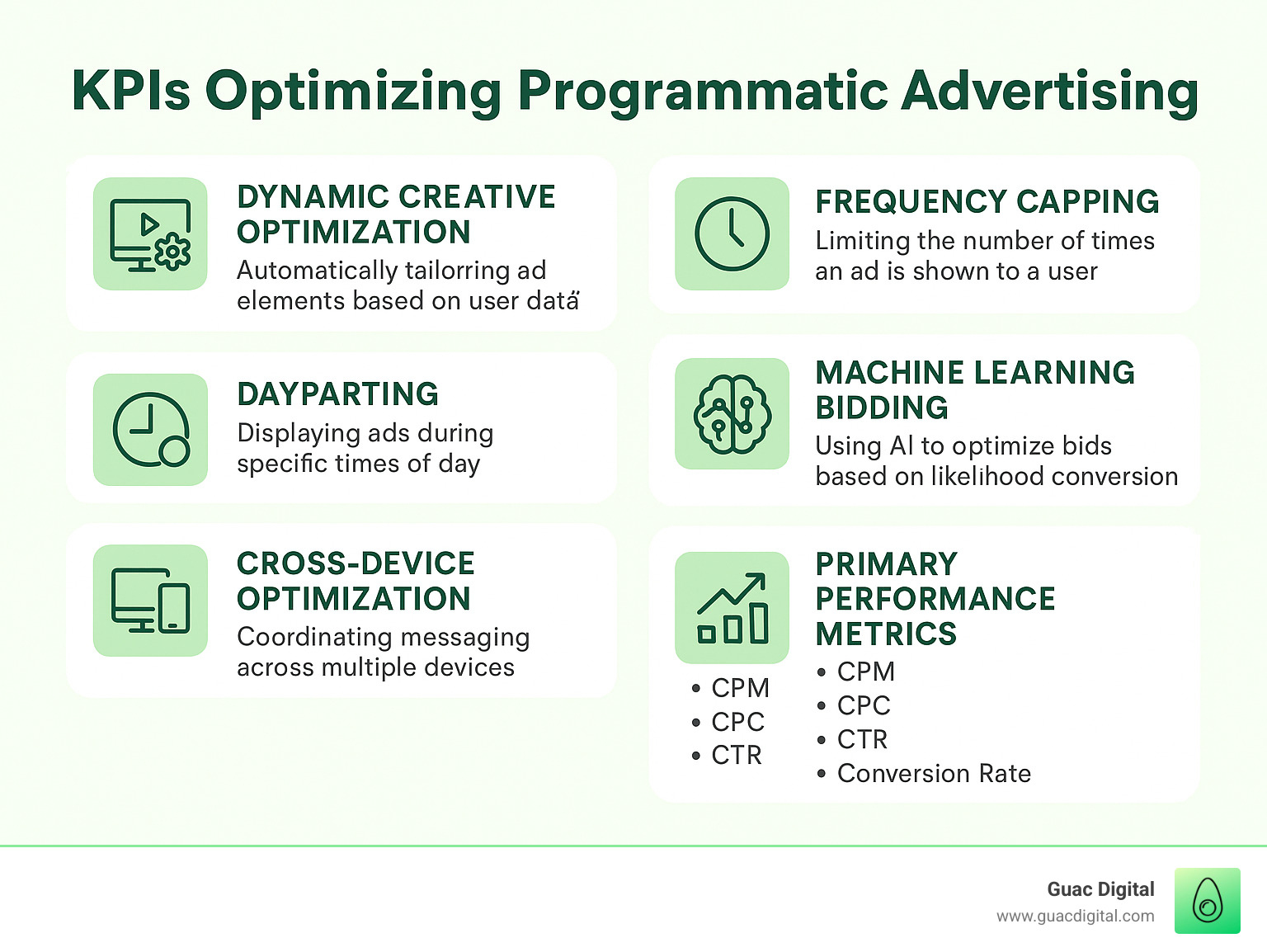
Dynamic Creative Optimization (DCO) automatically tailors your ad elements based on who’s seeing them. When Hertz tried this approach, they saw a whopping 215% increase in display revenue compared to static ads.
Frequency capping prevents ad fatigue by limiting how often the same person sees your ad. Most campaigns start seeing diminishing returns after 3-5 exposures.
Dayparting lets you schedule ads during specific times when your audience is most receptive. Why pay premium prices to reach people when they’re asleep or unlikely to engage?
Machine learning bidding now predicts the optimal amount for each impression based on conversion likelihood.
Measuring Success & Controlling Costs
You can’t improve what you don’t measure. Smart programmatic advertisers obsess over metrics that matter.
The basics include CPM (what you’re paying per thousand impressions), CPC (cost per click), and CTR (what percentage of people who see your ad actually click). But the real money metrics dig deeper: conversion rate tells you how many clicks turn into actual business, while ROAS (return on ad spend) and ACOS (advertising cost of sale) connect your spending directly to revenue.
How you attribute success matters tremendously. The simplest approach, last-click attribution, gives all credit to the final touchpoint before conversion. But reality is rarely so simple. Multi-touch attribution distributes credit across multiple interactions, while data-driven attribution uses algorithms to determine each touchpoint’s actual impact.
Guardrails: Brand Safety, Fraud Prevention & Compliance
In the programmatic world, protection is just as important as performance. Think of these guardrails as the security system for your brand and budget.
Brand safety measures ensure your ads appear in appropriate environments. Pre-bid filtering blocks unsuitable content categories before you even bid, while contextual analysis evaluates page content for brand fit.
The digital ad landscape unfortunately includes plenty of bad actors. Fraud prevention is essential when you consider that digital ad fraud cost advertisers a staggering $81 billion in 2022. Services like DoubleVerify provide third-party verification, while invalid traffic detection identifies and filters out bot traffic.
The regulatory landscape keeps evolving too. GDPR, CCPA, and other privacy regulations set strict rules for data collection and targeting. Meanwhile, with over 25% of US internet users employing ad blockers, adaptability is key.
How to Select the Best Programmatic Advertising Buying Service
Choosing the right programmatic advertising buying service is a bit like finding the perfect dance partner – you need someone who complements your style, understands your rhythm, and helps you shine. With so many Programmatic Ad Buying Platforms vying for your attention, how do you find “the one” that will truly lift your digital marketing?
I’ve guided dozens of businesses through this selection process, and I’ve found that the best decisions come from carefully weighing several key factors. Think about your channel needs – do you need to reach audiences across display, video, Connected TV, audio, and digital out-of-home? Consider the targeting capabilities you’ll require – how precisely do you need to pinpoint your audience?
Your access to quality inventory matters tremendously. Look for transparency in how the service discloses fees, uses data, and reports on where your ads appear. Don’t overlook the practical aspects: Is the user interface intuitive? What level of support will you receive? How smoothly will the platform integrate with your existing marketing technology?
Leading Platforms & What They Offer
The programmatic landscape features some truly impressive platforms, each with their own special sauce:
The Trade Desk stands tall as the sophisticated yet approachable option. When clients ask me about comprehensive omnichannel capabilities, I often point them to The Trade Desk. Their Connected TV offerings are particularly strong, and their interface manages to make complex data-driven targeting feel almost intuitive.
Xandr (formerly AppNexus) has earned its reputation for powerful audience analysis. Their cross-screen capabilities mean your message stays consistent whether your audience is on mobile, desktop, or connected TV.
PubMatic offers something special for brands seeking premium inventory. As a leading sell-side platform that’s expanded into buy-side solutions, they process a mind-boggling 2.1 trillion advertiser bids daily.
Criteo shines brightest for e-commerce advertisers. Their treasure trove of shopper data powers remarkably effective retargeting campaigns that can follow users throughout their purchase journey.
MediaMath stands out for brands that prioritize transparency. Their Brain algorithm continuously optimizes campaigns based on performance data.
Magnite (formerly Rubicon Project) offers exceptional access to premium publisher inventory across all formats. Their Connected TV strength has grown impressively in recent years.
StackAdapt has won fans with its user-friendly approach and outstanding customer support. I’ve seen several teams new to programmatic find their footing quickly with StackAdapt’s intuitive platform.
Adobe Advertising Cloud leverages the power of Adobe’s broader ecosystem. As part of Adobe’s Experience Cloud, Adobe Advertising Cloud offers deep integration with other Adobe products.
Real-World Wins With Programmatic Advertising Buying Services
The real magic of a great programmatic advertising buying service reveals itself in the results. These success stories show what’s possible when sophisticated technology meets strategic implementation:
Hertz transformed their display advertising through dynamic creative optimization, experiencing a 215% surge in display revenue compared to their traditional static campaigns.
A major hotel chain took a full-funnel approach to their programmatic strategy, carefully targeting travelers at each stage of their decision journey. The results were nothing short of remarkable – over 1,000% ROAS and 2.5 times more direct bookings.
An online game publisher leveraged programmatic video and display with advanced retargeting to achieve an impressive 8.6% click-through rate – far above typical industry benchmarks.
Evaluating a Programmatic Advertising Buying Service Against Your Goals
Finding your perfect programmatic advertising buying service match requires aligning platform strengths with your specific marketing objectives.
If brand awareness tops your priority list, look for services with extensive reach across multiple channels. You’ll want robust brand safety controls to protect your reputation and viewability measurement to ensure your ads are actually seen.
For performance and conversion campaigns, focus on platforms with sophisticated audience targeting and retargeting capabilities. You’ll need strong measurement and attribution tools to track the customer journey from impression to purchase.
Local and regional marketers should ensure their chosen service offers precise geographic targeting. Look for platforms with strong mobile and digital out-of-home integration to reach consumers while they’re out and about in your target area.
B2B marketers will want platforms with account-based marketing capabilities that can target specific companies. Look for services with access to professional and industry-specific inventory where decision-makers spend their time.
Beyond these specific goals, several universal factors deserve your attention: ROI potential, scalability, transparency, and support level.
Frequently Asked Questions about Programmatic Advertising Buying Service
If you’re new to programmatic advertising, you probably have some questions about how it all works. Let’s address some of the most common questions we hear from clients considering a programmatic advertising buying service.
What Does a Programmatic Advertising Buying Service Cost?
When budgeting for programmatic advertising, it helps to understand the three main cost components:
First, there’s the actual media cost – the money that goes toward purchasing the ad impressions themselves. This varies widely depending on what you’re targeting and where. Display ads are typically the most affordable (often $1-$5 CPM), while premium formats like video and Connected TV command higher rates ($10-$30+ CPM).
Second, you’ll encounter platform fees from your DSP or service provider. These usually take one of three forms: a percentage of your media spend (typically 10-20%), a fixed fee per thousand impressions (usually $0.75-$2.00), or a minimum monthly platform fee ($1,000-$10,000+ depending on the provider).
Finally, if you’re working with an agency like Guac Digital, there may be service fees for campaign management and optimization. These typically range from 10-15% of media spend or come as a fixed monthly retainer.
For small businesses just dipping their toes into programmatic waters, plan for a minimum monthly investment of $5,000-$10,000 all-in. Enterprise campaigns often run $100,000+ per month.
Is Programmatic Advertising Safe From Fraud?
Let’s be honest – ad fraud is a genuine concern in programmatic advertising. In 2022 alone, global ad fraud cost advertisers a staggering $81 billion. But that doesn’t mean you should avoid programmatic entirely.
Reputable programmatic advertising buying services build multiple layers of protection into their processes. These typically include pre-bid filtering to block suspicious inventory before you ever bid on it, integration with third-party verification services like DoubleVerify and IAS, and ads.txt verification to ensure you’re buying from authorized sellers.
While no system can completely eliminate fraud, working with trustworthy partners and implementing comprehensive protection measures can keep fraud rates to a minimum – typically under 2-3% with good protection in place.
How Long Does It Take to Launch a Campaign?
“How quickly can we get this live?” is one of the most common questions we hear. The answer, as with many things in marketing, is: it depends.
If you’re using a self-service platform and already have your creative assets ready to go, simple campaigns can launch in as little as 10 minutes. More complex campaigns typically take 1-3 days to set up properly.
For managed services like what we offer at Guac Digital, the initial campaign setup usually takes 5-10 business days. This includes developing the strategy, defining your audience segments, reviewing creative assets, and configuring the platform.
While everyone wants their campaigns live yesterday, we’ve found that allowing adequate time for strategy development and proper setup pays enormous dividends in campaign performance. A few extra days of preparation can mean the difference between a campaign that delivers mediocre results and one that truly moves the needle for your business.
Conclusion
The world of programmatic advertising buying services has transformed digital marketing from a manual, relationship-based process into a sophisticated, data-driven ecosystem where decisions happen in milliseconds. But behind all the technology and automation, it’s still about connecting with real people in meaningful ways.
As we’ve seen throughout this guide, programmatic isn’t just a buzzword – it’s become the backbone of digital advertising. With 84% of global digital ad spend flowing through programmatic channels and US spending projected to hit $271 billion by 2025, this approach has firmly established itself as the new standard.
What makes programmatic so powerful? It’s the unique combination of scale and precision. The ability to reach millions while speaking to each person as an individual. The technology that lets you find your perfect customer wherever they are online, whether they’re watching Connected TV, listening to a podcast, or browsing on their phone.
Remember Hertz’s impressive 215% revenue surge using dynamic creative optimization? That’s not just a statistic – it represents real people responding to messages that felt relevant to them.
As you move forward with programmatic, keep these essential elements in mind:
- Audience targeting is your superpower – the ability to reach people based on who they are, what they like, and what they intend to do next
- Measurement isn’t just about collecting data – it’s about turning that data into insights that drive continuous improvement
- Brand safety isn’t optional – implementing robust protections ensures your ads appear in appropriate contexts and reach real humans, not bots
The programmatic landscape continues to evolve with developments like the phasing out of third-party cookies, the explosive growth of connected TV, and advances in machine learning. Staying ahead requires both technological capabilities and strategic expertise.
At Guac Digital, we specialize in helping businesses steer the programmatic landscape to achieve measurable results. Our Tampa-based team combines deep technical knowledge with strategic insight to create campaigns that deliver real business impact.
Ready to explore how a programmatic advertising buying service can transform your digital marketing? Learn more about our services and find how we can help you harness the power of programmatic to reach your marketing goals – not just to drive metrics, but to create meaningful connections with the people who matter most to your business.