
What Is a Social Media Agency and How Can They Transform Your Digital Presence in 2026?
Quick Answer
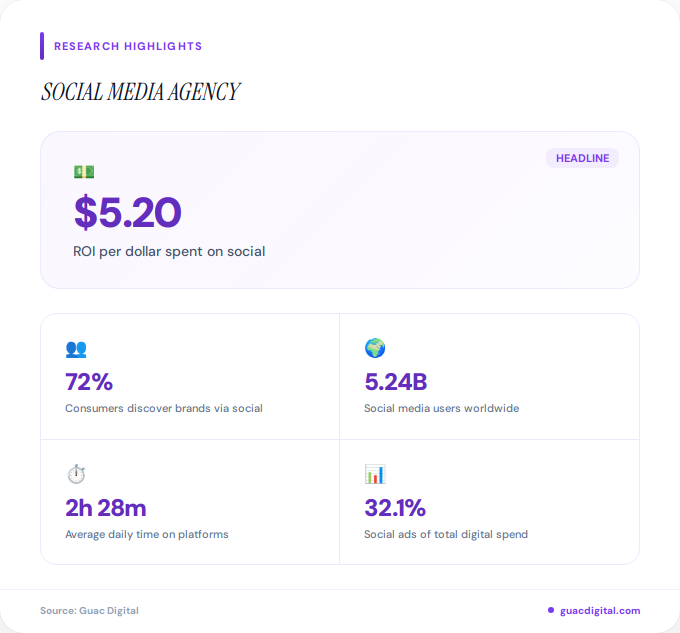
A social media agency is a specialized firm that manages all aspects of a brand’s social media presence, including strategy development, content creation, paid advertising, community management, and analytics. These agencies help businesses navigate the $277 billion global social advertising landscape, leveraging AI-driven campaigns and platform expertise to deliver an average ROI of $5.20 for every dollar spent.
Did you know that 72% of consumers now discover brands through social media platforms, with global social ad spend reaching $277 billion in 2026? As businesses struggle to navigate algorithm changes, rising ad costs, and the explosive growth of AI-powered campaigns, social media agencies have become indispensable partners in the digital marketing ecosystem.
With 5.24 billion social media users worldwide (64% of the global population) spending an average of 2 hours and 28 minutes per day on these platforms, the opportunity for brands to connect with their audience has never been greater. Yet, the complexity of managing multiple platforms, creating engaging content, and optimizing paid campaigns means most businesses need specialized expertise to succeed.
This comprehensive guide explores everything you need to know about social media agencies in 2026, from core services and pricing to the latest AI-driven strategies that are reshaping the industry. Whether you’re considering marketing on social media for the first time or looking to upgrade your current approach, understanding how these agencies operate is essential for digital success.
What Is a Social Media Agency?
A social media agency is a specialized digital marketing firm that focuses exclusively on managing and optimizing brands’ presence across social media platforms. Unlike traditional marketing agencies that offer broad services, these firms concentrate on the unique dynamics of social platforms like Facebook, Instagram, TikTok, YouTube, LinkedIn, and emerging networks.
These agencies employ teams of specialists including strategists, content creators, graphic designers, video producers, community managers, paid media experts, and data analysts. Their expertise spans both organic content strategies and paid advertising campaigns, combining creative execution with data-driven optimization.
The value proposition is clear: social media delivers an average return of $5.20 for every dollar spent, with video campaigns specifically driving 34% higher conversion rates than other formats. As platforms continuously evolve their algorithms and advertising systems, agencies provide the specialized knowledge needed to stay ahead of these changes and maximize investment returns.
What Does the Social Media Agency Market Look Like in 2026?
The social media agency sector is experiencing unprecedented growth, driven by explosive increases in advertising spend and platform adoption. According to Statista’s global advertising outlook, social media advertising now represents 32.1% of total digital ad spend, with projections reaching over $300 billion by 2027.
| Metric | 2026 Data | 2027 Projection |
|---|---|---|
| Global Social Ad Spend | $276-338.75B | >$300B |
| Social Media Users Worldwide | 5.24-5.66B | Continued growth |
| Average Daily Usage | 2h 28m | Stable |
The market dynamics reveal several critical trends. First, platform CPMs (cost per thousand impressions) have increased 18% year-over-year, making expert campaign optimization essential for cost efficiency. Second, TikTok’s advertising share has surged 34% annually, forcing agencies to rapidly develop expertise in this platform’s unique content formats and algorithm.
Perhaps most significantly, 41% of Gen Z consumers now start product searches on social media rather than traditional search engines, fundamentally shifting where brands need to establish their presence. This represents a massive opportunity for businesses that understand how to leverage these platforms effectively through strategic digital marketing partnerships.

What Services Do Social Media Agencies Actually Provide?
Modern social media agencies offer comprehensive service suites that extend far beyond simple post scheduling. Their offerings typically encompass both strategic and tactical execution across multiple disciplines.
Strategy Development and Planning
Agencies begin with in-depth audits of existing social presence, competitive analysis, and audience research. They develop comprehensive strategies aligned with business objectives, defining target audiences, content pillars, platform priorities, and KPI frameworks. This foundational work ensures all tactical execution supports measurable business outcomes.
Content Creation and Production
Content teams produce diverse assets including graphics, short-form video, long-form video, animation, photography, copywriting, and interactive content. With video delivering the highest ROI of any content format at 41%, agencies invest heavily in video production capabilities. Many now offer complete studio services for TikTok, Instagram Reels, and YouTube content optimized for each platform’s unique algorithm.
Community Management
Dedicated community managers monitor comments, messages, and brand mentions across all platforms, responding in the brand’s voice to build relationships and address concerns. This real-time engagement is crucial as response time directly impacts customer satisfaction and platform algorithms increasingly favor accounts with high engagement rates.
Paid Social Advertising
Campaign specialists design, launch, and optimize paid campaigns across Meta Ads Manager, TikTok Ads, LinkedIn Campaign Manager, Twitter Ads, and Pinterest Ads. They continuously test creative variations, audience segments, and bidding strategies to maximize return on ad spend. With Meta fully automating ad delivery by end-2026, agencies now focus on strategic oversight and creative optimization rather than manual bid adjustments.
Analytics and Reporting
Data teams track performance metrics, identify trends, and provide actionable insights through custom dashboards and regular reports. Understanding how to properly track and interpret metrics is essential, which is why many agencies specialize in helping clients measure social media ROI comprehensively.
“The agencies winning in 2026 are those that seamlessly integrate AI tools for efficiency while maintaining the creative strategy and human insight that algorithms can’t replicate. It’s not about replacing people with AI but empowering strategists to focus on what matters most: understanding audience psychology and crafting compelling narratives.” – Industry expert from We Are Social
Why Should Your Business Hire a Social Media Agency?
The decision to partner with a social media agency often comes down to expertise, efficiency, and results. While some businesses attempt in-house management, the complexity and time investment required frequently make agency partnerships more effective.
Specialized Expertise Across Platforms: Each social platform operates with unique algorithms, content formats, and audience behaviors. Agencies employ specialists who understand these nuances deeply, staying current with constant platform updates that in-house teams struggle to track. With 94% of marketers planning to use AI for content creation in 2026, agencies also provide access to cutting-edge tools and techniques.
Time and Resource Efficiency: Social media management is labor-intensive. Creating content, engaging communities, managing paid campaigns, and analyzing performance requires dedicated hours daily. For most businesses, building an in-house team with equivalent capabilities costs significantly more than agency partnerships.
Measurable ROI: Professional agencies bring proven frameworks for tracking performance and optimizing for business results. They connect social media activities directly to revenue, lead generation, or other key objectives. Resources like our guide on how to measure social media ROI demonstrate the sophisticated attribution methodologies agencies employ.
Creative Excellence: Agencies employ teams of creative professionals including designers, videographers, copywriters, and art directors who produce professional-quality content consistently. This creative firepower is difficult to replicate internally without significant investment.
How Much Does a Social Media Agency Cost?
Social media agency pricing varies dramatically based on scope, platform focus, content volume, paid media budgets, and agency reputation. Understanding the investment required helps businesses budget appropriately and set realistic expectations.
Pricing typically ranges from $3,000 to $50,000+ per month, depending on your specific project requirements and the scope of services. Entry-level packages focusing on 1-2 platforms with organic content only might start at the lower end, while comprehensive programs managing multiple platforms with substantial paid media budgets and custom content production can exceed $100,000 monthly.
Pricing structures generally follow three models:
- Monthly Retainers: Fixed monthly fees for defined service packages, providing predictable costs and ongoing support
- Project-Based: One-time fees for specific deliverables like strategy development, campaign launches, or content creation sprints
- Performance-Based: Compensation tied to results like lead generation, sales, or engagement metrics, though less common due to factors outside agency control
It’s important to note that pricing varies based on your specific project needs, industry competitiveness, geographic market, and desired outcomes. Premium agencies emphasize value delivery and measurable business impact rather than competing solely on price. The most successful partnerships align investment levels with business growth objectives, viewing agency services as revenue drivers rather than cost centers.
When evaluating agency costs, consider the full scope: strategy development, content creation costs, community management hours, paid media management fees (often 10-20% of ad spend), analytics and reporting, and technology/tool expenses. Many agencies also charge separately for paid media budgets, which typically range from $5,000 to $500,000+ monthly depending on business size and objectives.
How Do You Choose the Right Social Media Agency?
Selecting the right social media agency partner requires evaluating multiple factors beyond portfolio quality and pricing. The best matches align on objectives, communication style, and strategic vision.
Industry Experience: Look for agencies with proven success in your specific industry or with similar business models. They’ll understand your audience, competitive landscape, and regulatory considerations. Case studies demonstrating measurable results for comparable businesses indicate the agency can replicate that success.
Platform Expertise: Ensure the agency excels on the platforms most relevant to your audience. An agency dominating Instagram might lack TikTok expertise, which matters if your target demographic skews younger. With platform user bases varying dramatically (Facebook at 3.1 billion MAUs vs. TikTok at 1.6 billion), platform selection significantly impacts reach potential.
Service Integration: Consider whether you need a specialized social agency or broader digital marketing integration. If you also require SEO, PPC, or web development, agencies offering integrated services like comprehensive SEO services can provide more cohesive strategies.
Communication and Reporting: Evaluate how agencies communicate progress, handle revisions, and structure reporting. Weekly or bi-weekly check-ins, transparent dashboards, and responsive account teams distinguish superior agencies from those treating clients as numbers.
Creative Chemistry: Review their creative work critically. Does their aesthetic align with your brand vision? Do they demonstrate versatility or stick to formulaic approaches? The best agencies push creative boundaries while respecting brand guidelines.
Technology Stack: Ask what tools and platforms they use for scheduling, analytics, creative production, and campaign management. Modern agencies leverage sophisticated technology to drive efficiency and insights.
How Are AI and Automation Transforming Social Media Agencies?
Artificial intelligence has fundamentally reshaped how social media agencies operate in 2026. With Meta fully automating ad delivery by year-end and 94% of marketers using AI for content creation, agencies that haven’t integrated these technologies risk obsolescence.
AI-Powered Content Creation: Generative AI tools now assist with copywriting, image generation, video editing, and even strategic ideation. Agencies use these tools to accelerate production timelines, test more creative variations, and personalize content at scale. However, human oversight remains critical as algorithm-generated content often lacks the nuance and emotional resonance that drives meaningful engagement.
Automated Campaign Optimization: Machine learning algorithms continuously optimize bid strategies, audience targeting, and creative rotation across paid campaigns. Meta’s full ad automation means agencies now focus on strategic parameters, creative development, and performance interpretation rather than manual bidding adjustments.
Predictive Analytics: AI-powered analytics tools identify emerging trends, predict content performance, and recommend optimal posting times based on historical data. These insights help agencies make proactive decisions rather than reactive adjustments.
Chatbot and Community Management: Sophisticated AI chatbots handle routine inquiries, freeing community managers to focus on complex interactions requiring human judgment. These tools maintain 24/7 responsiveness while routing appropriate conversations to human team members.
The key insight is that AI amplifies human capabilities rather than replacing them. The agencies achieving the strongest results combine technological efficiency with strategic creativity, using AI to handle repetitive tasks while focusing human talent on innovation, storytelling, and relationship-building.
Which Social Media Platforms Should Your Agency Focus On?
Platform selection significantly impacts campaign success, as each network serves distinct demographics and content preferences. Smart agencies match platform strategies to client objectives rather than applying one-size-fits-all approaches.
Best For: Community building, detailed targeting
Demographics: Broad age range, skewing 35+
Content: Mix of formats, groups excel
Best For: Visual storytelling, e-commerce
Demographics: 18-34 core, 60%+ discovery
Content: Reels dominating, Stories, Shopping
Best For: Brand awareness, viral content
Demographics: Gen Z and Millennials
Content: Short-form video, authenticity valued
Best For: B2B marketing, thought leadership
Demographics: Professionals, decision-makers
Content: Long-form posts, industry insights
Best For: Educational content, long-form video
Demographics: Broadest reach, all ages
Content: Tutorials, reviews, entertainment
Best For: Real-time engagement, news
Demographics: News-focused users
Content: Text-based, trending topics
Strategic agencies don’t automatically recommend presence on all platforms. Instead, they analyze where target audiences spend time, what content formats align with brand strengths, and which platforms deliver the best ROI for specific objectives. Resource allocation matters: dominating 2-3 platforms typically outperforms mediocre presence across six.
Platform priorities should align with business goals. B2C brands with strong visual identities prioritize Instagram and TikTok. B2B companies focusing on lead generation emphasize LinkedIn and YouTube. E-commerce businesses leverage Instagram Shopping and TikTok Shop features for direct conversions.
How Do Social Media Agencies Measure Success?
Effective measurement separates results-driven agencies from those focused on vanity metrics. The most sophisticated agencies build custom measurement frameworks aligned with specific business objectives rather than relying solely on platform analytics.
Awareness Metrics: For brand awareness campaigns, agencies track reach, impressions, follower growth, share of voice, and brand mention sentiment. These indicators measure how effectively content expands brand visibility.
Engagement Metrics: Engagement rate, comment quality, save rate, and share rate indicate how well content resonates with audiences. Instagram’s average engagement rate of 0.48% provides benchmarks, though rates vary significantly by industry and follower count.
Conversion Metrics: The ultimate measure for most businesses is how social media drives business outcomes. Agencies track click-through rates, landing page conversions, lead submissions, e-commerce purchases, and customer acquisition costs. Advanced attribution models connect social touchpoints to eventual conversions, even when social media serves as an early awareness channel rather than the final conversion point.
Revenue Attribution: Top agencies implement sophisticated tracking to demonstrate revenue impact. This might include promo code tracking, UTM parameter analysis, multi-touch attribution modeling, or CRM integration showing social media’s influence on sales pipelines.
The most valuable agencies provide transparent reporting that connects tactical metrics to strategic objectives. Rather than celebrating likes and followers, they demonstrate how social media investments contribute to revenue growth, customer retention, or other business KPIs that matter to executives.
What Are the Emerging Trends in Social Media Marketing?
The social media landscape continues evolving rapidly, and agencies that anticipate trends position clients for competitive advantage. Several developments are reshaping strategies for 2026 and beyond.
Social Commerce Expansion: With 60%+ of product discovery happening on social platforms and 26% of marketers exploring Instagram Shops, social commerce is maturing from experimental to essential. Agencies now integrate shopping features directly into content strategies, creating shoppable posts, live shopping events, and seamless checkout experiences.
Short-Form Video Dominance: Short-form video continues delivering the highest ROI, outperforming traditional formats 2-3x. TikTok’s 34% year-over-year ad share growth reflects this shift, forcing agencies to prioritize video production capabilities and vertical format expertise.
Augmented Reality Integration: With 2 billion users engaging with AR features in social apps, brands experiment with AR filters, virtual try-ons, and immersive experiences. Early adopters see significant engagement lifts as these features provide novel, shareable content.
Metaverse and Virtual Spaces: While still emerging, projections suggest over 100 million active users in metaverse social platforms by 2027. Forward-thinking agencies help clients establish presence in virtual worlds, though ROI remains difficult to quantify.
Privacy-First Targeting: As third-party cookies disappear and privacy regulations expand, agencies adapt targeting strategies to first-party data, contextual advertising, and platform-native tools. This shift requires more sophisticated data collection and CRM integration strategies.
Authentic and Purpose-Driven Content: Audiences increasingly favor authentic, unpolished content over overly produced material. Agencies balance professional quality with the raw authenticity that builds trust, particularly on platforms like TikTok where authenticity drives virality.
Key Takeaways
- Social media agencies provide specialized expertise managing brand presence across platforms, delivering an average ROI of $5.20 per dollar spent in the $277 billion global social advertising market
- Core services span strategy development, content creation, community management, paid advertising, and analytics, with agencies employing diverse specialists rather than generalists
- AI integration is transforming agency operations, with 94% of marketers using AI for content creation and Meta fully automating ad delivery by end-2026
- Pricing ranges from $3,000 to $50,000+ monthly depending on scope, platforms, content volume, and ad spend, with investment levels aligned to business growth objectives
- Platform selection should match audience demographics and business objectives rather than maintaining presence everywhere, with Instagram, TikTok, and Facebook dominating user attention
- Success measurement extends beyond vanity metrics to business outcomes, with sophisticated agencies demonstrating clear revenue attribution and ROI
- Emerging trends including social commerce, short-form video, AR integration, and authentic content are reshaping strategies for competitive advantage
People Also Ask
What is the difference between a social media agency and a digital marketing agency?
Social media agencies specialize exclusively in social platform management, content creation, and advertising across networks like Instagram, TikTok, and Facebook. Digital marketing agencies offer broader services including SEO, email marketing, website development, and PPC across search engines, providing more comprehensive but less specialized support.
How long does it take to see results from a social media agency?
Organic social media results typically require 3-6 months to show meaningful traction as agencies build audience, test content, and optimize strategy. Paid advertising campaigns can demonstrate results within weeks, though optimization continues over time. Most agencies recommend committing to at least 6 months to properly evaluate performance and achieve sustainable growth.
Should small businesses hire a social media agency?
Small businesses benefit from agency expertise when they lack in-house resources or expertise, particularly if social media represents a primary customer acquisition channel. Many agencies offer scaled packages starting at lower monthly retainers specifically designed for small business budgets, making professional management accessible even with limited resources.
What industries benefit most from social media agencies?
E-commerce, fashion, beauty, food and beverage, fitness, entertainment, and direct-to-consumer brands typically see the strongest returns from social media agencies due to visual product appeal and consumer shopping behaviors. However, B2B companies increasingly leverage agencies for LinkedIn thought leadership and targeted advertising to decision-makers.
Can social media agencies guarantee results?
Reputable agencies never guarantee specific follower counts or engagement numbers, as these depend on multiple factors including budget, content quality, market competitiveness, and platform algorithms. However, they should provide realistic projections based on historical performance and commit to transparent reporting, continuous optimization, and meeting agreed KPIs.
How often should a social media agency post content?
Optimal posting frequency varies by platform and strategy, but most agencies recommend 3-5 posts weekly on Instagram, 1-2 daily on TikTok for growth, 3-5 weekly on Facebook, and 2-5 weekly on LinkedIn. Quality consistently outweighs quantity, with strategic, well-crafted content outperforming high-volume, low-quality approaches.
Frequently Asked Questions
What credentials should I look for when hiring a social media agency?+
Look for agencies with platform certifications (Meta Blueprint, TikTok Marketing Partner), proven case studies with measurable results, industry awards or recognition, and client testimonials. Request references from current clients in similar industries and ask about team credentials, including years of platform-specific experience and creative portfolios.
Do I need to provide content to the agency or do they create everything?+
Most full-service agencies create all content in-house, including graphics, videos, and copy. However, they typically request brand assets (logos, guidelines, product photos) and appreciate user-generated content, customer testimonials, or behind-the-scenes footage from your team. The best partnerships involve collaboration where agencies lead creative execution while you provide brand knowledge and approval.
How do social media agencies handle negative comments or PR crises?+
Professional agencies establish crisis communication protocols during onboarding, defining response procedures, escalation paths, and approval requirements for sensitive situations. Community managers monitor sentiment continuously, respond to routine criticism professionally, and immediately alert clients to potential crises. Most agencies recommend 24/7 monitoring for brands with high public profiles.
What happens to my social media accounts if I stop working with an agency?+
You retain ownership of all social media accounts, followers, and content rights (unless specifically contracted otherwise). Reputable agencies provide transition documentation including login credentials, content calendars, analytics reports, and strategic recommendations. Some offer transition support or training for in-house teams. Always clarify ownership terms in initial contracts to avoid disputes.
Can I work with a social media agency on a project basis instead of ongoing retainer?+
Many agencies offer project-based engagements for specific deliverables like strategy development, campaign launches, or content production sprints. However, social media typically requires consistent presence and optimization, making ongoing retainers more effective for sustained growth. Project work suits businesses testing agency partnerships or needing specific expertise for limited initiatives.
How do agencies stay current with constantly changing platform algorithms?+
Leading agencies invest in continuous education through platform partner programs, industry conferences, and dedicated research teams. They test algorithm changes across client accounts, participate in beta programs for new features, and maintain direct relationships with platform representatives. This institutional knowledge and testing capacity gives agencies significant advantages over in-house teams managing single accounts.
What tools and software do social media agencies use?+
Professional agencies leverage scheduling platforms (Hootsuite, Sprout Social, Later), analytics tools (Google Analytics, platform-native insights, custom dashboards), creative tools (Adobe Creative Suite, Canva Pro, CapCut), project management software (Asana, Monday), and collaboration platforms (Slack, Microsoft Teams). Many also use proprietary tools and AI platforms for content optimization and performance prediction.