
Ecommerce CRO Guide: Proven Tactics That Drive Sales
Quick Answer
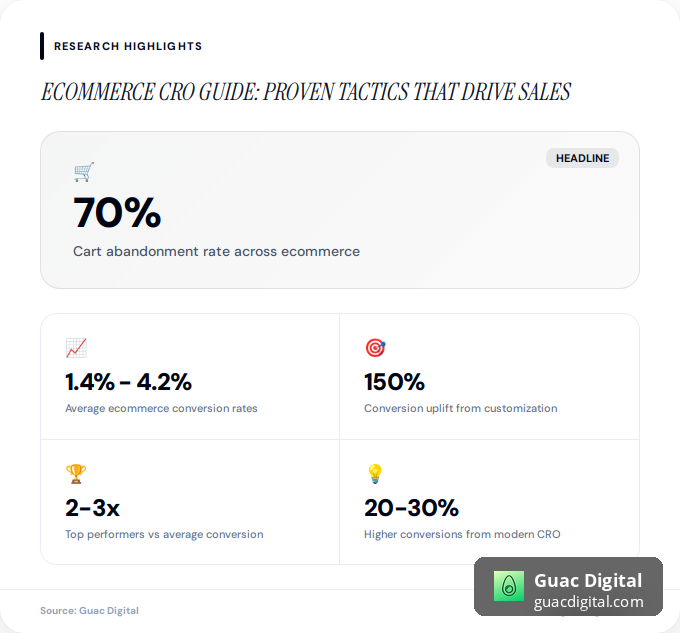
Ecommerce CRO in 2026 centers on AI-driven personalization and experiential commerce, delivering conversion rates between 1.4% to 4.2% across industries. Companies implementing product customization and dynamic offers achieve 150% conversion uplifts, while tactics like video integration, speed optimization, and AI chatbots dramatically reduce the 70% cart abandonment rate plaguing most online stores.
Did you know that nearly 70% of shopping carts are abandoned before checkout, representing billions in lost revenue across the ecommerce industry? For agencies serving ecommerce clients, conversion rate optimization (CRO) represents the single most impactful way to drive revenue growth without increasing ad spend.
The ecommerce CRO guide you’re reading reveals proven tactics that top-performing brands use to transform browsers into buyers. Whether you’re optimizing for startups testing product-market fit or enterprise brands scaling profitably, these strategies deliver measurable results.
In 2026, the gap between conversion-optimized stores and those relying on outdated tactics continues to widen. Brands implementing modern CRO strategies are projected to see 20-30% higher conversions than competitors who ignore these critical optimizations.
What Is Ecommerce CRO and Why Does It Matter in 2026?
Ecommerce conversion rate optimization (CRO) is the systematic process of increasing the percentage of website visitors who complete desired actions, whether that’s making a purchase, signing up for emails, or adding items to cart. Unlike traffic acquisition, CRO maximizes the value of visitors you already have.
In 2026, ecommerce CRO has evolved beyond simple A/B testing. The focus has shifted to experiential commerce and mass personalization, where AI analyzes real-time user intent to deliver tailored recommendations and dynamic offers. This evolution is driven by consumer expectations for Amazon-like experiences across all shopping platforms.
For agencies, mastering this ecommerce CRO guide means delivering tangible ROI for clients. A 1% improvement in conversion rate can translate to hundreds of thousands in additional annual revenue for mid-market brands, making CRO one of the highest-leverage services you can offer.
What Are Current Ecommerce Conversion Rate Benchmarks?
Understanding where your clients stand relative to industry benchmarks is critical for setting realistic CRO goals. In 2026, average ecommerce conversion rates range from 1.4% to 4.2% depending on industry, traffic source, and product category.
These benchmarks reveal significant opportunity. Most ecommerce sites convert less than 3% of visitors, meaning 97 out of 100 potential customers leave without purchasing. Even incremental improvements compound dramatically over time.
| Industry/Category | Average Conversion Rate | Top Performer Benchmark |
|---|---|---|
| Fashion & Apparel | 1.8% | 4.5%+ |
| Health & Beauty | 2.4% | 5.2%+ |
| Home & Garden | 1.4% | 3.8%+ |
| Food & Beverage | 2.9% | 6.1%+ |
| Electronics | 1.6% | 4.2%+ |
The data shows substantial variation, with top performers achieving 2-3x the average conversion rate in their category. Research on 2026 conversion trends indicates these leaders share common characteristics: personalized experiences, frictionless checkout, and mobile-first design.

How Does AI-Driven Personalization Drive Sales?
AI-powered personalization represents the single biggest opportunity in this ecommerce CRO guide. Companies enabling customer co-creation and product customization see 150% average conversion uplifts compared to static product pages.
Modern AI tools analyze browsing behavior, purchase history, and real-time intent signals to deliver tailored product recommendations, dynamic pricing, and personalized content. Advanced personalization platforms now use semantic search understanding to show the right products at the right moment.
“The shift from surface-level tweaks to experiential commerce powered by AI personalization represents the fundamental change in ecommerce CRO. Brands that embrace mass personalization are not just optimizing conversion rates; they’re fundamentally transforming how customers interact with their products.”
Key AI personalization tactics include:
- Dynamic product recommendations that adapt based on browsing patterns and similar customer journeys
- Personalized site search with autocomplete, spell correction, and semantic understanding that prevents zero-result frustration
- Relevance ranking that prioritizes high-conversion products for each visitor segment
- Behavioral targeting that shows different homepage heroes, category pages, and promotions based on user attributes
For Shopify and other platform-based stores, implementing AI personalization no longer requires extensive development resources. Many solutions integrate directly through app marketplaces, making advanced personalization accessible to mid-market brands.
What Product Page Tactics Deliver Maximum Conversion Impact?
Product pages are the battleground where conversion happens or dies. High-performing product pages combine compelling visual content, social proof, and strategic friction reduction to move browsers toward purchase.
Video integration stands out as particularly impactful. Products featuring video on landing pages see 80%+ conversion increases compared to static images alone. Video demonstrates product use, builds emotional connection, and answers questions that might otherwise delay purchase decisions.
Beyond video, these product page optimizations drive measurable results:
- High-quality, zoomable product photography from multiple angles, including lifestyle contexts
- Clear, benefit-focused product descriptions that address customer pain points and questions
- Strategic social proof placement including ratings, reviews, and user-generated content
- Visible trust signals such as return policies, guarantees, and security badges
- Urgency and scarcity indicators when authentic (low stock alerts, limited-time offers)
- Size guides and fit calculators that reduce purchase anxiety for apparel and footwear
Leading conversion optimization experts emphasize that product page CRO should focus on removing doubt and friction rather than aggressive sales tactics. The goal is confident, informed buyers who complete purchases and rarely return products.

How Can You Reduce Cart Abandonment and Boost Checkout Conversions?
With nearly 70% of shopping carts abandoned before purchase completion, checkout optimization represents enormous revenue potential. Small improvements in checkout conversion can deliver six-figure revenue gains for growing ecommerce brands.
AI chatbots now resolve 70% of checkout issues that would otherwise result in abandonment. These intelligent assistants answer questions about shipping, returns, sizing, and payment options at the exact moment customers need reassurance.
Critical checkout optimization tactics include:
- Guest checkout options that eliminate forced account creation
- Progress indicators showing how many steps remain
- Multiple payment methods including digital wallets and buy-now-pay-later options
- Transparent shipping costs shown early to prevent sticker shock at final step
- Autofill and address validation to reduce form completion friction
- Exit-intent popups with targeted offers for abandoning visitors
- Security reassurance through SSL certificates, trust badges, and familiar payment processors
Post-abandonment recovery campaigns add another layer of conversion opportunity. Email and SMS sequences targeting cart abandoners recover significant lost sales, particularly when personalized with the specific products left behind and time-limited incentives to complete purchase.
Why Are Speed and Mobile Performance Critical for CRO?
Site speed directly impacts conversion rates, with every second of load time decreasing conversion probability. Mobile performance matters even more, as mobile commerce now represents the majority of ecommerce traffic for most industries.
Speed optimizations on revenue-critical paths (homepage to product to checkout) reduce bounce rates and improve checkout completion. Technical optimization studies show that pages loading in under 2 seconds convert at significantly higher rates than slower alternatives.
Priority speed optimizations include:
- Image optimization and lazy loading to reduce initial page weight
- Content delivery network (CDN) implementation for faster global load times
- Theme and code optimization to eliminate render-blocking resources
- Third-party script management to prevent marketing tags from slowing core experience
- Mobile-specific optimization including responsive images and touch-friendly interfaces
For Shopify stores specifically, theme selection and app management dramatically impact performance. Many conversion-focused agencies audit installed apps quarterly, removing unused tools that add load time without providing value.

What Testing Strategies Should Agencies Prioritize?
Effective CRO requires systematic testing rather than guesswork. The agencies delivering the best results for clients use structured experimentation frameworks that prioritize high-impact tests and learn continuously from results.
A/B testing remains foundational, but modern approaches incorporate multivariate testing, personalization testing, and sequential testing methodologies. CRO best practices for 2026 emphasize testing velocity alongside statistical rigor.
High-priority testing areas include:
- Homepage value proposition and hero messaging to optimize first impressions
- Product page layouts and content hierarchy testing video placement, review prominence, and CTA design
- Checkout flow variations comparing single-page vs. multi-step approaches
- Promotional offer types testing free shipping thresholds vs. percentage discounts
- Navigation and site search to improve product discovery
Testing doesn’t require extensive coding knowledge. Platforms like Optimizely, VWO, and Google Optimize provide beginner-friendly interfaces for implementing tests. The key is consistent testing cadence rather than perfect statistical methodology.
Smart agencies also implement margin-aware merchandising, testing bundles and threshold incentives that maintain profitability versus broad discounts that erode margins. This approach aligns CRO with business sustainability.
Key Takeaways
- Average ecommerce conversion rates range from 1.4% to 4.2% across industries, with significant room for improvement through targeted optimization
- AI-driven personalization delivers 150% conversion uplifts by enabling customer co-creation and dynamic product recommendations
- Video integration on product pages produces 80%+ conversion increases compared to static image galleries alone
- Nearly 70% of shopping carts are abandoned, representing massive revenue opportunity through checkout optimization and recovery campaigns
- AI chatbots resolve 70% of checkout issues that would otherwise result in lost sales
- Site speed and mobile performance directly impact conversion, with sub-2-second load times dramatically outperforming slower alternatives
- Systematic A/B testing focused on high-traffic pages (product, checkout, homepage) delivers the highest ROI for CRO investments
People Also Ask
Average ecommerce conversion rates range from 1.4% to 4.2% depending on industry, with food and beverage averaging 2.9%, health and beauty at 2.4%, and home and garden at 1.4%. Top performers in each category achieve 2-3x these benchmarks through personalization and optimization.
No, most modern CRO tools offer beginner-friendly interfaces requiring no coding. A/B testing platforms, heatmap tools, and personalization apps integrate directly with ecommerce platforms like Shopify through simple installations, making optimization accessible to non-technical teams.
Focus on high-traffic pages with conversion bottlenecks: product pages, checkout flow, and homepage. These areas generate the most revenue impact, with product page optimizations and checkout improvements delivering immediate measurable results for most ecommerce businesses.
Quick wins like speed optimization and checkout friction removal can show results within days. Comprehensive CRO programs typically demonstrate measurable improvement within 30-90 days, with compounding benefits over 6-12 months as testing learns accumulate and personalization algorithms optimize.
CRO typically delivers 3-10x ROI by maximizing revenue from existing traffic. A 1% conversion rate improvement for a store with $1 million in annual revenue generating 100,000 visitors at 2% conversion translates to approximately $50,000 in additional annual revenue without increasing ad spend.
AI personalization analyzes browsing behavior, purchase history, and real-time intent to deliver tailored product recommendations and dynamic content. This mass personalization approach delivers 150% conversion uplifts by showing each visitor the most relevant products and offers at optimal moments in their journey.
Frequently Asked Questions
Traditional marketing focuses on acquiring new visitors through advertising and content, while CRO maximizes the value of traffic you already have by increasing the percentage who convert. CRO is typically more cost-effective because it improves ROI on existing marketing spend rather than requiring additional budget.
While higher traffic enables faster statistical significance, you can run meaningful tests with as few as 1,000 visitors per week by focusing on high-impact changes and longer test durations. Prioritize tests on your highest-traffic pages and most significant proposed changes to achieve results with limited traffic.
Optimize for mobile first, as mobile commerce represents the majority of traffic for most ecommerce sites in 2026. Mobile optimization includes responsive design, touch-friendly interfaces, simplified checkout flows, and fast load times on cellular connections. Desktop optimization remains important but secondary to mobile experience.
Essential CRO tools include Google Analytics for baseline measurement, an A/B testing platform (Optimizely, VWO, or Google Optimize), heatmap and session recording software (Hotjar, Crazy Egg), and customer feedback tools (surveys, on-site polls). Many ecommerce platforms also offer built-in analytics and testing capabilities.
Measure CRO success through conversion rate (percentage of visitors who purchase), average order value, revenue per visitor, cart abandonment rate, and ultimately total revenue. Track these metrics before and after optimizations, and attribute revenue lift to specific CRO initiatives using proper test controls and analytics segmentation.
Yes, even high-converting stores benefit from ongoing CRO. Top performers continuously test to maintain competitive advantage, optimize for changing consumer behavior, and maximize average order value through upsells and bundles. Advanced CRO techniques focus on incrementally improving already-strong performance rather than fixing broken experiences.
The biggest mistake is optimizing based on assumptions rather than data. Many brands implement changes without testing, copy competitors without understanding their audience, or focus on cosmetic tweaks instead of friction removal. Successful CRO requires systematic research, hypothesis-driven testing, and prioritization of high-impact opportunities over aesthetic preferences.
Ready to Transform Your Conversion Rates?
This ecommerce CRO guide provides the foundation for driving measurable sales growth. The tactics covered here, from AI personalization to checkout optimization, represent proven strategies that top-performing brands use to outconvert competitors.
Implementation is where strategy becomes results. Whether you’re optimizing for your own ecommerce brand or delivering CRO services for clients, the difference between good and great performance lies in systematic execution and continuous testing.
At Guac Digital, we help ecommerce businesses implement these conversion optimization strategies through data-driven testing and personalization. Our approach focuses on high-impact tactics that deliver measurable ROI, not vanity metrics or surface-level tweaks.
The opportunity in ecommerce CRO continues to expand as AI tools become more sophisticated and consumer expectations rise. Brands that invest in optimization now will build sustainable competitive advantages that compound over time, generating more revenue from every marketing dollar spent.