
How to enhance SEO? 10 Powerful Ways for Amazing Results 2025
Why Your Website Needs SEO Improvement Now
How to improve SEO? is the question every business owner asks when their website isn’t bringing in enough customers. The answer involves a systematic approach to improving your site’s visibility, speed, content quality, and authority signals.
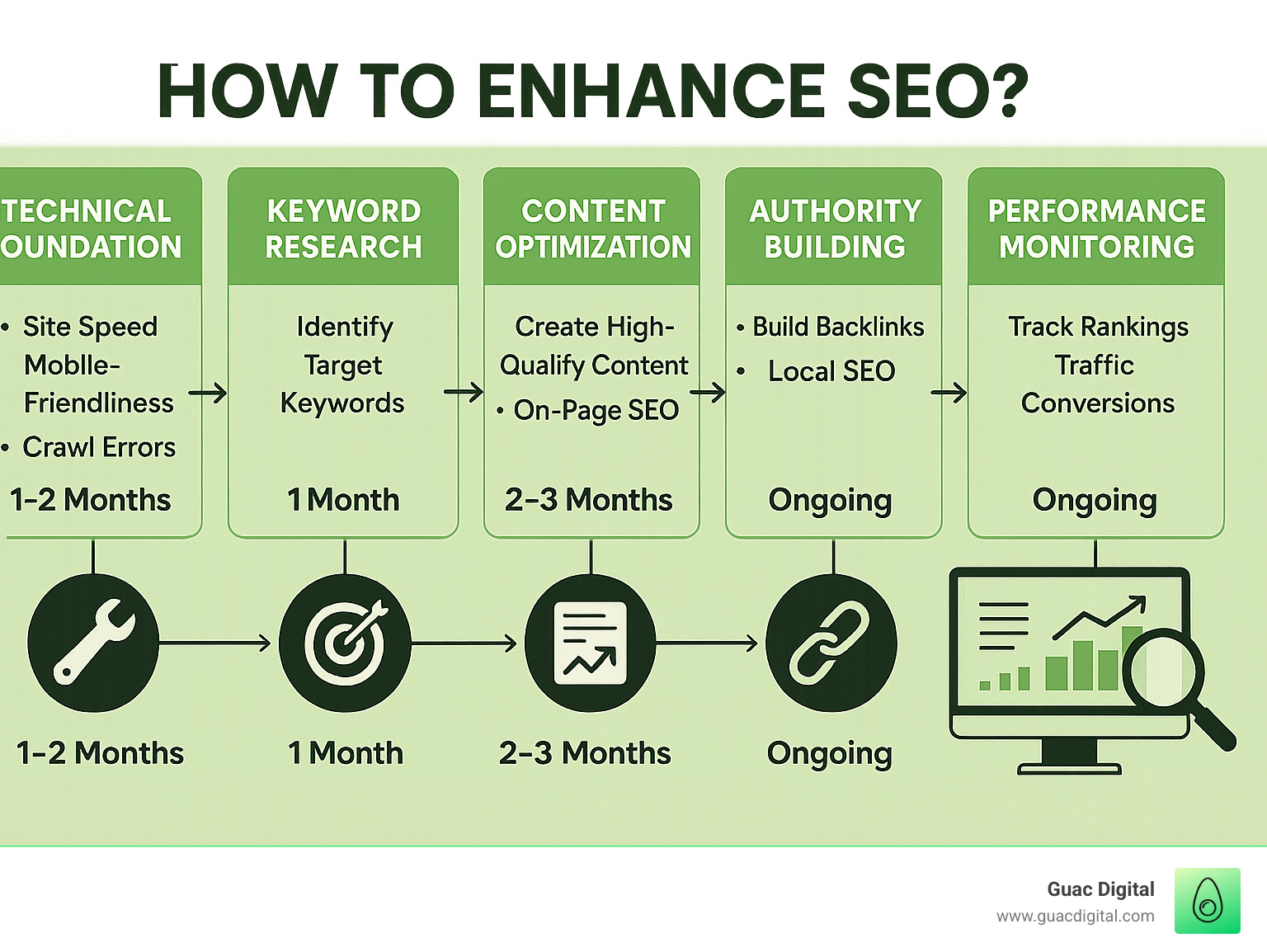
Here’s the quick roadmap for SEO improvement:
- Technical Foundation – Fix site speed, mobile responsiveness, and crawl errors
- Keyword Research – Target terms your customers actually search for
- Content Optimization – Create valuable, well-structured content that answers user questions
- Authority Building – Earn quality backlinks and local citations
- Performance Monitoring – Track rankings, traffic, and conversions regularly
The stakes are higher than ever. 80% of people read headlines, but only 20% read the full content. Your site needs to capture attention fast and deliver real value. Research shows that pages ranking in Google’s top 10 are typically over two years old – meaning consistency and patience pay off.
But here’s what most businesses get wrong: they focus on quick fixes instead of building sustainable SEO systems. Pages with embedded videos show 11.2% better bounce rates than those without. Sites that update content regularly get crawled more frequently by search engines. These aren’t accidents – they’re the result of understanding how search engines and users actually behave.
I’m Guy Leon, founder and CEO of Guac Digital, where we’ve helped clients achieve a 350% boost in engagement through strategic digital marketing campaigns. My expertise in how to improve SEO comes from successfully implementing comprehensive optimization strategies that have generated 300% increases in website traffic for businesses just like yours.
Quick How to improve SEO? definitions:
– How to use data in marketing?
– What is programmatic advertising?
– seo copywriting and content optimization services
Core SEO Foundations
Think of SEO like building a house—you wouldn’t dream of starting with the decorative trim before pouring a solid foundation. The same logic applies when figuring out how to improve SEO. Without rock-solid technical foundations, even the most brilliant content strategy will struggle to gain traction.
The truth is, most websites have hidden technical issues that are quietly sabotaging their search rankings. Site speed alone can make or break your SEO efforts—Google uses page speed as a direct ranking factor, and our research consistently shows that top-ranking pages load significantly faster than their competitors.
Mobile-first design isn’t just trendy—it’s essential. Google switched to mobile-first indexing, which means they primarily use your mobile site’s content for ranking and indexing. If your site doesn’t work smoothly on smartphones, you’re essentially invisible to most searchers.
Your URL structure tells both users and search engines what to expect from your content. Clean, descriptive URLs like “guacdigital.com/how-to-improve-seo” work infinitely better than messy ones like “guacdigital.com/p=123?ref=abc.” This simple change often delivers immediate improvements in both user experience and search visibility.
Heading tags create a logical roadmap through your content. Use your H1 tag once per page with your primary keyword, then guide readers through your information with well-structured H2 and H3 tags. This isn’t just about pleasing search engines—it dramatically improves how real people consume your content.
We always recommend PageSpeed Insights for identifying speed bottlenecks. Common fixes like compressing images, enabling browser caching, and minimizing JavaScript often deliver quick wins in both rankings and user satisfaction.
Keyword Research & Intent Mapping
Here’s where most businesses go wrong: they target keywords they think are important instead of terms their customers actually use. Understanding real search behavior is the cornerstone of effective SEO improvement.
Search intent comes in four flavors: informational (learning something new), navigational (finding a specific website), commercial (researching products), and transactional (ready to buy right now). Someone searching “leaking tap” is just starting their journey, while “emergency plumber Tampa” signals immediate buying intent.
Topic clusters work better than scattered keyword targeting. Instead of creating separate pages for “SEO tips,” “SEO strategies,” and “SEO techniques,” build one comprehensive pillar page about SEO improvement and connect related subtopics to it. This approach aligns perfectly with how Google’s algorithm understands semantic relationships between concepts.
Mapping keywords to the buyer journey ensures you capture users at every stage. Target awareness-stage terms like “what is SEO,” consideration-stage phrases like “best SEO tools,” and decision-stage searches like “hire SEO agency Tampa.” This comprehensive approach dramatically improves your conversion rates.
Tools like Ahrefs and Google Keyword Planner provide essential search volume and competition data, but don’t overlook SEO AI Keyword research for finding emerging terms and valuable long-tail opportunities. Those longer, more specific phrases often convert better because they reflect precise user intent.
Technical Health Checks
Your website’s technical health directly impacts how search engines crawl, index, and rank your content. Small technical issues can create massive ranking problems—we’ve seen sites lose 50% of their traffic from simple technical oversights.
Your sitemap acts like a roadmap that tells search engines which pages exist on your site. Submit it through Google Search Console and monitor for indexing errors. A properly configured sitemap can dramatically accelerate how quickly new content gets finded and indexed.
The robots.txt file controls search engine access to different parts of your site. Common mistakes include accidentally blocking important pages or allowing crawlers to waste time on irrelevant sections like admin areas. Getting this wrong can completely hide your content from search engines.
HTTPS provides both security and SEO benefits—Google explicitly gives secure sites a ranking boost. If you’re still using HTTP, migrating to HTTPS should be your immediate priority. It’s not just about rankings; users trust secure sites more.
Core Web Vitals measure real user experience through three key metrics: Largest Contentful Paint (loading performance), First Input Delay (interactivity), and Cumulative Layout Shift (visual stability). These metrics directly impact both SEO rankings and user satisfaction.
Schema markup helps search engines understand your content context. Adding structured data can enable rich snippets in search results, which dramatically improve click-through rates. Even basic schema implementation often leads to immediate improvements in search visibility.
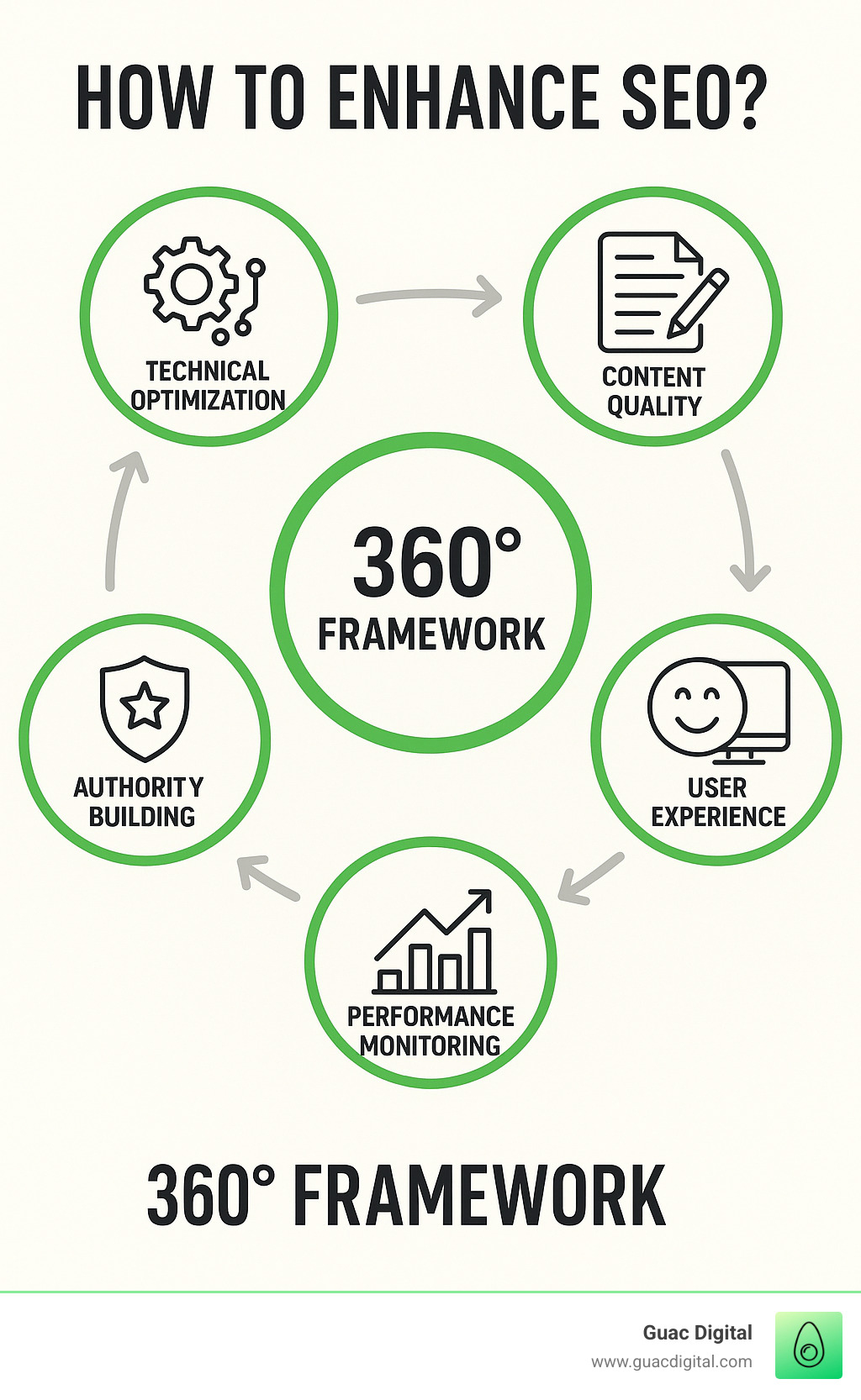
How to Improve SEO? The 360° Framework
When people ask “How to improve SEO?” the answer isn’t just one magic trick—it’s about creating a complete system where every piece works together. Think of it like a well-oiled machine where technical optimization, content quality, user experience, and authority building all support each other.
Here’s what makes this approach so effective: great content without proper technical setup won’t rank, and perfect technical SEO can’t save thin, unhelpful content. Everything needs to work in harmony.
Let’s start with the basics that can make an immediate difference. Your meta tags are like your website’s first impression in search results. Your title tag should include your main keyword and stay under 60 characters—otherwise Google cuts it off with those dreaded “…” dots.
Meta descriptions don’t directly boost your rankings, but they absolutely influence whether people click on your result. Write them like mini-advertisements that accurately describe what’s on your page and give people a reason to visit.
Alt text for images serves two important purposes: it helps visually impaired users understand your content, and it gives search engines context about your images. Instead of lazy descriptions like “image1.jpg,” be specific: “Tampa business owner reviewing SEO checklist on laptop.”
Your internal linking strategy acts like a roadway system, guiding both users and search engines through your most important content. Use descriptive anchor text that includes relevant keywords, but keep it natural. When you link to related articles, you’re essentially telling Google “this content is connected and valuable.”
Featured snippets represent a huge opportunity to steal visibility from competitors. Structure your content to answer common questions directly and clearly. Use numbered lists, bullet points, and clear headings to make it easy for Google to extract and display your information.
Here’s something interesting: dwell time—how long people actually stay on your page—sends powerful quality signals to search engines. Pages with embedded videos show 11.2% better bounce rates because they keep people engaged longer. When you create content that thoroughly answers questions and keeps people reading, Google notices.
How to Improve SEO? On-Page Content Mastery
Content quality has become the make-or-break factor for SEO success. Google’s E-E-A-T guidelines (Experience, Expertise, Authoritativeness, Trustworthiness) aren’t just buzzwords—they’re the foundation of how search engines evaluate whether your content deserves to rank.
Creating 10X content means building resources that are significantly better than anything else available on your topic. This isn’t about writing longer articles just to hit word counts. It’s about providing unique insights, original research, and genuinely helpful information that people can’t find anywhere else.
Your header hierarchy should tell a clear story. Start with your H1 as the main topic, use H2s for major sections, and break down subtopics with H3s. This logical flow helps both readers and search engines understand how your content is organized.
Keyword placement needs to feel natural, not forced. Include your primary keyword in the title, first paragraph, and at least one subheading. But remember—you’re writing for real people first, search engines second. When you focus on answering questions and solving problems, keywords naturally fall into place.
Readability directly impacts how long people stay on your page. Use short paragraphs, plenty of white space, and break up text with subheadings. If your content is hard to read, people bounce quickly—and Google definitely notices that behavior.
At Guac Digital, we’ve seen how proper content optimization transforms websites from invisible to indispensable. Our SEO Copywriting and Content Optimization Services help businesses create content that not only ranks well but actually converts visitors into customers.
How to Improve SEO? Authority & Backlink Engine
Domain authority and backlinks remain among the strongest ranking factors because they represent real votes of confidence from other websites. When reputable sites link to your content, they’re essentially telling Google “this information is valuable and trustworthy.”
Quality absolutely trumps quantity in link building. A single link from a highly authoritative site in your industry carries more weight than dozens of links from random, low-quality directories. Focus your efforts on earning links from websites your customers already know and trust.
Guest posting can be incredibly effective when done right. The key is providing genuine value to the host site’s audience rather than just promoting your business. The best guest posts solve real problems and establish you as a thought leader in your field.
Broken link building offers a win-win opportunity: you help website owners fix broken links while earning quality backlinks for yourself. Find broken links on relevant websites and suggest your content as a helpful replacement. Tools like Ahrefs make this process much more manageable.
Digital PR tactics involve creating newsworthy content that naturally attracts attention and links. Conduct original research, publish compelling statistics, or offer unique insights that journalists and bloggers want to reference. When you become a go-to source for industry data, links follow naturally.
For businesses serving specific geographic areas, local citations are absolutely crucial. Your Name, Address, and Phone number (NAP) must be consistent across all online directories. Even small inconsistencies can confuse search engines and hurt your local rankings.
Our Local SEO for Small Business services help companies dominate their local markets through strategic citation building and Google Business Profile optimization. When done correctly, local SEO can transform a struggling business into the go-to choice in their area.
Advanced SEO Tactics for 2025 and Beyond
The digital landscape is shifting faster than ever, and how to improve SEO in 2025 requires staying ahead of emerging trends. Voice search is changing how people find information, AI is changing search results, and new features like Google’s Perspectives tab are creating fresh opportunities for visibility.
Think about how you search when you’re driving. Instead of typing “pizza near me,” you ask Siri “Where’s the best pizza place around here?” That’s the voice search revolution in action. These conversational queries are longer and more specific than traditional text searches. Your content needs to answer these natural, question-based searches directly.
The rise of AI search results means Google is getting smarter at understanding context and user intent. This shift actually benefits businesses that focus on authentic, experience-based content. When you share real stories, specific examples, and genuine insights from your work, you’re giving AI systems exactly what they need to understand your expertise.
Google’s Perspectives tab highlights content from real people sharing personal experiences. This feature rewards businesses that showcase their human side. Instead of generic advice, share specific challenges you’ve solved for clients and the exact steps you took.
Video SEO represents one of the biggest opportunities right now. YouTube is the second-largest search engine, and videos often appear in regular Google search results too. When you create video content, optimize the title, description, and transcript just like you would a blog post. Upload to YouTube first, then embed the video on your website to capture traffic from both platforms.
Structured data through Schema.org markup helps search engines understand what your content is actually about. Think of it as giving Google a cheat sheet about your page. This markup can trigger rich snippets in search results—those improved listings with star ratings, prices, or event dates that make your result stand out from the crowd.
Content Refresh & Repurposing
Even your best content won’t stay at the top of search results forever. Content decay is a real phenomenon where pages gradually lose rankings as competitors publish newer, more comprehensive resources. The good news? Refreshing existing content often delivers faster results than creating new pages from scratch.
We recommend quarterly content audits to identify pages that need attention. Look for content that’s dropping in rankings or getting less traffic than before. Often, these pages just need updated statistics, fresh examples, or expanded sections covering new developments in your field.
Google’s freshness algorithm rewards recently updated content, especially for topics where timeliness matters. When you update a blog post with new information, Google often recrawls it faster and may boost its rankings. This is particularly effective for evergreen topics that benefit from current examples and data.
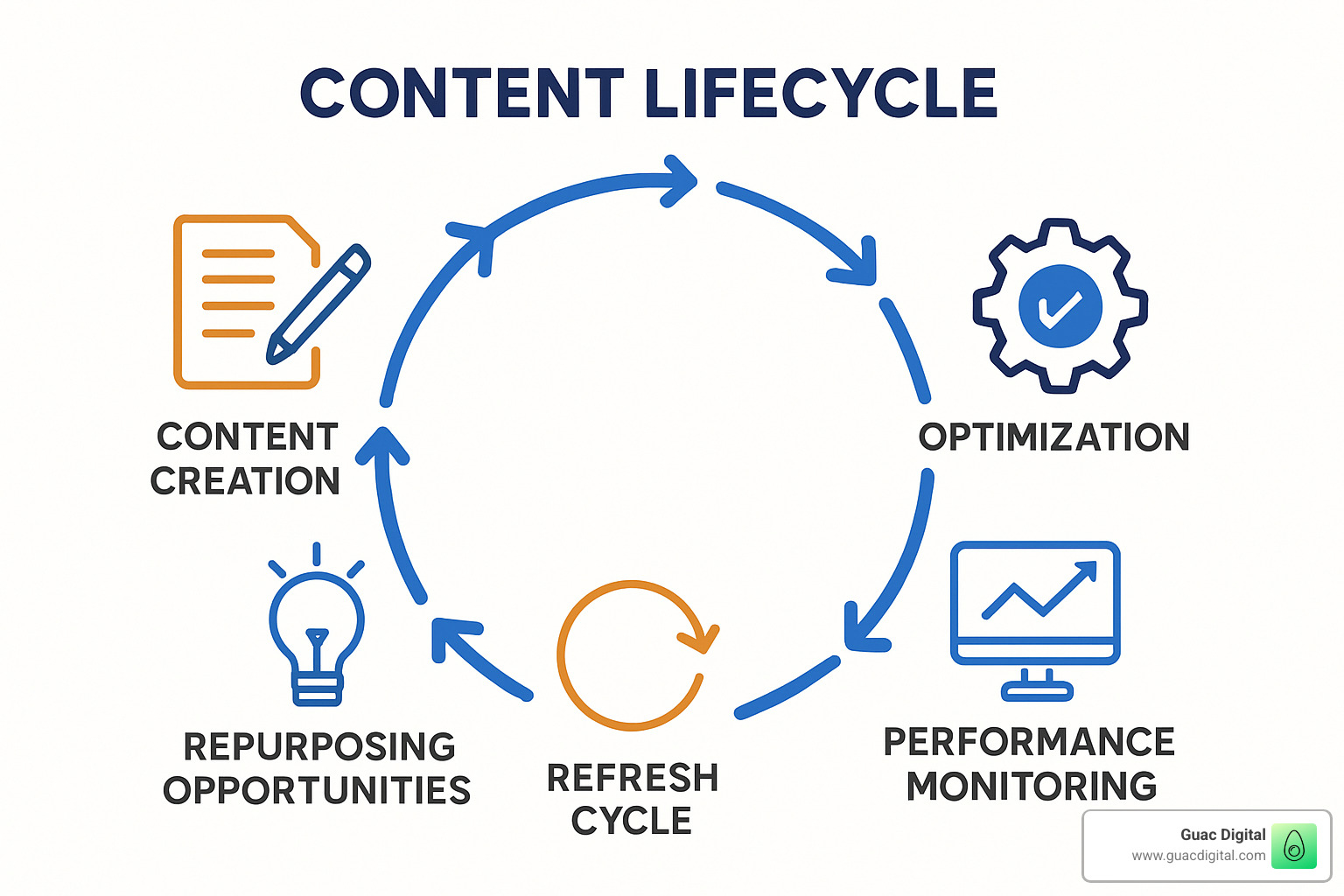
Content repurposing multiplies the value of your investment. That comprehensive blog post about SEO strategies? Turn it into a video tutorial, a podcast episode, an infographic, and a series of social media posts. Each format captures different audience preferences and search behaviors.
Multimedia integration isn’t just nice to have anymore—it’s essential. Pages with embedded videos show 11.2% better bounce rates because they keep visitors engaged longer. Podcasts reach people during commutes and workouts when they can’t read. Infographics get shared more frequently on social media, expanding your reach organically.
The key is creating a content ecosystem where each piece reinforces the others. Your video might drive traffic to your blog post, which links to your podcast, which mentions your downloadable guide. This interconnected approach helps search engines understand your expertise while giving users multiple ways to consume your information.
International & Local Expansion
Expanding your SEO reach requires different strategies depending on whether you’re targeting local customers or international markets. Understanding these differences helps you allocate resources effectively and avoid common pitfalls.
Hreflang tags are crucial for international SEO success. These HTML attributes tell search engines which language and region your content targets. Without proper hreflang implementation, you might compete against your own pages in search results or confuse search engines about your intended audience.
For local expansion, geo-targeted landing pages work incredibly well. Instead of one generic service page, create specific pages for each location you serve. A Tampa-based agency might have separate pages for “SEO Services Tampa,” “SEO Services Orlando,” and “SEO Services St. Petersburg,” each with location-specific content and local success stories.
Your Google Business Profile remains the foundation of local SEO. Complete every section, post regular updates, and encourage customer reviews. Online reviews influence 88% of consumers’ purchasing decisions, making review management a critical part of local SEO strategy.
Don’t overlook Apple Business Connect as Apple Maps gains market share. Ensuring your business information is accurate across all mapping platforms captures local search traffic from different sources and devices.
| Factor | Local SEO | International SEO |
|---|---|---|
| Primary Focus | Geographic proximity | Language and cultural relevance |
| Key Platforms | Google Business Profile, local directories | Multiple search engines, social platforms |
| Content Strategy | Location-specific keywords, local events | Cultural adaptation, translated content |
| Link Building | Local citations, community partnerships | International publications, global brands |
| Technical Setup | Local schema markup, geo-targeting | Hreflang implementation, CDN setup |
The biggest difference between local and international SEO is search engine diversity. While Google dominates most markets, Baidu leads in China, Yandex in Russia, and Naver in South Korea. Each platform has unique ranking factors and optimization requirements that affect your expansion strategy.
Monitoring, Measurement & Common Pitfalls
The most successful SEO campaigns share one crucial trait: they measure what matters. Too many businesses get caught up tracking vanity metrics that look impressive in reports but don’t actually drive revenue. We’ve learned that focusing on the right indicators makes all the difference between spinning your wheels and accelerating growth.
How to improve SEO? starts with understanding your current performance through meaningful metrics. Organic traffic growth tells you if more people are finding your site, but conversion rate from organic traffic reveals whether those visitors become customers. Keyword ranking improvements show your visibility progress, while return on SEO investment proves the financial impact of your efforts.
The key is connecting these dots to tell your complete SEO story. A 50% increase in organic traffic means nothing if those visitors bounce immediately. But a 20% traffic increase that leads to 40% more qualified leads? That’s real progress worth celebrating.
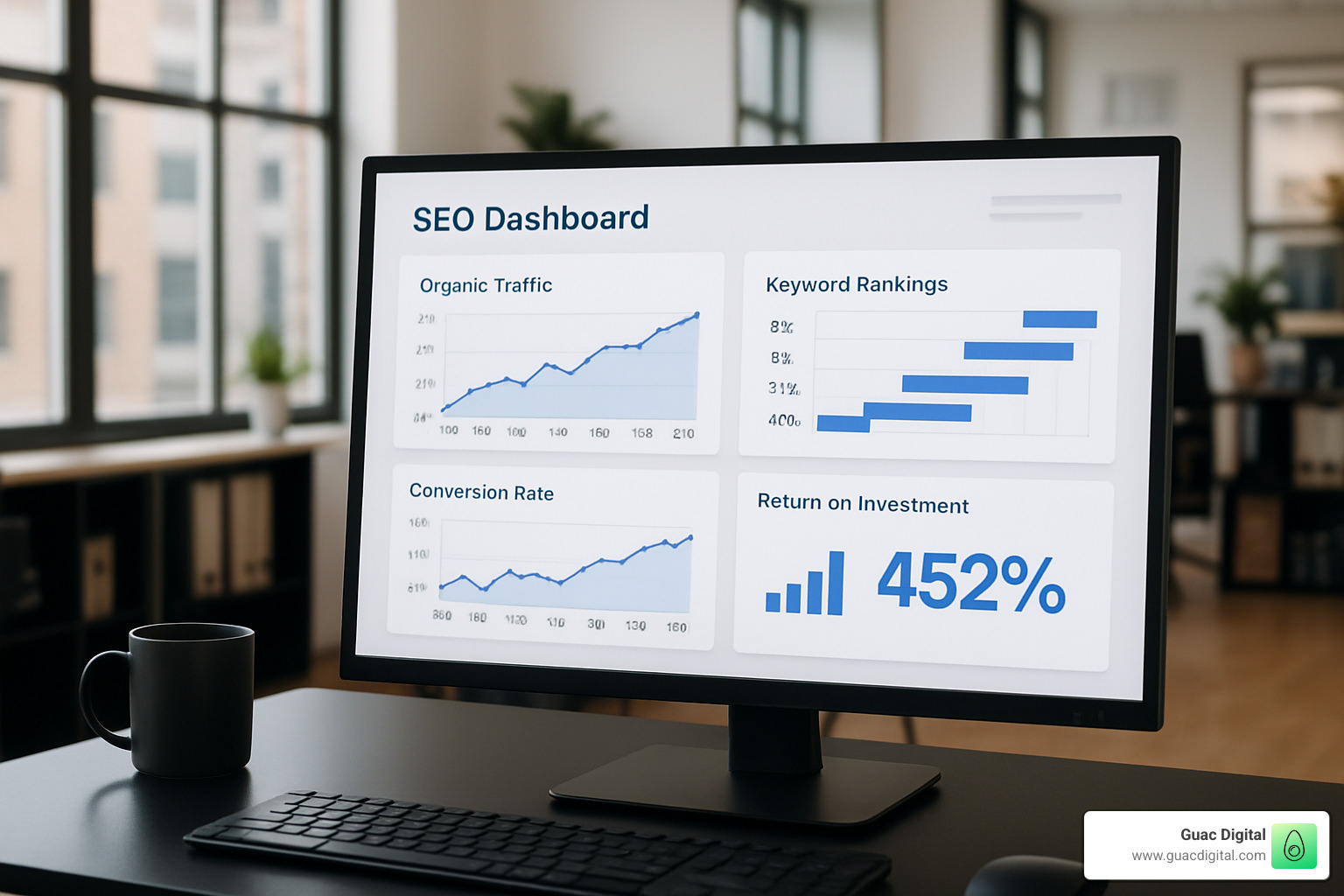
Your analytics setup should track the entire customer journey from that first search click to final purchase. Google Analytics becomes your detective tool, revealing which content attracts visitors, where they get stuck, and what finally convinces them to convert. This insight helps you double down on what’s working and fix what isn’t.
Dashboard creation saves countless hours and keeps everyone focused on the same goals. We create custom dashboards that display each client’s most important metrics at a glance. No more digging through complex reports to find the numbers that actually matter.
Regular audit tools help catch problems before they become ranking disasters. Google Search Console flags indexing issues, PageSpeed Insights reveals performance bottlenecks, and Screaming Frog identifies technical SEO problems. Think of these tools as your early warning system.
Duplicate content confuses search engines and splits your ranking power across multiple pages. Use canonical tags to tell Google which version you prefer, and avoid publishing identical content on different URLs. It’s like having two business cards with different addresses—nobody knows where to find you.
Intrusive advertisements create a terrible user experience and trigger Google penalties. We get it—you need revenue from ads. But balance is everything. Google explicitly penalizes sites with disruptive ads that make content hard to read or access. Your SEO success depends on keeping users happy first.
Our Services for SEO include comprehensive monitoring that keeps you informed without overwhelming you with data. We focus on the metrics that drive real business growth and provide actionable insights for continued improvement.
Tool Stack & Reporting Cadence
The right tools transform SEO from guesswork into strategic decision-making. We’ve tested dozens of platforms over the years and settled on a combination that provides comprehensive coverage without breaking the budget.
Google Analytics forms the foundation of everything we do. Set up goals and conversion tracking to understand which organic traffic actually produces results. Custom segments help isolate organic performance from paid ads and social media traffic, giving you clear insight into SEO effectiveness.
Semrush and Ahrefs provide competitive intelligence that reveals opportunities your competitors are missing. These tools show which keywords they rank for, where their backlinks come from, and how their content performs. It’s like having a window into their strategy meetings.
StoryChief streamlines content creation and distribution across multiple channels. This ensures your carefully crafted content reaches the widest possible audience while maintaining consistent messaging. Why create great content if only a few people see it?
Data Studio automates reporting with real-time updates that eliminate manual work. Stakeholders get current performance data whenever they need it, and you spend less time creating reports and more time improving results.
Monthly reporting works better than daily obsessing. SEO results take time to develop, and daily ranking fluctuations often mean nothing. Monthly reviews reveal actual performance patterns and help you make strategic decisions based on real trends rather than temporary blips.
Mistakes to Avoid
Learning from common SEO mistakes saves months of frustration and wasted effort. We’ve seen these errors destroy otherwise solid campaigns across every industry imaginable.
Keyword stuffing makes content unreadable and triggers Google penalties faster than almost anything else. Your content should flow naturally and provide genuine value. If you’re forcing keywords into every sentence, you’re doing it wrong. Focus on creating helpful content that naturally incorporates relevant terms.
Thin content rarely ranks well in today’s competitive landscape. Instead of creating dozens of shallow pages, develop comprehensive resources that thoroughly answer user questions. One amazing 3,000-word guide often outperforms ten mediocre 300-word posts.
Slow page loading times hurt everything—user experience, rankings, and conversions. Regularly test your site speed using tools like PageSpeed Insights and address issues promptly. Simple fixes like compressing images and enabling caching often provide dramatic improvements.
Broken links frustrate users and waste the crawl budget Google allocates to your site. Use tools to regularly scan for broken internal and external links, then fix or remove them quickly. It’s basic maintenance that many sites neglect.
Black-hat shortcuts promise quick results but often lead to devastating penalties. Buying links, using private blog networks, or trying to trick Google might work temporarily, but the long-term consequences can destroy years of legitimate SEO work. The risk simply isn’t worth the potential reward.
Frequently Asked Questions about Enhancing SEO
What is SEO and why does it matter?
SEO (Search Engine Optimization) is the practice of improving your website to increase its visibility in search engine results. Think of it as making your website more attractive and understandable to both search engines and real people who are looking for what you offer.
Here’s why SEO matters so much: organic search drives more website traffic than any other source. When someone searches for “Tampa digital marketing agency” and finds your site naturally in the results, they’re much more likely to trust you than if they see a paid ad. People have learned to skip past advertisements and focus on the “real” results.
The beautiful thing about effective SEO is that it helps you reach customers who are actively searching for your products or services. Unlike a billboard that hopes the right person drives by, or a TV commercial that interrupts someone’s evening, SEO connects you with users who already have intent. They’re raising their hand saying “I need this right now.”
When we work with clients at Guac Digital, we often see businesses surprised by how much more qualified their organic traffic is compared to other sources. These visitors convert better because they found you while solving a specific problem.
How long does it take to see results?
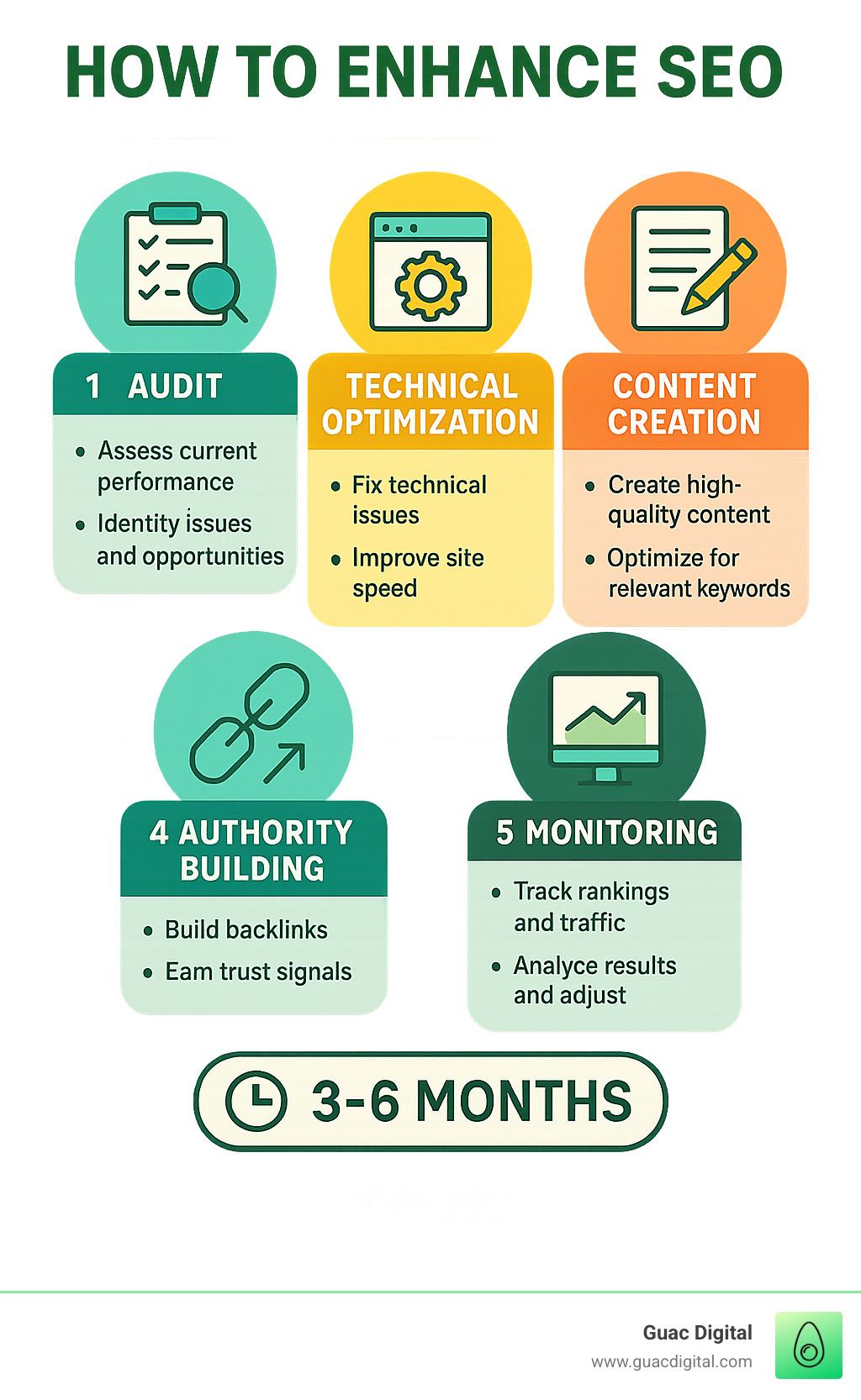
SEO typically takes 3-6 months to show significant results, though you might notice some improvements sooner. I know that sounds like forever in our instant-gratification world, but here’s the reality: anything promising overnight SEO results is probably trying to sell you something that won’t work long-term.
Technical fixes might improve rankings within weeks. If your site loads slowly or has crawl errors, fixing these issues can boost your visibility relatively quickly. We’ve seen clients jump several positions just by compressing images and fixing broken links.
Content and authority building efforts usually require longer timeframes because you’re essentially building trust with Google. Search engines want to see that you consistently produce valuable content and that other reputable sites link to you. This doesn’t happen overnight.
The timeline depends on several factors: your site’s current condition, competition level in your industry, and the scope of optimization efforts. A local Tampa restaurant competing for “best pizza” will see results faster than a tech startup trying to rank for “enterprise software solutions.”
Consistent, quality work produces better long-term results than sporadic intensive efforts. It’s like going to the gym—working out consistently for months beats cramming all your exercise into one week.
Which SEO tactic delivers the quickest wins?
Technical SEO fixes often provide the fastest results when you’re wondering how to improve SEO quickly. Improving page speed, fixing crawl errors, and optimizing meta tags can boost rankings within weeks. These improvements work fast because they remove barriers that prevent search engines from properly understanding your content.
Think of technical fixes like removing roadblocks. If Google’s crawlers can’t access your site properly, even the world’s best content won’t rank. But once you clear the path, everything else starts working better.
Content optimization for existing pages that already rank on page 2-3 can also deliver quick improvements. These pages are so close to the first page that small tweaks often push them over the edge. Small changes to title tags, meta descriptions, and content structure often move pages from position 15 to position 5 relatively quickly.
Another quick win involves fixing obvious user experience problems. If people immediately leave your site because it’s confusing or slow, Google notices. Simple improvements like adding clear navigation, speeding up load times, and making your content easier to read can have immediate impact.
The key is focusing on low-hanging fruit first—problems that are easy to fix but have been holding your site back. Once you handle these foundational issues, you can move on to longer-term strategies like content creation and link building.
Conclusion & Next Steps
How to improve SEO? The answer isn’t found in a single magic trick or overnight solution. It’s built through consistent, strategic efforts that compound over time. Think of SEO like tending a garden—you plant the seeds with technical optimization, nurture growth with quality content, and watch your rankings flourish through ongoing care and attention.
We’ve walked through everything from technical foundations to advanced tactics, but here’s the truth: knowing what to do and actually doing it are two very different things. Most businesses start strong but lose momentum when they don’t see immediate results. The companies that succeed are those that understand SEO is a marathon, not a sprint.
At Guac Digital, we’ve seen this pattern countless times. Our clients who achieve the most dramatic improvements—like the 350% engagement boosts and 300% traffic increases we’ve delivered—share one common trait: they commit to the process. They understand that every element works together like pieces of a puzzle.
Your technical optimization enables search engines to find and understand your content. Your quality content earns the authority signals that boost rankings. Those authority signals then help all your content perform better. It’s a beautiful cycle, but it requires expertise and patience to execute properly.
Start where you’ll see the biggest impact fastest. Run a technical audit to catch any glaring issues that might be holding you back. Fix your page speed, mobile responsiveness, and indexing problems first. These foundational fixes often open up improvements across your entire site.
Then move into content optimization. Look at pages that already rank on page two or three—small improvements to these can often push them into the top ten quickly. Finally, build your long-term authority through consistent content creation and relationship building.
The businesses dominating search results aren’t necessarily the biggest or oldest. They’re the ones that consistently apply proven SEO strategies while adapting to algorithm changes and user behavior shifts.
Ready to transform your online visibility? Our team at Guac Digital specializes in creating comprehensive SEO strategies that deliver measurable results. Boost Your Online Presence with Expert SEO Services and find how our data-driven approach can help your business capture more qualified traffic.
For detailed information about our optimization services, visit our More info about engine optimization services page to learn how we can help your business dominate search results in your industry.
SEO improvement is an investment in your business’s future. Every hour you spend optimizing today pays dividends for months and years to come. The question isn’t whether you can afford to invest in SEO—it’s whether you can afford not to.