
programmatic dsp: 7 Powerful Reasons to Succeed in 2025
Understanding the Programmatic Advertising Ecosystem
A programmatic DSP (Demand-Side Platform) is automated software that allows advertisers to purchase digital ad inventory across multiple publishers and ad exchanges through a single interface.
What is a Programmatic DSP?
| Feature | Description |
|---|---|
| Definition | Technology platform that automates digital ad buying through real-time bidding |
| Purpose | Enables advertisers to purchase ad inventory across multiple publishers efficiently |
| Key Function | Evaluates ad impressions in milliseconds based on targeting criteria |
| Main Benefits | Efficiency, precise targeting, transparent reporting, budget optimization |
| Common Types | Self-serve, white-label, and full-service DSPs |
Programmatic advertising has revolutionized how brands connect with audiences online. Gone are the days of manual insertion orders, spreadsheets, and lengthy negotiations with individual publishers. Today, programmatic DSP technology enables advertisers to reach the right person, at the right time, with the right message—all in less than a second through automated bidding.
Think of a programmatic DSP as your ad-buying engine that leverages sophisticated algorithms to make instantaneous decisions about which ad impressions to purchase and how much to bid for them. This technology processes countless data signals—from demographics and browsing behavior to location and device type—to deliver highly targeted advertising across websites, mobile apps, connected TV, audio streams, and digital out-of-home placements.
As Basis DSP explains, “Programmatic serves up relevant ad impressions to audiences through automated steps, in less than a second.” This lightning-fast process has transformed digital advertising from a cumbersome manual task to a streamlined, data-driven operation.
I’m Guy Leon, founder of Guac Digital, with over a decade of experience implementing programmatic DSP strategies that have helped businesses achieve up to 350% increases in conversion rates through precision targeting and real-time optimization.

Handy programmatic dsp terms:
– programmatic advertising platforms
– programmatic trading
– programmatic video
Why Programmatic Matters Now
The shift to programmatic isn’t just a trend—it’s a fundamental change in how digital advertising works. In 2023, programmatic ad spending in the US alone reached over $123 billion, with projections showing continued growth as more channels become programmatically available.
Why has this happened? Simply put: efficiency and results. Programmatic advertising automates what was once an incredibly labor-intensive process. Instead of negotiating with dozens of publishers individually, advertisers can now reach their target audience wherever they are online through a single platform.
The numbers speak for themselves:
– 91% of businesses now use video advertising, often executed through programmatic DSPs, to engage users online
– Advertisers using sophisticated DSPs report access to over 40 billion daily impressions across all devices and channels
– A recent case study showed a national retail pharmacy achieved a $9.04 incremental return on ad spend (ROAS) using a cookieless DSP solution
As consumer attention fragments across devices and platforms, the ability to coordinate messaging and control frequency across these touchpoints has become essential. This is exactly what a programmatic DSP delivers.
Programmatic DSP Fundamentals
Think of a programmatic DSP as your digital advertising command center – it’s where all the magic happens. This technology sits right at the heart of the programmatic ecosystem, giving marketers a single powerful platform to plan, launch, monitor, and fine-tune campaigns across the entire digital landscape.
Remember the old days of digital advertising? You needed direct relationships with dozens of publishers, endless emails, and manual insertion orders. Those days are thankfully behind us! A programmatic DSP connects you directly to massive pools of ad inventory through seamless integrations with ad exchanges and supply-side platforms.
“A DSP is to digital advertising what a Bloomberg terminal is to stock trading—a sophisticated tool that gives you access to the entire marketplace and the ability to execute transactions in real-time,” as one seasoned industry expert puts it.
Your typical programmatic DSP comes equipped with several essential components. There’s the user-friendly dashboard where you’ll set up campaigns and define your audience targets. Behind the scenes, the algorithmic bidding engine evaluates available impressions in real-time. You’ve also got robust data management systems processing both your first-party data and any third-party data you’re using. Once you win an impression, the ad server delivers your creative, while comprehensive reporting tools track every aspect of performance.

How a Programmatic DSP Works
The beauty of a programmatic DSP is how it accomplishes complex tasks in milliseconds. Here’s what happens in less time than it takes you to blink:
When someone visits a website, the publisher’s supply-side platform instantly sends out a bid request to multiple ad exchanges. These exchanges forward the opportunity to connected DSPs, where the real intelligence kicks in. Your DSP evaluates each impression based on your targeting criteria, available user data, campaign parameters, and past performance.
If the impression matches what you’re looking for, your DSP submits a bid. The highest bid wins the auction, and voilà – your ad appears for the user. All of this happens in under 100 milliseconds!
The bidding component is truly the brains of the operation. It’s constantly balancing multiple factors: how likely a user is to respond to your ad, how valuable that user is to your business, your maximum bid limits, remaining budget, and historical performance data. Modern DSPs use sophisticated machine learning to continuously improve these bidding strategies, automatically adjusting to maximize your campaign goals.
Real-Time Bidding inside a Programmatic DSP
Real-Time Bidding (RTB) is the heartbeat of programmatic advertising. When your programmatic DSP receives a bid request, it has mere milliseconds to make smart decisions about whether to bid and how much to offer.
The process is neatly simple yet incredibly powerful. Your DSP receives detailed information about the available impression – the website or app, ad size and format, anonymized user information, and contextual data about the page content. The bidding algorithm quickly evaluates this opportunity against your specific requirements.
When there’s a good match, your DSP calculates a bid price (typically on a CPM basis), submits it to the exchange, and competes against other bidders. The highest bid wins, though often using a second-price auction model where you pay just slightly above the second-highest bid.
“RTB creates a win-win scenario. Advertisers pay market rates for exactly the audiences they want, while publishers maximize the value of their inventory by selling each impression to the buyer who values it most,” explains one programmatic expert.
This auction model is brilliant because it creates efficient pricing that truly reflects market value. Rather than paying fixed rates, you bid more for users who perfectly match your target audience and less for general impressions.
Programmatic DSP vs Manual Buying
To really appreciate the value of a programmatic DSP, let’s compare it with traditional manual buying:
Manual buying takes days or weeks just to negotiate and launch campaigns – with a DSP, you can set up in minutes and execute in seconds. Where manual processes are limited by human capacity, programmatic can process billions of impressions daily. Instead of broad site-level targeting, you get precise audience and contextual targeting. Rather than periodic, manual adjustments, you enjoy continuous, algorithmic optimization with real-time, granular insights instead of delayed reporting.
“Before programmatic, I spent hours emailing publishers, negotiating rates, and manually tracking performance in spreadsheets,” recalls a veteran media buyer. “Now, I focus on strategy while the DSP handles execution across hundreds of sites simultaneously.”
The efficiency gains are truly game-changing. A campaign that might have taken weeks to set up manually can be launched in minutes through a DSP, with the ability to make real-time adjustments based on performance data.
Want to dive deeper into how this all works? Check out our comprehensive guide on Programmatic Advertising Explained.
DSP, SSP, Ad Exchange & Ad Network – Who Does What?
Ever feel like you need a translator just to understand all the acronyms in programmatic advertising? Let’s break down this alphabet soup into something digestible and see how these pieces fit together in the digital advertising puzzle.
The programmatic ecosystem is like a well-orchestrated dance between several key players, each with their own role in getting ads from brands to consumers.
DSP (Demand-Side Platform)
On the advertiser side, we have the star of our show—the programmatic DSP. This is where advertisers and agencies go to buy ad inventory across the digital landscape. Think of platforms like Google’s Display & Video 360, The Trade Desk, or Amazon DSP. These platforms give advertisers powerful tools for targeting specific audiences, managing bids, and optimizing campaigns for better performance.
SSP (Supply-Side Platform)
Flip to the other side, and you’ll find publishers using Supply-Side Platforms like Google Ad Manager, Magnite, or PubMatic. Publishers use SSPs to automatically sell their ad space to the highest bidders. These platforms help website owners and app developers maximize their revenue through features like yield optimization and floor pricing (setting minimum acceptable bid amounts).
Ad Exchange
In the middle, connecting these two worlds, are ad exchanges. They’re essentially the digital marketplaces where DSPs and SSPs meet to conduct business. Google Ad Exchange, OpenX, and AppNexus are some major players here. Think of them as digital auction houses where billions of ad impressions are bought and sold every day in real-time.
Ad Network
Ad networks have been around longer than the other components and serve both advertisers and publishers. Networks like Google Display Network and Criteo aggregate inventory from multiple publishers and sell it as packages to advertisers. They’re simpler to use but typically offer less transparency about where your ads appear and what you’re really paying for the media.
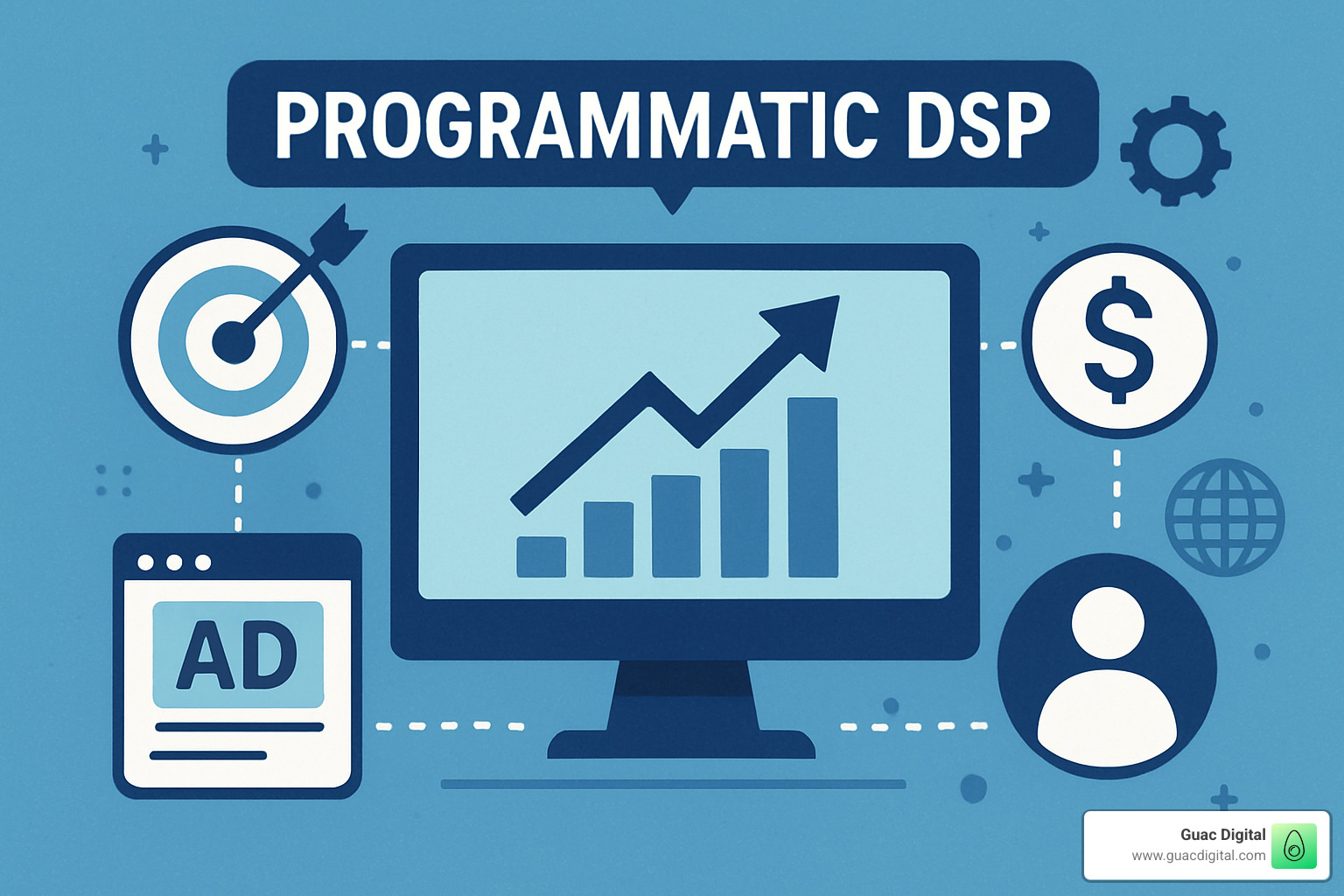
When everything’s working smoothly, data flows through this ecosystem like this: Publishers make their ad space available through SSPs, which connect to exchanges where DSPs can bid on behalf of advertisers. If a DSP wins the auction, the ad appears on the publisher’s site, and performance data flows back to both sides of the equation.
This ecosystem ensures advertisers can efficiently find their audiences while publishers maximize the value of their digital real estate. Everyone wins!
Why a DSP Is Not an Ad Network
I often hear people use “DSP” and “ad network” interchangeably, but they’re actually quite different beasts. Understanding these differences can save you from some serious headaches.
Transparency is perhaps the biggest difference. Ad networks have traditionally been “black boxes” where advertisers don’t know exactly where their ads appear or what portion of their spend actually goes toward media. A programmatic DSP, on the other hand, shows you exactly where your ads run and what you’re paying.
In terms of control, ad networks make many decisions for you, while DSPs put you in the driver’s seat. With a DSP, you decide targeting parameters, bidding strategies, and optimization approaches.
When it comes to access, ad networks offer a limited pool of pre-packaged inventory, while DSPs connect to multiple exchanges, giving you access to virtually the entire digital advertising landscape.
The pricing models differ too. Ad networks often mark up inventory at undisclosed rates, while DSPs typically charge transparent platform fees while passing through actual media costs.
As one of my favorite industry experts puts it: “Ad networks were the first step toward programmatic, but DSPs represent its full evolution—putting control, transparency, and sophisticated tools directly in advertisers’ hands.”
Connecting DSPs to SSPs via Exchanges
The connection between DSPs and SSPs happens through ad exchanges, and it can take several forms depending on your campaign goals:
Open Auction (RTB) is what most people think of when they hear “programmatic.” It’s a free-for-all where any DSP can bid on available inventory, and the highest bidder wins. This approach is great for reaching broad audiences efficiently and is typically where you’ll find the best deals.
Private Marketplace (PMP) deals are invitation-only auctions where select buyers get access to premium inventory. Think of it as the VIP section of programmatic—you might pay a bit more, but you get better quality inventory and more assurances about where your ads will appear.
Programmatic Direct brings the efficiency of programmatic to traditional direct deals. Here, buyers and sellers negotiate terms in advance (like guaranteed impressions at a fixed price), but use programmatic technology to execute the deal. This is perfect for securing specific high-value placements.
Header Bidding is a technical approach that allows multiple exchanges to bid simultaneously on a publisher’s inventory before the ad server is called. This creates more competition for each impression, typically resulting in higher yields for publishers and better inventory access for advertisers.
Each of these approaches has its place in a well-rounded programmatic strategy. For a brand awareness campaign, you might leverage open auctions for efficiency. For a premium brand campaign, programmatic direct might be the ticket to securing those high-impact placements.
For more insights on how browser technologies impact programmatic advertising, check out this article on Browser Wars Browser Wars.
Types of Programmatic DSPs & Omnichannel Use Cases
The world of programmatic DSP options can feel a bit like walking into an ice cream shop with dozens of flavors—exciting but potentially overwhelming! Let’s break down the main types to help you find your perfect match.
Self-Serve Programmatic DSP Platforms
Imagine having the keys to your own programmatic kingdom—that’s what self-serve DSPs offer. These platforms put you in the driver’s seat, giving you hands-on control of your campaigns from start to finish.
With a self-serve programmatic DSP, you’ll get direct access to a robust interface where you can build, launch, and tweak campaigns to your heart’s content. It’s like having your own trading desk right at your fingertips. The transparency is refreshing—you’ll see exactly where your budget goes and how each tactic performs.
The catch? You’ll need some know-how to steer these waters effectively. Most self-serve platforms also come with minimum monthly spends (typically between $5,000-$20,000), so they’re not always the best fit for smaller experiments.
“Self-serve DSPs offer the most control but require a learning curve,” as one programmatic specialist puts it. “They’re like having your own programmatic trading desk, with all the power and responsibility that entails.”
Popular options include The Trade Desk, MediaMath, and Basis Technologies—platforms that marketing teams with existing programmatic expertise often gravitate toward.
White-Label Programmatic DSP Solutions
Want the speed of a ready-made solution but with your company’s name on it? White-label DSPs offer exactly that magic combination.
These solutions allow businesses to offer programmatic capabilities under their own brand without building the technology from scratch. It’s a bit like getting a custom suit that’s been pre-custom—you get the perfect fit without waiting months.
The beauty of white-label programmatic DSP options is their flexibility. You can customize the interface with your branding while the heavy technological lifting happens behind the scenes. What might take years to build from scratch can be up and running in weeks.
This approach has gained serious traction as the barriers to entry for custom DSP development have grown higher. Agencies looking to launch their own trading desk or ad tech companies expanding their offerings find particular value here.
For a deeper dive into various buying platforms, our guide on Programmatic Ad-Buying Platforms provides additional insights.
Full-Service Programmatic DSPs
Not everyone wants to become a programmatic expert—sometimes you just want the results without the learning curve. That’s where full-service DSPs shine.
These platforms combine powerful technology with human expertise, essentially offering a “we’ll handle it for you” approach. Your campaigns get managed by the DSP’s in-house experts, who bring their specialized knowledge to your specific goals.
The trade-off is clear: you get convenience but sacrifice some control. As one industry observer notes, “Full-service DSPs are convenient but sacrifice control and flexibility.” They’re perfect for brands dipping their toes into programmatic waters or those without dedicated in-house talent.
While they may carry higher fees to cover the service component, the reduction in staffing needs often balances the equation. Just ensure you’re getting full transparency on performance and costs.

Beyond these structural differences, the programmatic DSP world has evolved to include channel specialists:
Mobile DSPs excel at reaching audiences on smartphones and tablets, whether they’re browsing the web or using apps. Video DSPs focus on delivering engaging pre-roll, mid-roll, and outstream video formats across the web. If you’re targeting the growing connected TV audience, CTV DSPs provide specialized access to inventory on streaming platforms.
The innovation doesn’t stop there. DOOH DSPs have transformed traditional billboard advertising into programmable digital displays. Audio DSPs help brands reach listeners during their Spotify sessions or podcast binges. And for the gaming audience, Gaming DSPs offer unique ways to integrate with interactive entertainment.
Many leading platforms now offer omnichannel capabilities—letting you orchestrate campaigns across multiple touchpoints from a single dashboard. This integrated approach means your messaging stays consistent, you can manage frequency across channels, and all your reporting lives in one place.
At Guac Digital, we help clients steer this complex landscape, matching them with the right programmatic DSP based on their unique goals, audience, and internal capabilities. Our cross-platform expertise ensures you’ll maximize value from whichever programmatic path you choose.
Must-Have Features, Data & Optimization Strategies
When you’re investing in a programmatic DSP, you want to make sure you’re getting the right tools for success. It’s like buying a car – you need to look under the hood, not just admire the paint job! Let’s explore what features really matter in today’s digital advertising landscape.
The best DSPs combine powerful targeting capabilities with user-friendly interfaces and robust optimization tools. I’ve seen how the right platform can transform campaign performance, turning modest budgets into significant business results.
Core Platform Features
The heart of any programmatic DSP is its audience targeting capabilities. You want a platform that lets you zero in on exactly who matters to your business – whether that’s based on demographics, behaviors, or the context of where your ad appears. Look for a DSP that makes it easy to create custom audience segments and expand your reach through look-alike modeling.
Brand safety is non-negotiable in today’s environment. Your DSP should offer pre-bid fraud prevention, comprehensive brand safety controls, and viewability optimization to ensure your ads appear in quality environments. Without these protections, you might as well be throwing your budget into a black hole!
The best platforms make campaign management intuitive with user-friendly interfaces, bulk editing capabilities, and automated rules that save you time. As one Viant DSP client with a 95% satisfaction rate shared: “The platform’s ability to combine audience targeting with real-time optimization delivered a 19.1% lift in buyer penetration and a 1.1% lift in spend per buyer.” Those are the kind of results that speak volumes.
Great DSPs also provide comprehensive reporting and analytics. You need real-time dashboards, custom report builders, and multiple attribution models to truly understand your campaign performance. And don’t forget creative capabilities – from dynamic optimization to multi-format support, your DSP should help your ads shine.
Data Targeting & DMP Connections
Data is the secret sauce of programmatic advertising. It’s what transforms broad audience targeting into precision marketing that delivers results.
First-party data activation has become increasingly important in today’s privacy-conscious world. Your programmatic DSP should make it easy to onboard your CRM data, retarget website visitors, and create custom audiences based on your actual customers. This is your most valuable data asset – make sure your DSP knows how to use it effectively!
Third-party data integration expands your targeting horizons. Look for platforms that connect with major data providers and offer transparent data costs. As industry experts note, “The integration of DSP with a DMP to leverage first- and third-party data for more precise targeting” is essential for campaign success.
Identity solutions are becoming critical as cookies fade away. Advanced DSPs now offer cookieless targeting capabilities, household-level identification, and privacy-forward identity frameworks that future-proof your campaigns. These solutions help you maintain targeting precision even as traditional identifiers disappear.
Optimization Inside a DSP
The true magic of a programmatic DSP happens in its optimization capabilities. This is where artificial intelligence and machine learning really earn their keep.

AI-powered bidding adjusts your bids in real-time based on the likelihood of conversion, stretching your budget further by focusing spend on the impressions most likely to deliver results. These algorithms process billions of data points to identify patterns that human operators simply couldn’t spot – making your campaigns smarter with every impression.
Aligning with your actual business KPIs is crucial. Modern DSPs optimize toward business outcomes, not just clicks or impressions. Whether you’re focused on ROAS, CPA, or incremental lift, your platform should speak your language when it comes to performance.
Smart budget management ensures your campaigns deliver consistently throughout their flight. Features like dayparting, impression forecasting, and bid shading prevent wasted spend and help you make the most of every dollar. As one expert puts it, “Machine learning features for dynamic budget optimization” are increasingly critical as campaigns become more complex.
Creative optimization completes the picture by testing different elements and personalizing messaging based on user data. The best DSPs automatically identify which creative approaches work best for different audience segments, continuously improving performance.
Measuring Success with Your Programmatic DSP
What gets measured gets managed – and improved! Effective measurement is the foundation of programmatic success.
Modern attribution models go beyond simple last-click to understand the full customer journey. Your DSP should offer multi-touch attribution, view-through conversion tracking, and even online-to-offline measurement capabilities. These tools help you understand which touchpoints truly influence purchase decisions.
Performance metrics should tie directly to business outcomes. Cost per acquisition, return on ad spend, lifetime value – these are the numbers that matter to your bottom line. A national retail pharmacy using a cookieless DSP solution recently achieved “$9.04 incremental ROAS, a 19.1% lift in buyer penetration, and a 1.1% lift in spend per buyer.” Those are results worth celebrating!
Audience insights help you understand not just what’s working, but why. Segment performance analysis, audience overlap reports, and customer journey mapping reveal valuable information about your customers that can inform future campaigns and even broader marketing strategy.
Cross-device measurement has become essential in our multi-screen world. Your DSP should provide unified reporting across channels, device path analysis, and holistic campaign views that capture the complete customer experience.
At Guac Digital, we work closely with clients to implement measurement frameworks that connect programmatic activities directly to business outcomes. This approach ensures campaigns are optimized for what truly matters: driving revenue and growth for your business.
For more information about our programmatic advertising services, visit Programmatic Advertising Services.
Choosing the Right DSP & Future Outlook
Finding your perfect programmatic DSP match feels a bit like dating – you need compatibility, shared goals, and good communication. Let’s walk through how to choose a platform that truly fits your needs, and peek into what’s coming next in this fast-evolving space.
Step-by-Step DSP Selection Framework
Choosing a DSP shouldn’t be overwhelming. Start by getting crystal clear about what you’re trying to achieve. Are you focused on building awareness, driving consideration, or generating conversions? Each goal might point you toward different platforms with specialized strengths.
Your channel mix matters too. If connected TV is your priority, you’ll need a DSP with strong CTV inventory. If you’re all about mobile, look for platforms with robust in-app capabilities. And be honest about how hands-on you want to be – do you want to drive the car yourself (self-serve) or hire a chauffeur (managed service)?
“When we switched to a self-serve DSP, we cut our CPAs by 40% but had to hire a dedicated specialist,” shared one of our e-commerce clients. “The control was worth it for us, but it’s not right for everyone.”
Next, think about your technical needs. How will the DSP connect with your existing data? What reporting capabilities do you need to prove success to stakeholders? Will you need API access to integrate with other marketing tools? These practical considerations often separate the merely good options from your perfect match.
When you’re ready to evaluate specific platforms, dig into their inventory access (quantity and quality), targeting options, optimization capabilities, and measurement approaches. The best DSP for you will excel in the areas most critical to your specific goals.
Don’t underestimate the importance of user experience, either. A clunky interface can drain productivity and lead to costly mistakes. Request demos to see how intuitive the platform feels for your team, and ask about training and support resources.
As one programmatic expert advises: “Ask each DSP about available inventory types and associated pricing. Inquire how the DSP’s bidding technology works and whether it’s continually updated.”
When comparing costs, look beyond the sticker price. Consider:
– Platform fees (percentage or flat fee)
– Additional data costs for third-party segments
– Service fees for managed services
– Minimum spend requirements
– Contract length and flexibility
At Guac Digital, we’ve guided dozens of businesses through this selection process, matching their unique needs to the right programmatic DSP solution. Our vendor-neutral approach ensures you find the best fit, not just the most convenient option.
Future Trends Shaping Programmatic DSP
The programmatic world never stands still. Here’s what’s reshaping DSPs as we speak:
Privacy is now the headline act, not a supporting player. With third-party cookies crumbling and privacy regulations tightening worldwide, DSPs are racing to develop new targeting approaches. First-party data activation has become the new gold standard, with platforms building better tools to help you open up the value in your own customer data. We’re also seeing a renaissance in contextual targeting, now powered by sophisticated AI that understands content at a much deeper level than before.
Speaking of AI, it’s changing every aspect of programmatic. Beyond basic optimization, today’s cutting-edge DSPs use predictive audience modeling to identify your next best customers before they even show interest. Automated creative optimization is getting smarter too, moving beyond simple A/B testing to dynamic assembly of the perfect creative elements for each viewer.
Connected TV continues its meteoric rise, with more premium inventory becoming programmatically available every month. DSPs are developing specialized cross-screen measurement capabilities to help you understand how CTV works alongside your other channels. The lines between traditional TV buying and programmatic are blurring with the emergence of programmatic upfronts for securing premium streaming inventory.
Retail media integration represents another frontier, with DSPs building direct connections to retail networks like Amazon, Walmart, and Target. These integrations enable closed-loop measurement that tracks users from ad impression all the way to purchase – the holy grail of attribution.
Sustainability has also entered the conversation, with forward-thinking DSPs developing tools to measure and reduce the carbon footprint of programmatic campaigns. Energy-efficient bidding algorithms and sustainable supply chain certification are becoming competitive advantages as brands prioritize green initiatives.
“In a cookie-less world, DSPs are pivoting to first-party data and contextual targeting supported by machine learning,” notes one industry observer. This shift represents both a challenge and an opportunity to develop more durable, privacy-friendly targeting strategies.
For more insights on navigating the post-cookie landscape, check out this article on Scaling In A Cookie-Less World.
At Guac Digital, we keep our finger on the pulse of these emerging trends, helping our clients stay ahead of the curve. The programmatic DSP landscape will continue evolving, and having a knowledgeable partner can make all the difference in turning these changes into competitive advantages.
Frequently Asked Questions about Programmatic DSP
What is the biggest benefit of using a programmatic DSP?
When clients ask me about the main advantage of a programmatic DSP, I always come back to one thing: it’s all about efficiency at scale. Remember the old days of digital advertising? Those endless spreadsheets, manual insertion orders, and back-and-forth emails with dozens of publishers? Programmatic has changed all that.
Today’s programmatic DSPs automate what used to take entire teams weeks to accomplish. You can now reach your exact target audience across thousands of websites, apps, and streaming platforms with just a few clicks. The system makes data-driven decisions based on real-time performance, not gut feelings or outdated reports.
I love how one of our clients put it: “It’s like having a digital media team working 24/7, making thousands of smart decisions every second.” That’s exactly right. The algorithms continuously optimize your campaigns, reducing wasted impressions through precise targeting, all while scaling efficiently without requiring more of your valuable time.
This efficiency isn’t just convenient—it translates directly to better performance and lower costs. You’re reaching exactly who you want, when they’re most receptive, without paying for impressions that don’t matter to your business.
How does a programmatic DSP keep ads brand-safe?
Brand safety keeps many marketers up at night, and for good reason. Nobody wants their carefully crafted brand appearing alongside inappropriate content. Fortunately, modern programmatic DSPs offer robust protection through multiple security layers.
The first line of defense is pre-bid filtering. This includes category exclusions that block sensitive content categories, keyword blocking to avoid specific topics, and URL/app blocklists to exclude problematic sites. Domain verification ensures you’re only buying from legitimate publishers.
Beyond that, advanced contextual analysis uses AI to scan and classify content in real time. These systems don’t just look for obvious red flags—they analyze sentiment and evaluate overall brand suitability on a page-by-page basis.
For additional peace of mind, most DSPs integrate with third-party verification partners like IAS, DoubleVerify, and MOAT. These independent services provide another layer of measurement and reporting to verify that your ads appear only in appropriate environments.
I always advise our clients to regularly review and update their brand safety parameters. What was acceptable last year might not align with today’s brand guidelines or current events. As one client told me after implementing a comprehensive brand safety framework: “I finally sleep well knowing our ads won’t surprise me in the wrong places.”
Can small budgets succeed on a programmatic DSP?
“We don’t have Google or Amazon’s budget—can programmatic still work for us?” I hear this question all the time, and my answer is always an enthusiastic yes! Advertisers with smaller budgets can absolutely succeed with programmatic, though your approach should be a bit different.
First, platform selection becomes crucial. Look for DSPs with low or no minimum spend requirements and transparent fee structures that maximize your working media dollars. Several self-serve platforms now offer entry-level options specifically designed for smaller advertisers.
With limited budget, strategic targeting becomes your best friend. Rather than trying to reach everyone, focus on your highest-intent audience segments. Start with retargeting people who’ve already visited your site or engaged with your brand. These warm audiences typically convert at much higher rates, giving you more bang for your buck.
I remember working with a local furniture retailer who started with just $3,000 per month. By focusing exclusively on in-market shoppers within a 15-mile radius of their stores, they generated a 12x return on ad spend in their first month. They’ve since tripled their programmatic investment based on those initial results.
The key is starting focused, gathering data, and expanding gradually. As one of our media directors likes to say: “It’s better to reach 100% of your best prospects than 10% of a general audience.” That’s the beauty of programmatic DSP technology—it scales up or down to fit your needs, making sophisticated digital advertising accessible to businesses of all sizes.
Conclusion
The journey through the programmatic DSP landscape reveals just how dramatically digital advertising has evolved. What once required countless phone calls, emails, and manual insertions has transformed into an intelligent, data-driven ecosystem that connects brands with their perfect audiences in milliseconds.
Throughout this guide, we’ve seen how modern programmatic DSPs have become the command centers of effective digital advertising. They’re not just platforms – they’re powerful engines that drive results through:
Automated buying that spans every digital channel from display to CTV to audio. Gone are the days of managing dozens of separate platform relationships. Today’s DSPs give you a single dashboard to reach audiences wherever they consume content.
Data-powered targeting that goes far beyond basic demographics. The best programmatic DSPs blend your first-party data with contextual signals to find exactly the right person at the right moment – even in our increasingly privacy-focused world.
Real-time optimization that never sleeps. Machine learning algorithms continuously analyze performance, shifting budget toward what’s working and away from what isn’t. This happens automatically, 24/7, creating efficiency that manual management could never match.
Transparent insights that connect advertising to business outcomes. Modern DSPs don’t just show you clicks and impressions – they reveal the customer journey from first impression to final conversion, helping you understand true campaign impact.
The most exciting part? This technology is more accessible than ever before. Whether you’re a global brand with million-dollar budgets or a growing business testing programmatic for the first time, there’s a DSP solution that fits your needs.
At Guac Digital, we’ve guided clients through every stage of the programmatic journey. Our team of specialists works as an extension of your marketing department, helping you:
Steer the complex DSP selection process to find the perfect platform match for your specific goals and budget. We’ve tested them all so you don’t have to.
Build data strategies that maximize the value of your customer information while respecting privacy. In a post-cookie world, this expertise is more valuable than ever.
Design campaigns that balance reach with precision, ensuring your message reaches the right audience without wasting impressions on the wrong ones.
Optimize continuously based on what actually matters to your business – not just vanity metrics, but real business outcomes that drive growth.
The programmatic DSP landscape will continue evolving rapidly. New channels will emerge, privacy regulations will shift, and AI capabilities will advance. But the fundamental promise remains the same: connecting brands with audiences more efficiently and effectively than ever before.
Ready to transform your digital advertising with the power of programmatic? Let’s talk about how Guac Digital can help you build a strategy that delivers exceptional results. No jargon, no unnecessary complexity – just clear expertise and proven performance.
For more information about our comprehensive digital marketing services, visit Guac Digital Services.