
How Choosing the Right Marketing Agency Can Transform Your Business
Marketing agency decisions can make or break your business growth. Need a quick guide to picking the best one? Here’s what matters most:
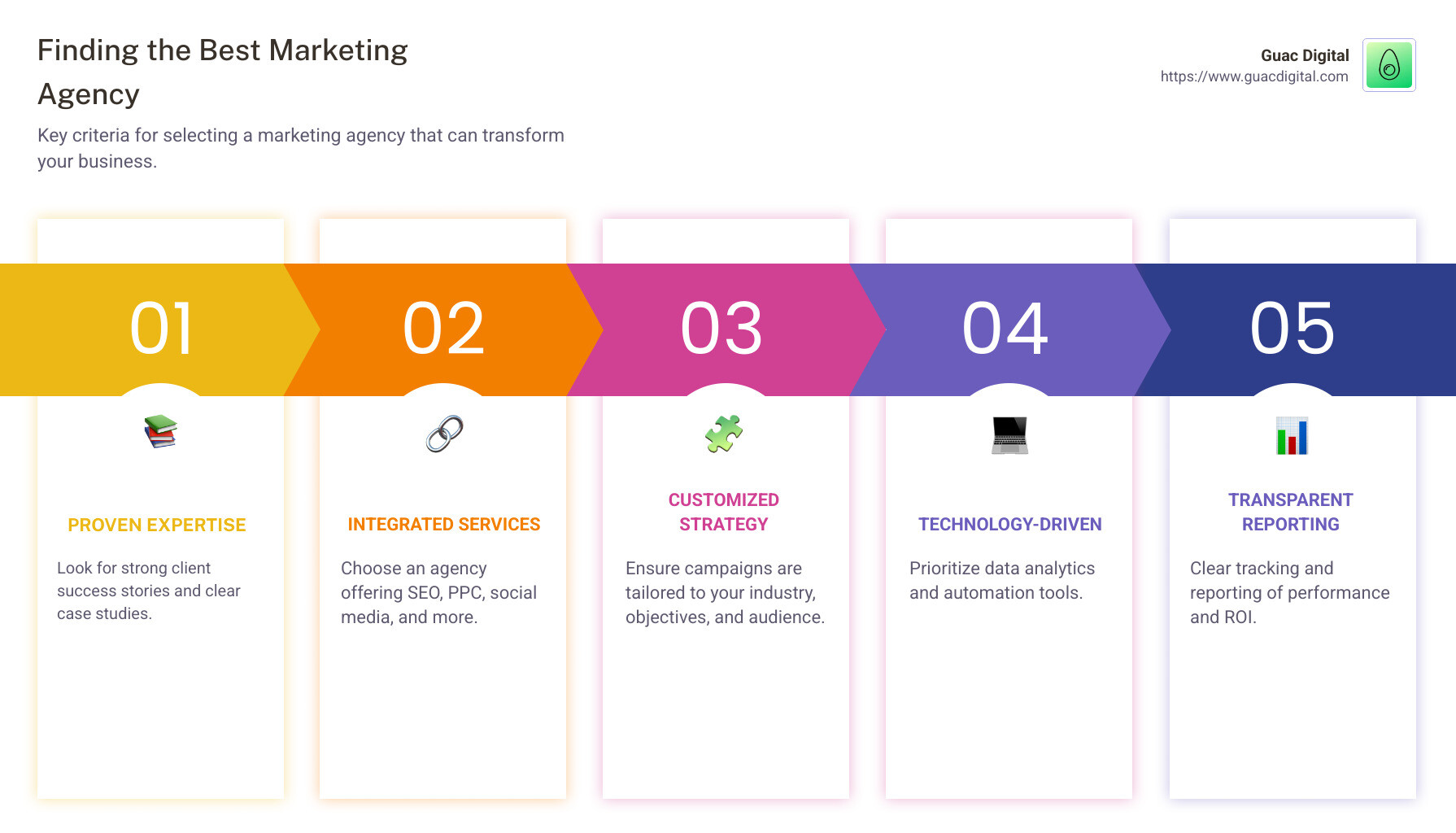
- Proven expertise: Look for agencies with strong client success stories and clear case studies.
- Integrated services: Choose an agency offering a full range of services like SEO, PPC, social media, content creation, and web design.
- Customized strategy: Ensure the agency tailors campaigns to your industry, objectives, and audience.
- Technology-driven approach: Prioritize agencies leveraging data analytics and automation tools.
- Transparent reporting & measurable ROI: Your agency must clearly track and report performance so you know exactly how campaigns are working.
I’m Guy Leon, founder and CEO of Guac Digital, with extensive experience leading a specialized marketing agency that’s boosted client engagement by over 350% and significantly increased online conversions. Let me walk you through exactly how to find the best agency for your business.
Find more about marketing agency:
- what does a digital marketing agency do
- how much do marketing agencies charge
- how do marketing agencies make money
Understanding Your Marketing Needs
Finding the perfect marketing agency starts with a clear understanding of what your business actually needs. I’ve seen too many companies rush into agency partnerships without doing this crucial homework first—and it rarely ends well.
Defining Your Business Objectives
Think of your business objectives as your destination on a map. Without knowing where you’re going, how can you possibly get there?
Are you hoping to boost brand awareness among new audiences? Maybe you need to generate more qualified leads for your sales team. Perhaps your online sales need a serious boost, or you’re planning to enter entirely new markets. Some businesses come to us at Guac Digital looking to launch a new product, while others need to breathe fresh life into their existing brand.
Each of these goals requires a completely different approach. I remember one client who came to us frustrated after wasting six months with an agency that focused exclusively on growing their Instagram following when what they actually needed was qualified B2B leads. They had the wrong vehicle for their journey because they hadn’t clearly mapped their destination.
Understanding Your Target Audience
The more precisely you can describe your ideal customer, the more effectively your marketing agency can help you reach them. This goes far beyond basic demographics.
Think about who really buys from you. How old are they? Where do they live? What’s their income level and education? But don’t stop there—dig deeper into their interests, values, and lifestyle choices. Consider their buying behaviors, what challenges they face daily, and where they spend their time online.
One marketing director we worked with put it perfectly: “Guac Digital enables us to increase our impact without increasing our headcount.” This happens when an agency truly understands not just who your audience is, but what makes them tick.
Setting Clear Marketing Goals
Vague goals lead to disappointing results. Instead, we always recommend setting SMART goals with our clients—goals that are Specific, Measurable, Achievable, Relevant, and Time-bound.
Rather than saying “we want more website visitors,” try “we want to increase organic traffic by 50% within the next 6 months.” Instead of “we need more leads,” specify “we need to generate 100 qualified leads per month by Q3.”
I’ll never forget the client who initially told us, “We just want more customers.” After we helped them define what success actually looked like—with specific numbers and timeframes—we increased their qualified leads by 275% within three months. The difference? We knew exactly what target we were aiming for.
Budget Considerations
Let’s talk money—because your marketing budget will significantly impact which agencies you can realistically consider. Be honest about what you can invest, but also understand that quality marketing delivers a return.
Most marketing agencies structure their pricing in one of three ways:
- Hourly rates (typically $100-$300 per hour depending on expertise)
- Project-based fees (one-time costs for specific deliverables)
- Retainer models (monthly fees for ongoing services)
At Guac Digital, we’ve found that clients who view marketing as an investment rather than an expense tend to see the best results. One client noted after seeing a 454% growth in their Google Ads revenue: “Their expertise has helped our brand grow its overall business.”
The cheapest option rarely delivers the best value. The right agency partnership should eventually pay for itself through improved business results and growth.
Core Services Offered by Marketing Agencies
Modern marketing agencies offer a wide range of services to help businesses grow. Understanding these core offerings will help you identify which agency aligns best with your needs.
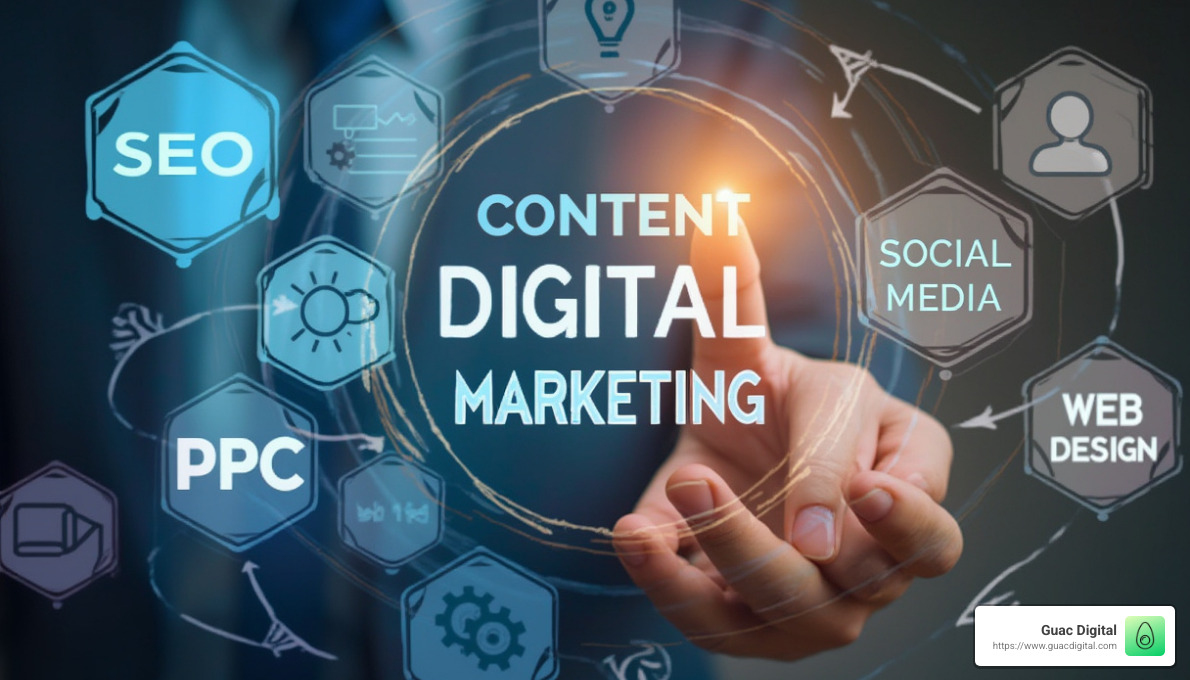
Digital Marketing
Digital marketing encompasses all marketing efforts that use electronic devices or the internet. When I work with clients at Guac Digital, I often find they’re surprised by just how comprehensive digital marketing services have become.
Search Engine Optimization (SEO)
SEO is the art and science of making your website more visible to search engines. Think of it as making your business easier to find when potential customers are looking for exactly what you offer.
Technical SEO ensures your website’s foundation is solid – like making sure a house is properly wired before decorating it. On-page SEO optimizes your actual content and metadata to speak search engines’ language. Off-page SEO builds your site’s reputation through quality backlinks, while local SEO helps nearby customers find you.
I recently worked with a client who was skeptical about investing in SEO. Six months later, they experienced a 268% increase in organic traffic using our AI-driven approach. The best part? Unlike paid advertising, these results continue paying dividends long after the initial optimization work.
Pay-Per-Click Advertising (PPC)
PPC is like having a billboard that you only pay for when someone actually stops to look at it. It’s immediate, measurable, and incredibly efficient when managed properly.
The magic of PPC isn’t just in placing ads – it’s in the continuous refinement process. We regularly conduct keyword research, craft compelling ad copy, manage bids, optimize landing pages, run A/B tests, and track performance metrics.
One of our most satisfying success stories involved helping a client reduce their cost per click by 41% while simultaneously increasing their lead volume. This wasn’t magic – it was methodical analysis and optimization that transformed their digital advertising from a cost center to a profit generator.
Social Media Marketing
Social media isn’t just about posting content – it’s about creating meaningful connections with your audience where they already spend their time. Whether it’s Facebook, Instagram, LinkedIn, Twitter, or TikTok, each platform offers unique ways to engage potential customers.
The most effective social media strategies combine organic community building with targeted paid advertising. One marketing manager I worked with was amazed when we helped increase their post engagement rate by 400% by simply shifting their content approach to focus on solving customer problems rather than promoting products.
Content Marketing
Content marketing is about becoming a valuable resource for your audience rather than just another company selling things. By creating helpful, informative, and engaging content, you build trust and establish expertise.
From in-depth blog posts and comprehensive guides to eye-catching infographics and compelling videos, content marketing takes many forms. The key is consistency and quality. One of our e-commerce clients saw 54% year-over-year revenue growth after implementing our content optimization recommendations. The reason? Their content started answering the exact questions their customers were asking.
Traditional Marketing
While digital dominates today’s landscape, traditional marketing channels still play an important role in a comprehensive strategy. At Guac Digital, we help clients integrate traditional approaches with digital initiatives for maximum impact.
Brand Development
Your brand is so much more than a logo – it’s the personality of your business and how people feel when they interact with you. Strong brand development creates an emotional connection with customers that transcends individual marketing campaigns.
Brand strategy defines your positioning and what makes you unique. Visual identity elements like your logo and color palette make you instantly recognizable. Your brand voice establishes how you communicate, while comprehensive guidelines ensure consistency across all touchpoints.
As I often tell clients, “A strong brand doesn’t just get noticed – it gets remembered and recommended.” This emotional connection is what transforms one-time buyers into loyal advocates.
Public Relations
PR shapes how the public perceives your business through strategic communication. In today’s interconnected world, effective PR is more important than ever.
Good PR professionals are master storytellers who can craft compelling narratives about your business. They build relationships with media outlets, manage your public image, handle potential crises, and organize events that generate buzz. PR helps control the conversation about your brand rather than leaving it to chance.
Print and Broadcast Advertising
Despite the digital revolution, traditional advertising channels still deliver impressive results for many businesses. Print ads in targeted publications, strategic direct mail campaigns, radio spots during drive time, television commercials, and well-placed outdoor advertising can all reach audiences that might miss digital-only approaches.
The key is integration – using traditional channels to complement and reinforce your digital efforts rather than treating them as separate initiatives.
Web Design and Development
Your website is often the first impression potential customers have of your business, and first impressions matter. That’s why many marketing agencies include web design and development in their service offerings.
Modern web design is about creating beautiful, functional sites that deliver exceptional user experiences across all devices. E-commerce solutions enable seamless online sales. Mobile optimization ensures your site works perfectly on smartphones and tablets. UX/UI design makes your site intuitive and enjoyable to use.
I recently helped a construction company completely overhaul their outdated website. The results were staggering – an 800% increase in online leads and a 640% increase in conversion rates. This change wasn’t just about making the site look better; it was about creating a digital experience that guided visitors toward becoming customers.
At Guac Digital, we believe the most effective marketing strategies integrate multiple services custom to your specific business goals. By understanding the full range of available options, you can make informed decisions about which marketing agency services will deliver the best results for your unique situation.
How to Choose the Best Marketing Agency
Selecting the right marketing agency can feel overwhelming—like trying to pick the perfect avocado at the grocery store. (We couldn’t resist a good guacamole reference.) But it’s also one of the most important marketing decisions you’ll make, impacting your business growth and bottom line.

Determine Your Specific Needs
First things first: Know exactly what you’re looking for. Clearly outline your business needs—think about the marketing services you require, the budget you’re comfortable with, your timeline, how involved you want your team to be, and the metrics you’ll use to measure success.
For example, maybe you’re looking for expert SEO and content marketing to boost organic traffic, or you might need full-service digital support to launch a new product. Having your priorities straight will make choosing an agency much easier (and less stressful).
Research Potential Agencies
Next, do your homework and build a shortlist. Look for agencies with relevant experience—ideally in your industry or at least with similar challenges. Verify that they offer the services you need, fit within your budget, and come highly recommended with genuine client reviews.
Check online testimonials and reviews, paying attention to how clients describe working with the agency. Positive feedback about communication, transparency, and results is a great sign. One client summed up their agency partnership simply: “They do everything they say… no BS.” That’s the kind of straightforward reliability you want.
Evaluate Their Portfolio and Case Studies
A good marketing agency will proudly showcase their past successes. Take a deep dive into their portfolio and case studies. Look beyond flashy graphics and pretty websites—focus instead on measurable results. Did their clients see improved organic traffic, higher conversion rates, or increased ROI?
For example, one client (a law firm) experienced a remarkable 664% boost in organic traffic and a 360% increase in online leads after working with an agency that blended expert SEO and PPC strategies. Look for detailed case studies like these that clearly demonstrate strategic thinking, measurable outcomes, and actual business results.
Check Client Testimonials and Reviews
Reading client testimonials gives you a peek behind the curtain. Look for patterns in the feedback provided by current and former clients. This includes how well the agency communicates, meets deadlines, handles curveballs, and delivers on promises.
Great client relationships are built on clear communication, adaptability, transparency, and results-driven marketing. If you consistently see positive comments about these qualities, you’re probably on to a winner.
Assess Cultural Fit
This is a big one. Your marketing agency partnership isn’t just a short-term transaction—it’s a long-term relationship that can grow and evolve. Ask yourself if their values align with yours. Do they speak your language and genuinely understand your brand voice and audience?
You’ll be collaborating closely, so it helps if you actually like them! Trust is key. If you feel comfortable and confident talking with their team, that’s a great sign.
Interview Multiple Agencies
Don’t settle for the first avocado—interview at least a few candidates. During calls or meetings, ask questions to understand their approach to your specific challenges. How do they measure success? Who will you work with directly, and how frequently will you get updates?
Talk about practical details too, like their communication style, pricing structure, contract terms, and how they handle feedback. Being thorough here will help avoid surprises later.
Request a Proposal
Once you’ve narrowed things down, ask agencies for proposals. A strong proposal shows they understand your business goals and outlines the specific strategies they’ll use to achieve them. It should have a clear timeline, pricing breakdown, expected outcomes (KPIs), and introduce you to the main team members assigned to your account.
A clear, detailed proposal is often a reliable indicator of the agency’s professionalism and commitment. Vague proposals that lack specifics are usually a red flag.
Consider the Long-Term Relationship
Think long-term. A great marketing agency will adapt and scale with your company as your business grows. Ask yourself: Can they adjust quickly to market changes? Do they emphasize continuous improvement and optimization, or do they rely on a rigid set of tactics?
You’ll want an agency that’s flexible, committed to long-term success, and willing to grow alongside you. Consider also their knowledge transfer methods—will they help educate your internal team along the way?
Trust Your Instincts
At the end of the day, trust your gut. You’ve done your research. You’ve examined the proposals, testimonials, and case studies. Now, ask yourself how you feel. Do you trust this agency to handle your marketing strategies and budget? Can you confidently imagine building a successful partnership together?
Your instincts matter. When things feel right, they usually are. (Just like picking the perfect avocado!)
Evaluating a Marketing Agency’s Experience and Expertise
When evaluating experience, go beyond just years in business. Dig deeper into industry-specific expertise. Some agencies specialize in particular niches—like healthcare, finance, or e-commerce—while others (like Guac Digital) offer integrated, full-service solutions across multiple marketing channels.
Consider team qualifications too. Do their experts have industry certifications (like Google Ads, HubSpot, or Facebook Blueprint)? Look at their professional development. An agency committed to continuous learning ensures they stay ahead of trends.
Don’t underestimate awards and recognition. While not everything, industry awards or client satisfaction achievements indicate a respected agency. For instance, finding out an agency was named “Ad Age Small Agency of the Year” speaks volumes about their industry standing.
Ask for detailed case studies highlighting specific metrics and KPIs. A strong case study isn’t just a pretty presentation—it’s proof of strategic thinking and real-world success. For example, one impressive case study showed a coffee brand achieving 454% growth in Google Ads revenue after restructuring their campaigns. That’s the kind of clear, measurable results you want to see.

Assessing a Marketing Agency’s Understanding of Your Business
The best agencies aren’t just contractors—they’re partners who genuinely understand and care about your business. During initial conversations, pay close attention to the questions they ask. Do they seek an in-depth understanding of your broader business goals, challenges, competition, and audience?
Avoid agencies pushing cookie-cutter solutions. Each business is unique, and your marketing strategies should be custom specifically to your needs, budget, and objectives. As one smart agency puts it, “We don’t just bring you shiny new objects; we turn the lights on!” You want strategic solutions, not flashy gimmicks.
Don’t underestimate communication style and frequency. This partnership thrives on regular updates, open dialogue, and clear explanations. Ensure the agency is responsive, transparent, and proactive in communication.
Finally, look at their alignment with your goals and vision. They should clearly understand your short-term and long-term objectives, your audience, your competitive advantage, and your brand values. The agency you choose should feel like an extension of your team.
Choosing the right marketing agency is a big decision—but it’s also exciting! Follow these steps and trust your instincts, and you’ll find the perfect partner to help your business flourish.
The Role of Technology in Modern Marketing Agencies
Technology has changed the game for today’s marketing agencies. Gone are the days of guessing and hoping—now, modern technology lets agencies like Guac Digital deliver precise, measurable results for their clients. Let’s take a warm, human look at how advanced technology is helping businesses grow.
Data-Driven Decision Making
Successful marketing today is all about the data. Every decision made by a modern marketing agency is guided by hard facts, analytics, and insights. Agencies use data to deeply understand customer behavior, optimize campaign performance, perform accurate audience segmentation, gain competitive intelligence, and clearly track the customer journey through attribution modeling.
At Guac Digital, we love telling stories—but we make sure every story we tell is backed by solid data. As one agency beautifully puts it, “With data and ROI at the forefront, we ensure our strategies aren’t just pretty—they actually perform.”
Marketing Automation
Ever wish there were more hours in your day? Marketing automation feels exactly like that for an agency. It takes repetitive tasks off human hands and allows marketers to focus on strategy and creativity. Automation technology powers email marketing sequences, social media scheduling, and customer journey mapping. It also enables personalized content delivery at just the right moments, ensuring your audience always receives timely, relevant communication.
Guac Digital leverages automation to nurture leads effectively, ensuring that no potential customer slips through the cracks.
AI and Machine Learning
Artificial intelligence (AI) and machine learning might sound futuristic, but savvy marketing agencies are already embracing these technologies to boost performance. AI-driven predictive analytics help marketers anticipate what customers want next, allowing for smarter, proactive campaigns. AI also improves content creation and optimization, powers conversational marketing through chatbots, and even optimizes sites for voice search.
One particularly impressive case study showed an agency using AI-driven SEO to increase organic traffic by 268%. It’s proof that, when leveraged correctly, AI can deliver results that genuinely move the needle.
Want to dive deeper? Check out the latest insights on leveraging technology in marketing.
Marketing Technology Stack
Behind every great agency is a reliable “tech stack”—the collection of tools and platforms that help them organize, execute, and measure their marketing efforts. When you’re selecting a marketing agency, it’s helpful to know they have expertise with tools like Google Analytics and Adobe Analytics for website insights, CRMs like Salesforce or HubSpot for customer management, and SEO platforms like SEMrush or Ahrefs for search optimization.
At Guac Digital, we combine powerful technology with our human expertise to deliver measurable, meaningful results. Our tech toolkit includes everything needed to manage social media effectively (like Hootsuite or Sprout Social), create amazing content with CMS platforms like WordPress, and deliver personalized email experiences through Mailchimp or Klaviyo.
Programmatic Marketing

Programmatic marketing is one of the most exciting breakthroughs in modern advertising. Simply put, it automates the buying and placement of digital ads using advanced algorithms, machine learning, and real-time bidding.
With programmatic marketing, Guac Digital can ensure your ads appear precisely when they’re most relevant to your ideal customers—exactly when they’re actively searching or browsing online. It replaces slow, manual ad negotiations with lightning-fast automation that delivers smarter, more effective placements.
You can explore more about this powerful approach here: More info about programmatic marketing.
Benefits of Programmatic Marketing
Programmatic marketing isn’t just cool technology—it’s a game changer for your business results. At Guac Digital, we’ve seen how it delivers meaningful benefits.
For starters, precision targeting is best. Programmatic platforms let you reach audiences based on detailed demographics, geographic location, online behavior, and even past purchasing habits. One client we worked with experienced a whopping 300% increase in bottom-of-funnel return on ad spend after shifting to programmatic ads. Talk about a targeted approach!
And that precise targeting naturally leads to higher ROI. With fewer wasted ad dollars and better-matched audiences, your cost per acquisition goes down—even as your leads and conversions go up. We’ve seen cases where businesses reduced their cost per click by over 41% while simultaneously increasing leads—exactly what every business dreams of.
On top of that, programmatic offers incredible efficiency and scale. Rather than manually managing individual ad placements, the system operates 24/7, continuously optimizing and adjusting campaigns based on real-time data. That means your campaigns get smarter every single day, maximizing every dollar you spend.
Finally, there’s transparency. Programmatic platforms deliver detailed performance data, clear attribution, and actionable insights. As one marketing manager shared, “The transparency we get from programmatic campaigns has transformed how we allocate our marketing budget.”
At Guac Digital, programmatic isn’t just a buzzword. It’s part of our core strategy to help our clients grow their businesses efficiently, effectively, and measurably.
Measuring Success with Your Marketing Agency
When you partner with a marketing agency, how do you know if you’re getting real results? It’s not enough to feel like things are going well – you need concrete evidence that your investment is paying off. Let’s walk through how to measure success and ensure your agency is delivering the value you deserve.
Defining Key Performance Indicators (KPIs)
Think of KPIs as your marketing report card. They’re the specific metrics that tell you whether your campaigns are hitting the mark or missing by a mile.
For brand awareness campaigns, we’re looking at website traffic growth, social media engagement, how often people mention your brand online, and whether more people are searching for your company by name. One of our retail clients saw their brand search volume double in just three months after implementing a strategic content campaign – that’s the kind of measurable awareness boost you want to see.
If lead generation is your goal, you’ll want to track the number and quality of leads coming in, what you’re paying for each lead, and how many of those leads are converting into customers. Marketing agency partnerships thrive when both sides agree on what success looks like from the start.
For revenue-focused campaigns, the metrics get even more concrete: conversion rates, average order values, customer acquisition costs, and return on ad spend (ROAS). I remember one client who was thrilled when we showed them their ROAS had increased from 3:1 to 8:1 after just three months of campaign optimization – that’s the power of measuring what matters.
Customer engagement metrics tell you how people are interacting with your content: time spent on your site, pages viewed per session, email open rates, and social media interactions. These engagement metrics often predict future sales performance.

Setting Realistic Expectations
Let’s be honest – marketing isn’t magic. Your marketing agency should help you understand what’s realistic based on your industry, budget, competition, and timeline.
SEO typically takes 3-6 months to show significant results, while paid advertising can deliver leads almost immediately. Content marketing often builds momentum over time, with compounding returns. Understanding these timelines prevents frustration and keeps expectations aligned.
As we tell our clients at Guac Digital, “We’d rather under-promise and over-deliver than set unrealistic expectations that lead to disappointment.” This honest approach builds trust and long-term partnerships.
Regular Reporting and Analysis
A good marketing agency doesn’t just send automated reports – they help you understand what the numbers mean and what actions to take next.
Your reporting should be:
- Scheduled regularly (weekly, monthly, or quarterly depending on your needs)
- Clear and jargon-free (you shouldn’t need a marketing degree to understand it)
- Visually appealing (charts and graphs that tell a story)
- Benchmarked against goals (are we on track or off track?)
- Actionable (what should we do differently based on these results?)
One of our clients put it perfectly: “Before working with Guac Digital, we got monthly reports that might as well have been written in another language. Now we get insights we can actually use to make business decisions.”
Continuous Optimization
Marketing is never “set it and forget it.” The best marketing agency partnerships involve constant testing, learning, and improving.
We had a client in the home services industry whose cost per lead was steadily decreasing month after month – not because we got lucky, but because we were continuously testing different ad copy, adjusting audience targeting, and refining landing pages based on user behavior data.
This continuous optimization is where the magic happens. Initial results are rarely the best results possible. It’s the ongoing refinement that turns good campaigns into great ones.
Return on Investment (ROI)
At the end of the day, marketing should make you money. Your marketing agency should help you understand the true ROI of your campaigns – not just direct sales, but also the value of assisted conversions, increased customer lifetime value, and marketing-influenced pipeline.
One of our e-commerce clients initially focused only on immediate ROAS but later finded that customers acquired through their content marketing campaigns had a 35% higher lifetime value than customers from other channels. This insight completely changed how they valued different marketing activities.
Transparent Communication
The foundation of measuring success is honest, transparent communication. Your agency should be upfront about:
- What’s working well
- What’s not performing as expected
- Challenges they’re facing
- Changes in the competitive landscape
- Recommendations for improvement
As one of our long-term clients said, “What I value most about working with Guac Digital is that they don’t hide problems – they bring them to me along with solutions.”
This transparency builds trust and ensures that both you and your marketing agency are aligned on performance expectations. When challenges arise (and they always do), you’ll face them together as partners rather than as adversaries.
Want to learn more about how the right marketing approach can boost your bottom line? Check out our guide on how a digital marketing agency can boost your online revenue.
Measuring success isn’t just about hitting arbitrary numbers – it’s about achieving meaningful business outcomes that help your company grow. The right marketing agency partnership should feel like having an extension of your team that’s just as invested in your success as you are.
Frequently Asked Questions about Hiring a Marketing Agency
What distinguishes one marketing agency from another?
It can feel overwhelming when you first start researching different marketing agencies. At first glance, many seem to offer similar services. But look closely, and you’ll see several key differences that really matter.
For starters, specialized expertise can set an agency apart. Some agencies focus on specific industries such as healthcare, technology, or B2B, while others might specialize in particular marketing disciplines like SEO, content marketing, or social media management. Choosing an agency with specific experience in your industry or the exact service you need makes a big difference in the quality of results.
Another important consideration is the agency’s strategic approach. The best marketing partners develop customized strategies based solely on your unique business goals. They steer clear of cookie-cutter solutions and take the time to understand your company, audience, and objectives before crafting a custom plan.
You might also find significant differences in company culture and values. This matters more than you might think—when your agency’s values align with yours, the partnership becomes smoother, communication is clearer, and campaigns run more effectively. Always pay attention to how an agency communicates and interacts with you. That’s a strong indicator of their values in action.
Technology and tools are another differentiator. Advanced agencies leverage cutting-edge technologies like artificial intelligence, machine learning, and proprietary analytics platforms. For example, at Guac Digital, we use big data and advanced programmatic marketing solutions to help clients achieve higher ROI at scale.
The size and structure of an agency also play an important role. Smaller boutique agencies typically offer more personalized attention and flexibility, while large agencies often provide broader capabilities and more extensive resources. There’s no right or wrong choice here—just consider what matches your business needs best.
Finally (and perhaps most importantly), results and track record should always guide your decision. Look for agencies with proven case studies and strong client testimonials. As one agency executive explained, “What makes us different is our data-driven approach combined with creative storytelling—we don’t believe these should be separate disciplines.”
How do marketing agencies measure campaign success?
A good marketing agency uses a combination of metrics to track campaign results. While flashy marketing might look impressive, true success lies in measurable business outcomes.
First, performance metrics give you a direct look at your campaigns on a micro-level. These include channel-specific KPIs like click-through rates, conversion rates, engagement rates, and cost per acquisition. Agencies track these closely and adjust campaigns to keep performance high.
More importantly, great agencies link performance directly to business impact metrics. These connect your marketing activities to clear, measurable business results like revenue growth, market share gains, or increases in customer lifetime value.
Another crucial measurement is return on investment (ROI). Your agency should be able to clearly calculate and explain the financial return generated from your marketing investment. Next-level agencies also employ attribution modeling to determine exactly which marketing activities contributed most significantly to conversions.
Competitive benchmarking is another way to gauge your success. Comparing your campaign performance against industry standards and competitors ensures your marketing keeps pace with—or exceeds—industry expectations.
The best agencies provide regular, transparent reporting that clearly communicates both successes and areas needing improvement. As one happy client shared: “Our leads have more than doubled, despite a tremendous amount of new competition in our space.”
How much should I budget for marketing agency services?
Budgeting for a marketing agency might feel tricky at first, but there are some general guidelines to help you decide what’s appropriate.
Most businesses typically allocate between 5% to 15% of their total revenue to marketing, although smaller businesses looking to gain market share often need to invest a higher percentage. If you’re aiming for aggressive growth, expect to increase your marketing spend accordingly.
Your industry’s competitiveness also affects your budget. If you operate in a crowded, competitive market, you’ll likely need a larger marketing investment to stand out effectively. Additionally, the scope of services matters—full-service engagements naturally cost more than single-channel, one-off projects.
Geographic focus is also a factor. Running local campaigns typically costs less than national or international efforts because of the more limited audience reach.
Marketing agencies generally price their services in a few different ways. Monthly retainers, where clients pay a set fee each month for ongoing services, are common and can typically range between $2,500 and $25,000+ depending on services included. Project-based pricing involves a fixed fee for specific deliverables and can run anywhere from $1,000 to over $100,000 based on complexity. Performance-based models, where payments align with achieving specific results, are sometimes used in combination with a base retainer. Finally, some agencies still use hourly rates, usually around $100 to $300 per hour depending on the expertise required.
The cheapest option isn’t always the best choice. One marketing director put it perfectly: “When sourcing quotes for our project, the least expensive option wasn’t the best choice—you always get what you pay for.”
At Guac Digital, we believe in transparent pricing based on value delivered. We work closely with every client to develop customized marketing packages that align beautifully with their business objectives and budget needs.
Conclusion
Finding the best marketing agency for your business isn’t just another checkbox on your to-do list—it’s a decision that could completely transform your growth trajectory. Throughout this guide, we’ve seen that the right agency partnership goes far beyond simply executing campaigns. It’s about finding a strategic ally who truly gets your business, understands your audience, and aligns with your goals.

Key Takeaways
When you’re ready to take that next step with a marketing agency, remember what truly matters. Start with absolute clarity about what you want to achieve. The clearer you are about your objectives, target audience, and what success looks like to you, the better your agency can deliver.
Look beyond the services listed on an agency’s website. Capabilities matter, but their approach, culture, and strategic thinking are equally important. I’ve seen businesses choose agencies based purely on impressive service lists, only to find the relationship wasn’t a good fit.
Demand measurable results from day one. The right agency won’t shy away from setting clear KPIs and providing transparent reporting. They’ll want you to see exactly how your investment is performing.
Value expertise over promises. Anyone can make big claims, but case studies, client testimonials, and proven results tell the real story. When an agency has increased organic traffic by 268% or boosted conversion rates by 640% (as we have at Guac Digital), that speaks volumes about what they can deliver.
Accept technology as your competitive advantage. Agencies leveraging advanced tools like programmatic marketing and AI aren’t just being trendy—they’re delivering superior results through precision and efficiency that simply wasn’t possible a few years ago.
Prioritize communication from the start. The foundation of any successful agency relationship is regular, clear communication. If you’re struggling to get responses during the sales process, that’s probably not going to improve once you’ve signed.
Think long-term about your agency relationship. The best partnerships evolve and grow stronger over time as your agency learns more about your business and fine-tunes their approach.
At Guac Digital, we’ve built our marketing agency on these exact principles. Our data-driven, personalized approach has helped clients achieve remarkable results across industries. We don’t just work for you—we work with you.
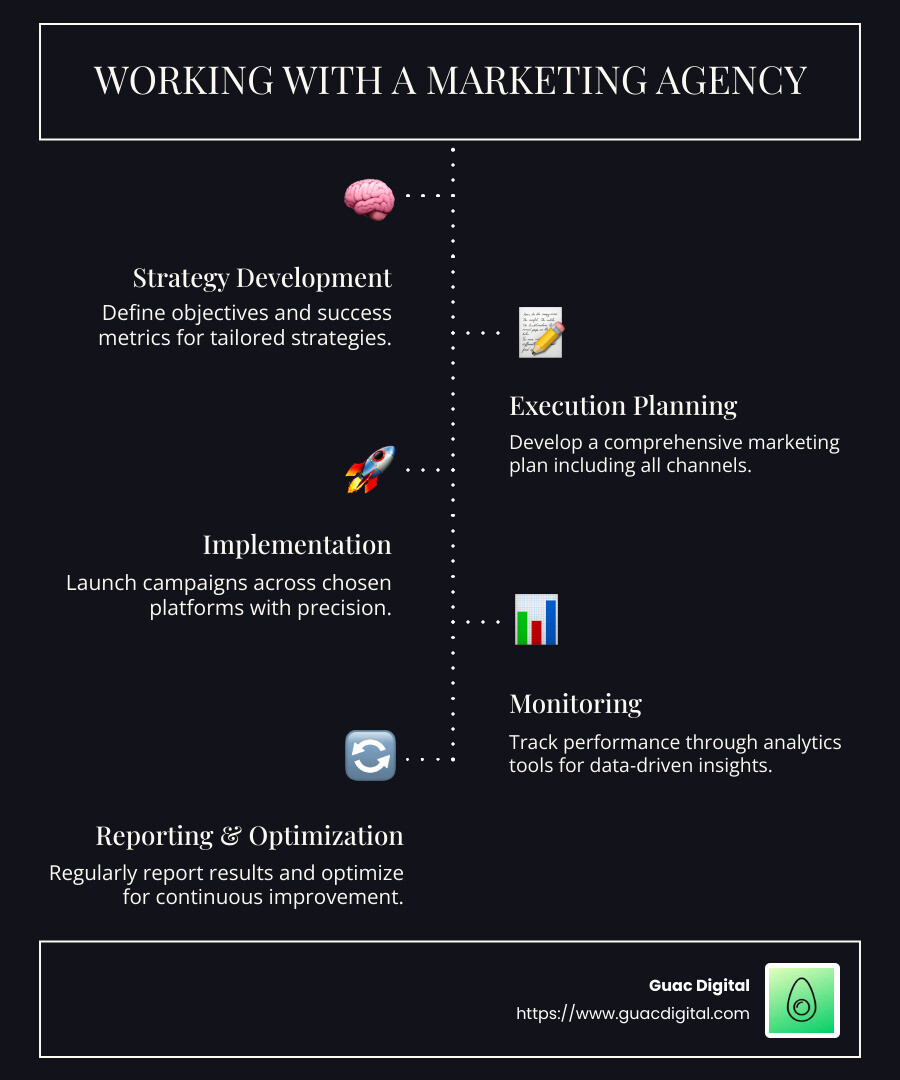
Your Next Steps
So where do you go from here? First, take a good hard look at your current marketing performance. What’s working? Where are the gaps? What opportunities are you missing that an agency could help you capture?
Then, use the criteria we’ve outlined in this guide to create a shortlist of potential agency partners. Don’t rush this process—the right match is worth the extra time.
When you request proposals, ask for specific strategies rather than generic capabilities. Any agency can tell you they’re great at SEO or social media, but you want to see how they would approach your unique challenges.
Always check references. Speaking with current clients gives you unfiltered insights into what it’s really like to work with an agency day-to-day. Ask about communication, results, and how the agency handles challenges.
Consider starting with a defined project before committing to a long-term retainer. This gives both you and the agency a chance to see if you work well together before making a bigger commitment.
The best marketing agency relationships aren’t transactional—they’re true partnerships. At Guac Digital, we don’t just execute tactics and collect our fee. We become an extension of your team, genuinely invested in your success. Our Tampa-based team brings global insights and cutting-edge technology to create campaigns that deliver exceptional ROI.
Whether you’re looking to boost brand awareness, generate qualified leads, or drive e-commerce sales, finding the right marketing partner is your crucial first step. By following the guidance in this ultimate guide, you’re well on your way to making a decision that will positively impact your business for years to come. And isn’t that what great marketing is all about—creating positive impact that lasts?